I joined the “CTV National News with Sandie Rinaldo” to discuss the new director for the next film in the James Bond franchise, Canadian Denis Villeneuve.
There’s an old proverb that reads, “Words have meaning, names have power.” “The Other Fellow,” a new documentary now paying in select theatres and on VOD, examines the power, along with the blessings, curses and the potentially life changing effects, of sharing a name with one of the most famous fictional characters of all time, super spy James Bond.
Like any good 007 film, “The Other Fellow” hops around the globe from Canada and the United States, to Guyana, Baghdad and Sweden, among other exotic locales, to tell its story. But unlike the proper Bond movies, this globe-trotting doc isn’t about high tech gadgets or supervillains. This is a study of identity, of the power of a name, thrust upon the film’s subjects at birth, to influence the path of the bearer’s life, particularly in our digital age.
From the amusing—several “Bonds” complain about hearing the same “shaken not stirred” jokes everyday of their lives—to the sinister—an African American Bond describes being jailed for 60 days for obstruction of justice for “playfully” saying his name to a police officer—director Matt Bauer examines the issue from several viewpoints.
The result is a funny, yet poignant film that entertains as it tackles big societal and personal issues. There’s a murder mystery, a story of abuse and a name change, all woven together to complete a portrait of how the aura of masculinity of the associated name comes loaded with challenges and unwanted attention.
Some have capitalized on the name. A New York theatre director reluctantly does a Bond style commercial for a casino, even though he has nothing in common with the character except the name. “He has a six-pack. I have a keg.”
Gunnar Schäfer, a Swedish man abandoned by his Nazi deserter father, filled the familial gap in his life with Bond, changing his name and adopting a 007 lifestyle and even opening a James Bond museum. In the embrace of the name, his story differs from the rest, but his obsession sheds light on the way a name can change the path of a life.
“The Other Fellow” isn’t a James Bond film, or a film about James Bond films. Instead, it is an intriguing and well packaged look at what it is like to be James Bond, or at least carry his name.
Richard looks at the five best and most unusual movie getaway cars of all time!
“A former homicide detective and a crime expert for Bell Media, Mark Mendelson said an ambulance, given its sirens and size, is a bad choice if you want to escape a foe or the police. His getaway car dos and don’ts are all about being inconspicuous.
“Common sedans are what works best. No SUVs. Smaller is better. In short, low key is the magic component. I’m thinking Honda, Subaru or Hyundai,” Mendelson said. “Pick a car that isn’t flashy. Boring is good. Don’t squeal on the way out. Nice and easy does it. You don’t want to attract attention.”
“Of course, directors like Bay want to attract audience attention with unusual getaway cars, like the ones listed below. Here are a few of the interesting cinematic choices that have appeared in past movies…” Read the whole thing HERE!
On this episode of “Last Call with Richard Crouse” we visit Paris and James Bond’s favourite bar. The home of the Bloody Mary and “An American in Paris,” Harry’s New York Bar at 5, Rue Daunou, is one of the world’s most legendary cocktail bars. With the help of cocktail historians Jared Brown and Anistatia Miller of Mixellany, Richard traces the history of the bar where real life “International Bar Flies” like F. Scott Fitzgerald, Ernest Hemingway, Coco Chanel, Humphrey Bogart, Edward VIII and George Gershwin all bent elbows. Join us for a story of a disgraced sport superstar, cocktails, and a New Year’s Eve wild goose chase around Paris.
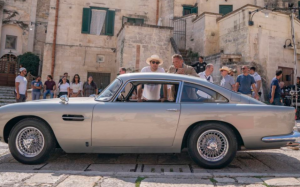
Richard writes about five cars made popular by the movies.
“Often the biggest star in a movie isn’t the one with their name in the title. Will Smith, Kate Winslet and Tom Cruise are big stars, but the cars they drive frequently get as much attention as they do. Many of the bestselling cars in history vaulted to iconic status after appearing as product placement on the big screen. It’s called “brand awareness,” and Mike Jackson, GM North America vice-president for marketing and advertising, said that the right car in the right movie “represents the perfect intersection of entertainment, marketing and design.” It can also lead to big sales, as these examples show…” Read the whole thing HERE!
Will James Bond (Daniel Craig) ever be happy? The dour superspy looks great in a tux, has saved the planet a dozen or more times and piloted invisible planes but despite his list of achievements, true happiness always seems to have eluded him.
In “No Time to Die,” however, it looks like Bond may have found a sweet spot in his life with his pretty love interest, Dr. Madeleine Swann (Léa Seydoux). But Craig’s fifth and final time as 007 isn’t all sunshine and roses as much as it is a requiem for a character who was shaped by trauma.
“No Time to Die,” now only playing in theatres, kicks off with a cold open unlike any other Bond beginning. Two decades ago, against a remote, icy Norwegian backdrop, the young daughter of a Spectre agent is orphaned when a masked murderer invades her home. “Your father killed my entire family,” he says between bullets. She survives, and twenty or so years later grows up to be Dr. Swann, psychotherapist and the only woman who can make James Bond smile.
On holiday in Materna, Italy, she encourages him to visit the grave of heartbreaker Vesper Lynd, and put her memory to rest. He does, and soon the idyll with his new girlfriend ends, literally blowing up in his face.
Convinced Swann has betrayed him, the superspy cuts her loose, vowing to never lay eyes on her again.
Cut to five years later. Bond is retired from MI6, but lured back into the game of international espionage when his friend and CIA field officer Felix Leiter (Jeffrey Wright) and associate Logan Ash (Billy Magnussen) ask him to help locate Valdo Obruche (David Dencik), a missing scientist working on a deadly DNA Nanobots weapon.
The job sees Bond square off with one of his greatest foes, Ernst Stavro Blofeld (Christoph Waltz) and revenge-thirsty terrorist Lyutsifer Safin (Rami Malek), a master in the art of asymmetric warfare.
“No Time to Die” shakes up the Bond formula while still offering most of what fans pay to see. There are exotic locations, some high-flying action and the odd 007 one-liner. They are embedded into the DNA of the franchise; character traits that have not been genetically edited out of the movie.
The womanizing, which was so much a part of the Bond folklore, is still there, but trimmed, and played for comic effect. In one instance Ana de Armas, whose appearance as CIA agent Paloma amounts to an extended cameo, charmingly closes the door on that aspect of the Bond legend. In a short but eventful scene, she almost steals the show, and leaves the audience wanting more.
What director Cary Joji Fukunaga, who co-wrote the script alongside Neal Purvis, Robert Wade, Phoebe Waller-Bridge and Scott Z. Burns, has done is add in a ponderous reevaluation of Craig’s years as Bond. Call backs abound to “Casino Royale,” “Quantum of Solace,” “Skyfall,” and “Spectre” and loose ends are tied into bows in in the film’s many Easter eggs. Much of that material is fan service as the fifteen-year Craig reign comes to a close. A shot of M’s (Judi Dench) portrait nods to Bond’s connection to her and Fukunaga reaches back to “Casino Royale” for a tribute to Felix “Brother from Langley” Leiter (Jeffrey Wright). It feels like a nice, respectful way to usher out one era and bring in the next, in whatever form that may take.
But “No Time to Die” is not simply a tip of the hat to the past. With an eye to the future, Fukunaga and Craig have fundamentally changed what a Bond movie is. As the only Bond actor to have an arc for his character, Craig didn’t simply put on Pierce Brosnan’s tux and carry on as so many of the previous actors have done. He took Bond to places he’s never been before, amping up the emotionality of the character as a person born out of trauma. He talks about having everything taken from him as a child, “before I was even in the fight.” For the first time in Bond history, 007 is feeling the ticking of the clock, and not the timer on a bomb he’s trying to diffuse, but the metaphorical hands of time tightening around him.
This approach effectively changes “No Time to Die’s” dynamic, from action film to soul-searching character drama. The 163-minute running time allows the characters to explore why and how they landed where they did in life, but it also sucks much of the urgency from the storytelling. Add to that Malek’s Safin, a clichéd villain who really should make a larger impact, and the drama necessary to shake that martini is lessened.
There is #NoTimeForSpoilers in this review but suffice to say, “No Time to Die” is a Bond film unlike any other. Craig leaves the franchise having made the biggest impact on the character since Sean Connery set the rules more than half a century ago. His finale is drawn out and may rely too heavily on pop psychologically but it’s an important film in the Bond canon. It may even be the most important and exciting since “Dr. No.” Why? Because, as an on-screen card promises, “James Bond will return,” but the movie gives us no hint as to what that re-invented future will entail and that, after almost sixty years of a steady diet of 007isms, is “No Time to Die’s” most exciting achievement.
Daniel Craig suits up again in the latest Bond flick, taking his fourth spin as the super spy in Spectre. The film’s overseas reviews have been very strong and it will likely dominate the weekend’s box office but who among us would call Craig the best Bond?
I have a theory that the Bond nearest and dearest to your heart is the first 007 you saw projected on the big screen.
Popular consensus tells us that Sean Connery, who played the role in six films spanning 1962 To 1971 and then once again in 1983’s non-officially sanctioned Never Say Never Again, is the best Bond. As cool as Connery was he isn’t my top of the pops. Dr. No, the first 007 movie, came out before I was born and Connery more or less permanently parked his Aston Martin around the time I entered grade two.
The Bond that made the biggest impression on me was Roger Moore. I know critically speaking he wasn’t the most beloved Bond. Pauline Kael once wrote about him, “Roger Moore is dutiful and passive as Bond; his clothes are neatly pressed and he shows up for work, like an office manager who is turning into dead wood but hanging on to collect his pension.”
I also know that hardcore spy fans considered Moore too well-mannered and pleasant to be effective, but he was my first, and I guess the first cut is the deepest because I still have a fondness for his breezy take on the super agent.
But that’s just me.
To get a broader picture I did a highly scientific Double-Blind Bond Peer Reviewed In House Clinical Trial (in other words I asked my Facebook and Twitter friends) to determine the world’s favourite 007 portrayer.
The contenders were Connery, George Lazenby, Moore, Timothy Dalton, Pierce Brosnan and Craig — everyone who has played Bond in one of the 24 officially sanctioned 007 movies.
Several contributors brought up others like Barry Nelson, who played James Bond in a 1954 television adaptation of Casino Royale. Also mentioned were David Niven’s turn as Bond in 1967’s Casino Royale and another actor who has never played 007. “Clive Owen,” suggested one poster, “once they get around to casting him in the next one.”
After eliminating the unofficial 007s and non-Bonds a team of experts (OK, it was just me reading through the posts as Live and Let Die played on the TV behind me) sifted through the results.
Pollsters said Brosnan Is Not Enough to ’90s Bond Pierce Brosnan who came in dead last with just 1.9 per cent of the vote.
“I liked Pierce Brosnan because he embodied all the others combined,” wrote one positive poster. “Charm, humour, ruthlessness, cunning.”
Timothy Dalton earned 3.9 per cent with one respondent saying, “If there really was an agent who was an assassin with a licence to kill … it would be him.”
At 9.8 per cent, George Lazenby fared better than Brosnan and Dalton even though he only made one 007 film.
My favourite Bond came in third with 15.6 per cent, just behind Daniel Craig’s 21.5 per cent. “Craig gets me wanting to watch whereas the others are placeholders,” wrote a Facebook friend, “Sorry.”
By far and away, Sean Connery was the winner with a whopping 39.2 per cent of the vote. This comment seems to sum up the reason why people like him. “Sean Connery because Sean Connery!”
Who is your favourite Bond? Chime in at @metropicks.
For many of us James Bond has been a constant. For more than 50 years a series of actors have taken on the role over the course of twenty-four officially sanctioned movies. He has been, by times a killer, a clown, a lover, a sinner and a saint. In “Spectre,” the latest edition of the Bond Follies, he is all those things and more.
The new film opens just days after the events of “Skyfall.” M (Judy Dench), Bond’s boss and confident, has been killed and 007 (Daniel Craig) is fulfilling her last request. He’s in Mexico City (just the first of many exotic locations in “Spectre’s” travelogue) to assassinate an Italian mobster through a crowded Dia De Los Muertos parade. It’s a wild scene—involving thousands of extras, helicopters, exploding building and a serious fall broken by a well-placed sofa—that sets the tone for the rest of the film; Big, loud and slightly silly.
Information gathered from the mobster’s widow (Monica Bellucci) leads Bond to Rome and a meeting of the super-duper, top-secret terrorist organization SPECTRE (Special Executive for Counter-intelligence, Terrorism, Revenge and Extortion) led by evil genius Oberhauser (Christoph Waltz).
Back in London the new M (Ralph Fiennes) is defending the 007 program from C (Andrew Scott), a bureaucrat who snidely says, “We’re going to bring British intelligence out of the dark ages and into the light.” In other words, on-the-ground agents and their licences to kill are about to be replaced with drones and high tech surveillance and security. The plan is to unite the defence systems of the world and dispense with Bond’s human touch.
Meanwhile Bond is still globetrotting, now with Madeleine Swann (Léa Seydoux) on his handsomely tailored arm. She’s the daughter of a former SPECTRE member and just might hold the key to infiltrating the organization.
“Spectre” is worth a look for the scenery alone, and no, I don’t just mean Daniel Craig’s Tom Ford suits or Monica Bellucci’s jewels. From Rome to Tangiers to Mexico City and beyond the movie is a parade of beautifully shot tourism brochure-ready landscapes.
The stuff that happens in front of those landscapes is worth a look too. Director Sam Mendes keeps the pedal to the metal, tossing out implausible plot twists and action scenes with great regularity. City blocks blow up, airplanes chase automobiles and, of course, the classic ticking bomb makes an appearance. As usual the body count is high and there’s even a wild areal fight sequence before no more than four lines of dialogue have been spoken.
There’s all that and a lighter tone then the other Craig Bonds. The grim-faced 007 has been replaced by a slightly-less grim faced Bond. Craig isn’t channelling Roger Moore or anything quite so broad, but there are laugh out loud moments as “Spectre” simultaneously plays up to and satirizes Bond stereotypes. In one scene Dr. Swann and Bond fall into a surprise embrace. In any other Bond movie they would kiss and tumble into bed. Here she says, “Don’t think for a moment this is where I fall into your arms,” effectively satirizing the Bond as lady-killer stereotype and making strides for Bond Girls everywhere.
Too bad there’s no such reinvention of the Bond villain. As Oberhauser Christoph Waltz is a bit of a dud. His backstory is interesting and he certainly has evil intent, but he comes across here more as a bully than a supervillain. Waltz doesn’t come close to the menace he brought to “Inglourious Basterds’” Col. Hans Landa. He’s barely in the film but casts a long shadow… a long shadow that could have been much darker.
If there is a message in “Spectre” it has to do with new versus old. C represents a dangerous future where drones and surveillance put enemies at arm’s length. M and Bond represent tradition, a more gentlemanly form of killing where you have to look into the eyes of the person you’re about to off. It seems to be asking if James Bond is of the past, a dinosaur. I’d say no, not as long as the 007 movies are as entertaining as this one.
Like a violent “My Fair Lady,” “Kingsman: The Secret Service” takes a guy from the wrong side of the tracks and transforms him into a Kingsman Tailor. They are a super spy organization with manners that would make Henry Higgins proud and gadgets that James Bond would envy.
Harry Hart (Colin Firth) is a Kingman, codename Galahad. He’s a dapper Dan and a dangerous man who takes rebellious teenager Eggsy (Taron Egerton) under his wing, in part to repay a debt owed to the boy’s father, in part to groom him to join the organization.
The Kingsman are the modern day knights; their finely tailored suits are their armour. If Eggsy makes it through “the most dangerous job interview in the world” he will adopt the name Lancelot and take his place in a glamorous and dangerous 007ish world of intrigue.
While Eggsy is in training Galahad is investigating the interesting case of internet billionaire Richmond Valentine (Samuel L. Jackson)—imagine a more malevolent Bill Gates or Steve Jobs with aspirations of world domination… oh wait….—and his evil plot to save the world by destroying it and starting again.
At one point Galahad says, “Give me a farfetched theatrical plot any day,” and director Matthew “Kick-Ass” Vaughn grants that wish. Working from a 2012 spy comic book series written by Mark Millar and Dave Gibbons, the director has embraced the story’s absurdity, delivering a demented movie that is at once an homage to James Bond and his ilk and a satire of spy movies.
Then idea of the gentleman spy is played out to the nth degree—a proper Kingsman even has his own martini, gin, stirred for ten seconds while glancing at an unopened bottle of vermouth—but this isn’t a genteel movie. Ultraviolent—one frenetic fight scene makes the shooting, stabbing, punching and impaling of the bloody “Walking Dead” look like “My Fair Lady”—and raunchy—a smirky sex joke at the end would make even James Bond raise an eyebrow—“Kingsman: The Secret Service” pushes the limits, and is as extreme as it is entertaining.
Vaughn clearly has franchise hopes here and lays a good foundation despite some lapses in taste, but it is difficult to see how much more he can push the envelope before even the not-easily-shocked Galahad might think it was too farfetched.