Based on a historical novel by Canadian-born author Patrick deWitt “The Sisters Brothers” is a buddy Western that, for better and for worse, doesn’t rely on the clichés associated with buddy flicks or Westerns.
Set in 1851 Oregon, “The Sisters Brothers” tells parallel stories. First we meet the brothers, Eli (Reilly) and Charlie Sisters (Joaquin Phoenix). The pair are bounty hunters and all-round thugs for hire, currently working for a mysterious Oregon City mob boss known only as the Commodore (Rutger Hauer in a wordless cameo). “You do realize our father was stark raving mad and his foul blood runs in us,” Charlie says to his big bro. “Its why were good at what we do.” Violent and ruthless, wherever they go a heap of sorrow is left behind.
Their latest job is to meet detective John Morris (Jake Gyllenhaal) who is to hand off Hermann Kermit Warm (Riz Ahmed), a chemist-turned-gold-prospector who has developed a formula to make searching for gold a scientific rather than physical procedure. It’s a chemical mixture that, when poured in the river, lights up the gold. All you have to do is reach in and pick it up
It’s a get rich quick scheme and the Commodore desperately wants to get his hands on it. Warm’s ultimate goal is much more pure. He has visions of using the gold money to create a new society in Texas that favours nonviolence, education and true democracy. Morris the hunter becomes the hunted when Warm appeals to his better nature. Moved by warm’s plea—“The Sisters will cut off my fingers, burn my feet,” he says—Morris becomes a business partner. The big question? What will happen if and when the Sister Brothers catch up with them?
The four leads play tough guys and cowboys who spend as much time discussing their feelings as they do firing their guns. The brothers have daddy issues—he was a violent alcoholic—while Morris hated his father for any number of sins, both personal and professional.
The brothers bicker constantly. Eli, a great lummox who, at first glance seems ill suited for the job at hand and yet never hesitates to shoot an adversary in the head, is sensitive and wants to settle down. Charlie, on the other hand, is a wild card, with a hair trigger and a more limited idea as to what the future may or may not bring.
The conversations range from heartfelt to funny and are the engine that propels the action. There are shoot-outs and horses and all the other tropes of the genre but this story is actually about the guys, not their actions. A John Wayne oater this ain’t. Instead it is a movie that explores the masculine bond that lies at the heart of so may westerns but is never fully explored.
“The Sisters Brothers” is a story about family, purpose and male bonding made human by a sensitive performance from Reilly (who also produced) and his chemistry with Phoenix. It’s a buddy flick and a Western but it’s also more than the sum of its parts.
People call Jeff Bauman a hero but it’s not a label he enjoys.
“I don’t like being called a hero,” he says. “In my eyes, there are heroes I look up to, the people who saved my life, the caretakers, my surgeon and my wife, the love of my life. She’s my hero. I lost something but my heroes picked me up.”
Jake Gyllenhaal plays Bauman in Stronger, the story of the man whose life changed the morning of April 15, 2013. Bauman, while waiting at the Boston Marathon finish line for his ex-girlfriend to finish the race, was standing next to one of the Boston Bombers. Gravely injured after the blast he was rescued by a stranger in a cowboy hat and rushed to the hospital where both his legs were amputated above the knees. The tragedy thrust Bauman into the spotlight, making him a reluctant beacon for the Boston Strong movement.
“Through a number of circumstances the movie was hard to get made,” says Gyllenhaal who also produced the film. “Number one, movies like this, stories like this, aren’t being told as much. There is a real balance in this movie of humour and a certain type of depth that I think tonally can confuse people who want something that seems a little simpler.
“I think also, in a lot of ways, when they heard about this story people thought it was too soon or who wants to make a movie out of that event. In truth, the movie is not about the event at all. That’s why I loved it.”
Stronger is not the story of a bomb or the radical politics that saw it planted at the finish line of the Boston Marathon. It’s the story of the aftermath and Bauman’s inspirational recovery.
“The thing that is most important to me is that people see this movie,” says Gyllenhaal. “We have always been that movie that has a little of that underdog spirit. It has been a long and pretty incredible journey. I just want people to see it because I think today there are so many hard things happening in the world and Jeff’s story sort of proves to people that they can keep going, that they can take another step. That they can survive that minute or that second or that hour that they don’t think they’ll be able to get through. He is a beacon for that and I want people to see that.”
Bauman says he’s proud of the movie but says watching it for the first time was “sensory overload” as it forced him to relive the worst moment of his life.
“I cried a lot,” he says. “I kind of just went, ‘I want to go home afterward and go to sleep,’ and I did. I went home and went to sleep. The next day things hit me a little bit more. It’s emotional for me.”
Bauman may not want to be called a hero, but Gyllenhaal, who became close with the Boston native during he making of the film, says, “A lot of people have asked me over my career: ‘When are you going to play in a superhero movie?’ I feel like I finally kind-of have. To me, that’s how I feel about him. He’s a total inspiration to me.”
“Stronger” is not the story of a bomb or the radical politics that saw it planted at the finish line of the Boston Marathon. It’s the story of the aftermath.
When we first meet Jeff Bauman (Jake Gyllenhaal) he’s a goofy, out-going 28-year-old guy working as a chicken roaster at Costco. The only thing he loves more than the Red Socks is his ex girlfriend Erin Hurley (Tatiana Maslany), an uptown girl who is running in the Boston Marathon on April 15, 2013. The night before the run he bumps into her. “I suffered an industrial chicken related accident today,” he says, flirting, “but I’ll be there at the finish line for you.”
History reports what happened next. Bauman, standing next to one of the Boston Bombers, was gravely injured. Rescued by a stranger in a cowboy hat (Carlos Sanz as Carlos Arredondo) he is rushed to the hospital where both his legs are amputated above the knees.
The tragedy shines a spotlight on Jeff who becomes a reluctant beacon for the Boston Strong movement. Released from hospital a hero, as he struggles to learn how to navigate his new body, Erin re-enters his life, drawn by love and guilt for being the reasons he attended the race. As that relationship blossoms and the city embraces him, Jeff grows uneasy, plagued by PTSD. “I don’t want to relive the worst day of my life,” he says.
As he grapples with fame, a mother (Miranda Richardson) who lives vicariously through his newfound celebrity, his relationship with Erin becomes strained. It isn’t until he reconnects with Carlos, the man who saved his life, that Jeff begins to piece together the broken shards of his life.
Because we know the story of the Boston bombing so well, tension builds soon as the marathon scene begins. A man with a backpack, ball cap and shades bumps into Jeff, signalling what is to come but this isn’t an action movie. It is strongest when it gets to be emotional care of the film, Jeff’s inability to deal with his new reality.
Director David Gordon Green is aided by a nuanced performance from Gyllenhaal that mutes his usual movie star physique in favour of a more vulnerable physicality—the scenes of his struggle to adapt to his wheelchair are painful—in favour of a rich inner life. His performance provides a glimpse of Jeff’s complicated feelings as he comes to grips with his new reality. He’s less a movie star and more a down-home heroic figure in-the-making. “I’m reluctant hero,” he says. “People see that I don’t let anything hold me down and maybe they won’t let anything hold them down either.”
As Erin, Maslany is the very embodiment of empathy. She delivers a quiet performance that subtly conveys an olio of emotions from love and guilt to compassion and anger. It’s terrific work that brings some much-needed subtlety to a film that occasionally goes a bit over-the-top.
Jeff’s plain-spoken, high strung family, lead by Jeff Sr (Clancy Brown) and Patty “Did you have sex with my son?” Bauman, is played a bit too broadly. A hint of rough-and-tumble Boston caricature seeps in whenever the Bauman clan gathers in a movie that is at its best when it is restrained.
“Stronger” is sometimes a bit too on the money—“You’re a symbol to a lot of people,” gushes dad, “you’re Boston Strong.”—but works well when it lets go of the triumph of the human spirit angle and allows the characters to behave like people, not heroes.
From visionary South Korean director Bong Joon Ho comes a film that defies categorization. “Okja” has elements of family entertainment, sci fi fantasy, cultural satire and more all wrapped up in a cautionary tale about genetically modified meat. It’s a big, handsome and entertaining adventure that not so subtly poises questions about the relationship between corporations and where are food comes from.
In its opening minutes the story of a girl and her super-pig feels almost like a Disney movie. 14-year-old Mija (An Seo Hyun) and Okja, a gigantic genetically engineered swine bred to become a food source, live a quiet life in the far-flung mountains of South Korea. They romp and play, bonded by ten years together and the animal’s gentle, protective nature. They are a human-porcine Milo and Otis, inseparable until Mirando Corporation CEO Lucy (Tilda Swinton) recalls Okja is back to the United States.
Created by in an agrichemical laboratory in New Jersey, the adorable Ojka was created to “consume less feed, produce less excretions” and to make people fall in love with an animal they are going to end up eating. “Soon supermarkets will be filled with their flesh and their organs.” Transported to New York, the animal is slated to become the kind face of Lucy’s plan to end world hunger while increasing her company’s bottom line. Working with Mirando but wrestling with the ethics of the situation is celebrity zoologist Dr. Johnny Wilcox (an unhinged Jake Gyllenhaal).
Concerned with appearances Lucy tries to exploit the Mija’s and Okja’s relationship for PR purposes but Mija has other ideas. Working to make sure Okja doesn’t end up on a giant BBQ, Mija comes to the rescue, aided by the Animal Liberation Front, a crafty and idealistic group led by Jay (Paul Dano) and Red (Lily Collins).
“Okja” features strong work from Swinton—in a double role, playing Lucy and her even more cutthroat sister Nancy—and a wild performance from Gyllenhaal but it really is all about the bond between the girl and her super-pig. An Seo Hyun’s moon face conveys her pure and sincere love for Okja but it is the beast itself who brings heart to the movie. A combo of CGI and puppetry Okja is a strange animal but a tender one. He rescues Mija from danger and later, when she returns the favour, the bond between them is palpable.
That relationship smooths the way for the rest of this uneven but entertaining movie. The way “Okja” veers between action and comedy, horror and social commentary could lead to whiplash but it is never less than audacious.
Best selling romance writer Jude Deveraux declares that there are no new stories, just interesting, inventive ways of taking the journey with characters. “In romances,” she says, “the characters are going to fall in love with each other; you know that when you see the syrupy cover. It’s how they get there that’s the fun.”
The new monster-in-space flick “Life” would seem to prove this theory. It hits theatres on a mighty gust of déjà vu courtesy of “Alien” and “Gravity,” two movies that share its DNA and several plot points.
Headliners Jake Gyllenhaal, Rebecca Ferguson and Ryan Reynolds are David Jordan, Miranda North and Roy Adams, three of six astronauts (alongside Olga Dihovichnaya and Hiroyuki Sanada) aboard an International Space Station. Their mission involves intercepting a shuttle containing a space specimen from Mars. In the beginning the microscopic alien, nicknamed Calvin, is benign, an inert collection of cells.
“We’re looking at the first proof of life on Mars,” says head honcho scientist Hugh Derry (Arlyon Bakare).
What could have been one of the greatest scientific discoveries of all time, however, changes when Derry feeds Calvin a glucose meal. The snack changes the organism from extraterrestrial to extra-terrible as it grows into some kind of jelloy-gremlin-Martian-hellbeast, gains intelligence and goes on a homicidal rampage. The astronauts says things like, “We can’t let that thing in here!” and “You don’t know what it can do!” as they fight, not only for their own safety but also the survival of Earth. “If it is between letting it here,” says Miranda, “or letting it down there, we let it in here!”
If the story sounds familiar it’s because it is, but is Ms. Deveraux right? Is the journey enough to keep the audience interested? For most of the running time the answer is yes.
Director Daniel Espinosa keeps things wound tight as he ramps up the danger and the stakes for the characters. Unlike most space operas, “Life” is an ensemble without a clear hero. The small cast are all equally important, and all equally expendable which adds an air of unpredictability that ratchets up the tension. As Calvin’s powers increase the movie’s powers decrease slightly, changing from finely tuned thriller to space caper.
Near the end, with just minutes to spare, characters (I will not tell you who, no spoilers here) have an extended moment of solace. A time of reflection and for a discussion about procedure and from that point on it’s a by-the-book Got-To-Kill-The-Space-Monster flick.
By the time the end credits roll, however, “Life” will have subverted your expectations enough to earn it an “all systems go.”
Grief is no laughing matter, but with Demolition Jake Gyllenhaal has made a whimsical movie about a man on the edge of falling into the abyss.
The film continues Gyllenhaal’s quest to explore characters who aren’t immediately likeable or understandable. No other mainstream actor puts himself or herself out there as consistently or successfully as Gyllenhaal. He takes chances, throwing himself at edgy portrayals of real people. Recently we’ve seen him as Nightcrawler’s reptilian Lou Bloom, a slick-talking drifter who falls into the freelance news gathering business, a man who seeks his doppelganger in Enemy and Southpaw’s inarticulate brute with a heart of gold, World Middleweight Boxing Champion Billy Hope.
In Demolition plays investment banker Davis Mitchell. Wealthy and happy, his life is turned upside down when he and his wife Julia are bickering about banal home stuff when the car they’re in is broadsided and she is killed.
Instead of being plunged into grief Davis becomes numb, impervious to the seven stages that usually accompany grave loss. Going back to work immediately after the funeral, however, his behaviour becomes increasingly strange. When he writes a complaint letter to a vending machine company demanding a refund he finds an outlet for his feelings and a therapist of sorts in customer service rep Karen Moreno, played by Naomi Watts. As his letters grow increasingly heartfelt and raw Karen’s sympathetic ear and later, her rebellious son, help Davis demolish his life so he can rebuild his world.
“It’s a story about a guy who begins the movie in a conventional way and ends the movie through an unconventional journey,” said Gyllenhaal at a press conference I hosted with him at TIFF last year, “feeling however [he wants and needs to], and not how society tells him to feel.”
Here the thirty-five-year old actor delivers strong work, grounding the film’s quirkiness in a character you may not understand but can empathize with. He does the heavy lifting and his work humanizes this offbeat film.
When Davis spontaneously dances on the streets of New York or demolishes his martial home it’s outrageous, but it is the sight of a man in pain refusing to face up to the fact that he wasn’t a very good husband and will never be able to make amends to Julia. It’s occasionally very funny, other times tragic and Gyllenhaal drifts between the two poles effortlessly.
The surreal dance scenes are surprising for the audience, but Gyllenhaal says they were a surprise to him as well. “I always looked on the schedule for when the dancing was going to be,” he said at the presser, revealing that director Jean Marc Vallee shot the scenes spontaneously.
“The first time I danced, we were on the train and [Vallee] said, ‘Okay, the train’s pulling in,’ and handed me an iPod, gave me an earphone and said, ‘Are you ready to dance? Let’s go. By the end, I didn’t want to stop dancing, I made like a whirling dervish.”
Gyllenhaal takes the path less trodden, but it has resulted in a body of work populated by interesting and unusual characters.
“I think the people I admire as artists are the people who really listen to themselves,” he says, “even if it is to the detriment of what people might consider success. I’d rather be myself and do what I love than listen to someone else and follow that role and be unhappy.”
Grief is no laughing matter, but with “Demolition” director Jean-Marc Vallée has managed to make a whimsical movie about a man on the edge of falling into the abyss.
Jake Gyllenhaal is investment banker Davis Mitchell. Wealthy and happy, his life is turned upside down after an accident. The movie begins with a shocking shot of Davis and his wife Julia (Heather Lind) driving and bickering about banal home stuff when they’re broadsided and she is killed.
Instead of being plunged into grief Davis becomes numb, impervious to the seven stages that usually accompanies grave loss. Going back to work immediately after the funeral, however, his behaviour becomes increasingly strange. When he writes a complaint letter to a vending machine company demanding a refund he finds an outlet for his feelings and a therapist of sorts in customer service rep Karen Moreno (Naomi Watts). As his letters grow increasingly heartfelt and raw Karen’s sympathetic ear and later, her rebellious son Chris (Judah Lewis) help Davis tear down his life so he can rebuild his world.
Gyllenhaal continues his quest to explore characters who aren’t immediately likeable or understandable. No other mainstream actor puts himself or herself out there as consistently or successfully as Gyllenhaal. He takes chances, throwing himself at edgy portrayals of real people. Here he delivers strong work, grounding the film’s quirkiness in a character you may not understand but can empathize with. He’s doing the heavy lifting here and his work humanizes this offbeat film. When Davis spontaneously dances on the streets of New York or demolishes his martial home it’s outrageous, but it is the sight of a man in pain refusing to face up to the fact that he wasn’t a very good husband and will never be able to make amends to Julia. It’s occasionally very funny, other times tragic and Gyllenhaal drifts between the two poles effortlessly.
“Demolition” is let down in its final moments when Vallée softens the soul-searching tone but the despite an ending that feels inauthentic, the film offers a welcome chance to see Gyllenhaal push boundaries.
If you’re an armchair adventurer like me the hardships the characters in the new snowsuit drama “Everest” put themselves through—and pay handsomely for—seem extreme. Paying $65,000 to climb to the summit of Earth’s highest mountain seems a high price to risk life and limb and when I say life and limb, I mean it. If the altitude and avalanches don’t get you, frostbite may well take an arm or a leg.
Based on the real events of the 1996 Mount Everest disaster, Jason Clark plays Rob Hall, experienced climber and leader of commercial expeditions up the mountain. His group, Adventure Consultants, is one of several making the trip. Another, led by party boy Scott Fischer (Jake Gyllenhaal) leaves at the same time, and agrees to share resources on the trek. Climbers include Beck Weathers (Josh Brolin), Doug Hansen (John Hawkes), Yasuko Namba (Naoko Mori) and journalist Jon Krakauer (Michael Kelly). Some reach the summit, others do not, but the trick isn’t getting to the top, it’s getting back down again, and that’s where the drama really begins.
Director Baltasar Kormákur delivers a screen full of beautiful—and occasionally vertigo inducing–“You are there 3-D shots” to give the viewer a sense of the dangers Hall and Company are up against and you will want to take a hot bath after the frostbite scenes, but the human element is lacking.
Kormákur tries to set the stakes before much actual climbing happens. Back home marriages are crumbling and wives are expecting babies but that’s about as far as we get with any real character work. Sure, Hall is a principled and skilled climber, heroic even, but the movie gets beyond the broad strokes with the cast. When they start falling and freezing to death it’s hard to muster much emotion, given that we never really get to know the characters. The fact they’re all bundled up in snow gear and mostly unrecognizable most of the time doesn’t help. Remind me again, was Doug wearing the blue or the yellow suit?
(SPOILER ALERT) There are some unexpected turns. Suffice to say that marquee value does not guarantee survival.
We never get a palpable, passionate answer as to why the climbers are so driven to hike up the side of a mountain to the approximate cruising altitude of a Boeing 747. It’s not enough to say, “It’s not altitude, it’s the attitude.” A little more depth would have helped the movie scale new heights and given us a reason to embrace the characters.
If George Mallory, the English mountaineer who took part in the first three British expeditions to Mount Everest in the early 1920s, was a film critic he might suggest you go see “Everest” “Because it’s there,” but his famous line doesn’t apply here. Instead, go for the scenery, but don’t expect great drama.
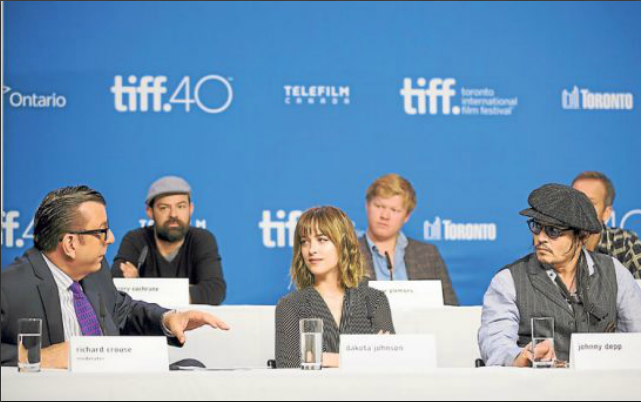
The backstage room at the TIFF Bell Lightbox’s press conference area is a beehive of activity.
“Is George here yet?”
“Is that Johnny vaping in the corner?”
It’s a place where no last names are necessary and the star wattage is blinding. Actors, directors, publicists and gofers mingle while air kisses, handshakes and Hollywood hugs are exchanged.
This year the Toronto International Film Festival is mounting 11 press conferences featuring everyone from Matt Damon and Sandra Bullock to George Clooney and Keith Richards.
I’m hosting four of them — Demolition, The Martian, Our Brand is Crisis and Black Mass — with, as MGM used to brag, “More stars than are in the heavens.”
Despite the buzzy nature of the events, backstage is a casually chaotic place where actors get caught up with one another before taking the stage.
Matt Damon made the rounds, glad-handing with his The Martian cast mates, many of whom he hadn’t met because he spent 90 per cent of his of screen time alone, stranded on Mars.
The business of the press conferences happens on stage. Moderating these things provides a fascinating glimpse into both sides of the publicity machine.
Ideally the press conferences are a reciprocal event: Reporters ask questions to actors and filmmakers they might not otherwise have access to, and in return the stars get publicity for their films. It’s a pretty simple but often unpredictable transaction.
Gone are the days of the legendary “journalist” who asked all her questions in rhyme, but for every sensible inquiry about the movie, there is inevitably another off-the-wall query that leaves panel lists either annoyed or scratching their heads.
At the Our Brand is Crisis conference someone asked Bullock about her character’s grown-out roots. The Oscar winner replied as best she could and when she finished, Clooney chimed in, “Aren’t you glad you asked that question?”
Later she shut down a silly query regarding how she keeps her bum as toned as it is in the film. “It’s so sad that you just want to talk about the butt,” she said, before tersely adding that leg lifts are the secret to posterior pertness.
Not that the attendees are the only ones to pull a gaffe or two. During the Demolition conference, I asked Chris Cooper a long, rambling question about his character. He seemed genuinely perplexed, and you know what? I was, too. Sometimes you can overthink these things.
Later at The Martian presser, there were 13 people on the stage, everyone from Michael Pena to Damon, Scott, Chiwetel Ejiofor and Jessica Chastain, and in the shuffle I made the horrifying mistake of forgetting to ask the great Sean Bean a question and didn’t realize it until we were out of time.
Who doesn’t acknowledge Lord Eddard Stark?
Me, idiotically. Next year I promise to go to him first and frequently.