For a movie set partially in the future “Tomorrowland,” the new action-adventure starring George Clooney, feels kind of old fashioned.
The movie begins in the recent past and the distant future. Precious child inventor Frank (played as a child by Thomas Robinson, Clooney as an adult) has made his way to the 1964 New York World’s Fair, jet pack in hand. There he meets Athena (Raffey Cassidy), a young girl who slips him a mysterious pin that allows him access to Tomorrowland, a future world where all the modern problems have been eradicated.
Years later a similar pin lands in the hands of Casey (Britt Robertson) the daughter of a NASA engineer and all round smarty-pants. Tracing the origin of the pin leads her to Athena, Frank and a mysterious world that has changed somewhat from Frank’s youth. “When I was a kid,” says Frank, “the future was different.”
Director Brad Bird has made a big, handsome movie, ripe with imagination and eye-popping images that attempts to create the same kind of nostalgic awe as vintage Spielberg. He comes close but misses by a hair. Instead he draws out the story for two-hours-and-ten-minutes, taking too long to get to the fairly meagre why-can’t-we-all-just-get-along-and-save-the-world premise. The pacing feels like it is from another era when audiences were more content to sit back and drink in the atmosphere.
The realization of the future world is impressive. From the interconnected swimming pool pods to the special effects—You will believe George Clooney can fly!—to the Jetson’s style architecture it’s an eyeful. “Will you stop being amazed!” Frank says with exasperation, and no, we may not as long as Bird is entertaining the eye. It’s only when he tries to engage the intellect that the movie falters.
Classic sci fiction has never shied away from Saving the Earth and “Tomorrowland” should be congratulated for it’s world-is-going-to-heck point of view, but (MILD SPOILER ALERT) its preachy ‘The world could get better but no one is willing to put in the effort,” stance and ‘The future belongs to the dreamers” attitude it is naive.
“Tomorrowland” is the rare kind of summer movie, one that values its originality and ideas. Too bad it isn’t as forward thinking as the name would suggest.
Nicky Spurgeon (Will Smith) is a seasoned grifter from a long line of con men. His father and grandfather were flim flam artists and now he is passing along the tricks of the trade to Jess (Margot Robbie) a beautiful newcomer with a light touch—perfect for picking pockets—who just might get Nicky to break his golden rule of never getting emotionally involved with anyone.
When Spurgeon first spots Jess she is working a low level scam in a hotel bar. He teaches her how to use misdirection to pick pockets. “You get their focus,” he says, “and then you can take whatever you like.” Using a mixture of his methods and chutzpah they hit the rubes at the Superbowl in New Orleans, raking in over a million dollars in one week.
A nervy game of one-upmanship nets another big score, and Jess, thinking she is part of the team—both professionally and romantically—imagines a life of crime with Nicky until he unceremoniously dumps her, gifting her with $80,000 and a free ride to the airport.
Three years later Nicky is in Buenos Aires working a big job for billionaire Garriga (Rodrigo Santoro). To his surprise Jess is also there, but is she working an angle or has she gone straight?
One part Scorsese, one part Soderbergh, with a healthy dose of “The Sting” thrown in, “Focus” is a stylish crime drama more about the characters than the crime. Nicky’s maxims—“Die with the lie.”—set the scene, but the story is more about a commitment-phobe who loses himself over a woman. It works because of the chemistry between Smith and Robbie. They have great repartee, trade snappy dialogue and despite a gaping age difference, make a credible couple.
Smith hasn’t been this effortlessly charming in years and Robbie blends streetwise—“It’s a minor miracle I’m not a hooker right now,” she says.—with easy charm. The pair are a winning combo, reminiscent of the spark-plug chemistry between George Clooney and Jennifer Lopez in “Out of Sight.”
“Focus” could use a bit more focus in the storytelling—a late movie plot twist doesn’t ring true given the lead up to the big reveal—but it zips along at such a pace and is enough fun that you may not notice.
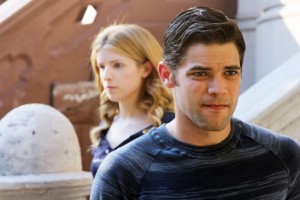
Anna Kendrick is perhaps best known for her break out role as the ambitious Human Resources person in Up in the Air who suggests conducting layoffs via videoconferencing to save money. Her performance opposite George Clooney created a stir at the 2009 Toronto International Film Festival, and now she’s back at TIFF with a much different movie.
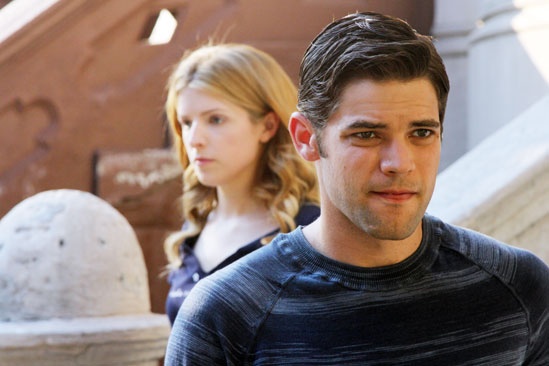
The Last Five Years is a musical based on Jason Robert Brown’s Off-Broadway hit of same name. It’s the story of the five-year relationship between actress Cathy and her novelist husband Jamie, played by Smash star Jeremy Jordan. It’s told from two different perspectives. Her storyline begins with the breakdown of the relationship. His starts at the beginning (it’s a very good place to start, as they say in musical theatre) as they court and eventually marry.
Kendrick, last sang on screen in Pitch Perfect and will soon be seen as Cinderella in the much anticipated movie version of Into the Woods, says the decision to sing live in front of the cameras, instead of prerecording in studio, aided her performance of the complex role.
“Doing it live was something we wanted to do whenever possible,” she says. “We didn’t want to make a point of it or be precious about it because it was equally important for us to be visually dynamic and change locations and be outside occasionally. I thought I would feel that the pre-recorded days would be a breeze, but it was so much easier to act the songs live because you weren’t retroactively going, ‘Oh yeah, that’s how I was playing that in the recording booth four weeks ago.’ So doing it live was a physical challenge, because, you know, it’s your voice, but it was so much easier to be present and honest and all that with singing live.”
Kendrick plays a struggling actress and in one memorable scene details the pain of auditioning for roles. In the Climbing Uphill sequence she sings, “I’m up ev’ry morning at six, And standing in line, With two hundred girls who are younger and thinner than me.” It;’s a feeling Kendrick says she knows well.
“It’s a competitive business by nature,” she says. “I know that room and that line of two hundred girls. I didn’t have to dig all that deep to know the anxiety and self-doubt. That was a fun thing to perform and see inside her head and talk about the indignity of not being paid attention to when you are trying to perform for somebody.”
Even though she is a Tony nominee for her work on Broadway in High Society and has starred in high profile films like Twilight and Scott Pilgrim vs. the World she says she still auditions.
“If there is something really incredible everybody wants it so I audition,” she says. I see friends of mine and we’re all in business suits and then at the next one we’re all in leather jackets. I’m like, ‘Yeah, this is so embarrassing.’ But that is the grind.”
I root for George Clooney. He has a lot going for him; he’s good looking, has a villa in Italy and is good friends with Sandra Bullock. That’s a lot for anyone, but that’s not why I root for him. I’m on his side because even though he’s a superstar he takes chances.
As an actor he put nipples on Batman, starred in a remake of an obscure Russian sci fi film, played a fox in a Wes Anderson movie and has played the lead in a movie about paranormal goats.
As a director he’s just as edgy. He’s stood behind the camera for a black and white look at Edward R. Murrow’s battle with Senator Joseph McCarthy, an old school football movie set in 1925 and an exposé of backroom politics.
He’s an a-lister who takes chances, and I applaud that which makes me sad to report I didn’t find as much to applaud in his most recent film as actor and director “The Monuments Men.”
Based on the book “The Monuments Men: Allied Heroes, Nazi Thieves and the Greatest Treasure Hunt in History” by Robert M. Edsel, the movie stars Clooney, Matt Damon, Bill Murray, John Goodman, Jean Dujardin, Bob Balaban and Hugh Bonneville as a motley crew of art historians, engineers and museum directors recruited to locate and rescue priceless art works stolen by the Nazis. When two members of their team are killed they are no longer observers but active participants in the war.
Helping in the mission to return the plundered cultural artifacts is Rose Valland (Cate Blanchett), a French art historian and member of the French Resistance who not only aids the Allied art platoon but also tries to work her Parisian charms on Damon’s character.
“The Monuments Men” is a wartime comedy. Think “Hogan’s Heroes” by way of Leonardo Da Vinci and you’ll get the idea. It has some mild laughs (the biggest laugh, for Canadians anyway, comes from the Parisians who blame Matt Damon’s terrible French on having spent too much time in Montreal) but also a great deal of reverence for the art and the work of the real-life Monuments Men. ”People can come back but if you destroy their achievements, their history,” says George L. Stout (Clooney), “they can’t come back from that. That’s why Monuments Men was created.”
The reverential tone is reinforced by old school pacing that focuses on the character and art over action and a rousing soundtrack that sounds air-lifted in from a classic wartime era movie. The cast is uniformly fine and Bill Murray shows, once again in a brief scene in a shower (NO SPOILERS HERE), how his understated style can move an audience.
No problems there, but co-writers Clooney and longtime collaborator Grant Heslov appear to have taken a dose of sentimentality pills before putting pen to paper. What might have been an edgy, exciting look at an underreported slice of World War II history is reduced to an elegantly directed but somewhat dull film.
“The Monuments Men” is an earnestly told story but the lack of any real energy or surprises undermines its effectiveness.
TOP THIRTEEN HITS (click on the title to see trailer)
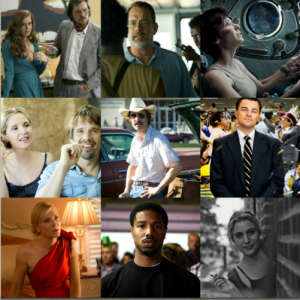
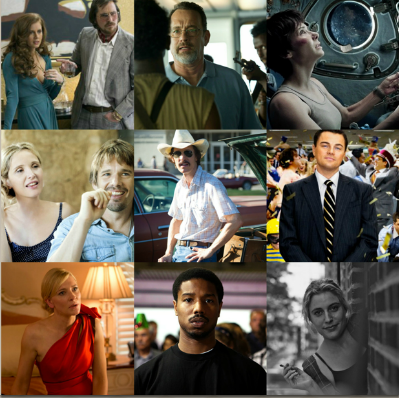
1. 12 Years a Slave. There’s a key line near the beginning of “12 Years a Slave, “ the new drama from “Shame” director Steve McQueen. Shortly after being shanghaied from his comfortable life as a freeman into a life of slavery Solomon Northup (Chiwetel Ejiofor) declares, “I don’t want to survive. I want to live.” Based on Northup’s 1853 memoir the movie is an uncompromising story about will, suffering and injustice.
2. American Hustle. “American Hustle” is one of the year’s best. It’s an entertainingly audacious movie that will doubtless be compared to “The Wolf of Wall Street” because of the similarity in tone and themes, but this time around David O. Russell has almost out-Scorsese’d Scorsese.
3. Before Midnight. “Before Midnight” is beautifully real stuff that fully explores the doubts and regrets that characterize Jesse and Celine’s (Ethan Hawke and Julie Delpy) love affair. Done with humor, heart and pathos, often in the same scene, it is a poignant farewell to two characters who grew up in front of us.
4. Blue Jasmine. Darker than most of Woody Allen’s recent output, “Blue Jasmine” doesn’t go for laughs—very often anyway—but is an astutely crafted psychological character study. Jasmine is a modern day Blanche Du Bois, a faded bright light now forced to depend on the kindness of strangers. Getting in her way are delusions of grandeur and a continued sense of denial—likely the same sense that kept her guilt free during the years the illegal cash was flowing—that eventually conspire to fracture her psyche. “There’s only so many traumas one can take,” she says, “ before you end up in the street, screaming.”
5. Captain Phillips. I don’t think it’s fair to charge audiences full price for screenings of “Captain Phillips.” While watching this exciting new Tom Hanks thriller I was reminded of the old Monster Trucks ads that bellowed, “You Pay for the Whole Seat but You’ll Only Need the Edge!”It a film about piracy and I don’t mean the sleazy guys who bootleg movies but the real pirates who were responsible for the first hijacking of an American cargo ship in two hundred years.
6. Dallas Buyer’s Club. In “Dallas Buyer’s Club” Canadian director Jean-Marc Vallée has made an emotional drama that never stoops to melodrama. Instead it’s an inspirational film about standing up for what you believe in.
7. Frances Ha. The seventh film from “Greenberg” director Noah Baumbach isn’t so much a traditional narrative as it is a character study of Frances (Greta Gerwig), an underemployed dancer struggling to find herself in New York City. It plays like a cleaned up black-and-white version of “Girls”; an emotionally rich and funny portrait of twenty-something ennui. “Frances Ha” is a collection of details. There is an engaging story, but it’s not exactly laid out in three acts. It feels more intimate and raw than the usual twenty-ish crisis flick and with each detail we get another piece of the puzzle that makes up Frances’ life.
8. Fruitvale Station. It’s important to remember that “Fruitvale Station” isn’t a documentary. Director Ryan Coogler has shaped the movie for maximum heartrending effect, and by the time the devastating last half hour plays out it’s hard to imagine any other movie this year packing such a emotional wallop.
9. Gravity. “Gravity” isn’t an epic like “2001: A Space Odyssey” or an outright horror film like “Alien.” There are no monsters or face hugging ETs. It’s not even a movie about life or death. Instead it is a life-affirming movie about the will to survive.
10. Her. “Her” is an oddball story, but it’s not an oddball film. It is ripe with real human emotion and commentary on a generation’s reliance on technology at the cost of social interaction.
11. Inside Llewyn Davis. “Inside Llewyn Davis” is a fictional look at the vibrant Greenwich Village folk scene. Imagine the cover of “The Freewheelin’ Bob Dylan” come to life. Sharp-eyed folkies will note not-so-coincidental similarities between the people Llewyn meets and real-life types like Tom Paxton, Alert Grossman and Mary Travers, but this isn’t a history, it’s a feel. It gives us an under-the-covers look at struggles and naked ambition it takes to get noticed.
12. Nebraska. The humour doesn’t come in the set-up-punch-line format but arises out of the situations. A scene of Woody’s gathered family—his elderly brothers and grown sons—watching a football game redefines the word taciturn but the subject of the sparse conversation, a 1974 Buick, is bang on, hilarious and will likely sound familiar to anyone with a large family.
13. Wolf of Wall Street. “Wolf of Wall Street” makes for entertaining viewing, mostly because DiCaprio and Jonah Hill are able to ride the line between the outrageous comedy on display and the human drama that takes over the movie’s final minutes. Both are terrific, buoyed by the throbbing pulse of Scorsese’s camera. With its fourth wall breaking narration, scandalous set pieces and absurd antics “The Wolf of Wall Street” is an experience. At three hours it’s almost as excessive as Balfort’s $26,000 dinners. It feels a bit long, but like the spoiled brats it portrays, it will not, and cannot, be ignored.
TOP FIVE MISSES
TREND: Big stars don’t guarantee box office!
1. The Fifth Estate – Budget: $28 million, Global box office: $6 million, Return: 21% Late into “The Fifth Estate” Guardian investigative journalist Nick Davies (David Thewlis) says, “most good stories start at the beginning.” I argue that he’s right– about 99% of the time. Unfortunately this look at WikiLeaks and hacker-turned-whistleblower Julian Assange falls into the 1%.
2. Bullet to the Head – Budget: $25 million, Global box office: $9 million, Return: 36% With a name like Bullet to the Head you know the new Sylvester Stallone movie isn’t a romantic comedy. Although he paraphrases the most famous rom com line of all time, “You had be at BLEEP BLEEP!” the movie is nothing but an ode to testosterone.
3. Getaway – Budget: R180-million, Global box office: R105-million, Return: 58 percent. On a scale of zero to stupid, ”Getaway” ranks an eleven. It is what we call in the film criticism business a S.D.M. (Silly Damn Movie). OK, I made that last part up, but I couldn’t really think of any other category to place this movie under. Maybe E.S.D.M. (Extremely Silly Damn Movie).
Every year around this time people ask me, “How should I do TIFF?”
“I beg your pardon?” is my usual shocked reply until I realize they’re referring to the Toronto International Film Festival, or as acronym aficionados refer to it, TIFF.
Gaining my composure I continue, “Get ready to enjoy ten days of standing in lines, sitting in the dark and only eating sporadically.” It sounds like some new age sense deprivation therapy or a Toronto City Council session but it’s actually what you can expect from attending the biggest public film festival in the world.
For ten days each September movie stars decorate red carpets, thousands of miles of film unspool and movie mavens push the limits of their endurance to take it all in. But how, exactly, does one “do” TIFF?
Let’s start with the galas, the star-studded screenings of the festival’s biggest movies. Advance tickets may come with sticker shock, but they also come with the chance of eyeballing George Clooney or Angelina Jolie up-close-and-personal.
These tickets are in high demand, so how do you get them? It helps if you strongly resemble someone famous. A few years ago a Bono look-a-like talked his way into gala screenings and parties and it wasn’t until much later everyone realized he was an imposter. If you are not a rock star or genetically blessed enough to look like Jon Hamm or Emily Blunt, however, you must plan in advance and be prepared to stand in lines. The gala presentations usually have a rush line the night of.
With the galas come celebrities so your chances of bumping into a bold-faced name or two increases exponentially during festival days. What’s the etiquette when you find yourself basking in the reflected glow of Brad Pitt or Dame Judi Dench?
Be yourself and don’t try too hard to impress and you’ll be fine. If that doesn’t work talk in film critic speak to get noticed. If you must sully their golden ears with your speech, fall into meaningless movie-speak; label their film a “tone poem” or tell them it was “quirky but inspiring.” Drop Pedro Almodóvar’s name. Say things like “the films this year show an international scope and diversity of voices,” and pepper your speech with any of the following words in any way that seems appropriate at the time: avant-garde, unconventional, innovational or causative. Don’t worry if what you’re saying doesn’t make sense, the celebs will be too tired or too self-absorbed to notice.
Do NOT corner Brad and spout your detailed opinion about his new movie. He doesn’t care what you think. He’d rather be at home with Angie and the kids. Also don’t ask about Angie or fish for an invite to George’s villa.
If you see Jackie Chan at TIFF’s Asian Film Summit refrain from asking how many times he’s broken his nose. Google it instead.
The above rules also apply to the festival parties. Keep the conversation going without offending anyone or actually saying anything worth repeating. Perfect for the party circuit.
The festival is more about celluloid than celebrities, however. You may get a great water cooler story from a casual celeb encounter, but the fest’s main attraction is, and has always been, the movies.
TIFF offers up the chance to see the best of domestic and world cinema, get a jump on Oscar season and watch movies you’d never be able to see otherwise.
What are three things one must bring to a screening? A good attitude, a willingness to be swept away by the movie and, on a less ephemeral note, a snack. These things never start on time and there is nothing worse than watching a movie on an empty stomach.
Three things NOT to bring: a cell phone (unless you promise to turn it off before the movie starts), candy wrapped in crinkly paper and a bad attitude.
It can be hard to maintain a rosy outlook, but as I always say, if TIFF isn’t an endurance test, you aren’t doing it right. You should go in filled with the hope of seeing great movies and possibly sharing a moment with your favorite movie star, and emerge on the other end of the ten days exhausted, but satisfied.
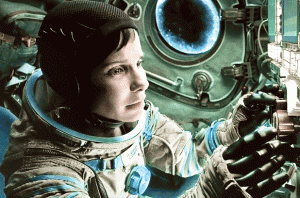
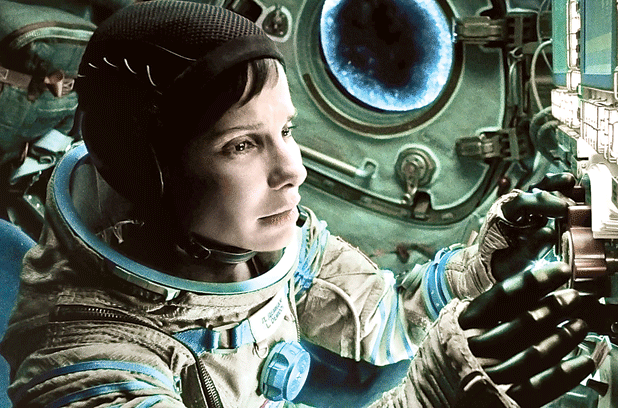
As “Alien” famously reminded us, “In space no one can hear you scream,” but they didn’t mention anything about heavy breathing. “Gravity,” a new space thriller starring Sandra Bullock and George Clooney as two astronauts adrift in the wild blue yonder, features more heavy breathing than a Linda Lovelace movie.
Beginning with an uninterrupted fifteen-minute opening shot, director Alfonso Cuarón presents a spacy story about medical engineer Dr. Ryan Stone (Bullock) and astronaut Matt Kowalsky (Clooney). She’s an uptight novice; he’s a wisecracking vet on his final mission.
It’s routine stuff—or as routine as space travel ever gets—until a debris storm, comprised of bits and pieces of old satellites, chunks of metal traveling as fast as bullets, crashes into their space shuttle. Stone is knocked “off structure” and drifting through the inky darkness while Kowalsky uses his experience and calm to rescue her. Cue the heavy breathing as her oxygen slowly runs out and panic sets in.
The storm has knocked their communications offline and they are forced to become Space MacGyvers in order to survive.
“Gravity” is an ambitious film. A two-hander set against the bleak backdrop of space, it relies on the cast and some tricky camerawork to maintain interest over the film’s deliberately paced but slight 85 minute running time.
The story is one of survival, but screenwriter Cuarón (who co-wrote it with his son Jonás) hasn’t simply written a horror film about imminent disaster. Stone signed up for outer space travel to isolate herself from a personal tragedy, but when the chips are down she finds new meaning in her life.
It’s a good way to ground the story. The isolation of space is well portrayed, the “off structure” sequences are tense and effective and the shots of Bullock drifting in the void or floating through her space shuttle are beautiful, like interstellar ballet. As effective as the human story is in Gravity, however, I could almost imagine turning the sound down and being content to just watch the pictures. Like Laser Floyd in Space.
But “Gravity,” while beautiful to look at, is occasionally too in love with its technique. The seventeen minute long uninterrupted shot that starts the film is spectacular and overall the look will make your eyeballs dance but then there’s a scene where we see Sandra Bullock reflected in one of her own, gravity free, tears. It’s a great image but one that feels a bit too clever. It was one of the few times in the film that I thought I was watching a special effect.
The look is an achievement, but when you find yourself daydreaming about how a scene was shot, it’s a sure sign the technique has taken you outside the story.
“Gravity” isn’t an epic like “2001: A Space Odyssey” or an outright horror film like “Alien.” There are no monsters or face hugging ETs. It’s not even a movie about life or death. Instead it is a life-affirming movie about the will to survive.
“I think we need to make another movie about how we made this movie,” says Sandra Bullock on the filming of Gravity, her new lost-in-space film.
The Heat star plays Dr. Ryan Stone, an astronaut untethered from her space shuttle following a debris storm. Cut loose from her space partner (George Clooney) and her ride to Earth, she drifts through the inky darkness until discovering a way to survive.
“The film is about adversities, and we were going through adversities,” says director Alfonso Cuarón. “Everything was a big challenge.”
Technically, the shoot was arduous. Recreating the zero-gravity of space required Bullock to learn to move at 30 per cent of her usual speed, and to be trussed up like a marionette on a 12-wire system and other torturous devices.
“We had a consultant from Guantanamo Bay come in,” jokes Cuarón.
Emotionally the shoot also presented issues. How could Bullock portray the impassioned inner life of the character when covered with a helmet and spacesuit for much of the performance?
“I think every actor will tell you that they are always panicked about being able to convey something with the least amount of preciousness,” she says. “If all you have are your eyes or your face, just feel it truthfully. For me, I didn’t think about being behind the visor. It was still my whole body feeling it.
“But a lot of times you’d feel yourself emoting something and they’d say, ‘No, we didn’t see anything.’ I just had to trust in what (Cuarón) saw. I saw nothing. I heard nothing. I had him in my head and I just had to trust that.
“It’s a weird profession. You have to unscrew your head and screw on this other head of what this other person is going through and you go, ‘Wow, that’s not a pretty place to live all day.’”
Working with Clooney, who she’s known since before they both were famous, also provided support.
When she was having trouble with a particular scene, Clooney sent an email with a some suggestions on how to make it work. “It’s not my business,” he wrote, “so throw this in the trash or use it.”
As it turns out, his ideas were bang-on. “That’s the gift of knowing someone for so long,” she says. “He gives you gold tidbits like that. It’s sweet.”
It’s quite a year to be a talking fox in Hollywood. After a long absence these carnivorous mammals are coming back strong with a surreal cameo in “Antichrist” (“Chaos Reigns!”) and now a starring role in a charming new stop-motion animation from director Wes Anderson, “Fantastic Mr. Fox.”
Loosely based on a Roald “Charlie and the Chocolate Factory” Dahl story of the same name, the story involves Mr. Fox (George Clooney) a smooth talking chicken thief who is part Danny Ocean, part John Robie (look it up!). When a chicken run goes wrong and he and Mrs. Fox (Meryl Streep) get busted he tries to go straight, but after buying a tree house he can’t afford he decides to return to a life of crime for one last big job. He sets his sights on the area’s three biggest and baddest farmers: Boggis (Robin Hurlstone), Bunce (Hugo Guinness) and Bean (Michael Gambon).
This has been an extraordinary year for kid’s filmed entertainment. “Up,” “Where the Wild Things Are” and “Coraline” are about as good as it gets when it comes to family films. They are movies that don’t talk down to their young audience; treat them with respect and give them a rollicking good time. You can add “Fantastic Mr. Fox” to that list.
Wes Anderson’s mix of deliberately old-school stop motion animation—you can see the fur moving where the animators have touched the puppet characters—gentle humor and action is unlike any other movie this year. In its pacing and style it is decidedly old fashioned, a throw back to the colorful Rankin and Bass animated Christmas specials, but without the schmaltz. I doubt you’d find an existential line like, “Now he’s just another dead rat in a dumpster behind a Chinese restaurant” in any other vintage stop motion film for kids and it is that edge that sets “Fantastic Mr. Fox” apart from the pap, like the recent “Astro Boy,” that passes for kid flicks.
You can tell it’s a Wes Anderson film because it’s loaded with his trademark subjects—sibling rivalry and unusual parental figures abound—and it has his quirky sensibility stamped all over it—there’s a transcendentally meditating fox!—but it is the vocal performances that really bring it to life.
George Clooney brings charm, wit and warmth to Mr. Fox. He’s an unpredictable character, smooth one minute, a wild animal the next, and Clooney gives him a nice sense of mischievousness. Meryl Streep doesn’t have as much to do, but it’s worth the price of admission to hear this celebrated actress (15 Oscar nominations and 2 wins) say, “Am I being flirted with by a psychotic rat?” The deliberate, naturalistic dialogue also comes easily to supporting cast members Bill Murray, Michael Gambon and Eric Anderson (brother of Wes) who makes his debut as Kristofferson, the athletic cousin.
Its stylish looks, engaging story and over-all wonky feel made me very happy. There are few kid’s films as fantastic as “Mr. Fox.”