Poet Paul Éluard said that to understand Jean Cocteau’s 1946 version of “La Belle et la Bête”—“Beauty and the Beast”—you must love your dog more than your car. It’s a good line that suggests Cocteau’s adaptation values the organic elements of the film — even the special effects are handmade—while refusing to allow the technical aspects of the film to interfere with the humanity of the story.
The same can’t be said of the new, big budget live action Disney version of the story. Inspired by their classic 1991 animated story of belle and beast, the remake relies too heavily on computer generated splendour and too little on the innate charms of the story.
Emma Watson plays the bright and beautiful Belle, the independent-minded daughter of eccentric inventor Maurice (Kevin Kline). She is, as the townsfolk warble, “strange but special, A most peculiar mad’moiselle!” She has caught the eye of dimwitted war hero Gaston (Luke Evans) who unsuccessfully tries to win her hand.
Taking one of his new gizmos to market Maurice picks a rose as a present for Belle but runs afoul of the Beast (Dan Stevens). Once a self-centered prince, he was changed into a part-man, part-wolf, part Chewbacca creature by a witch as punishment for his hedonistic life. The only way to beak the spell, she cackles, is to find someone to love him before the last petal falls off an enchanted rose. “Who could love a beast?” he asks.
Enter Belle.
On the hunt for her father, she makes her way to the Beast’s remote castle only to find Maurice locked up for rose theft. She pleads with her hairy host for a moment with her father, and while giving him a hug pushes him out of the cell, slamming the door behind her. Trading her freedom for his, she is now the Beast’s prisoner. The staff—once human, now transformed into the enchanted candlestick Lumiere (Ewan McGregor), Cogsworth the clock (Ian McKellen), a teapot Mrs. Potts (Emma Thompson) and wardrobe (Audra McDonald) although it feels like a missed opportunity to not have Daniel Craig play a eavesdropping microwave—see Belle as just the person to look past his ghastly appearance and see the true princely beauty within and lift his curse and theirs.
Director Bill Condon has made a classic big screen musical with state of the art special effects. Up front is a perfectly cast Emma Watson, who brings more tenacity to the character than we’ve seen in past versions as well as a considerable amount of charm. She is the movie’s beating heart, the human presence in the midst of a considerable amount of pomp and circumstance.
Condon decorates the screen, over-dressing almost every scene with layers of pageantry and CGI. It entertains the eye, particularly in the Busby Berkeley style “Be Our Guest” sequence but overwhelms the film’s humanity. This is a movie that loves its car more than its dog.
“Beauty and the Beast” is a handsome, straightforward movie that adds little to the animated classic. Some of the details have changed. Belle and Beast mourn their deceased mothers and Gaston’s minion Le Fou (Josh Gad) is now gay but the dreamlike of the 1991 version is lacking. The story just seems less magical when built from a collection of pixels.
Twenty-one years on from the full on frontal assault that was “Trainspotting,” the old gang is back together but the only things that truly binds them is a shared past. “You’re a tourist in your own youth,” says Sick Boy/Simon (Jonny Lee Miller).
At the center of it all is Mark Renton (Ewan McGregor). The last time we saw him he was a wastrel and double-crosser who cheated his friends out of £16,000 in a drug deal. After hightailing it to Amsterdam he’s now a fitness freak who spends more time running in a treadmill than running from the law.
His former friends, now all in their forties, are in various states of personal disrepair. “The wave of gentrification has yet to wash over us,” Simon quips.
Sick Boy/Simon is still a dodgy dude with a King Kong size Coke problem, who makes ends meet by blackmailing the wealthy customers of his prostitute business partner Veronika (Anjela Nedyalkova).
Spud/Daniel (Ewen Bremner), still an impressive mash-up of ears, teeth and gangly limbs, is now a pathetic creature that chooses heroin addiction over a life with his wife Shirley Henderson) and child.
The fourth member of the group, Begbie (Robert Carlyle), he of the bad attitude and broken pint glasses to the face, is indisposed, locked up but with a way out and a gut full of hate for Renton.
Loosely based on author Irvine Welsh’s “Trainspotting” follow-up novel “Porno,” the new film from Danny Boyle, asks if it is ever possible to go home again—in this case Edinburgh—especially if home involves a dangerous psychopath with a grudge and an ex-BFF who wants revenge.
“T2 Trainspotting” does something quite remarkable. It places nostalgia in the rear view mirror while, at the same time, celebrating bygone days. To see Mark confront his past complete with the emotional attachments and entanglements that come along with it feels like a universal reckoning, a reminder that the world changes even if we don’t.
That’s the beating heart of the film, the rest is window dressing, It’s fun to hang out with these almost lovable villains for a couple more hours, to catch up on old times, immerse ourselves in their down-and-dirty lives and even get a new Choose Life riff but a heavy air of regret hangs over the proceedings. It reinforces the idea that we can’t relive the glory days no matter how hard we try. It’s a middle-age truism brought to vivid life by Boyle and cast.
In revisiting the past the director does, however, put an intimate spin on the story with clever visual integration of past memories—present day characters mournfully share the screen with their younger counterparts—and a melancholy sense that no matter how hard we try to move forward ultimately our lives are simply a continuation of everything that came before. As Renton says, “choose history repeating itself.” It’s not a thunderbolt revelation but revisiting these characters—particularly the tragicomic Spud—puts a face to those anchored in the nostalgia.
For fans of the original film “T2 Trainspotting” will be an enjoyable ride. It is as good a sequel to a classic film as you could hope for. It’s a shame the returning female characters played by Kelly MacDonald and Shirley Henderson are relegated to cameos and the original’s sense of infectious anarchy has been dulled somewhat but the film’s mix of redemption and regret are ample replacements.
Ewan McGregor makes his directorial debut with “American Pastoral,” a crime-drama based on a novel by Phillip Roth. He deftly presents nice performances from Dakota Fanning, Jennifer Connelly, Rupert Evans and Valorie Curry but tells a story that feels disjointed.
McGregor stars as Seymour ‘Swede’ Levov, a man with a charmed life. He was a football star in high school, married Dawn (Connelly) his beautiful girlfriend, inherited a thriving business and was blessed with a daughter, Merry (played by Hannah Nordberg as a child, Fanning as a teen). He was “Our hero, our Kennedy,” says a schoolmate.
When little Merry, aged eleven, sees a news report of Buddhist monk Thích Quang Duc burning himself to death to protest the war in Vietnam, it awakens something inside her. “Why does that gentle man have to burn himself?” she cries. “Doesn’t anyone care? Doesn’t anyone have a conscience?”
Cut to several years later. Merry is now a politically engaged revolutionary teenager living under her father’s suburban Old Rim Rock, New Jersey roof. She calls the president, “Linden ‘Baby Burner’ Johnson,” and heads off to meet her radical friends in New York whenever possible. “What do you care about the war?” she shrieks at her parents. “You’re just contented middle-class people!”
The ‘Swede,’ concerned about his daughter’s behaviour forbids her to go to the city. Instead, he suggests, why doesn’t she protest a little closer to home? When the local post office blows up, killing the postmaster, and Merry disappears the human cost of her actions becomes clear. The bomb destroys the building, kills a man and presents ‘Swede’ with the first crisis of his charmed life.
“American Pastoral” is a handsome movie that tackles one of the most tumultuous times in American history. McGregor gets inside the stateside protest of the Vietnam War by keeping the story tight, focussed on one family and the devastating effect of radicalism has on them and, peripherally, on the victims of Merry’s crimes. Getting inside the head of a young woman driven to push away the comfy-cosy life provided by her wealthy parents for a life on the run would be fascinating. Too bad it isn’t here. Instead, Fanning plays Merry like a petulant teen, more likely to sneak out to meet boys than blow up government buildings.
Ditto the resulting toll Merry’s actions take on her decent, hardworking parents. Dawn falls apart, ending up in hospital before taking the most superficial way out of her heartbreaking problems.
There’s an affair and some intrigue but it’s all skin deep. There are many shots of McGregor looking concerned, but the full weight of the family’s tragedy is never truly felt. It feels by times as though sections of the movie are missing, either edited out from a longer version or left unfilmed. It’s a shame because what could have been an interesting look at what happens when radicalization comes home is neutered by some swiss cheese storytelling—lots of holes.
By default “Our Kind of Traitor” will probably be listed under the “thriller” section on Netflix and elsewhere simply because it was written by spymaster John le Carré but don’t be fooled. Labelling this Ewan McGregor film a thriller simply because of le Carré’s involvement is like calling “One Hour Photo” because Robin Williams took the lead.
McGregor and Naomie Harris are Perry Makepeace and Gail Perkins, an English couple on romantic holiday in Marrakesh. When she leaves him alone in a restaurant Perry meets flamboyant Russian oligarch Dima (Stellan Skarsgård) who takes the uptight poetry professor to a wild party resembling something out of a Fellini film. Inside a large mansion half naked women ride horseback and there’s enough drugs and booze to make Keith Richard do a double take. It’s a wild night that goes on until the sun rises, followed by a tennis match at Dima’s expansive villa.
Perry and Gail meet Dima’s family and nothing seems too odd until later that night at a cocktail party when the Russian asks Perry to smuggle a flash drive filled with very sensitive banking information to London. Turns out Dima is a money launderer whose usefulness to the mob has come to an end. He fears they may kill him and his family and his way out is to get the flash drive to the MI6 in return for safe passage to England.
Sounds like a plan until MI6 agent Hector (Damian Lewis) is less than entirely enthusiastic about the whole situation. Thus begins the intrigue, what little there is of it here, with Perry channelling his inner James Bond to become a Citizen Spy.
From buttoned down poetry professor to le Carré hero in a matter of days. It’s a leap, a gaping chasm even, which requires a well-oiled suspension of disbelief. The main problem is that the movie doesn’t offer up many clues as to why this couple would risk everything to come to the aid of a man they barely know. It’s a well-worn cinematic staple, the everyman as hero, but here it falls flat.
“I’ve BLEEPED up your life Professor,” says Dima. “Why are you still here?”
This would have been a good time for screenwriter Hossein Amini to offer up some kind of rational explanation as to why Perry has laid it all on the line. Instead we get this: “I’ve no idea.”
The rest of “Our Kind of Traitor” is about as riveting as that answer. Skarsgård’s boisterous performance is worth a look and Lewis is multi-layered enough to carry the whole thing but they are inexplicably pushed to the background behind the bland leads.
“I was born. I went to New York. I made some music. Did some dope and made some more music and you showed up at my door,” says Miles Davis (Don Cheadle) to journalist Dave Brill (Ewan McGregor). Of course, if that were all there was to the story “Miles Ahead” wouldn’t be much of a film. Luckily director, co-writer and star Cheadle fleshes out the story of one of the twentieth century’s greatest but most troubled musicians in a biopic that defies expectations. Expected: drug use and sublime music. Less expected: a car chase and shoot out.
We meet Davis as he seems to have reached the “more profitable dead than alive” stretch of his career. At the end of the five-year hiatus from music, and the world, the trumpeter is holding new session tapes hostage until his record company Columbia pays him $20,000.
Brill hopes to get the inside scoop on the Howard Hughes of jazz but isn’t above making a deal with Columbia to steal the tapes from Davis’s home. Instead the tapes or stolen by an enterprising music manager (Michael Stuhlbarg) who seizes the opportunity to make some cash off of Davis notoriety. This sets off a string of events that underscores the movie’s central theme, the idea that Miles cared more about music than his life.
Woven throughout are flashbacks to Davis’s early life, how he found fame and Frances (Emayatzy Corinealdi), the woman who would change his life. The tortured artist scenes that make up the bulk of the film are the most interesting for obvious reasons, but the backstory fill in the gaps, explaining why and how he became the man he did. Undone by police brutality, long-lost love, drugs, ego, women, infidelities and health issues Davis emerges as a textbook example of an artist who channelled his restless, self destructive personality into beautiful, ground breaking music.
“If you’re going to tell the story tell it was some attitude,” says Davis. “Don’t be coy.”
“Miles Ahead” is anything but coy. It’s not quite as wild as Davis or his music, but Cheadle mixes and matches various periods from Davis’s life to paint an impressionistic portrait of the man, warts and all. He builds a complete picture, showing Davis on his highest highs and lowest lows. There isn’t much insight into the nuts and bolts of how Davis actually created his music. The creative process remains a mystery but we do get the biographical details that shed light on a troubled life.
There are dozens of biographies on Johnny Depp and a surprising amount of them use the word “rebel” in the title. There’s the Passionate Rebel, the Modern Rebel and even Hollywood’s Best-Loved Rebel.
There can be no argument that Depp is a fearless actor, unafraid to tackle tough, challenging roles, but it’s hard to accept the rebel title these days. For 20 years, he wildly threw darts at the wall, making exciting movies with interesting directors.
With Tim Burton, he created the off-kilter Eds — Wood and Scissorhands. With John Waters, he produced Wade Walker, the greaser love interest in Cry-baby. And, with Lasse Hallström, he came up with Gilbert Grape, caregiver to his brother and morbidly obese mother.
Along the way, he was also Hunter S. Thompson in Fear and Loathing in Las Vegas, the world’s most successful drug dealer in Blow, and the depraved poet at the dark heart of The Libertine.
Few actors could have pulled off Ed Wood and no one does debauched like Johnny, but the carefully cultivated hip outsider image was never truly accurate. Shrouded in a cloud of Gauloise smoke, he was one of Hollywood’s too-cool-for-school kids, emitting an outsider’s aura, while astutely playing the Hollywood game.
But any remaining traces of Depp’s bohemian status were wiped away with Captain Jack Sparrow’s colourful scarves in the tetralogy of Pirates of the Caribbean movies. They made him a superstar, and wealthy enough to buy Bahamian islands, but also ushered in the damaging wig and makeup era of his career.
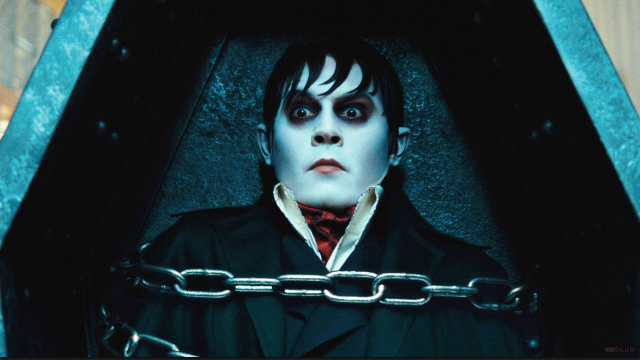
The pale makeup of Dark Shadows, Alice in Wonderland’s crazy oversized hat, and the raven headdress of The Lone Ranger overshadowed Depp’s performances, obscuring his character work with props and flash.
This weekend, he hides behind a moustache in the comedy Mortdecai.
As the title character, he’s pompous, bumbling — imagine Inspector Clouseau with an English accent and an attitude — and on a worldwide hunt for a painting said to contain the code to a lost bank account.
Will people be attracted to Mortdecai? Hard to know. Depp’s showy performances have, by-and-large, garnered big box office but profitability, while important to the suits who green light projects like this, is exactly what’s killing Depp’s credibility as a serious actor.
He’s not in Nicolas Cage territory yet — there’s an actor whose Western Kabuki style of acting redefines idiosyncratic — but with Pirates of the Caribbean 5 coming soon, perhaps it’s time to put Depp’s rebel actor image or reliance on props to bed.
Beware The Quirk! The Killer of Careers! The fearful beast is known to inhabit Southern California and frequently seen lurking in the Hollywood Hills. Easily recognizable by its overuse of make-up, strange facial hair and flamboyant dress, The Quirk lives off schtick and frequently speaks in a funny voice, seducing its victims—usually actors—with a siren song of bad jokes and vocal tics.
Johnny Depp has been outrunning The Quirk for years, narrowly missing the beast’s bony grip. Until now. The Quirk has finally claimed Depp, leaving behind a mass of exaggerated accents, silly walks, gapped teeth and lurid lip hair known as “Mortdecai.”
Based on “The Great Mortdecai Moustache Mystery” by Kyril Bonfiglioli, the movie stars Depp in the title role as a wealthy art dealer with a taste for the finer things in life, an obsessive habit of grooming his facial hair and a nearly empty bank account. He’s pompous, bumbling—imagine a jet-setting Inspector Clouseau with an English accent and an attitude—and on a worldwide hunt for a rare Goya painting said to contain the code to a lost bank account filled with Nazi gold. Along for the ride are Mortdecai’s his trusty cockney manservant Jock Strapp (Paul Bettany), Gwyneth Paltrow as Lady Johanna Mortdecai, Ewan McGregor as an MI5 agent and Jeff Goldblum as a “thick-fingered vulgarian.”
“Mortdecai” breathes the same air as “The Pink Panther” movies, with an added nod to the 1967 “Casino Royale,” an all-star heist movie most notable for featuring both Woody Allen and Orson Welles on the same marquee, but gets lightheaded when it comes to replicating the easy-breezy tone of those films. Capers flicks of a bygone era had a swingin’, hip feel of controlled chaos not overplayed farce but Depp is pedal-to-the-metal, quirking-it-up in a display completely without charm and worse, without wit. He sets the mood for the film—daft, overly mannered, arch and unfunny—and his preening feeds The Quirk, but leaves the audience hungry for laughs.
“Haywire,” a new action film from “Ocean’s 11” director Steven Soderbergh isn’t so much a movie as it is a showcase for the lithe athleticism of its star Gina Carano. Imagine an MMA match with a storyline and you get the idea.
Carano, the former champion mixed martial arts fighter, plays Mallory Kane, a mercenary who specializes in the dirty jobs that governments like to freelance out. Her idea of relaxation is “a glass of wine and gun maintenance.” Following a successful hostage rescue in Barcelona her handler Kenneth (Ewan McGregor) dispatches her to Dublin. There she teams with an MI5 operative (Michael Fassbender) only to discover she has been double-crossed. Angry, she Muay Thai’s herself back to the United States searching for clues and revenge.
Does the story mater? Nope. Not one bit. It’s the usual medium to complicated undercover spy tale—the kind that wraps up all the loose ends with a bit of exposition and some well chosen flashbacks at the end—but you don’t go to see “Haywire” for the story.
The movie is at it’s best when Carano is on the move, running, jumping, and kicking the snot out of her opponents. Soderbergh tosses in an action scene every ten minutes or so, but the violence here feels different. Sure necks get broken and people get shot in the face but unlike most action flicks Soderbergh doesn’t amp up the sound to go along with the punches, kicks and gunshots. Many films exaggerate the combat noises to add excitement, “Haywire” doesn’t. It trusts the fight choreography and because the violence isn’t particularly cartoony it doesn’t need to be juiced up.
The fights feel authentic—no CGI, few stunt people—a testament to Carano’s obvious fighting skills and Soderbergh’s wise decision to underplay the violence.
“Haywire” feels like a grrrl power version of a mid-80s Jean-Claude Van Damme movie. Of course it is elevated by the presence of actors like Fassbender, Antonio Banderas, Michael Douglas and Bill Paxton but at its heart it is a scrappy action movie that would play best in drive-ins and grindhouses.
Naomi Watts has battled Japanese spirits and domesticated a twenty-five foot tall ape, but in “The Impossible” she confronts a natural disaster she can’t tame—the 2004 Boxing Day tsunami which devastated fourteen countries bordering the Indian Ocean, claiming 230,000 lives.
Watts and Ewan McGregor are Henry and Maria, Japan-based-Brits who travel to Thailand for Christmas with their three kids Lucas (Tom Holland), Simon (Oaklee Pendergast) and Thomas (Samuel Joslin). Relaxing at a tony beachside resort, mom is lounging by the pool reading a book while dad splashes around with the kids. Suddenly a wave the height of an office building comes inland, destroying everything in its path and separating the family who float in different directions during the melee.
The first hour focuses on Maria and Lucas as they try and reach safety before switching gears to henry’s search for his wife and son.
In the immediate aftermath of the wave there isn’t much dialogue, just intense scenes of survival. Director Juan Antonio Bayona takes his time, really showing the immense power of the wave as it sweeps people, cars and even houses aside. It is harrowing stuff that hammers home the absolute helplessness of being in a situation governed by Mother Nature.
The second part of the story is more conventional, though still potent. Henry’s search for his wife is the stuff of action films, but McGregor brings some highly charged emotion to what could have been a standard against-all-odds scenario.
McGregor is good, but it is the kids and Watts that stick. As a mother who presses through injury to get her son to safety Watts is raw and real. It’s a great performance that will likely get recognized in award season.
The kids, particularly Holland as eldest Lucas, are naturals, and guaranteed to tug at your heartstrings. Bring a towel to soak up the tears.
“The Impossible” is more than simply the story of the tsunami or the family, it is about humanity’s ability to pull together in times of crisis; of those moments when a small gesture, like a hug or a fresh shirt can make a world of difference. It’s about people at their best in the worst of situations, and even though the ending is a bit pat, it makes you believe that there can be happy coincidences even in chaos.