“Widows” may be one of the most subversive heist films ever made. Based on a British mini-series from the 1980’s it stars Viola Davis, Elizabeth Debicki, Michelle Rodriguez and Cynthia Erivo as four women bonded by debts left to some very bad men by their late husbands. It is part caper flick and part survival story that makes strong statements on hot button topics like sexism, poverty, prejudice, power and police brutality.
Set in modern day Chicago, the action in the story begins when Harry (Liam Neeson) and his crew of robbers gunned down and blown up after a heist gone wrong. His widow, teachers’ union executive Veronica Rawlins (Viola Davis), is left with a $2 million debt to local crime boss Jamal Manning (Brian Tyree Henry). Manning is a tough guy attempting a stab at legitimacy by entering politics, running against corrupt local alderman, Jack Mulligan (Colin Farrell). Manning wants his money and, after mistreating Veronica’s dog, gives her just one month to come up with the cash. “That money was meant to buy me a new life,” snarls Jamal. “That money was about my life. Now it is about yours.” If she can’t come up with the cash she’ll have to deal with psychopathic strong arm Jatemme Manning (Daniel Kaluuya).
It is a dire situation but Veronica has a plan, or rather, a notebook and a plan. Harry left behind a handwritten book detailing every bribe he ever paid and blueprints for a future heist. Putting the widows of her late husband’s hoodlum crew to work (Debicki, Rodriguez, and non-widow Cynthia Erivo), she creates a gang of her own to steal $5 million cash and save their lives. “I’m the only thing standing between you and a bullet in your head,” says Veronica.
Co-written by McQueen and Gillian Flynn, the author and screenwriter of “Gone Girl,” “Widows” is a tightly constructed thriller that builds with each passing moment. McQueen takes his time with the material, allowing the audience to get to know the characters, to learn what’s at stake if this caper goes south.
First and foremost is Davis, fierce and formidable. Her evolution from executive and unsuspecting wife to criminal mastermind is emotional, logical and very motivated.
Opposite her is Debicki as a damaged woman whose own mother suggests prostitution as a career choice to make things meet. Her shift from abused woman to a person completely in control of her life and the way she is perceived—“It’s mine to be ashamed of or be proud of,” she says. “It’s my life.”—is one of the film’s true pleasures.
The cast is universally strong. Farrell could use a different accent coach but Kaluuya is evil personified, a psychopath with dead eyes and an attitude.
“Widows” is a stylish art house heist flick that pays tribute to the genre but layers in not only intrigue but also social commentary about racism, the cost of political power and the imbalance of power between some of the female characters and their male counterparts. The thrills will appeal both to your heart and head.
Denzel Washington has been nominated for seven acting Oscars, taking home two for “Glory” and “Training Day.” He’ll likely be nominated again this year for his turn as an idealistic defence attorney in “Roman J. Israel, Esq.” but don’t expect a nod for the film overall.
Washington is the title character, a brilliant behind-the-scenes legal eagle who, for thirty-six years, allowed his business partner to to be the public face of their firm. He’s a throwback to another time with an iPod with 8000 carefully selected deep jazz cuts and suits with lapels wide enough to take flight should the right wind conditions arise. He’s a stickler for the rules, a savant with a photographic memory for details, a sharp tongue and a higher purpose. “Not speaking out is ordinary,” he says. “We are agents of change.”
When his long time partner suddenly dies Roman is forced to work with hotshot lawyer George Pierce (Colin Farrell). Pierce is a shark, a corporate player with four upscale Los Angeles law offices that are essentially plea factories. However, he recognizes Roman’s genius. Roman wants to do the work of the angels, but his unconventional demeanour makes it difficult to find work in his chosen field, civil rights. Short of cash, he takes Pierce up on his offer. A square peg in a round hole, his ideas about reforming the legal system and social revolution don’t endear him to his co-workers.
Soon though Roman has a change of heart. “I’m tired of doing the impossible for the ungrateful,” he says of his impoverished clients. “I have more practical concerns. My lack of success is self-inflicted.” When he uses privileged information for personal gain he sets in motion a series of events he can’t control.
“Roman J. Israel, Esq.” is a character study of a man who betrays himself as well as others. He’s a man whose lifelong beliefs are pushed to the wayside when he butts up against a desperate situation. For a time his life gets better but, because this is a Dan Gilroy movie, you know it won’t last for long. It works for dramatic effect but Roman’s change of attitude rings hollow, as if simply having a few extra bucks in your back pocket—or, in this case, in a duffle bag in the stove—can smooth over all of Roman’s rough edges. The death of idealism is nothing new but the change in Roman never rings completely true.
Perhaps its because this is a legal drama with no courtroom showdown. It’s the anti “Law & Order,” a story that hinges on legal values but is more interested on how Roman believes in them, not why.
Still, while the movie may not satisfy as a frame for this interesting character, Washington impresses. He does edgy, complex work in a movie that is less interesting than its title character.
In 1971 the Don Siegel/Clint Eastwood Civil War drama “The Beguiled” was written off as “heavy handed,” “funny when it shouldn’t be, sentimental to a fault.” The story of a wounded Union soldier convalescing at a Southern girls’ school didn’t find an audience in North America but was a substantial hit in Europe.
Forty-six years later Sofia Coppola’s remake of the overwrought story grabbed the attention of a European audience, wining Coppola the Best Director Award at the 2017 Cannes Film Festival. Whether the film, which stars Nicole Kidman and Colin Farrell in the roles originated by Geraldine Page and Eastwood, will be a hit on these shores remains to be seen, but one thing is certain, the damning reviews from 1971 are unlikely to be repeated.
Coppola has taken the simple story, toned down some of the lurid aspects of the take to create a film that corrects the knocks against Siegel’s version. The director’s touch is lighter, the laughs are earned and has replaced the sentimentality with subtlety.
It’s 1864 Virginia, three years into the Civil War. Farrell is gravely wounded Union deserter Corporal John McBurney, an Irish charmer, fresh off the boat who took a payday of $300 to fight in a war he didn’t understand. Discovered by Amy (Oona Laurence), a young student at Miss Farnsworth’s Seminary for Young Ladies, he convinces her to help him. She brings him to the white columned school where the headmistress Martha Farnsworth (Kidman) and teacher Edwina Dabney (Kirsten Dunst) make a fateful decision. Sensing he will die soon they patch him up. If he lives they’ll turn him over to the first passing Confederate Army patrol. If not they’ll bury him. It is, as they say, “the Christian thing to do.”
His presence causes quite a stir in the house. Despite initial misgivings the residents of the house fall for McBurney’s charisma. At first its subtle—they start dressing nicer, wearing necklaces and pins that haven’t been taken out of the jewellery box for years—the flirtations increase during his convalescence. A profession of love to Edwina sets in motion a series of events that leads to betrayal and a life or death decision.
Coppola’s telling of the story takes its time establishing the atmosphere inside and outside of the Seminary for Young Ladies. As the war rages on around them, the teachers and five students (Laurence, Elle Fanning, Angourie Rice, Addison Riecke and Emma Howard) are sheltered, self-sufficient. They study French, learn to do needle point and become proper ladies. But life during the Civil war has also exposed them to the harsher realities of life. The younger ones may look like giggling schoolgirls but even they are no strangers to the dangerous vagaries of life during wartime. Coppola establishes their ecosystem and deftly displays the subtle changes that occur with McBurney’s arrival.
Removing the pulpy aspects of the story, Coppola is able to focus on the characters. Kidman is terrific as the pious but protective headmistress. A woman who could have been played as a one note straight and narrow caricature—all Southern charm and clasped hands—is instead given layers as the situation spins out of control.
Dunst is the model of repression while the younger actors are given distinct personalities from the bratty—Fanning and her devious grin—to sweet to infatuated. It’s a showcase for each and every one of them.
Farrell plays McBurney as a kind-hearted rapscallion, a man who can’t help but be charming. With sly wit and an even slier grin he is at once a welcome guest and a menace.
“The Beguiled” is an interesting and entertaining feminist take on a story that in the past was played as a sexualized fantasy.
Five years since Harry Potter last displayed his wizarding ways on the big screen his creator, J.K. Rowling, is back with another adventure. The new film is a Potter prequel following the adventures of Newt Scamander, author of the textbook Fantastic Beasts and Where to Find Them (which also happens to be the name of this movie).
Starring Oscar winner Eddie Redmayne, it takes place seventy years before Harry studied the text at Hogwarts, it focuses on Scamander’s adventures in 1920s New York City.
I spoke with the cast of Fantastic Beasts recently, asking them how Rowling and the Potter phenomenon touched them personally.
Alison Sudol plays free-spirited witch Queenie Goldstein: “I loved the wizarding world so much, from the get go, from the first page of the first book. I already loved The Chronicles of Narnia and Lewis Carroll and here was this world where there was an entirely parallel universe going on along side ours where all these insanely imaginative things were happening. It felt tangible and possible and real. It was such a beautiful place to inhabit in my imagination.”
Dan Fogler plays non-magical (or No-Maj) factory worker Jacob Kowalski: “I was a fan of Star Wars, the hero cycle, Joseph Campbell, fantasy, Dungeons and Dragons and all that. When I saw the [Potter] movies I thought, these really contain all of that and they also have that amazing coming of age feeling like you’re watching a John Hughes movie. All the incredibly personal stuff like when they did stuff like the Sorting Hats struck a chord for me. It reminded me of sleep-a-way camp when everyone found their own cliques.”
Ezra Miller is plays Credence Barebone, a mysterious member of the New Salem Philanthropic Society, a No-Maj anti-witchcraft group: “It’s hard for me to extricate JK Rowling and her work from any aspect of my life from the time I was seven. I think she gave to those of us who partook of her work as young people; those who have these natural gifts, a sense of justice and morality, of wonder and of imagination. A lot of us lose these gifts as we grow old and you look around and adults are boring, tired, jaded and disillusioned but I personally feel JK Rowling gave us a means by which to portage those inherent gifts of childhood over the wilderness and into our adult lives.”
Katherine Waterston plays Porpentina Goldstein, witch and former Auror for the Magical Congress of the United States of America: “I really identified with [Rowling’s] passion and commitment when I was in my twenties and was a struggling actor. You think of those people and have them in your mind as a mantra to keep you going. Not that one day you may have their success but that it is valid to pursue your creative impulses regardless of the outcome.”
Eddie Redmayne plays Newt” Scamander, Magizoologist and author of Fantastic Beasts and Where to Find Them: “I started watching the films when they came out and for me it was this incredibly warm, wondrous place to go back to every year or two and it felt familiar and new and I got to see some of my favourite actors doing extraordinary work. It became a consistent comfort.”
Five years since Harry Potter last displayed his wizarding ways on the big screen his creator, J.K. Rowling, is back with another adventure. The new film is a Potter prequel following the adventures of Newt Scamander, author of the textbook “Fantastic Beasts and Where to Find Them” (which also happens to be the name of this movie).
Taking place seventy years before Harry studied the text at Hogwarts, it hits on many of the things that made the Potter movies special—loyalty, courage, Good v. Evil—there are wands aplenty and yet it feels new and fresh.
Rowling fans will recognize the name Newt Scamander (Eddie Redmayne). An employee at the British Ministry of Magic, at the start of the film he’s just arrived in New York City with a briefcase full of wild, wonderful and fantastic beasts. The year is 1926 and NYC is under attack by a mysterious, destructive paranormal force, dark wizard Gellert Grindelwald has gone missing and the zealous New Salem Philanthropic Society run by anti-magic fanatic Mary Lou Barebone (Samantha Morton) is threatening to expose the seedy underbelly of wizardry in the city.
Not exactly the best time for a wizard to land in America with a case of magic beasts.
A simple mix-up with Newt’s suitcase—he inadvertently switches his with non-magical (or No-Maj) factory worker Jacob Kowalski’s (Dan Fogler) case—unleashes the beasts, finds Newt “arrested” by Magical Congress of the United States of America worker Tina Goldstein (Katherine Waterston) and uncovers a far reaching conspiracy that endangers wizards and No-Majs alike.
“Fantastic Beasts and Where to Find Them” feels like a Harry Potter film in spirit but looks nothing like the movies that came before it. Director David Yates, working from a script by Rowling, have reimagined the familiar wizarding world, adding period details ripe with richness. Rowling’s eye for story, quirky minutiae and veiled social comment—“I understand you have rather backward views about relations with non-magic people,” says Newt.—are all on display and should please her fanbase.
Also pleasing are the performances. Redmayne and Company, and this is very much an ensemble piece, find the humanity in the characters, even if they aren’t completely human. The performances feel somehow old fashioned, as if the actors stripped away any sense of method acting or other tricks, instead embracing the theatrical nature of the material. The actors occasionally get lost in the film’s reliance on CGI spectacle but always re-emerge to bring the story’s basic themes of loyalty, courage, Good v. Evil back to the fore.
When Newt says, “I was hoping to wait until we got to Arizona…” during one climatic moment he hints at adventures yet to come which feels like a set-up to a sequel. Those are the kind of words that usually fill me with dread—Just what we need, another franchise!—but “Fantastic Beasts and Where to Find Them,” with its message that magic is all around us if we know where to look, is a handsome, entertaining and ultimately sequel worthy piece of work.
August Strindberg’s play 1888 “Miss Julie” comes with a preface stressing several key points in the staging of the work. Liv Ullmann, director of the newest film adaptation of the show—the first appeared in 1912—changes the location of the story from the tradition Swedish setting to Ireland, but other than that, for better and for worse, has adhered to Strindberg’s instructions to keep the text natural, the conflict significant and the staging simple.
The action takes place on Midsummer Night 1890 in a mansion owned by Miss Julie’s (Jessica Chastain) aristocratic father. The rambling place is empty save for maid Cathleen (Samantha Morton), John the valet (Colin Farrell) and the count’s daughter.
The films follows a fiery and complex cat-and-mouse as Miss Julie attempts to seduce the handsome and intelligent John despite the presence of his fiancée Cathleen. It’s a power struggle between the well-born Julie and servant John—who reveals he’s been infatuated with her since childhood—that examines, challenges and upends the traditional notions of 19th century class and gender.
Ullmann’s take on “Miss Julie” is conventional. With the exception of a handful of scenes she remains “stage-bound,” presenting most of the action in kitchen of the manse. It is here the fireworks fly, but they come from the feisty performances and not the filmmaking. For the most part the camera stays out of the way, capturing the action as discreetly as possible. It’s a voyeuristic approach that captures the naturalism and simplicity Strindberg hoped for, even though much of the dialogue and situations (a “kiss the boot” scene feels like it might not have been out of place in “50 Shades of Grey”) are hopelessly theatrical.
By the end you’re left with the feeling that watching the latest “Miss Julie” is less a cinematic experience than it is a heightened theatrical one. I’m not sure it is exactly what Strindberg had in mind.
I am not a cold-hearted man. I like love stories as much as anyone and, as a fan of Say Anything, almost well up whenever I hear Peter Gabriel’s “In Your Eyes,” but the sledgehammer romance of “Winter’s Tale” left me feeling bruised rather than buoyed. What is meant to be an uplifting experience about the power of love and the triumph of good over evil felt more like being strapped to a chair and force-fed all nine seasons of “Touched by an Angel.”
Based on the best-selling novel of the same name by Mark Helprin and brought to the screen by Oscar winning writer-turned-director Akiva Goldsman the story begins when Peter Lake (Colin Farrell), a turn-of-the-last century burglar, comes across the love of his life while robbing a mansion he thought was empty.
Beverly Penn (Downton Abbey’s Jessica Brown Findlay) the beautiful-but-doomed daughter of a wealthy newspaper tycoon, is a precocious and philosophical young woman with just months to live. He wants to save her, but first he must save himself from demonic crime lord Pearly Soames (Russell Crowe), a brutal man who wants Lake dead. Then, in a twist suggested by the Brothers Grimm, he finds himself thrust one hundred years into the future with only the faded memory of Beverly and a white guardian angel horse as company.
The opening narration let’s us know that “magic is everywhere around us.” I just wish that some of that magic had spilled into the screenplay. The movie’s mix of metaphysical romance, magic realism and demonic revenge is a strange stew that worked well in the novel but seems to have lost something in the translation to the screen. In other words, perhaps the sight of Colin Farrell flying above New York on a winged Pegasus is best left in the mind’s eye.
As silly as the movie is, and make no mistake, this is what I like to call an S.D.M.—Silly Damn Movie—Farrell and Findlay manage to bring the romantic side of the tale alive. Their first meeting, over a cup of tea, is simple, effective and bristles with sexual tension. The love story, although a bit starry-eyed, works until the magic realism takes over and the story becomes loopier and loopier. By the time the words, “Is it possible to love someone so much they can’t die?” spill from Farrell’s lips all is lost, and that’s not even an hour into the story.
Putting aside the enchanted horses and dime store spirituality for a moment, the story often requires leaps of faith that would have even terrified Evel Knievel. This is the kind of movie where mothers willingly hand over their sick children to scruffy looking strangers on the promise of a miracle. It’s the kind of movie where people accept outlandish events with a tossed off phrase like, “How’s that even possible?” It’s the kind of sloppily plotted movie that involves a level of suspension of disbelieve so off-the-charts it’s almost in outer space.
“Winter’s Tale” is a frustrating movie. It overly complicates a boy-from-the-wrong- side-of-the-tracks-meets-rich-girl story with a bunch of hocus pocus that wastes some good work from Farrell, Findlay and Russell Crowe.
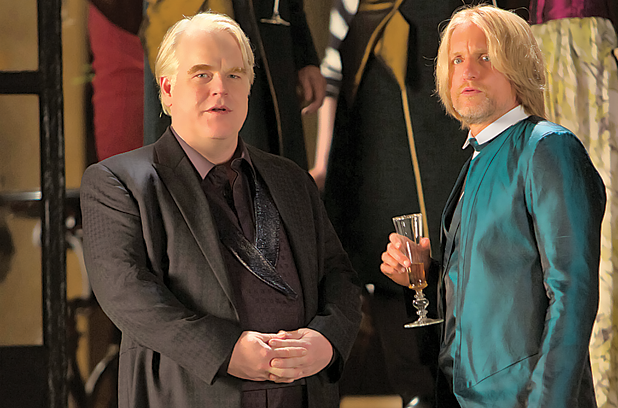
The news of Philip Seymour Hoffman’s sudden passing was met with a heartfelt outpouring of grief from fans and those who worked with him.
“Philip Seymour Hoffman was a singular talent and one of the most gifted actors of our generation,” Lionsgate, the studio behind the upcoming Hunger Games: Mockingjay Part 1 and 2, said in a written statement. “We’re very fortunate that he graced our Hunger Games family. Losing him in his prime is a tragedy, and we send our deepest condolences to Philip’s family.”
Hoffman played head -games-maker-turned-rebel leader Plutarch Heavensbee in the successful series. It is a pivotal role.
In the wake of the actor’s death, questions arose as to whether the uncompleted blockbusters-in-waiting would be completed in time for their scheduled November 21, 2014 for Part 1 and November 20, 2015 for Part 2 release dates.
Hollywood studios have handled the sudden death of cast members in many different ways. In some cases, films are even abandoned.
Production on Something’s Got to Give was shut down permanently after Marilyn Monroe’s August 1962 barbiturate overdose.
Dark Blood, River Phoenix’s final film, was put into cold storage when the young actor died before filming several crucial scenes. But both movies were eventually resurrected. The documentary Marilyn: The Final Days used footage from Monroe’s aborted film while Dark Blood sat for 19 years before being finished and shown at film festivals.
Father and son Bruce and Brandon Lee both died early, leaving behind unfinished films. The elder martial arts legend had completed 100 minutes of The Game of Death when a cerebral edema took his life.
Even more tragically, Brandon was killed on the set of The Crow in an accident involving a prop handgun.
Both films were salvaged with the use of stand-ins.
When Oliver Reed collapsed of a heart attack at a Malta pub after out-drinking a group of Royal Navy sailors, the editing crew of Gladiator replaced him digitally in the remaining scenes of the film.
More recently, Heath Ledger unexpectedly died during the production of The Imaginarium of Dr. Parnassus. He was replaced in the surreal story by three actors.
“I just started calling friends of Heath,” director Terry Gilliam said. “It’s as simple as that.”
“Johnny (Depp), Colin (Farrell) and Jude (Law) turned up. It was important that they were friends, because I wanted to keep it in the family. I wanted people who were close to him because, as Colin said when he was doing his part, he was channelling Heath part of the time, so Heath was very much still alive in some sense.
“Contractually, it was supposed to be a Terry Gilliam Film,” said Gilliam. “That’s what the lawyers said, but I said, ‘No way it’s going to be that. It’s going to be a film from Heath Ledger and friends.’ The cast sat around one night and that idea came up and I said, ‘This is it. Perfect. That’s how we do it.’”
As for the upcoming Hunger Games films, reports now confirm that Hoffman completed work on Part 1 and had just seven days left of shooting on Part 2.
His absence will not require any recasting, just a rewrite of one scene. And so Mockingjay Part 2 becomes the final film in Hoffman’s remarkable career.
“Words cannot convey the devastating loss we are all feeling right now. Philip was a wonderful person and an exceptional talent, and our hearts are breaking,” reads a statement released by The Hunger Games author Suzanne Collins, the films’ director Francis Lawrence, producers Nina Jacobson and Jon Kilik and star Jennifer Lawrence.
Based on the true story of Walt Disney’s (Tom Hanks) attempts to convince cantankerous “Mary Poppins” author P.L. Travers (Emma Tompson) to sell him the movie rights to the story, “Saving Mr. Banks” may be the only documented case of a writer holding an entire studio hostage.
Walt Disney made a promise to his daughter that would take twenty years to fulfill.
The young girl loved the magical nanny Mary Poppins, and wanted her father to bring her to life on the big screen. Trouble was, writer P.L. Travers wanted nothing to do with Disney.
“These books,” she said, “don’t lend themselves to chirping and prancing.” Fearing his adaptation of Poppins would careen “toward a happy ending like a kamikaze,” she tried to explain that Mary was the “enemy of whimsy and sentiment.”
Still, Disney wouldn’t take no for an answer and that’s where “Saving Mr. Banks” begins.
In a last ditch attempt to woo her, Disney flies Travers to Hollywood to work on a script with songwriters Richard and Robert Sherman (Jason Schwartzman and B. J. Novak) and screenwriter Don DaGradi (Bradley Whitford). The idea is to shape a movie that everyone can live with, but Travers, a pinched women whose withering remarks leave welts, is uncooperative.
(Side note: If she really was this contrary in real life, one has to wonder how the controlling Travers would have felt about having her actual life portrayed one screen.)
As the movie unfolds a psychological drama reveals itself in the form of flashbacks to Travers’s life as a child in 1907 Queensland, Australia. Turns out her contrary nature with the filmmakers comes from a deep seeded desire to protect the memory of her father, bank manager Travers Goff (Colin Farrell), a loveable scamp who drowned his inner torment with a sea of booze, and was the inspiration for the “Mary Poppins’s” patriarch, Mr. Banks.
“Saving Mr. Banks” is a serious movie about a whimsical movie. It also has darker underpinnings than you might imagine about the origins of “Mary Poppins.” The glossy Disney sheen casts its glow but the tone of the film is downbeat. Travers is a tough cookie, but heartbreakingly so. She’s a little girl lost, the product of an unhappy childhood that haunts her into adulthood.
It’s a character that could have been a flat line, a portrait of an unhappy woman with a perm-scowl and a bad attitude, but as Thompson allows her icy façade to melt Travers takes on dimensions. By the time we realize that Mary Poppins is not there to save the children but the troubled father the movie starts to pluck the heartstrings but because of Thompson’s skill it doesn’t feel manipulative.
Hanks is effortless as the folksy Disney. He hands in a quiet but lovingly rendered portrait with some real heart and lots of nuggets of wisdom.
Ditto Schwartzman and Novak, who breathe life into the creative process with enthusiastic performances and Paul Giamatti as limo driver Ralph. It’s a supporting role that doesn’t forward the story much but does add some nice light moments that seem to blunt some of Travers’s more deeply set psychological issues.
On the minus side “Saving Mr. Banks” hopscotches between time zones in Hollywood and Australia, a contrivance that slows both stories down, dividing the focus and keeping the audience off kilter for the entire running time. It’s a tough balance and the film doesn’t quite pull it off, but makes the uniformly excellent performances to cover the movie’s languid pacing.