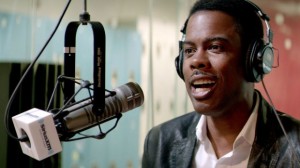
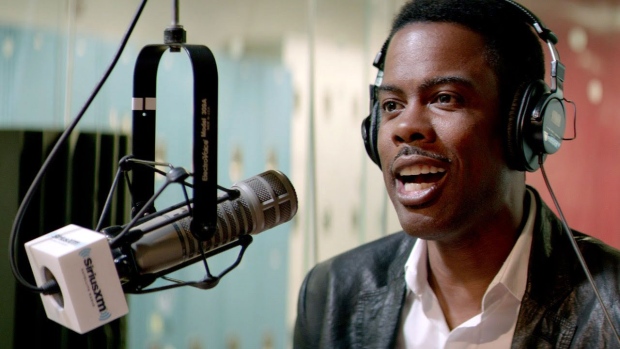
In “Top Five” comedic superstar Andre Allen (Chris Rock) faces a problem that has bedeviled many of his real life counterparts. “I don’t feel like being funny anymore,” he says, but will his audience be ready for his new, serious side?
Allen is at a make or break point in his career. After years of making popular comedies featuring a cop in a bear suit, his latest film, “Uprize,” is a serious drama about the slave revolt in Haiti and if it flops his agent (Kevin Hart) says, “we’re talking ‘Dancing With the Stars.’” Before he jets off to London to marry his reality star girlfriend (Gabrielle Union) he does the promotional circuit, including spending a day with New York Times reporter Chelsea Brown (Rosario Dawson). In the course of doing an in-depth profile on the actor Chelsea uncovers some uncomfortable truths about Allen and herself.
The top five things to know about “Top Five” is that it works as a comedy, as a romance, as a look at creative fulfillment, as a showcase for Chris Rock’s comedian friends and as a portrait of fame in the modern age. Rock, who also writes and directs, is firing on all cylinders in a personal film that crackles with energy and NSFW humour.
Rock and Dawson spark in long, uncut scenes of dialogue that echo “Before Midnight.” Flirting and sparring throughout the film, they are at the heart of the story but Rock has populated the movie with other interesting characters and cameos.
As Allen’s childhood friend and minder Silk, J.B. Smoove is smooth as silk and SNLer Leslie Jones is a showstopper but several supporting players threaten to walk away with the whole movie. Cedric the Entertainer lives up to his name, handing in an outrageous performance as a Houston comedy promoter and DMX, in a short cameo, can only be described as unhinged. Also, it’s almost worth the price of admission to see Jerry Seinfeld “makin’ it rain” in a strip club.
It’s a colourful collection of characters but Rock keeps the focus where it needs to be, on the chemistry between he and Dawson. The talk about everything from Charlie Chaplin—“The Grandmaster Flash of Ha Ha”—to whether or not the release of “Planet of the Apes” in linked to Martin Luther King’s assassination to Allen’s alcoholism. There is an easy air of authenticity between them that is imminently watchable.
Occasionally “Top Five” tries just a bit too hard to pluck the heartstrings—a scene between Allen and his father is a clunker, neither funny or effective—but Rock, unlike his alter ego Allen, is still clearly interested in making funny movies, and pulls it off with panache here.
Bill Murray became a big screen superstar on the back of loose-limbed performances in comedies like Caddyshack, Stripes and Ghostbusters. By 1984, however, he was tiring of playing the clown and looking to do something with a bit more edge.
When director John Byrum gave him a copy of W. Somerset Maugham’s 1944 novel The Razor’s Edge, Murray responded the very next day. Calling the director at 4 am he said, “This is Larry, Larry Darrell,” dropping the name of the novel’s main character, an enigmatic man on a quest for spiritual fulfillment.
The resulting film bombed, with Roger Ebert suggesting Murray played “the hero as if fate is a comedian and he is the straight man.” Of course Murray has gone on to become a credible and in demand dramatic actor, but the story of a comedian’s rocky leap from farce to drama still rings true today.
This weekend Chris Rock’s new comedy Top Five tells the story of Andre Allen, a fictional megastar trying to jump from silly comedies to Uprize, a serious drama about the slave revolt in Haiti.
Top Five is a new twist on an old story. Many comedians have tried to flick the switch from comedy to drama.
The late Robin Williams effortlessly hopped between genres. In 2002 alone he made three films, the lowbrow laffer Death to Smoochy, bookended by the psychodrama One Hour Photo and Christopher Nolan’s thriller Insomnia.
Will Ferrell, Steve Carell and Jonah Hill are best known for funny movies like Blades of Glory, The 40 Year-Old Virgin and Superbad, but each have stretched their dramatic muscles. Ferrell’s Stranger Than Fiction earned a good review from Roger Ebert who said Ferrell “has dramatic gifts to equal his comedic talent.” Carell’s new drama Foxcatcher looks poised to earn him notice at awards time and Jonah Hill is a two time Oscar nominee for heavyweights Moneyball and The Wolf of Wall Street.
Finally, think Jim Carrey and visions of talking butts and rubber-faced features come to mind but he made a serious run at being a serious actor. Perhaps he was pushed into more thoughtful work when his Batman Forever co-star Tommy Lee Jones told him, ‘I cannot sanction your buffoonery,” but whatever the case in movies like Man on the Moon, The Majestic and Eternal Sunshine of the Spotless Mind played it straight. “It’s going to be so hard to talk out of my ass after this,” he said when he won the Golden Globe for Best Actor award for The Truman Show, “but I’ll manage.”
The old saying, “They got bigger, but they didn’t grow up,” perfectly applies to this new Sandler and Company movie. It’s ninety minutes of middle-aged men, urination gags (too many to count) and cleavage shots. So while the actors may have matured (chronologically at least) the jokes haven’t.
Question is, Is it funny?
I didn’t really think so, although I have to say Shaquille O’Neal’s big-guy-Andre-the-Giant schick made me laugh.
“Grown Ups 2” picks up where the last movie left off. Lenny (Adam Sandler in his first ever sequel) has relocated his wife (Salma Hayek) and kids back to his hometown to be closer to friends and family. It’s the last day of school, and as the kids are packing up their books, their fathers (Kevin James, Chris Rock and David Spade) grapple with growing up, growing old and a gang of frat boys (lead by “Twilight’s” Taylor Lautner) who think the four old friends are WAY over the hill.
The movie comes equipped with an all-star comedy cast. In addition to the above-the-title actors there’s cameos by everyone from Colin Quinn, Tim Meadows, Georgia Engel and Steve Buscemi to name a few. In fact there may be more recognizable faces here than true laughs.
That’s not to say there are no laughs at all. James’ deadpan dumb kid who can’t add or spell is a funny running gag, Hayek does a pretty good Sofía Vergara imitation and O’Neal’s oversized antics are fun but for a movie about growing up it is all so juvenile. I didn’t expect a searing meditation on aging but I did think they might touch on the fact that they were growing old with more smarts than lines like, “I used to buy ten cases of beer for my parties, now I get ten cases of juice boxes.”
There’s nothing wrong with a good silly movie and “Grown Ups 2” had the chance to be just that, but I just wish it was silly AND about something other than a moose urinating on Sandler’s unsuspecting family, and by extension, the audience.
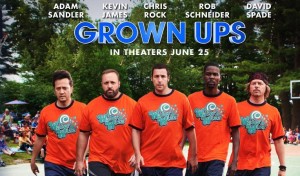
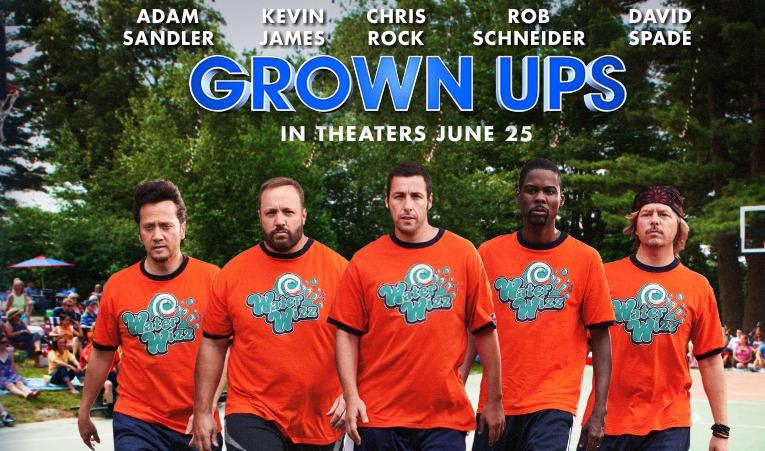
The once edgy comics of “Saturday Night Live” have gotten older and a little rounder in the middle but judging by their work in the ironically named “Grown Ups” they haven’t actually grown up.
Adam Sandler, Chris Rock, David Spade, Kevin James and Rob Schneider star in this celebration of arrested adolescence as five friend s reunited at the funeral of the beloved high school basketball coach. All married, except for the childlike Spade, they are at different stages of their lives. Schneider is a new age guru with a much older wife, Rock is a henpecked house husband, Sandler the hottest agent in Hollywood, with the hot wife (Salma Hayek) and James is the fat guy who falls down a lot. Like, a lot a lot. To spread their coach’s ashes they head to a cottage by a lake to spend the weekend, reconnect and endlessly trade good natured jibes. Over the course of the Fourth of July weekend their spoiled kids learn to live without cell phones, the boys play a dangerous game with a bow and arrow and ogle Schneider’s babelicious daughters.
“Grown Ups” isn’t quite rude enough for the Apatow crowd, but yet, not quite family friendly enough for grandma and the kids. For every outrageous joke about breast milk there’s a faux emotive or cutesy kid moment. The one liners come fast and furious—these guys only seem to be able to communicate by busting one another’s chops—but for the first hour there is precious little in the way of real jokes. It’s titter worthy rather than laugh out loud funny.
The guys have good chemistry, which they should, having spent years doing live television together, but it looks like the kind of movie that might have been more fun to make than to watch. These are (mostly) likeable actors but they’re not doing their most likeable work here. Sandler, for instance ruins a funny moment when his daughter says, “I want to get chocolate wasted!” with a snorting reaction that steps on the joke.
In the second hour Sandler is in heart warming mode but even this comes off as false. He spends the whole movie shrugging off his “Mr. Hollywood” nickname, but then in the climax—and I’ll be careful not to give anything away here—acts like a rich city slicker doing the local yokels a favor.
Luckily Sandler regular Steve Buscemi and the mangling of the name of a Canadian city provide some silly laughs.
“Grown Ups” is lowbrow with warm and fuzzy aspirations but misses the mark.
On the surface Good Hair sounds like the thinnest idea for a movie since Andy Warhol documented 24 hours in the life of the Empire State Building using only one static shot. Comedian Chris Rock’s look at the African-American hair industry could have been a bit on the gimmicky side but he and director Jeff Stilson wring every ounce of interest from the subject.
Inspired by his young daughter asking, “Daddy, how come I don’t have good hair?,” Rock uses gentle humor to examine the relationship black women have with their hair. He interviews everyone from teen star Raven-Symoné to author Maya Angelou to decipher why and how African-American women go to such lengths to modify their hair. They discuss weaves—hair extensions described as “the graduation of the wig”—and relaxer, a potion used to straighten hair for a more “European look” that several women refer to as “creamy crack” because of their dependence on the toxic balm.
It’s all rather light and breezy and would be kind of inconsequential if Rock and company hadn’t broadened the film to examine how hair care in the African-American community became a billion dollar industry and why more of the businesses that feed this industry aren’t black owned. “There’s something wrong when we can’t control something as basic as the hair on our heads,” says Al Sharpton (called the “Dalai Lama of Relaxer”).
Good Hair works because it cleverly uses a study of African-American hair culture as the gateway to examine larger issues of race without ever sounding preachy or pedantic. Is it perfect? No, a hair competition that bookends the film could easily have been shortened or cut altogether, but it’s worth the price of admission to watch Rock talk hair—male and female—with the folks at a barbershop or hear Ice-T talking about getting a mug shot taken while wearing curlers.
Ultimately Good Hair’s most important message is summed up by Al Sharpton who says, “The stuff on top of their heads isn’t as important as the stuff inside their heads.
You don’t have to be Dr. Phil to know that relationships are hard work. Everyone knows that to be really fulfilling they require a mix of respect, understanding, responsibility and maturity. Everyone, that is, except the characters in Chris Rock’s new comedy I Think I Love My Wife.
Inspired by a decades old French new wave film called Chloe in the Afternoon, Rock’s movie, which he produced, wrote, directed and stars in, follows the exploits of a henpecked investment banker who reconnects with a old friend. A really hot looking old friend who reminds him of a time before he settled down to raise a family. What starts out as harmless flirtation becomes a moral conundrum as heat develops between them.
Rock’s character continually says how happily married he is, but he sure doesn’t act like it. He hasn’t had sex with his wife since Boyz to Men were on the charts and his eye wanders more than a lost child at an amusement park. He’s bored, but instead of working on his relationship he looks outside for happiness.
It’s not exactly a new idea. The trouble with observational comedies about relationships is that we’ve pretty much seen it all before—10 and The Lady in Red got there first to name just a couple. The dynamics between men and women, married or not, have been explored every which way and there is very little new to say about them.
I Think In Love My Wife doesn’t break any new ground, in fact it might actually set back male-female relations a few steps. His banker is a stereotype, a weak willed man who can’t help but think that the grass is greener in the next bedroom, while his wife is a home decorating obsessed harridan who is treated as little more than a baby-making machine. As for the temptress, ably played by Kerry Washington, the only thing missing is a For Rent sign around her neck.
That’s not to say the movie isn’t funny. There are a fair amount of laughs here, but for someone who has been called “the funniest man in America” Rock is surprisingly flat. His performance here is the same one he gives in every movie. He’s a likeable performer, but every line he says sounds like he’s delivering the punchline in his stand-up act.
The best line in the movie isn’t delivered by Rock, but by character actor Edward Herrmann, best known for his portrayals of Franklin Roosevelt. He tells Rock, “You can lose a lot of money by chasing women, but you’ll never lose a lot of women chasing money.” Too bad Rock’s character doesn’t have more memorable lines like that one. Not quite as memorable, but fun to watch is Steve Buscemi as the sleaze ball co-worker so obsessed prone to having extra-martial affairs he keeps Viagara in his glove box right next to his Altoids.
I Think I Love My Wife isn’t as clever as it needs to be, or as funny, but it doesn’t redeem itself in its unexpected musical finale. If only the whole film was as funny and inventive as the last five minutes.
As summer blockbusters go, there is more invention and fun in the first twenty minutes of “Madagascar 3: Europe’s Most Wanted” than in all of “Battleship” and “Men in Black 3” combined.
As the movie opens Alex the lion (voiced by Ben Stiller), zebra Marty (Chris Rock), giraffe Melman (David Schwimmer) and hippo Gloria (Jada Pinkett Smith) are still stranded in the African savannah with dreams of returning to their New York home. Unfortunately their plane has been hijacked by some shady penguins, who are whooping it up on the French Rivera. The menagerie makes their way to Monte Carlo with an eye toward getting their plane back and heading home. There they attract the attention of Capt. Chantal Dubois (Frances McDormand) a psychotic animal-control officer determined to add Alex’s head to her trophy wall.
To escape from her grip they join an America-bound circus featuring jaguar Gia (Jessica Chastain) sea lion Stefano (Martin Short) and Siberian tiger Vitaly (Bryan Cranston). The animal performers have seen better days, and while they keep Alex and friends safe (for the time being) from the clutches of Dubois, some changes will have to be made if this circus will be able to cut it in America.
“Madagascar” series has ever been my favorite animated franchise. I found the first two films pleasant enough, but not memorable—with the exception of the wisecracking penguins. They are bright, colorful films with good messages but they didn’t have the oomph of Pixar, or even other Dreamworks animations like “How to Train Your Dragon.”
Until now.
The addition of writer Noah “Squid and the Whale” Baumbach has brought with it a sensibility and humor missing from the other films. It’s rare that a franchise improves as it hits its third installment, but “Madagascar” has.
The new film is funny—it’s worth the price of admission to hear Chris Rock’s Polka Dot Afro Circus song—surreal and literally bursts off the screen in an explosion of neon colored 3-D. It’s frenetic, but imaginative with gags hidden throughout and several show-stopping action and musical sequences.
The penguins still steal the show, but this time around the script and look of the film give them a run for their money.
You had to see this one coming. Any time a movie grosses 500 million dollars a sequel can’t be far behind. So from the same company that brought us Shrek 2 and 3 and the upcoming Shrek 4-D comes Madagascar Escape 2 Africa which sees all the original Central Park Zoo creatures—Alex the Lion (Ben Stiller), Marty the Zebra (Chris Rock), Melman the Giraffe (David Schwimmer), Gloria the Hippo (Jada Pinkett Smith) and, of course, the penguins take another road trip.
As we rejoin the New York-raised zoo animals they are still marooned in Madagascar. When the penguins find an old plane it looks like they might be able to travel back home to America. Unfortunately the plane crash lands far short of their target. This time they end up stranded in Africa, “our ancestral crib,” as Marty the Zebra calls it. They soon discover that despite long lost relatives and some unexpected romance that the African jungle is a much different place than the concrete jungle they’re used to.
Madagascar Escape 2 Africa isn’t a bad kid’s flick, but it suffers from the usual symptoms of sequelitis. It isn’t quite as funny as the first movie, the story feels padded, even at a compact 89 minutes and the situation seems a bit too familiar. Not that any of that will matter to the little ones once they’ve seen the fun supporting cast.
The leads, save for Chris Rock’s hyperactive zebra, are rather bland, so luckily they are supported by lively and colorful secondary characters. Sacha Baron Cohen of Borat fame plays King Julien, the dramatic lemur monarch. His slapstick antics should amuse kids but his sly double entendres are aimed directly at adults. He has a funny, and possibly slightly inappropriate, line about almonds and a silver platter that’ll fly high over the tot’s heads but wake up their parents. In fact, the movie is peppered with lines referring to Darwinism and union trade talks that are clearly calculated to widen the movie’s appeal to all members of the family.
Kids will like the lemur, but they will love the penguins. Penguins are the new dogs. Not since the heyday of dog movies like Benji and Lassie has one species won over the hearts of so many. March of the Penguins was a left field hit a few years ago and an R-rated parody of that movie, Farce of the Penguins, soon followed. The little furry birds have also appeared in Happy Feet, the 3-2-1 Penguins series and even something called Penguins Behind Bars. Everybody loves penguins, and in Madagascar Escape 2 Africa their gangster shenanigans are the highlight of the movie. Next—a third Madagascar movie is already in the works—hopefully Dreamworks will pull back on the bland Alex the Lion character and focus on the penguins.
Madagascar Escape 2 Africa is a family friendly movie with slapstick for the kids and slightly more sophisticated jokes for the adults.
Family functions can be intense at the best of times. A Christmas dinner can turn into a theatre of war over burnt gravy; a family reunion, a battleground of hurt feelings and resentment. Probably no other family event is as highly charged as a funeral. Emotions are heightened and everybody is on edge. Add to that charged atmosphere a boyfriend who has been accidentally dosed with LSD, a gay blackmailer, and a grumpy uncle and you have “Death at a Funeral,” a new all star farce starring Chris Rock and Tracy Morgan.
Based on a 2007 British film of the same name “Death of a Funeral” begins on the day of Aaron (Rock) and Ryan (Martin Lawrence) father’s funeral. Opting for a home funeral, every family member has been invited. They include the crusty uncles Russell and Duncan (Danny Glover and Ron Glass ), a soon to be married couple Elaine and Oscar (Zoe Saldana and James Marsden) and family friends Norman (Tracy Morgan) and Derek (Luke Wilson). Also attending is Frank (Peter Dinklage, reprising his role from the original) an uninvited guest with a secret about Aaron and Ryan’s father.
“Death at a Funeral” is a farce. There are lots of slamming doors, outrageous situations, a mysterious rash, a hallucinating guest and a coffin that seems unable to contain the dead body within. If you don’t like one joke, stay with it, there’ll be fifteen more in the next minute-and-a-half. They come fast and furious and while only about half of them land it’s enough to make “Death at a Funeral” worth a look.
Chris Rock as the centerpiece of all the action. He’s the comedic anchor around which all the action spins but he’s not just the film’s straight man. He sets up and knocks down joke after joke—including one hilarious Screamin’ Jay Hawkins reference—all the while adding some warmth to the rare non-comedic scenes.
Also strong is James Marsden who shows off his comic chops in the unforgiving role as the high guy. It’s a “Reefer Madness” portrayal of someone in the depths of an acid trip—if you want realism rent “Requiem for a Dream”—but it is funny watching him try and interact with the other guests at the funeral while out of his mind.
The rest of the ensemble cast flits in and out of the action with varying degrees of success. If the idea of Tracy Morgan saying, “I’m gonna forget about the poop in my mouth,” amuses you, then his role is successful (if a little less sophisticated than the material he spouts every week on “30 Rock”) and the great Danny Glover (who once played Nelson Mandela) has little to do other than reprise his stuck on a toilet gag from “Lethal Weapon 2.”
Much of “Death at a Funeral” is in very bad taste but despite a hint of homophobia delivers some solid laughs.