“The much-anticipated “Wicked: For Good,” based on act two of the 2003 Broadway musical by Stephen Schwartz and Winnie Holzman, picks up the story years after the events of last year’s “Wicked.”
“Elphaba Thropp (Cynthia Erivo), the Wicked Witch of the West, is now a fugitive who works tirelessly to free Oz’s silenced talking animals and expose the fraudulent activities of the not so Wonderful Wizard of Oz (Jeff Goldblum). “Our Wizard lies,” she skywrites in bold letters above Emerald City for all to see…”
SYNOPSIS: In “Wicked: For Good,” Elphaba Thropp (Cynthia Erivo), a.k.a. the Wicked Witch of the West and sorority-girl-turned-ruler Glinda the Good (Ariana Grande), are subjected to a series of events that tests the boundaries of their relationship.
CAST: Cynthia Erivo, Ariana Grande, Jonathan Bailey, Ethan Slater, Bowen Yang, Marissa Bode, Michelle Yeoh, Jeff Goldblum. Directed by John M. Chu.
REVIEW: “Wicked: For Good,” based on act two of the 2003 Broadway musical by Stephen Schwartz and Winnie Holzman, picks up the story years after the events of last year’s “Wicked.”
Elphaba Thropp (Cynthia Erivo), the Wicked Witch of the West, is now a fugitive who works tirelessly to free Oz’s silenced talking animals and expose the fraudulent activities of the not so Wonderful Wizard of Oz (Jeff Goldblum). “Our Wizard lies,” she skywrites in bold letters above Emerald City for all to see.
Her erstwhile friend Glinda the Good (Ariana Grande) is now a paragon of Goodness who floats around in a giant mechanized bubble. She is a walking, talking propaganda tool controlled by The Wizard and Madame Morrible (Michelle Yeoh) to convince Emerald City citizens that all is well under The Wizard’s rule.
As her wedding to the handsome Prince Fiyero (Jonathan Bailey) approaches, Glinda attempts to put things right between Elphaba and The Wizard, only to deepen the rift between the Wicked Witch and the ruling class of Oz, including Glinda.
As things heat up between Elphaba and Glinda, a famous foursome—Dorothy and Co.—arrive in Oz, heralding troubled times that can only be healed by the power of friendship. “We can’t let good be just a word,” says Elphaba. “It has to mean something.”
With some new songs like, “No Place Like Home” and “The Girl in the Bubble,” “Wicked: For Good” is a heart wrenching conclusion to the story, powered by impressive performances and emotional depth.
A darker, more serious film that the original, “For Good” explores themes of friendship, identity, and sacrifice through big, booming Broadway tunes. Less visually crowded than part one—it’s still baroque; art directed from here to Oz and back—but there is more unused space which allows the performances to speak for themselves without feeling crowded by the ornamental excess of the first film. The restraint places the focus on the songs and performers, trusting the material to deliver the story’s punch with fewer distractions.
Erivo and Grande share great on-screen chemistry and have the chops to elevate songs like “For Good” to show-stopper status. They are the movie’s secret sauce, and their story of friendship and sacrifice coupled with their supersonic vocals remain the film’s most compelling aspects.
“Wicked: For Good” is not a standalone movie. You’d likely get lost in the Ozian forest without the background story from last year’s “Wicked,” but those willing to invest five hours total into Elphaba and Glinda’s relationship will be rewarded with beautiful performances woven into an uplifting story of hope, resilience and acceptance.
SYNOPSIS: In “Jay Kelly,” a new comedy-drama in theatres now before moving to Netflix on December 5, George Clooney plays a coddled movie star whose growing discomfort with his comfortable existence causes major changes in his life and the lives of those around him. “Are you running to something or from something,” asks Jay Kelly’s manager Ron (Adam Sandler). “Yes,” says Kelly (Clooney).
CAST: George Clooney, Adam Sandler, Laura Dern, Billy Crudup, Emily Mortimer. Directed by Noah Baumbach.
REVIEW: A showcase for George Clooney and Adam Sandler, “Jay Kelly” is a comedy about the cost of fame, tinged with regret.
When we first meet Jay Kelly (George Clooney) he’s a major movie star—think George Clooney—wrapping up one project before starting another in the next week. He’s an on-the-go-guy, surrounded by an entourage, including longtime manager Ron Sukenick (Adam Sandler), publicist Liz (Laura Dern) and hairdresser Candy (Emily Mortimer), who fawn over him, catering to his every whim.
When his mentor passes away, at the funeral he reconnects with Timothy (Billy Crudup), an old friend from acting school who forces Jay to reassess his fame, his work, his entire life. “Is there a person in there?” Timothy asks. “Maybe you don’t actually exist.”
Rocked by the experience, he drops out of his next film and embarks on a journey of self-discovery to Europe, alongside Ron and the staff who have helped erect the wall between him and the real world.
“Jay Kelly” is a sharply written show business satire, but don’t expect “Sunset Boulevard,” “Tropic Thunder” or “Network.” The script, by Emily Mortimer and Noah Baumbach, does poke gentle fun at the usual Tinsel Town excesses, but this is more a cautionary tale of the price of success. “All my memories are movies,” Jay says ruefully, reflecting on his isolation from friends and family.
He’s loved by millions, but isn’t close with his daughters, Daisy (Grace Edwards) and Jessica (Riley Keough), and his friends are mostly staff. He has a movie star smile, but behind the nice guy façade, he can be cruelly dismissive of those who work with him. “You’re my friend who takes 15% of my salary,” he says to Ron, his long serving manager.
“We are not to him what he is to us,” says Liz, his publicist of thirty years.
Clooney nails the sorrow of a man who has it all, except for the things that really matter. Sauve, yet sad, he chose work and his career over all else and now searches for meaning in the relationships that sustained him for decades, even though he always put himself and ambitions first. Does Jay’s world mean anything when the price was not being able to spend meaningful time with his friends and family?
It’s not a Hollywood noir; it’s a Hollywood Melancholy.
Sandler displays his dramatic chops as the eager, puppy dog manager Ron. After thirty years of having his life upended by Jay’s every fancy, it finally dawns on his that the relationship is more one sided than he imagined. Sandler is by times in control, by times vulnerable, but he’s the glue that not only keeps Jay’s like together, but the movie as well.
“Jay Kelly” is slightly overlong, but in its exploration of what is important in life, and not just the life of a movie star, but all lives, it expertly rides the line between funny and heartbreak.
SYNOPSIS: In “Rental Family,” a new dramedy now playing in theatres, Brendan Fraser is a lonely, Tokyo based professional stand-in, portraying friends or family members at funerals and social gatherings, who discovers the meaning of true connection through his work.
CAST: Brendan Fraser, Takehiro Hira, Mari Yamamoto, Shannon Mahina Gorman, Akira Emoto. Directed by Hikari.
REVIEW: Low key and heartfelt, “Rental Family” succeeds because of star Brendan Fraser’s innate ability to portray an expressive soulfulness without slipping into performative mawkishness.
In a tender performance, Brendan Fraser plays Phillip Vandarploeug, an American actor living in Japan. His shot at fame, playing a superhero in a toothpaste commercial, was years ago and now he struggles to get by. When another acting audition goes south, he takes a job with Shinji (Takehiro Hira) at a company called Rental Family whose perky slogan reads, “Happiness Tailored to You!”
The gig sounds simple—provide commitment free companionship, stand-in for a long-lost relatives at funerals, essentially be a rent-a-relative in an era of alienation—but over time Phillip finds himself using less of his acting techniques and giving more of himself to the clients who have hired him for faux emotion.
“Rental Family” is a gentle movie with a simple message. Phillip learns the importance of being there for another person; how companionship, finding your logical family, benefits both parties. It’s not a new idea, but the unique setting and circumstance prevents the episodic story from slipping too far into fish-out-of-water cliché.
As he did in “The Whale,” Brendan Fraser brings quiet empathy to an introspective character who feels disconnection from society. The situations are different, but both characters create bonds with others to self-heal. Phillip is awkward, but Fraser goes deep, turning him into a nuanced character, more defined by the character’s inner life than his physical self. It’s a warm, respectful performance that anchors the film in tenderness.
He’s ably supported by Mari Yamamoto as a fiercely independent, morally conflicted Rental Family employee, Takehiro Hira as the unflappable agency owner and Akira Emoto whose moving work as a retired actor with a failing memory provides many of the film’s poignant moments.
“Rental Family” is a quiet comedy, but with a loud, beating heart.
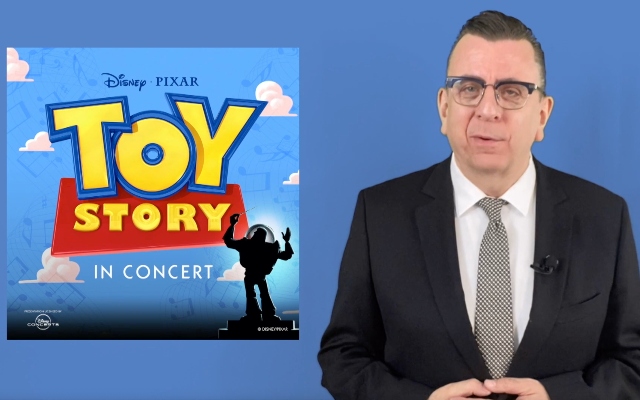
I’ll be hosting “Toy Story in Concert,” the animated classic on the big screen in its entirety, accompanied by a live orchestra performing composer Randy Newman’s vibrant score note for note on Friday, November 21 – 7:30 pm and Saturday, November 22 – 2 pm at Meridian Hall.
I appear in a CTV National News report by Sarah Plowman on Cineplex’s latest push to draw more people to the movies as they introduce ‘Monday Surprise Premieres.’
I join the CTV NewsChannel to talk about the big movies from the weekend, including Edgar Wright’s “The Running Man,” rhe magical thieves of “Now You See Me: Now You Don’t,” the Oscar worthy “Sentimental Value” and the animated “In Your Dreams.”
SYNOPSIS: Based on the novel “The Running Man” by Stephen King, which was published under the pseudonym Richard Bachman, the movie of the same name sees the unemployed Ben Richards (Glen Powell), desperate for cash to save his sick daughter, sign up for a “Squid Game” style show in which contestants must stay alive for 30 days while being pursued by “hunters” hired to kill them.
CAST: Glen Powell, William H. Macy, Lee Pace, Michael Cera, Emilia Jones, Daniel Ezra, Jayme Lawson, Colman Domingo, and Josh Brolin. Directed by Edgar Wright.
REVIEW: A survival thriller that puts a human face on the story’s themes of economic coercion, personal sacrifice and class Inequality, “The Running Man” is slick, high-energy satire with grim messages about media manipulation, exploitation and the chasm between the haves and the have nots.
Set in the near future where the reality show features Runners hunted by Hunters, “The Running Man” sees Ben Richards (Glen Powell), a desperate father convinced by the show’s cartoonishly evil producer Dan Killian (Josh Brolin) to enter the game to win a cash jackpot. “Rules are simple,” says Killian. “Survive thirty days with the entire nation hunting you down and get your family out of slum-side for good.”
Like a bloodthirsty episode of “Survivor,” the chaotic show within the movie is television’s highest rated program, but instead of getting voted off the island, you get voted off the mortal coil. “HUNT. HIM. DOWN!” shouts show host Bobby Thompson (Colman Domingo).
With a mix of paternal love and sheer will, Richards becomes a fan favorite; a viral star turned folk hero.
“The Running Man” begins with a strong premise; a father pushed to extremes to do what’s best for his family. Richards is an everyman—except that most desperate dads don’t have Powell’s charisma, and a six-pack that would make Adonis envious—thrust into a life-or-death situation. The situation is extreme, but the motivation is relatable, grounding the movie in an all-too-real world of an under-employed family unable to afford medical attention.
It’s a potent starting point, a dystopian nightmare with real world resonance. It’s when the movie puts Richards at the end of a gun barrel, on the run for his life, that “The Running Man” loses its grounding by succumbing to bombast. As the title suggests, the film does laps around the movie’s motifs, for the most part preferring to entertain the eye with high octane visuals than engage the brain, before circling back to the sociopolitical issues that inspired the story in the movie’s rushed finale.
It’s frenetic and frantic but lacks the verve that Wright usually brings to his films.
Woven into the film’s fabric are some interesting diversions. As anti-government activist Elton, Michael Cera brings a sense of anarchy and awkwardness that gives “The Running Man” a jolt in the film’s mid-section. It’s an exhilarating segment that provides the mix of comedy and action we expect from Wright’s caffeinated filmmaking.
Less successful is the introduction of one percenter Amelia Williams (Emilia Jones). An avatar of wealth and privilege more than an actual character, she’s a living metaphor of elite detachment, and becomes the blunt instrument Wright uses to hammer home his commentary on the economic divide in the film’s final section.
When Stephen King wrote “The Running Man” in 1982 his musings on corporate control, media manipulation and the economic gap felt dystopian. Times have changed, and now the most upsettingly dystopian thing about the movie might be how it depicts the future popularity of reality television.