I join the CTV NewsChannel to talk about the big movies from the weekend, including Edgar Wright’s “The Running Man,” rhe magical thieves of “Now You See Me: Now You Don’t,” the Oscar worthy “Sentimental Value” and the animated “In Your Dreams.”
SYNOPSIS: Based on the novel “The Running Man” by Stephen King, which was published under the pseudonym Richard Bachman, the movie of the same name sees the unemployed Ben Richards (Glen Powell), desperate for cash to save his sick daughter, sign up for a “Squid Game” style show in which contestants must stay alive for 30 days while being pursued by “hunters” hired to kill them.
CAST: Glen Powell, William H. Macy, Lee Pace, Michael Cera, Emilia Jones, Daniel Ezra, Jayme Lawson, Colman Domingo, and Josh Brolin. Directed by Edgar Wright.
REVIEW: A survival thriller that puts a human face on the story’s themes of economic coercion, personal sacrifice and class Inequality, “The Running Man” is slick, high-energy satire with grim messages about media manipulation, exploitation and the chasm between the haves and the have nots.
Set in the near future where the reality show features Runners hunted by Hunters, “The Running Man” sees Ben Richards (Glen Powell), a desperate father convinced by the show’s cartoonishly evil producer Dan Killian (Josh Brolin) to enter the game to win a cash jackpot. “Rules are simple,” says Killian. “Survive thirty days with the entire nation hunting you down and get your family out of slum-side for good.”
Like a bloodthirsty episode of “Survivor,” the chaotic show within the movie is television’s highest rated program, but instead of getting voted off the island, you get voted off the mortal coil. “HUNT. HIM. DOWN!” shouts show host Bobby Thompson (Colman Domingo).
With a mix of paternal love and sheer will, Richards becomes a fan favorite; a viral star turned folk hero.
“The Running Man” begins with a strong premise; a father pushed to extremes to do what’s best for his family. Richards is an everyman—except that most desperate dads don’t have Powell’s charisma, and a six-pack that would make Adonis envious—thrust into a life-or-death situation. The situation is extreme, but the motivation is relatable, grounding the movie in an all-too-real world of an under-employed family unable to afford medical attention.
It’s a potent starting point, a dystopian nightmare with real world resonance. It’s when the movie puts Richards at the end of a gun barrel, on the run for his life, that “The Running Man” loses its grounding by succumbing to bombast. As the title suggests, the film does laps around the movie’s motifs, for the most part preferring to entertain the eye with high octane visuals than engage the brain, before circling back to the sociopolitical issues that inspired the story in the movie’s rushed finale.
It’s frenetic and frantic but lacks the verve that Wright usually brings to his films.
Woven into the film’s fabric are some interesting diversions. As anti-government activist Elton, Michael Cera brings a sense of anarchy and awkwardness that gives “The Running Man” a jolt in the film’s mid-section. It’s an exhilarating segment that provides the mix of comedy and action we expect from Wright’s caffeinated filmmaking.
Less successful is the introduction of one percenter Amelia Williams (Emilia Jones). An avatar of wealth and privilege more than an actual character, she’s a living metaphor of elite detachment, and becomes the blunt instrument Wright uses to hammer home his commentary on the economic divide in the film’s final section.
When Stephen King wrote “The Running Man” in 1982 his musings on corporate control, media manipulation and the economic gap felt dystopian. Times have changed, and now the most upsettingly dystopian thing about the movie might be how it depicts the future popularity of reality television.
Since the release of the first Hunger Games novel in 2008, literary sleuths have picked it apart, searching for connections to other books and films.
The scrutiny increased when the first film in the tetralogy set records for the biggest opening weekend for a non-sequel in 2012, and continues unabated with the release of this weekend’s The Hunger Games: Mockingjay, Part 1.
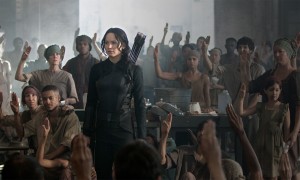
Based on Suzanne Collins’s mega-successful series, the movies are set in a dystopian world ruled by a fascist-style president (Donald Sutherland) who presides over The Hunger Games, a televised battle-to-the-death between 24 young players, two from each of the country’s districts, including Katniss Everdeen (Jennifer Lawrence) and Peeta Mellark (Josh Hutcherson).
The series draws on things we’ve seen before, in everything from the human sacrifices of Greek mythology or Survivor-style television shows to news stories of government corruption to create a world with its own rules, style and customs.
The most often-cited influence is Battle Royale, a 2000 Japanese movie based on a book by Koushun Takami. Like The Hunger Games, it’s a story of school kids in a televised government-sanctioned death match.
Battle Royale’s DVD box set even included a quote from a critic suggesting there’d be no Hunger Games without the Japanese film. “This is the movie that started it all,” it reads.
Hunger fans were quick to point out differences in the two films. The Japanese movie is about survival, they said, while Collins wrote about revolution. The author revealed her main influences were reality television and the Iraq war.
“I had never heard of that book or that author until my book was turned in,” she told the New York Times.
It’s worth noting that the idea of humans being preyed upon for the entertainment of the upper classes dates back at least as far as 1932’s The Most Dangerous Game. The story of a big-game hunter who tracks humans for sport on an isolated island is based on a Richard Connell short story that also loosely inspired episodes of everything from Gilligan’s Island to Lost in Space. Since then, Norman Jewison’s Rollerball, Roger Corman’s Deathrace 2000 (and its 2008 Jason Statham remake) and The Running Man have mined similar territory.
As for the author who wrote Battle Royale, he gave ABC News a very diplomatic answer when asked about the similarities between the two stories. “I think every novel has something to offer,” he said. “If readers find value in either book, that’s all an author can ask for.”