SYNOPSIS: In “Sinners,” a new Southern Gothic now playing in theatres, Michael B. Jordan stars in a dual role as twin brothers Smoke and Stack, World War I veterans who came of age as part of Al Capone’s gang in Chicago. With a bag of Capone cash, some illegal prohibition hootch and a hope for a new beginning, they buy an old sawmill in their Southern, Jim Crow-segregated hometown with the intention of opening a juke joint. When Remmick (Jack O’Connell) shows up at their door, they are exposed to an evil like they’ve never experienced before. “You keep dancing with the devil,” says a preacher, “one day he’s going to follow you home.”
CAST: Michael B. Jordan, Hailee Steinfeld, Miles Caton, Jack O’Connell, Wunmi Mosaku, Jayme Lawson, Omar Miller, Li Jun Li, and Delroy Lindo. Directed by Ryan Coogler.
REVIEW: Rich in detail, ambitious in its themes and knee deep in blood, “Sinners” defies easy categorization. Director Ryan Coogler calls the movie mashup “genre fluid,” and even that clever descriptor doesn’t come close to capturing the width and breadth of the story.
What begins as a portrait of brotherly ambition in the Jim Crow South broadens to become a story of building community, the spiritual impact of music and racism filtered through a Southern Gothic lens. That it is also a kickass vampire flick, with overtones of African folklore, doesn’t feel like an overstep. Great speculative fiction is never only about the scares or the monsters; they are comments on the society in which they are set. Coogler’s vampires are bloodthirsty predators hell bent on consuming the cultural identity of Smoke, Stack and their Juke Joint customers.
The film’s climax, (SLIGHT SPOILER) a battle between humans and vampires isn’t simply a blood splattered way to bring the movie to a close. In context, it’s a fight for survival, both physical and cultural. The vampires are, of course, supernatural creatures, but the threat they represent feels all too human.
It’s heady stuff wrapped up in an entertaining package. Coogler regular Michael B. Jordan—their previous films include “Fruitvale Station,” “Creed,” “Black Panther” and “Black Panther: Wakanda Forever”—impresses in the dual role of twin brothers. As Smoke he’s hardened, quick to temper. His take on Stack reveals a softer, more hopeful side. In totality it’s seamless work that doesn’t feel like a gimmick.
“Sinners” is ambitious, audacious and while it may rely a bit too heavily on flashbacks and feels like it goes a step or two too far to find its resolution, the boldness of its filmmaking delivers on both the pulpy and poignant aspects of the story.
SYNOPSIS: “One to One: John & Yoko,” a new documentary now playing on IMAX and in theatres, is a look at New York City in the early 1970s through the actions of two of its most famous residents, John Lennon and Yoko Ono.
CAST: John Lennon, Yoko Ono, Richard Nixon, Jerry Rubin, Alan Ginsberg, George McGovern. Co-directed by Kevin Macdonald and Sam Rice-Edwards.
REVIEW: “One to One: John & Yoko” isn’t a traditional documentary. There is plenty of archival footage, but no interviews or narration. Instead, it’s a feel. Through never-before-seen concert and news footage co-directors Kevin Macdonald and Sam Rice-Edwards create an immersive look at activism in the early 1970s, seen through the lens of John Lennon and Yoko Ono’s political engagement.
Before John and Yoko moved to the Upper West Side of Manhattan and their famous address at The Dakota Building, they lived in a small two-room apartment at 105 Bank Street in Greenwich Village, rented from Joe Butler of the Lovin’ Spoonful.Tucked away on a cobblestone street, for eighteen months (until a home invasion prompted a move to the more secure Dakota), roughly 1971 to 1973, the apartment became a counterculture hub for musicians and anti-Vietnam War activists.
While Lennon and Ono were consorting with the likes of Yippie leader Jerry Rubin, Black Panther co-founder Bobby Seale and “Howl” poet Allen Ginsberg, they also attracted the attention of FBI head J. Edgar Hoover and the Immigration and Naturalization Service who ordered the musician’s deportation based on alleged Communist ties.
It’s this tumultuous time that Macdonald and Rice-Edwards explore in a film that feels like flipping through the television channels of the day. It’s a style, Macdonald says, inspired by Lennon’s obsessive television watching in the tiny apartment. Lennon absorbed pop and political culture through TV and “One to One: John & Yoko” replicates the feeling of watching the tube with someone with an itchy finger on the remote.
Newly restored footage, with remastered audio overseen by Sean Ono Lennon, of Lennon’s only full-length, post-Beatles concert is intercut with talk show appearance, home movies and news accounts to create a sense of time and place.
Most revealing are phone calls recorded by John and Yoko. During their surveillance by the Feds the couple began recording all their phone calls just in case they needed them as evidence in a court case. The concert footage, which is spectacular, grabs the eye, but it is the phone calls that provide the most fodder for Berratle fans.
From the heartfelt—Yoko talking about the break-up of the Beatles—to the bizarre—there’s a lot of talk of collecting house flies for an art installation—to the political—Lennon floating an idea to raise bail money through ticket sales—and the personal—Lennon’s attempts to get Bob Dylan “garbologist” A.J. Weberman to stop sifting through the folk icon’s garbage—the calls provide a close-up-and-personal portrait of John and Yoko at that time.
“One To One: John & Yoko” captures the aura of a chaotic time for the couple, both personally and professionally, as the couple struggled to find their place in a complicated world. “OK, so flower power didn’t work,” Lennon says. “So what? We start again.”
Abstract in its presentation, but immersive in its effect, it’s a must for Beatle completists who will get a charge out of “new” versions of “Come Together,” “Instant Karma” and “Hound Dog,” while poli-sci students who just might see parallels between the unrest of the 1970s and today.
SYNOPSIS: In “The Wedding Baquet,” a new romantic dramedy starring Bowen Yang and Lily Gladstone, and now playing in theatres, two couples come up with an unusual arrangement. Lee (Lily Gladstone) and Angela (Kelly Marie Tran) are trying to have a baby but can’t afford another round of IVF treatment. Their landlords, Min (Han Gi-chan), whose student visa is set to expire, and Chris (Bowen Yang), his commitment-phobe boyfriend, are having a rocky patch. Min wants to get married, but Chris is hesitant. In exchange for the money for more IVF Angela agrees to a marriage of convenience with Min, who’ll then get his Green Card. The plan is complicated when Min’s rich grandmother (“Minari” Oscar-winner Youn Yuh-jung), who doesn’t know Min is gay, unexpectedly arrives for a visit. “If my grandmother thinks your marrying me for money,” Moin says, “she’ll blow the whole thing up.”
CAST: Bowen Yang, Lily Gladstone, Kelly Marie Tran, Han Gi-chan, Joan Chen, Youn Yuh-jung. Directed by Andrew Ahn who co-wrote the script with James Schamus.
REVIEW: A modern update of Ang Lee’s 1993 Oscar-nominated film of the same name, the new movie features all the standard rom com flourishes. There’s the usual miscommunications, physical comedy and romantic antics but they are tempered by emotion that elevates “The Wedding Banquet” from rom com to, if not drama, at least a low-key dramedy, heavy on the poignant moments.
The tonal switches are made believable by a talented cast. The scenes between Lee and Angela, Lily Gladstone and Kelly Marie Tran, have a warm, lived-in feel that reveals their deep connection. Ditto the connection between Angela and her mother (Joan Chen). It’s a shame we don’t get more scenes of the dynamic between mother and daughter.
Best of all is a late movie scene between Min and his grandmother, played by Youn Yuh-jung. Youn brings warmth, humour and understanding to a scene that could easily have slipped into melodrama.
“The Wedding Banquet” nicely updates the original’s (which Schamus co-wrote) take on the modern vs. the traditional and does so with a great deal of heart. It winds up with a rushed ending, but rom coms, even ones with a serious edge, are never about the destination. We know how these movies will end. They’re about the journey and “The Wedding Banquet” is a fun ride.
SYNOPSIS: “Queen of the Ring,” a new sports drama now playing on theatres, is the (mostly) true story of Mildred Burke, a female wrestler who defied skeptics to become a champion when all-girl wrestling was banned in most of America. “I can’t sing and I can’t dance,” she says, “but I can tell a story and beat some ass.”
CAST: Emily Bett Rickards, Josh Lucas, Tyler Posey, Francesca Eastwood, Marie Avgeropoulos, Deborah Ann Woll, Cara Buono, Adam Demos, Martin Kove, Kelli Berglund, Damaris Lewis, Gavin Casalegno, Walton Goggins, Mildred Burke. Directed by Ash Avildsen.
REVIEW: Mildred Burke (Canadian actor Emily Bett Rickards) is a pioneer in wrestling history. A three-time women’s world champion she was the queen of the ring and enjoyed a career that was anything but standard. It’s a shame then, that her biopic, “Queen of the Ring” is such a straightforward affair.
Director Ash Avildsen (son of “Rocky” director John G. Avildsen), working from his own script, never met an inspirational moment he couldn’t heighten. According to “Queen of the Ring” Burke’s every move, in and out of the ring, is worthy of a fist pump and some stirring music on the soundtrack. There are no peaks and valleys. Even when she faces hardship there’s just peaks, which blunts the effectiveness of the film as a hero’s story.
The result is a cartoonish portrait that doesn’t feel authentic.
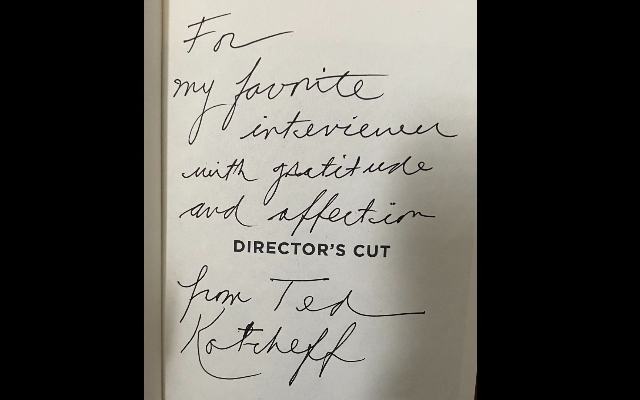
Sad to hear the news of Ted Kotcheff’s passing. Had many great conversations with him over the years. He always had the best stories. Have a listen to one of our chats HERE (starts at 30:47) Rest in Power.
I present a list of Canadian sports movies guaranteed to light the lamp! From airborne bloody Chiclets and a hockey icon to the story of Saul Indian Horse and an elegy for a man who spent much of his career earning $25 a game, I have a look at Canada’s favorite game on the big screen.
On the Saturday April 12, 2025 edition of The Richard Crouse Show we’ll meet artist and musician Sean Ono Lennon. A new documentary called “One to One: John & Yoko,” is a look at New York City in the early 1970s through the actions of two of its most famous residents, John Lennon and Yoko Ono. Newly restored footage, with remastered audio overseen by Sean Ono Lennon, of John Lennon’s only full-length, post-Beatles concert is intercut with talk show appearance, home movies and news accounts to create a sense of time and place. In this conversation we talk about the film and how, for Sean, working on it is “almost like getting more time with my dad.”
Then, we’ll meet the creative team behind an intense new film called “Warfare.” Based on ex-Navy Seal Ray Mendoza’s real-life experiences during the Iraq War, “Warfare” is a harrowing portrait of modern warfare that sees a platoon of American Navy SEALs in battle with enemy combatants. On this show we meet co-directors Alex Garland and Rayn Mendoza and star D’Pharaoh Woon-A-Tai.
Each week on the nationally syndicated Richard Crouse Show, Canada’s most recognized movie critic brings together some of the most interesting and opinionated people from the movies, television and music to put a fresh spin on news from the world of lifestyle and pop-culture. Tune into this show to hear in-depth interviews with actors and directors, to find out what’s going on behind the scenes of your favourite shows and movies and get a new take on current trends. Recent guests include Chris Pratt, Elvis Costello, Baz Luhrmann, Martin Freeman, David Cronenberg, Mayim Bialik, The Kids in the Hall and many more!
All iHeartRadio Canada stations are available across Canada via live stream on iHeartRadio.caand the iHeartRadio Canada app. iHeartRadio Canada stations are also connected through Alexa, Siri, and Google Home smart speakers.
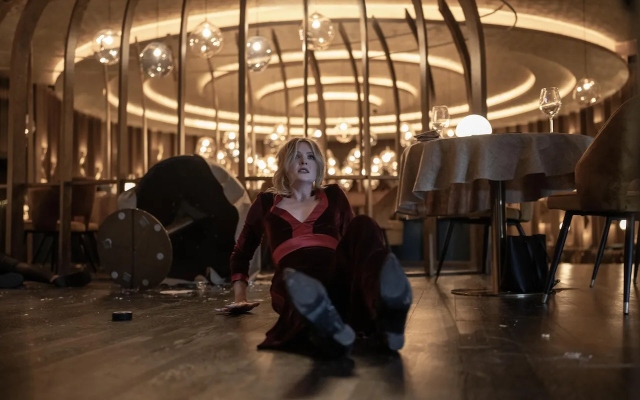
SYNOPSIS: In “Drop,” a darkly comedic new thriller now playing in theatres, Meghann Fahy plays a widow whose first date in years takes a strange turn when someone named Let’s Play “drops” a series of mysterious messages on her phone that threaten the lives of her sister, son and date. “You gotta be within fifty feet to send a drop,” says her date, Henry. “It’s someone in this restaurant.”
CAST: Meghann Fahy, Brandon Sklenar, Violett Beane, Jacob Robinson, Reed Diamond, Gabrielle Ryan Spring, Jeffery Self, Ed Weeks, Travis Nelson. Directed by Christopher Landon.
REVIEW: Not since the high-flying blackmail of Wes Craven’s “Red Eye” has a movie embraced its unlikely premise with such conviction.
The story of the worst—but perhaps most memorable—first date ever, fully commits to its story of technical and psychological warfare, no matter how silly the situation gets.
Action-packed, “Drop” is not. Director Christopher Landon trusts the “WWYD?—What Would You Do?— situation and the characters to carry the show as Violet (Meghann Fahy) tries to follow the crazy, texted demands clogging up her phone without alerting her date (Brandon Sklenar). With stylish photography—including some splashy Hitchcock inspired visuals—and the sparkling chemistry between Fahy and Sklenar, the director crafts a rollercoaster ride of a movie.
So, as a viewer, it’s best to leave your disbelief at the concession stand. If you can do that, “Drop” will be a darkly fun and tension filled story that pays off just before you fall off the edge of your seat.
If not, you may find yourself wondering why Henry didn’t hightail it out of there after the first text.
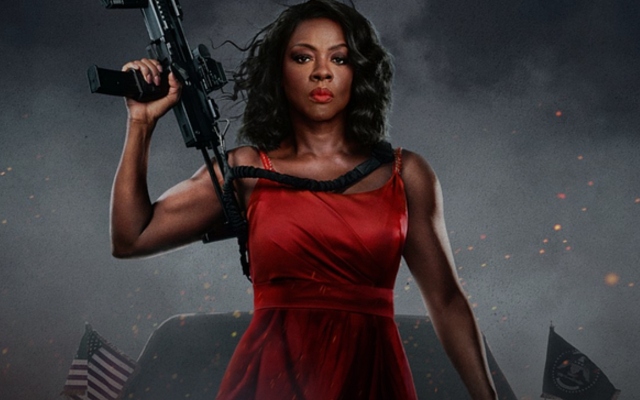
SYNOPSIS: In “G20,” a new action thriller starring Oscar and Emmy winner Viola Davis, and now streaming on Prime Video, terrorists take over the G20 Summit in Cape Town, South Africa. American President Danielle Sutton evades capture and uses her military training to defend the captured world leaders and her family. “If you want to survive,” she says, “you’ll follow me.”
CAST: Viola Davis, Anthony Anderson, Marsai Martin, Ramón Rodríguez, Antony Starr, Douglas Hodge, Elizabeth Marvel, Sabrina Impacciatore, and Clark Gregg. Directed by Patricia Riggen.
REVIEW: It comes as no surprise that Artificial Intelligence is the weapon of choice for the “G20” baddies. Their evil plan to use AI to create Deep Fake videos of world leaders plays on Hollywood’s fear of the disruptive technology, which is odd because the movie, with its clichés and throwbacks to movies like “Air Force One,” feels like it could have been written by AI. It wasn’t, there are four “screenplay by” credits (Caitlin Parrish, Erica Weiss, Noah Miller and Logan Miller), but it certainly feels like the script originated with a prompt on ChatGPT.
Take the snarling bad guys for instance.
Little more than a list of modern grievances come to “life” they are bonded by a belief in a litany of fringe conspiracy theories and tote high caliber guns which they don’t know how to use (more on that later). Led by Rutledge (Antony Starr), they’re standard issue new world order villains straight out of central casting who use violence and AI to stage a global coup and spout meme-worthy sayings about “rebelling against world leaders who strip away the rights of their citizens.”
As President Danielle Sutton, Viola Davis delivers a standard issue action movie heroine. She can throw fists and, like so many action stars before her, is able to run through a hail of bullets unharmed. For some reason, the evildoers in movies like this shoot like their gun barrels are bent at a ninety-degree angle while her aim is true. Her character is all pluck, equally comfortable using her wits as she is pressing a hulking bad guy’s face on a hot grill.
Amid the chaos are her precocious teen kids, Serena and Demetrius (Marsai Martin and Christopher Farrar) who watch their mom kill the bad guys and joke, “Did you know she could do that all the time? Lucky we only got grounded.”
“G20” is a parade of cliches that leads up at an unlikely twist and a logic defying climax that only plays out in the way that it does to provide another opportunity for some showy action theatrics. By the time the end credits roll it’s clear that AI isn’t the only threat facing Hollywood. Unoriginality is.