“Showing Up,” a new dramedy starring Michelle Williams and now playing in theatres, is like a swan. At first glance, it appear calm, cool and collected, but a closer look reveals it is peddling madly underneath the surface.
Set in Portland, Oregon, the story revolves around a week in the life of Lizzy (Williams), a sculptor struggling to prepare for an important show, one that could determine her future, despite the distractions of her day-to-day life. Her frayed nerves are put to the test when her passive-aggressive landlord, and fellow-artist, Jo (Hong Chau), refuses to fix the buildings hot water tank, thus making it impossible for Lizzy to shower. On top of that, Lizzy is stuck caring for a pigeon her cat Ricky seriously injured and left for dead, her co-worker Eric (André Benjamin, aka André 3000) left a piece in the kiln too long, causing it to crack.
Even her family stresses her out. Her mother (Maryann Plunkett), is also her boss at the Oregon College of Art and Craft, and her sculptor father (Judd Hirsch) is less than enthusiastic about her work and ambition. Her brother (brother (John Megaro) suffers with mental illness and spends his days digging a giant hole in his backyard.
“Showing Up” features the slow moving, leisurely pacing that has become writer/director Kelly Reichardt’s trademark. Lizzy’s world is revealed bit by bit, each obstacle adding to the growing anxiety as her opening night approaches.
It feels like watching a slow-motion car crash, but instead of the expected smash-up, the film gently uncovers how Lizzy’s devotion to her art is her lifeline. She lives an artistic life, connected to her community in ways that feed her creativity. Even the poor, broken pigeon finds a spot in Lizzy’s heart and helps transform her life in unforeseen ways.
Williams is a model of restraint, but finds way to add some light comedy into the character. Chau is a live-wire, adding some electricity to the film, even if her role is somewhat underwritten.
It would be easy to think that nothing much happens in “Showing Up,” and it is a quiet movie, but it is loud and proud in its declaration about the miracle of making art that matters while balancing the frustrations of everyday life.
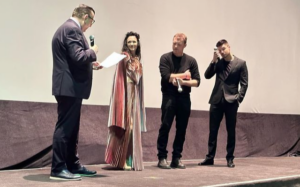
Thanks to Mongrel Media for having me in to host the Q&A at the Canadian premier of “Simulant” with director April Mullen and actors Sam Worthington and Robbie Amell.
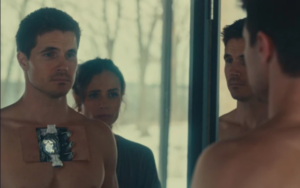
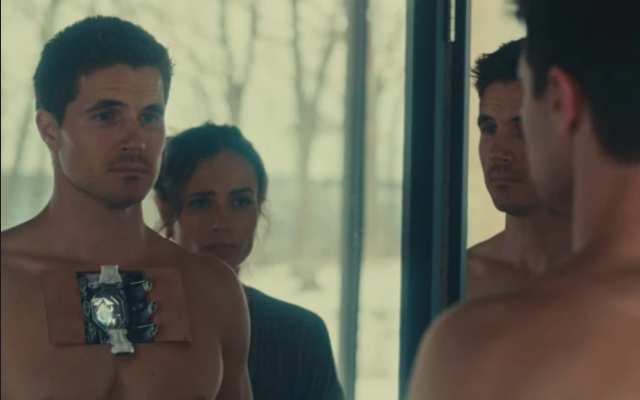
The movie’s synopsis: With androids (SIMS) and humans coexisting, Simulant centers around FAYE (Jordana Brewster) who has already pulled the plug on her late husband, now she can’t bring herself to do the same to EVAN (Robbie Amell), his android counterpart. Instead of deactivating Evan, Faye sets him up in an apartment to live illegally on his own. While there he meets Casey (Simu Liu), a brilliant programmer who helps him become more human in order to win Faye back. Unbeknownst to Evan, his new friend is wanted for questioning by a determined Artificial Intelligence Compliance Enforcement (AICE) agent Kessler (Sam Worthington). Evan has to win over Faye’s heart before they are both discovered and he loses everything.
It may be hard to imagine now, but there was a time when the words Nike and basketball were not synonymous. Way back in the early years of the Reagan administration, Nike was a third tier sneaker company, better known for lagging behind Adidas and Converse than for their now famous swoosh logo.
“Air,” a new sports drama that reteams Matt Damon and Ben Affleck, tells the story of the celebrity endorsement that changed the game for Nike, sports merchandising and popular culture.
Damon is Sonny Vaccaro, a pudgy marketer who tries to convince basketball stars to align themselves with Nike. Trouble is, back then the company was best known for making comfortable shoes for middle-aged joggers.
“There’s nothing cool about Nike,” says college basketball coach George Raveling (Marlon Wayans).
When Vaccaro finds rookie Michael Jordan (Damian Delano Young), he is convinced the 21-year-old backboard-shattering phenom could be the face of the company. “I believe he is the future,” says Vaccaro. Now all he has to do is convince his skeptical boss, the elaborately toupéed Phil Knight (Affleck), and Jordan’s even more skeptical parents James and Deloris (James R. Jordan Sr. and Viola Davis) that this is a good deal for everybody.
“I believe in your son,” he says to Deloris. “And his story is going to make us want to fly. But a show is just a shoe.”
“Until my son steps into it,” she replies.
“Air” is a biography of a brand that, somehow, doesn’t feel like a two-hour advertisement for basketball shoes. That’s because it’s really not about the shoes, although there are several beauty shots of the prototype Air Jordans. Like all good sports stories, the specificity of the story, in this case Vaccaro’s journey, becomes a universal story of inspiration, determination and risk taking.
Damon is in likable puppy dog mode here, handing in an affable performance that relies on his considerable charm as an actor to buoy the movie’s never-say-die themes. We know how this story ends, but because Damon is easy to get on side with, we go along for the ride.
He’s supported by a terrific secondary cast, including Jason Bateman and Chris Tucker as the rule-breaking members of the Nike marketing team and Chris Messina as an over-the-top agent who says, “I don’t have friends. I have clients.”
As Michael Jordan’s mother Deloris, it is Viola Davis who delivers the film’s most potent message. In a performance fueled by grit and warmth, the character’s steadfast belief in knowing the value of a person is conveyed without a trace of sentiment or manipulation.
The lack of Michael Jordan, in what is essentially a Jordan origin story of a sort, is puzzling. Affleck, who also directed the movie, says because Jordan is so well known, he felt making him a character would be distracting. We’ll never know for sure, but it does feel odd that on the handful of times he appears—other than in archival footage—we never see his face, only his back and shoulders and usually out of focus.
According to “Air,” number three on Nike’s business manifesto was “Break the rules,” and certainly, in the courting and signing of Jordan, they did. Affleck breaks fewer rules, using standard montages and a lot of needle drops to establish the 1980s backdrop. We’ve seen a lot of this stuff before, usually in movies that aren’t as good as this one. But despite some familiar visuals and music, “Air’s” underdog story is still a crowd-pleaser.
The most famous plumbers since Thomas Crapper, the man who popularized the flush toilet, are back in “The Super Mario Bros. Movie.” The new animated film starring the voices of Chris Pratt, Charlie Day and Anya Taylor-Joy, and now playing in theatres, sends Mario and Luigi on an adventure that begins with a mysterious water pipe.
While working on a broken water main, Brooklyn, New York plumbers Mario (Pratt) and his fraternal twin brother Luigi (Day), leave the real world, sucked through the pipe into the Mushroom Kingdom.
“What is this place?” asks Mario.
Buried deep beneath the Earth’s surface, it’s the psychedelic principality of the strong-willed Princess Peach (Taylor-Joy), a ruler who shares her castle with Toad (Keegan-Michael Key), a humanoid mushroom aching to find adventure in his life.
But there is bad news.
“Your brother has landed in the Darklands,” Toad informs Mario. “They’re under Bowser’s (Jack Black) control.” Bowser, a giant, fire breathing turtle with world conquering ambitions, has Luigi, and it’s up to Mario to rescue his brother and save the Mushroom Kingdom.
“My little brother is lost,” says Mario. “He looks exactly like me, but tall and skinny. And green.”
With the help of the Princess and Toad, Mario’s quest begins.
“Excuse me, everybody,” shouts Toad. “Coming through! This guy’s brother is going to die imminently! Out of the way, please!”
There are questions you have to ask when reviewing a movie inspired by a video game. Is it good because it remains faithful to the game? Or is it successful because it transcends the game and embraces the big screen?
If you answered yes to the former and no to the latter, you may enjoy “The Super Mario Bros. Movie.” The theatrical experience of the film is essentially like playing the game, without the inconvenience of actually having to play the game.
The beautifully animated movie mostly delivers what Nintendo has been successfully doling out for forty years; Mario, Luigi and the gang dodging Bowser in the Mushroom Kingdom. That formula earned the game accolades as one of the greatest video games of all time, so why tinker with success?
I’ll tell you why. Because by not tinkering with success, by playing it safe, by bowing down to fan service, directors Aaron Horvath and Michael Jelenic have created a movie with all the charm of a broken Game Boy. Loud and frenetic, it’s propped up by nostalgia for the game and little else.
All the Guy Ritchie trademarks that made so many of his other films so much fun are visible in “Operation Fortune: Ruse de guerre,” a new action adventure now streaming on Amazon Prime. Jason Statham comes back for a fifth kick at the can with the director, bringing with him the gravelly voice and fisticuffs first made famous in Ritchie’s “Lock, Stock and Two Smoking Barrels.” There’s also some comedy, outrageous crime, slick cameras moves and a bangin’ soundtrack.
Why then, does it feel been there done that? Is it that familiarity has bred a certain kind of contempt, or is Ritchie coasting on his merits?
All-round action man Orson Fortune (Statham), tech genius Sarah Fidel (Aubrey Plaza) and sniper J.J. Davies (Bugzy Malone) are members of a top-secret British government agency run by Nathan Jasmine (Cary Elwes). Their latest assignment involves retrieving something called “The Handle,” a gewgaw—we’re not really told—that could cause a rift in the world order.
“We don’t know what’s been stolen,” says Nathan. “That remains a mystery for you to solve. But we need to stop it from getting onto the open market. Threat’s imminent.”
Before it can be sold on the black market, the crew must infiltrate billionaire arms dealer Greg Simmonds’s (Hugh Grant) inner circle. Their ticket in? International movie star and Simmonds’s favorite actor Danny Francesco (Josh Hartnett).
“The best agents are stars,” says Orson, “and the best actors are movie stars.”
“Operation Fortune: Ruse de guerre” feels like a Xerox copy of the movies that made Ritchie and Statham famous. The world-ending stakes are a bit higher, and there is more lifestyle porn—like private jets and global locations—but the fast pace, the late movie reveal (we eventually find out what The Handle actually does) and the “colourful” characters that have populated his movies from the get go all return but the glow is a bit dimmer this time.
Hugh Grant’s Michael Caine impersonation is a blast, and Ritchie still knows how to move a camera during the action scenes, but because we are so familiar with so many of the elements in play here, “Operation Fortune: Ruse de guerre” almost feels like a sequel to a reboot of a sequel. It’s the law of diminishing returns. The further away you get from the source, the less effective the movie will be. In this case, the sum of all the parts is a bland espionage story that is, at best, serviceable.
On Friday April 7, 2023 I’ll be hosting a Q&A with the director and cast of the new sci fi film “Simulant” at the Scotiabank theatre in Toronto. Guests include director April Mullen and cast members Sam Worthington, Robbie Amell and Alicia Sanz.
Here’s some info on the film: With androids (SIMS) and humans coexisting, Simulant centers around FAYE (Jordana Brewster) who has already pulled the plug on her late husband, now she can’t bring herself to do the same to EVAN (Robbie Amell), his android counterpart. Instead of deactivating Evan, Faye sets him up in an apartment to live illegally on his own. While there he meets Casey (Simu Liu), a brilliant programmer who helps him become more human in order to win Faye back. Unbeknownst to Evan, his new friend is wanted for questioning by a determined Artificial Intelligence Compliance Enforcement (AICE) agent Kessler (Sam Worthington). Evan has to win over Faye’s heart before they are both discovered and he loses everything.
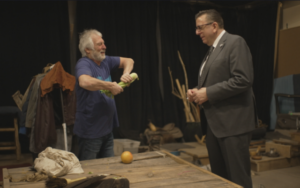
A story I did for “W5,” Canada’s most-watched current affairs and documentary program, on Foley master Andy Malcolm and his team at Footsteps Studio, aired on Sat. April 1 on CTV & CTV GO! “Everybody within the industry,” said recent Oscar winner Sarah Polley, who appears with me in the piece, “kind of worships him.”
Watch Part One of the story HERE and part two HERE to learn how Andy creates the sounds you hear in movies.
A QUICK HISTORY OF FOLEY:
The “Star Wars” lightsaber is one of the most famous props in movie history, but would it have become as iconic without its high-tech hum? We’ll never know, because of one man, sound designer and Foley artist Ben Burtt.
On the set the lightsabers were silent. Cobbled together from thrift stores finds like Graflex camera parts, World War I rifle grenades and faucet knobs, the glowing weapons looked cool, unlike any other sword in movie history, but needed a sound to make it pop.
Ignoring the usual futuristic electronic sounds common to sci-fi movies, Burtt chose to mix “found sounds” to create a more natural sound. The former projectionist recorded the warm hum of projection equipment mixed with the buzz of a vintage television tube. The result was the now instantly recognizable hum of a lightsaber, a Foley effect added to the film in post-production.
Named after movie pioneer Jack Foley, Foley is the art of creating and performing sounds for movies and television shows. The one-time stuntman and silent film director began his sound career at the advent of the talkies, helping to bring movies like “The Jazz Singer” (1927), “Tarzan the Tiger” (1929) and “Dracula” (1931) alive with his techniques to create everyday sounds, like chewing, knocking on wood and footsteps.
For nearly thirty years Foley and his team labored, without credit, adding texture to Universal films with sound. When the studio restructured in the 1950s, Foley’s team, called his “disciples,” scattered, working all over Hollywood. In tribute, when they wrapped a scene they would say, “That’s a wrap. Let’s Foley it,” and the artform Foley created had an official name.
Many of the techniques Foley established are still in use today by Foley artists like Andy Malcolm, owner of Footsteps Post-Production Sound, located in Uxbridge, Ontario, an hour outside of Toronto.
“Watching Andy is like watching a magician,” says “Women Talking” director Sarah Polley.
For decades Malcolm and his team, now including apprentice Goro Koyama, supplied footsteps, page turns, gunshots and any other sound you can imagine in hundreds of movies, including “Women Talking,” “Dune,” “Bridesmaids” and “The 40-Year Old Virgin.”
Malcolm uses cornstarch to create the sound of footsteps in the snow, roast chickens to replicate punch sounds and raw pasta to create the sound of broken bones. Those are just a few of the secrets of his invisible art he revealed to W5 when we visited his “foley farm.”
“He’s a master,” says Polley, “and everybody within the industry kind of worships him. It’s like the energy of a four-year-old imagination, turbo, with adult genius.”