Richard meets Andrew Goodwin, Adam West’s former manager, Batman super-fan and owner of a very cool Batmobile replica!
“It’s not like you can go to your local Canadian Tire to buy a part for a 1966 Batmobile,” said Goodwin. “Everything had to be fabricated. Mine is built on a 1978 Lincoln Continental and all that’s left is the chassis and drive train. The support for the body and everything all had to be custom made…” Read the whole thing HERE!
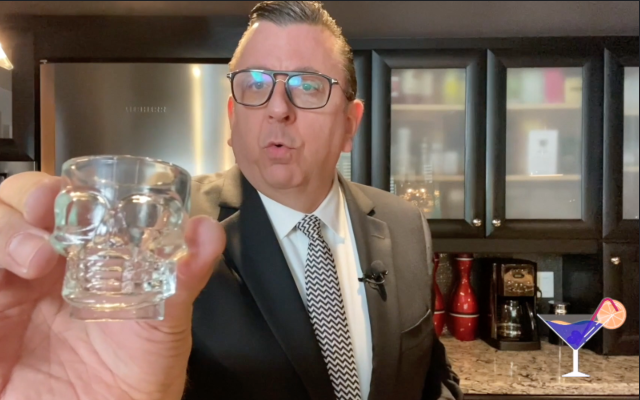
Richard makes a Bloody Mess, the perfect cocktail to enjoy while having a drink and a think about “Spiral: From the Book of Saw,” the latest chapter in the “Saw” franchise.
In adapting “The Woman in the Window,” a new thriller starring Amy Adams, now streaming on Netflix, director Joe Wright borrows liberally from the Hitchcock playbook, paying visual tribute to everything from “Foreign Correspondent” and “Psycho” to “Vertigo” and, of course, “Rear Window.” There are so many Hitch lifts in the look of the movie it makes Brian DePalma’s myriad Hitchcock homages look like petty thievery.
Adams plays child psychologist Anna Fox who lives alone in a rambling brownstone on 124th Street in Manhattan. Agoraphobic, she gets panic attacks at the idea of going outside, let alone actually stepping over her front threshold to the big bad world. Her only regular contact with the outside comes with her weekly visit from her therapist (Tracy Letts) and a downstairs tenant (Wyatt Russell).
When her new neighbors from across the street drop by unexpectedly, she reluctantly lets teenager Ethan (Fred Hechinger) in for a get-to-know-you visit. A day or so later Jane (Julianne Moore) swings by to chat, ask nosy questions and have a glass of wine.
After the visits Anna becomes voyeuristically invested in their lives, watching them from the safety of her apartment as they go about their day to days lives, exposed by two large windows that showcase their living areas.
One night, after mixing wine with her anxiety medication, she witnesses what appears to be an ugly domestic dispute that turns fatal. Trouble is, no one believes the “drunken, pill popping, cat lady.”
Question is, did she really witness a murder or was it a hallucination?
Anna is a classic unreliable narrator, a character whose credibility is questioned at every step of the way. Adams keeps her interesting, bringing a human face to trauma, anxiety and grief. We’re never sure if what we’re seeing is filtered through a haze of medication or actually happening and while Wright finds flashy visual ways to portray this, it is Adams who connects emotionally.
There are moments of supercharged filmmaking in “The Woman in the Window” but the tonal shifts and pacing get in the way of making this edge of your seat viewing. Director Joe Wright brings his trademarked visual style to illustrate Anna’s anxiety. Unusual angles and lurid colours illustrate Anna’s disconnected moments, wide shots of her empty apartment represent her isolation. It’s effectively and inventively done, but the slack pacing sucks much of the energy out of the storytelling.
“The Woman in the Window” has moments that truly work but it is dulled by its deliberate pace, repetitive nature and typical confessional ending.
“And Justice for All,” the last four words of the American Pledge of Allegiance, sum up the dynamic of “Spiral: From the Book of ‘Saw,’” the ninth instalment of the “Saw” franchise, now playing in theatres.
On one hand you have a murderer dispensing their own brand of justice; inventively slaughtering people who have broken a twisted moral code known only to the killer. For instance, a detective who has lied on the stand many times, is given the choice, provide justice by tearing out his own lying tongue, or be killed. “Live or die. Make your choice.”
Then, there are the police who must use more traditional means to enforce their brand of justice.
It might not be exactly what Congress had in mind, but in the “Saw” universe there is more than one definition of the word justice.
Chris Rock is Zeke Banks, an idealistic-but-disillusioned big city detective trying to get out from under the shadow of his father Marcus (Samuel L. Jackson), a decorated, hero cop and retired police chief. When Zeke and his partner, an eager rookie named William Shenk (Max Minghella), catch an unusual, grisly case, the game is afoot.
Literally.
A new serial killer, playing from the same gamebook as the notorious villain Jigsaw, who put his victims through deadly scenarios he referred to as “games” or “tests,” is terrorizing the city’s dirty cops, looking to avenge wrongs perpetrated by the South Metro Police and “reform” the department. “A Jigsaw copycat,” says Marcus. “That could be difficult.”
As the bodies pile up Zeke suspects the killer isn’t just playing around, that he has another motive. Something personal.
After eight instalments of the “Saw” franchise, countless deadly traps and one iconic baddie, “Spiral” finds a newish way in to tell an old story. Billy the Puppet and Jigsaw are gone, as is much of the gore that splattered the screen in earlier incarnations of the series. They’ve been replaced with a timely but underdeveloped subtext regarding police corruption and the addition of humor, an element often sorely lacking from previous instalments.
Directed by Darren Lynn Bousman, who helmed the second, third and fourth “Saw” movies, “Spiral” is as character based as it is consequence based. Bousman, and “Jigsaw” screenwriters Josh Stolberg and Pete Goldfinger, have dialed back the grim stuff. There are still enough traps and gore to keep “Saw” purists happy—there’s a finger ripping machine and some nasty hot wax—but an increased emphasis on character raises the stakes so the gory stuff has more impact. It’s still a horror film, but Bousman structures it like a thriller, even if his reliance on flashbacks and exposition mutes some of the thrills.
There’s also loads of uninspired hard-boiled dialogue and lots of yelling but also just enough of the nasty stuff and deadly game playing to keep fans satisfied.
The spiral logo that gives the movie its name is supposed to be emblematic of change and progress, but the movie doesn’t quite live up to the symbol’s meaning. It shakes some of the dust off the old franchise without reinventing it or doing justice to it.
“In the Earth,” the latest film from Ben Wheatley, now on VOD, once again returns to the psychological horror that fueled his other movies like “Kill List” and “A Field in England” with a hint of the social commentary of his J. G. Ballard adaptation “High-Rise.” Add to that a dash of folk-horror and you have a truly timely and mind-bending film that is best avoided by the squeamish.
Most people see a walk in the woods as a quiet respite from the world. But when researcher Martin (Joel Fry) and ranger Alma (Ellora Torchia) head out to meet scientist Dr. Olivia Wendle (Hayley Squires) and perform some tests in the forest during a pandemic, they are sent off with some ominous advice. “People get a bit funny in the woods sometimes,” says Martin’s doctor Frank (Mark Monero). “It’s a hostile environment.”
Sure enough, things go wrong early on. They come across eerie, abandoned campsites, equipment breaks down, Martin becomes ill and they are even attacked in their tent on a tense, sleepless night. The next day help comes in the form of Zach (Reece Shearsmith), an eccentric loner who lives deep in the woods. He offers some painful but much-needed help—this is roughly where the squeamish may want to go make a sandwich and read a book—but soon begins acting erratically with a mix of metaphysical ramblings and homicidal tendencies.
By the time they contact Dr. Wendle, it is unclear who they can trust as their journey into the heart of darkness takes on an increasingly mysterious, psychedelic tone.
“In the Earth” is a trippy movie that nonetheless feels earthbound. No matter how weird the going gets, and it does get strange, masks, isolation, HAZMAT-suits and talk of quarantine and being outside for the first time in forever, ground the story in all too familiar terms. The postapocalyptic vibe is all too real, but the Pagan alchemist rituals, evil spirits and a dollop of paranoia provide the journey into the heart of darkness and the absurdist comedy integral to Wheatley’s style.
Some will call “In the Earth” a horror film, but it isn’t really. The repeated home surgery scenes are woozy-making, and the strobe effects are unsettling, but your pulse will never quicken. Then there’s the under developed characters. You may feel sorry for them when weird things happen, but it’s hard to be invested in them.
What that leaves you with is a movie that offers up a handful of ambitious notions about science vs. religion and some extra-ghastly visuals but, at best, it’s about intellectual dread; all ideas and no emotion.
If I was to categorize “Together Together,” a new movie starring Ed Helms and now on V.O.D., I guess I’d have to create a new category, the non rom com. It’s a relationship comedy that has some, but not all, of the hallmarks of a romantic comedy, but walks its own path.
Helms is Matt, a 45-year-old single man who wants to start a family. When we first meet him he’s awkwardly interviewing 26-year-old millennial Anna (Patti Harrison) for the job of surrogate. She has snappy answers to his questions—Have you ever stolen anything?—and gets the job. Matt is eager to begin his new life as a single dad but Anna, who gave a baby up for adoption years before, sees it as a gig, a transaction with a $15,000 fee.
Divided into trimesters, as story unfolds Matt and Anna’s relationship grows. They share meals, watch “Friends,” which she has never seen, and take prenatal classes together. They even attend a kind of couple’s therapy, even though their relationship isn’t romantic. It’s more complicated than that. They aren’t a couple but their relationship is intimate on many levels and it leads to misunderstandings that threaten their personal and business relationship.
“Together Together” often feels like it is turning the corner to becoming a Hollywood rom com and then, just as often, does a u-turn. It constantly defies the traditional rom com journey, while allowing the characters to have an interesting connection.
Writer/director Nikole Beckwith has crafted a movie about a platonic relationship between a man and a woman, fringed with humour, melancholy and warmth. Helms brings his trademarked nerdy awkwardness to the role, expertly playing off Harrison’s more sardonic take on Anna. They are a compelling couple, even if they’re not actually a couple.
“Together Together” is a different take on “When Harry Met Sally,” providing an updated and rather sweet answer to that movie’s famous query, “Can men and women be friends or does sex always get in the way?”
Richard has a look at the enduring popularity of drive-ins for the Toronto Star!
“I always tell people I’m selling sovereignty, but at the same time it’s a community thing where you can do whatever you want in your car as long as you’re respectful of the people around you. My bad joke is, ‘Bring your babies. Bring your dog. Bring your weed. Just don’t bring them together…’” Read the whole thing HERE!
A remake of Nicolas Boukhrief’s 2004 French film “Le Convoyeur,” “Wrath of Man,” now playing in theatres and coming soon to VOD, is a revenge/heist flick that sees director Guy Ritchie reunited with his trademarked tricky storytelling style, Jason Statham and the ruthless violence that made his early movies such eye poppers.
Statham plays “’H’, like in bomb,” a man of few words with a mysterious past. Big surprise there. They should call him Gazpacho because he is the coolest of cool cucumbers. No matter what, this guy’s pulse rate never rises above 50 beats per minute.
When we first meet him, he takes a job as a security guard for Fortico, a Los Angeles armored car company. A recent robbery left three people dead and made the surviving guards edgy and uneasy. “Do you have any idea how dangerous this job can be?” a coworker named Boy Sweat Dave (Josh Hartnett) asks him. “We ain’t the predator, we’re the prey.”
When some very bad people attempt to rob one of the company’s cash trucks “H” reveals a special set of skills to the shock and awe of his co-workers. “It doesn’t feel right,” says security guard Bullet (Holt McCallany). “It’s like he wants the trucks to get hit.”
As the bodies pile up “H’s” lethal past is exposed and it becomes clear that he didn’t take the gig at the armored car company simply because he needed a week to week pay cheque. “I can do in two weeks,” “H” says to the shadowy Agent King (Andy Garcia), “what you wish you could do in twenty years.”
Told on a broken timeline and sectioned-off into chapters with names like “Bad, Animals, Bad” and “Scorched Earth,” the movie’s plot can be boiled down to one line. “I do bear a grudge,” “H” says, summing up the film’s raison d’etre as bullets fly and bodies pile up. A nihilistic story about revenge decorated with a tense heist subplot, it’s a riff on Statham’s earlier work in which he usually played either Character #1, a “loner with a past who must protect a loved one,” or Character #2, the “loner with a past who must protect a youthful innocent.”
Here he shakes things up by showing a disregard for the lives of some while avenging the loss of a loved one. Gone is the jokey Statham of “Spy” and his over-the-top “Fast and Furious” work. This is a back-to-basics performance that sees him settle on one facial expression, as though his chiseled face is encased in amber, to convey the character’s one deadly motive. The taciturn thing has worked for him before and it works well here. “H” is no laughing matter. Danger follows him around, and Statham’s coiled spring performance, no matter how basic, suggests that ultra-violence could erupt at any moment. It gives the movie much of its edge as Ritchie navigates the grim but stylish goings-on.
Are there plot holes? Yes. I can’t go into them without giving the story away but let’s just say “H’s” resilience is impressive.
Somewhere buried deep in the gunplay there is an elegance to “Wrath of Man.” Ritchie’s tough-talking film is tautly crafted, and, for those expecting “Snatch” style editing tricks, quite restrained.
The editing, not the violence.
Shot through a hail of bullets, the movie builds to a tense “Heat” style climax that doesn’t waste time or ammo. The jittery atmosphere is amped up by an angrily effective score from composer Chris Benstead.
On the downside, Ritchie’s taste for macho posturing doesn’t add much to the film’s early scenes. There are barely any female characters, save for Niamh Algar’s security guard Dana and assorted wife characters, and the hard-boiled dialogue between the often men borders on parody.
“Wrath of Man” is bleak and the characters are all, at best, anti-heroes, but for those with a taste for adrenaline pumping action set pieces, “Wrath of Man” delivers.