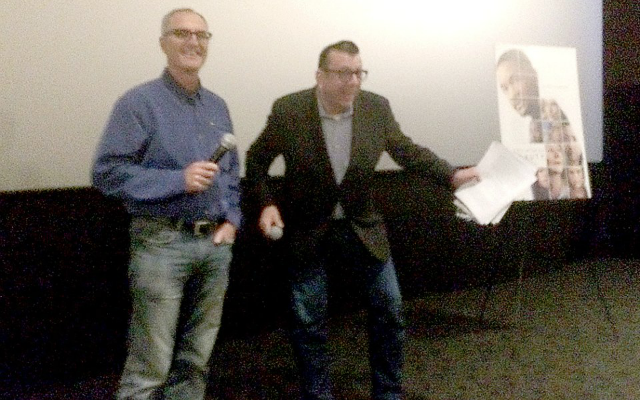
In Office Christmas Party T.J. Miller plays Clay, a scattered office manager with a “mind like a drunk baby.” In a last ditch effort to save his branch from closure he tries to woo a lucrative client by throwing a no-holds-barred Christmas party.
“This is the way we close Walter,” says Clay. “We throw the best Christmas party he’s ever seen. We could save everybody’s jobs.”
Miller leads an ensemble cast featuring heavy-hitters like Jason Bateman, Olivia Munn, Kate McKinnon and Jennifer Aniston but he doesn’t want to talk about that. Not right away, anyway.
Instead he begins the interview with, “Let’s talk comedy in a time of tragedy.”
OK, lets.
“Basically I have a political obstacle to my social mission statement,” he says. “The social statement was, tragedy permeates our everyday lives, people are lonely, they’re scared, they have death anxiety, they don’t know how to attribute meaning to their own existence, so through comedy we can provide an opiate or distraction that permeates our everyday lives. Through satire we can hopefully frame the world in a way that people can laugh at.
“Also I aim to help people, through my stand up, to release the death anxiety. I aim to help people not take themselves so seriously.”
When Miller, who also currently plays Erlich Bachman on Silicon Valley, finally gets around to talking about Office Christmas Party, he’s still on message.
“It’s very easy to promote a comedy during the apocalypse,” he says.
The Christmas film, which features a greedy pimp, a sexually repressed head of HR and an office load of drunk, disgruntled employees, is a mix and match of sentimentality and debauchery that Miller thinks is perfect for the season.
“What better way to spend the holidays?” he asks. “First of all you don’t have to talk to your family for an hour-and-a-half during the holidays. That’s a bonus. If the movie is funny, you talk about how funny it was for half-an-hour. How dynamic Jenifer Aniston, Jason Bateman and Courtney B. Vance are. How strange I look in a Santa suit for that long. That my facial hair is still abrasive and arresting. That’s two- and-a-half to three hours towards a stress free holiday. That’s what we’re pitching you.
“It’s a funny movie. It’s a laugh a minute. Well, it’s a laugh every minute-and-a-half to two minutes. We wanted to give you a break. It’s exhausting to laugh every minute.”
Miller, who once worked as a legal secretary in the same Chicago office building seen in the film, says the movie is silly and fun but shares his core comedy philosophy.
“Workplace environments have become so sterile and corporations have become so much about profit and not the people they work with that we’ve lost the fun of work. We don’t have cool office Christmas parties anymore. We are saying, ‘You spend so much time with the people you work with, why not have a night or two a year where you can kind of just relax? Take a night off from worrying about offending someone or giving ‘tude.’
“That is our message to North America. Take the holidays, drink way too much eggnog, laugh, relax and know that we’ve got a lot of work to do in 2017.”
This weekend Jessica Chastain stars in the political thriller Miss Sloane. The title refers to the lobbyist main character but the film could easily have been titled Drain the Swamp.
Made before Donald Trump became president-elect, it only takes about 20 seconds before the word “trump” crops up in the dialogue. He’s never mentioned by name, but this look at “the most morally bankrupt profession since faith healing” paints exactly the ugly picture of behind-the-scenes machinations that Trump railed against on the campaign trail.
Chastain is Elizabeth Sloane, a sleep-deprived D.C. lobbyist “at the forefront of a business with a terrible reputation.” She’ll represent anyone, it seems, except the gun lobby, who offer her a lucrative contract, only to be laughed at and rejected.
Soon after she leaves her firm — one of the biggest in the country — to join a small, scrappy group who aim to whip up support for a bill that will demand background checks for all gun owners.
It’s a new hot-button peek behind the curtain of a political process, but Hollywood has been making Drain the Swamp movies for years.
The explosive Advise and Consent is based on former New York Times congressional correspondent Allen Drury’s Pulitzer Prize-winning novel about the ratification of a secretary of state and the dirty little secrets people in public life must keep hidden. Political battle lines are drawn as a full frontal attack is launched on the character and credentials of the new nominee.
Director Otto Preminger almost pulled off one of the great casting coups of the 1960s when he offered civil rights leader Martin Luther King Jr. a role in Advise and Consent. The mercurial director thought King would be perfect for the role of a southern senator, despite the fact that no African Americans were serving in Senate at the time. King gave the offer some thought, but declined fearing the backlash and possible harm to the civil right movement.
More recently, in The Ides of March George Clooney (who also directed) played a Democratic Party candidate; the kind of guy who would make the top of Bill O’Reilly’s head pop off. He’s pro-ecology, anti-oil. He wants to tax the rich and legalize gay marriage. If he leans any further left he’ll topple over.
Although Clooney has spoken out about many of these topics in real life, he didn’t make a left-wing film. Instead he made a warts-and-all political movie about dirty dealings on the campaign trail.
The first hour is good stuff, great acting from Ryan Gosling, Paul Giamatti and Philip Seymour Hoffman and a fascinating, if occasionally dry look at life in the political fast lane. Then comes the blackmail, the meetings in darkened stairwells and double-crossing journalists.
Finally The Campaign, a comedy starring Will Ferrell and Zach Galifianakis as incumbent congressmen, begins with a quote from former presidential hopeful Ross Perot: “War has rules. Mud wrestling has rules. Politics has no rules.”
Neither does the movie; no rules or boundaries. These candidates go beyond the usual name-calling — “He looks like Osama Bin Laden” — to dirty tricks that would make Tricky Dick blush. It’s a through-the-looking glass-vision of how politics works that features ambition, greed, corruption and even a candidate who punches a baby.
Jennifer Aniston and Jason Bateman appeared in the edgy “Horrible Bosses” films so you’d expect their new movie, “Office Christmas Party” to be holiday fare more naughty than nice. But you’d be wrong. Their latest suffers from not being too vulgar, but from being not vulgar enough.
Aniston runs Zenotech Data Storage Systems, a tech company she inherited from her late father. Dad left her the company but gave the main branch to her party animal brother Clay (T.J. Miller). She’s a strict by–the-book business person the Grinch who cancels all branch Christmas parties to save money and gives Clay until the end of the quarter, just two days away, to turn things around or she will lay off 40% of the staff and cancel all bonuses.
Clay is scattered with a “mind like a drunk baby,” but determined to protect his branch and his staff. To that end he recruits head programmers Josh (Jason Bateman) and Tracey (Olivia Munn) to woo a lucrative client (Courtney B. Vance) by throwing a no-holds-barred office Christmas party. “This is the way we close Walter, we throw the best Christmas party he’s ever seen,” says Clay. “We could save everybody’s jobs.”
Despite Clay’s warning, “When I drink a lot bad things happen,” they proceed with the party. Add in a greedy pimp, $300,000 in cold hard cash, a sexually repressed head of HR (Kate McKinnon) and an office load of drunk, disgruntled employees and you have a Bacchanalia that would make would make Caligula blush.
Given the premise “Office Christmas Party” is not nearly as wild as a movie about and out of control party should be. Despite the excess of flesh and booze the movie often opts for sentimentality over debauchery. It most certainly doesn’t put the ‘X’ in Xmas.
Tone wise it should feel like anything could happen; like the movie could go off the rails at any second. Instead it’s as sweet and gooey as a (slightly soiled) Hallmark Christmas card.
Packed with comedy heavy hitters like Aniston, Bateman, McKinnon and Miller, it’s the supporting cast who garner most of the laughs. Fortune Feimster, a comic best known for her work on “The Mindy Project” livens things up as a motor mouth Uber driver and Randall Park’s take on a shy-but-kinky office worker has its charms but it is Courtney B. Vance who steals the show. The velvet-voiced character actor who specializes in playing lawyers—think “Law & Order” and his Johnnie Cochran in
“The People v. O.J. Simpson: American Crime Story”—unexpectedly lets his freak flag fly and the results are glorious. If it was his movie it might have been more fun.
Less a biopic than an intimate character study, “Jackie,” sees Natalie Portman play one of the most famous women of the twentieth century, first lady Jacqueline Bouvier Kennedy. DirectoPablo Larraín personalizes the reaction to assassination of John F. Kennedy, presenting a portrait of grief that values rawness over slick sentimentality.
Focussing on the events immediately following November 22, 1963, the film cuts through the carefully constructed image Jacqueline Kennedy presented to the world. Instead it shows her as a grieving widow struggling to fulfil her personal responsibilities under the scrutiny of the American people and White House staff.
Larraín employs a standard biopic starting point—an interview with a journalist (Billy Crudup)—to frame the tale, but then throws all other familiar biographical approaches out the window. Kennedy’s story is a tragic one played out on the world stage and yet the film is never mawkish. It is a look at the end of “Camelot”—the musical and the ideological state of mind it personified for the Kennedy administration—as a psychological portrait of the woman at the very centre of it all.
Portman plays Kennedy not from the point of view of history—she is remembered for her grace and dignity—but as a woman fraying around the edges as she ponders the gravity of her situation and the legacy that will be left behind. She doesn’t look like Kennedy but, in a performance largely captured in close up, creates a portrait that seamlessly blends the poised, public Kennedy persona with a woman on the verge of a breakdown. It is often harrowing and certainly shows a different side of Kennedy than any other look at the subject.
“Jackie” is a bold film that values visceral feelings over glossy convention. It presumes much in its efforts to peer into the cracks of history, taking abundant artistic licence with what some will see as an intrusive look into Kennedy’s life. This is not “Camelot,” it’s the flipside of that romantic fairy tale.
“Lion,” the heart-tugging true tale of Saroo Brierley, is the story of one determined man’s attempt to connect with a past he barely remembers.
When we first meet Saroo (played as a child by Sunny Pawar) he’s a lively five-year-old boy living in abject poverty in a small town in India. His mother is a labourer, moving rocks to eek out a living for her family. Saroo and his brother Guddu (Abhishek Bharate) help out, stealing coal from passing trains to make money to buy milk. When the boys get separated while looking for work the youngster ends up on a train, destined for Calcutta, 1600 km from home.
Alone and lost, he desperately tries to find his way home, but without knowing the name of his town or mother—“Her name is Mum,” he says.—he wanders the streets, his only possession a piece of cardboard to sleep on. For weeks he navigates through the dangerous city streets, learning who to trust and when to run. Found and sent to an orphanage, he is then adopted by Australians Sue and John Brierley (Nicole Kidman and David Wenham). “Did you really look for my mom?” he asks as his caseworker signs off on the paperwork.
Cut to twenty years later. Saroo (now played by Dev Patel), raised by loving parents, has grown into a handsome young man, but is increasingly troubled by the question marks of his early life. “I’m lost,” he says to girlfriend Lucy (Rooney Mara). “Do you have any idea knowing what it is like knowing my real mother and brother spent every day looking for me?” Thoughts of his early life plague him until he begins to piece together the details of where his journey began.
Nicole Kidman may be the Academy Award winner in the cast, and she is very good, but the performances you’ll remember come from the two Saroos, Sunny Pawar and Dev Patel. Two actors, one character; both looking to find themselves, physically and spiritually. It’s an engrossing and often heart-wrenching journey and the pair keep us interested for the whole trip.
Pawar is a wide-eyed charmer, innocent but fearless, who conveys both the desperation to get home and the will to survive in dangerous situations. It’s a performance completely free of the preciousness that often mars kid’s work; one that effortlessly cuts through to the core of the character.
Patel navigates a different part of Saroo’s journey. As an adult he speaks English with a heavy Australian accent and can no longer remember the Hindi of his youth. Thoroughly westernized it isn’t until he accesses some long repressed memories that his need to find his real home surfaces. Patel embodies the emotional battle between the home he has grown up in, with all the comforts of a loving adopted family, and a need to understand where and who he came from.
“Lion” isn’t perfect—some of the Google Earth searches are as interesting as you might imagine a Google Earth search on the big screen to be—but it is emotionally engaged with all of its characters, and you will be to.
The title of political thriller “Miss Sloane” refers to the main character, a lobbyist played by Jessica Chastain, but the film could easily have been titled “Drain the Swamp.” Made before Donald Trump became President Elect, it only takes about twenty seconds before the word “trump” crops up in the dialogue. He’s never mentioned by name, but this look at “the most morally bankrupt profession since faith healing” paints exactly the ugly picture of behind-the-scenes machinations that Mr. Trump railed against on the champagne trail.
Chastain is Elizabeth Sloane, a sleep-deprived D.C. lobbyist “at the forefront of a business with a terrible reputation.” She’ll represent anyone, it seems, except the gun lobby, who offer her a lucrative contract, only to be laughed at and rejected. Soon after she leaves her firm—one of the biggest in the country—to join a small, scrappy group who aim to whip up support for a bill that will demand background checks for all gun owners.
The bulk of the film consists of the inner-workings of a campaign, the dirty tricks and money management it takes to influence the influencers. Sloane, focussed on the win, pushes protégé and mass shooting survivor Esme Manucharian (Gugu Mbatha-Raw) front and center, making her the face of the issue. Soon unexpected personal consequences of Sloane’s aggressive antics and a congressional enquiry into her behaviour threaten to derail all her hard work.
“Miss Sloane” is a fast paced political suspense that reverberates with echoes of Armando Iannucci, Paddy Chayefsky and Aaron Sorkin. Zippy dialogue flies off the screen probably easier than it would actually fly off the tongue, giving voice to colourful characters who say mostly interesting things. “When this town guts you like a trout and chokes you with the entrails don’t come snivelling to me,” snarls Sloane. It’s a catchy line and Chastain spits it out with conviction and often transcends the rat-a-tat dialogue by bringing some actual humanity to a character largely made up of bon mots and a bad attitude. It’s a struggle for Chastain to grow Elizabeth Sloane as a character but in her rare quiet moments, when she isn’t mouthing Jonathan Perera’s carefully crafted words, she finds warmth and vulnerability in a person described as the “personification of an ice cube.”
All the good work, the dialogue, the character work, the timely “drain the swamp” subject, all of it, is undone in just a few minutes as “Miss Sloane” climaxes with one of the worst endings in recent memory. There will be no spoilers here, but in the movie’s final moments a crescendo of over plotting takes over, pushing the story into a melodramatic territory. Instead of echoing Armando Iannucci, Paddy Chayefsky and Aaron Sorkin, Perera appears to pay tribute to Agatha Christie with a series of ridiculous revelations that defy logic.
“Miss Sloane” feels timely but its determination to live up to Sloane’s ethos—“It’s about making sure you surprise them and they don’t surprise you.”—undermines it effectiveness.
Richard and “Collateral Beauty” director David Frankel spoke in front of an invited audience at a screening of the film in Toronto recently. To hear Frankel (whose other films include “The Devil Wears Prada” and “Marley and Me”) and Richard discuss working with Will Smith, rewriting on the fly and shooting in New York City, keep your ear on the House of Crouse podcast the week of December 16!
This weekend, for the first time all year, none of the new films on release have a number or a colon in the title. That means no sequels, prequels or reboots cluttering up screens. Hollywood hasn’t suddenly decided to change their tactic of squeezing every dime out of ever tried-and-true concept in their back catalogue. Nope, it’s because after American Thanksgiving, one of the biggest movie times of the year, the studios figure everyone ate too much turkey to bother going to the movies this week.
That means we have smaller, not-ever-likely-to-be-sequelized movies like Lovesick, Antibirth and The Other Half on offer. All, depending on your taste, are worth your dollar and each ticket bought sends a message that moviegoers won’t be content with constant rehashes of stories we already know.
Recently a tentative deal to make Bad Boys 3 and 4 was announced. While the prospect of a third and fourth movie in that decades old series is about as welcome as a plantar wart, we did this to ourselves by supporting endlessly repackaged stories and ideas.
Hollywood wouldn’t spend the time or effort to make photocopy quality sequels if we didn’t line up to see them, so why not your buying power to demand better movies? Read these easy-to-follow rules for sequel avoidance:
Generally speaking, shun movies with numbers in the titles. This sounds straightforward, but movies like One Flew Over the Cuckoo’s Nest, Three Days of the Condor, 8½, and The Seven Samurai muddy the waters.
By all means go see or stream those, but when choosing a movie beware of titles containing colons (Lawnmower Man 2: Beyond Cyberspace), the word “part” (Friday the 13th Part 3: 3D), unless of course it’s The Godfather Part II, a subtitle like “This Time It’s Personal” (Sister Act: Back in the Habit), roman numerals (Superman IV: The Quest For Peace) or any combination of the above (Friday the 13th Part VIII: Jason Takes Manhattan).
Other trouble spots include titles containing the words “Beginning” (Psycho IV: The Beginning), “Bride” (Bride of Chucky), “Return” (Return to the Blue Lagoon), “Vs.” (Gamera vs. Jiger), “Boogaloo” (Breakin’ 2: Electric Boogaloo) or “Revenge” (Jaws: The Revenge).
Worse than numbered sequels are movies which substitute a homophonous word for the number (Look Who’s Talking Too, Teen Wolf Too).
Avoid movies that recycle ideas while simply changing the tense of the movie title. Examples? What was funny in Analyze This became less so in Analyze That and there is a reason I Still Know What You Did Last Summer sits at a 7% approval rating on Rotten Tomatoes.
And finally, as a matter of principle, steer clear of any movie in which Ben Stiller plays supermodel Derek Zoolander.
Of course I’m joking, except about Zoolander. Any movie that subtitles itself with “No. 2” is really asking for it. Go see whatever you want, but keep in mind when supporting bad movies the joke is on us. It feeds the notion that audiences are as creatively bankrupt as the studios. Not so. If you are given a steady diet of dog food, pretty soon you get a taste for Alpo, but if occasionally you have something better, soon enough you’ll crave foie gras. Sequels are the dog food of the movie industry. Don’t let them force feed you.
“The Other Half, starring Tom Cullen and Tatiana Maslany, is an uncompromising and intense look at mental illness.
Cullen (“Downton Abbey’s” Anthony Gillingham) is Nickie, a short-tempered waiter shown the restaurant’s door when he has a run in with a customer. Coming to his defense is aspiring painter Emily (Maslany), an outgoing young woman suffering from bipolar disease. The pair begin a relationship, sharing a deeply felt connection that weathers Nickie’s sudden rages and Emily’s descent into depression. When her condition spirals out of control her father Jacob (Henry Czerny), fearing for her safety opts to institutionalize his daughter. Months later the couple reunite, moving in together but old problems arise.
Director Joey Klein straightforwardly but sensitively portrays the couple’s travails with a combination of clever photography, sound design and careful scripting. Nickie’s alienation is brought to life with dreamlike audio and disorienting visual cues. Maslany brings a kinetic energy to Emily’s troubled state, emphasizing the self-destructive urges that rule her behaviour.
Both leads hand in remarkable performances. Maslany is external, physical in her work, Cullen all brooding and internal. Together they click, creating the emotional core of the film as they struggle to find a way to be together. “The Other Half” is a movie that never takes the easy way out and neither do the actors.