Fast reviews for busy people! Watch as I review three movies in less time than it takes to make your bed. Have a look as I race against the clock to tell you about the legacy sequel “The Devil Wears Prada 2,” the unsettling “Hokum” and the shallow “Deep Water.”
I sit in with CKTB morning show host Steph Vivier to have a look at movies in theatres including the legacy sequel “The Devil Wears Prada 2,” the unsettling “Hokum” and the shallow “Deep Water.”
SYNOPSIS: In “The Devil Wears Prada 2,” the twenty-years-in-the-making sequel to the 2006 Meryl Streep, Anne Hathaway and Emily Blunt hit, Andy Sachs returns to Runway Magazine as Miranda Priestly navigates the new world of media. “Well, look what TJ Maxx dragged in,” says Nigel (Stanley Tucci).
CAST: Meryl Streep, Anne Hathaway, Emily Blunt, and Stanley Tucci, Justin Theroux, Kenneth Branagh. Directed by David Frankel.
REVIEWS: The clever callbacks and echoes of the past in “The Devil Wears Prada 2” should satisfy fans of the original but may leave series newcomers with a case of the cerulean blues. (Fans will get the joke.)
The movie begins in a much different world from the 2006 movie. Journalism is under fire and the formerly high-flying world of fashion magazines has been grounded, relegated to creating “content for people to scroll past while they pee.”
Even Miranda Priestly (Meryl Streep), editor-in-chief of the formerly formidable magazine “Runway,” feels the pinch. She still has a beautiful corner office, longtime right-hand Nigel Kipling (Stanley Tucci) and a withering attitude toward her staff, but these days she is reduced to hanging up her own coat rather than tossing it one of her assistants.
Fate brings together Miranda and her former second assistant Andy Sachs (Anne Hathaway) in a perfect storm of journalism woes. Andy loses her job as an investigative reporter just as Miranda is accused of failing to fact check a story about a fashion company that secretly uses sweat shops to produce their clothes.
Much to Miranda’s consternation, “Runway’s” owner hires Andy as Features Editor hoping that her standard of journalistic excellence will rehabilitate the magazine’s tattered reputation. “All I have to do is bide my time until you fail,” Miranda says disdainfully, “and you will.”
Andy’s job at the magazine is to “turn on new readers without turning off old readers,” which, coincidentally, is also director David Frankel’s job with the film’s viewers.
For the most part he succeeds.
The script, by Aline Brosh McKenna, who also wrote the original, follows a similar structure to the first film, placing Andy, once again, as an eager outsider in the exotic world inhabited by Miranda, Nigel and Emily. Frankel puts the band—Streep, Hathaway, Tucci, and Blunt—back together, keeping the traits that made them popular in the first place, while allowing them to grow.
Fans will get a boatload of Miranda’s dismissive remarks, Andy’s puppy dog energy and ambition, Nigel’s quiet mentorship and Emily’s judgmental edge, but all are tweaked. Miranda has vulnerabilities, Andy is more confident, Nigel is an avatar for the changing industry and Emily is still fiercely fashionable and wants to please Miranda but has a modicum of power she didn’t have before.
Reunited, the characters fit together like puzzle pieces, but it is the movie’s macro focus that gives “The Devil Wears Prada 2” its juice.
Of course, the characters click and there are beautiful, over-the-top clothes, but that’s not the point. Amid the laughs and emotional plot turns, mixed in with the runway drama, is a timely, love letter to the importance of journalism. The gloomy picture the movie paints of the future of journalism and media outlets is unexpected, and seemingly at odds with the glamourous backdrop, but it adds a dose of maturity to the story. The audience has grown up and so have the characters and the situation.
“The Devil Wears Prada 2” has style and substance. It isn’t as light and fluffy as the original but has a modern tone that reflects where the world and the characters are today. It’s still a bit of a fairy tale, with callbacks and nostalgia, but a grounded one that fans should enjoy.
Collateral Beauty had a long Hollywood history before director David Frankel came on board. Hugh Jackman was attached at one point and Rachel McAdams had been approached to play a part.
The long development came to an end when Will Smith signed on to play Howard Inlet, a charismatic advertising kingpin who becomes despondent after the death of his six-year-old daughter.
“When I came on it, it felt like it was written in stone,” says Frankel. “Everybody loved the screenplay and we were going in three months and then people started whispering, ‘I wish we could fix that.’ So it turned out to be a pretty normal development process where we tried a lot of stuff.
“Once the actors got involved, Professor Will Smith, Professor Edward Norton and Professor Kate Winslet, there was a lot more writing. Mostly condensing. Edward had this brilliant vision of the movie as a screwball comedy, which I think was really smart. Will always said, ‘We have to make the first half of the movie as funny as possible so that we don’t kill people.’ We worked on that.”
The changes continued into the shooting. In the story Howard spends his nights practising self-therapy, writing angry letters to the abstractions of Time, Love and Death demanding answers as to why his child was taken. In the original script he met the abstractions, personified by Jacob Latimore, Keira Knightley and Helen Mirren, in a different order than in the finished film.
“It was written where he first ran into Love, then Time then Death,” says Frankel. “We shot them in the order, Death, Time, Love so as we were approaching Love Will and I were still arguing about whether Love should be first or last in the sequence.
“We had prepped for six months up to that moment thinking Love was first. He came to me the day before and said, ‘I think Love should be last.’ I fought him tooth and nail about it because I really thought that moment on the train when he confronts Death was the pivotal moment and then it rained and because of the weather (the shots) wouldn’t have matched. The sequence wouldn’t have made sense.
“Of course Will said, ‘God works in mysterious ways.’ But Will Smith got his way. Big surprise.”
The movie details the anguish Howard feels and the steps his friends take to help him reconnect with the world.
“I have seen some pretty profound grief,” says Frankel. “My wife lost her mom six years ago and grief really can distort someone’s connection to the universe. I learned you don’t just get over it. That’s why the line Helen (Mirren) has, I think is the most profound line in the movie. ‘Nothing is really ever dead if you look at it right.’
“That I thought was really beautiful. That is how we all live on, in memory, not in fact.”
It may seem like an odd subject for a Christmas film but Frankel says, “In holiday movies you always want a sense of hope. That’s ultimately what we dreamed of for this movie.
“I know when Will saw it for the first time he ran to hug Willow who was in the audience with him. People want to connect and realize the fragility of our time here.”
“Collateral Beauty” tries desperately to be a feel good movie, but is really a feel bad flick. Or maybe it’s just a bad movie about the intersection where grief and greed cross.
When we first meet Howard Inlet (Will Smith) he’s a charismatic advertising kingpin giving his employees a pep talk that could raise the dead. He’s an inspiring figure but just three years later, after the death of his six-year-old daughter, he becomes despondent dude who sees his life, his time on the planet, as a prison sentence. He barely says a word, spending his days at work making giant domino mazes. Without his leadership the company hits hard times.
Fortunately his partners, best friend Whit (Edward Norton), Claire (Kate Winslet) and Simon (Michael Peña), have a great offer that would see them all make a fortune. Unfortunately Howard, who owns sixty percent of the company, does not want to sell.
Determined to make the deal happen Howard’s three friends and partners conspire against him. When a private investigator discovers Howard spends his nights practising self-therapy, writing angry letters to the abstractions of Time, Love and Death, they concoct a plan to use the notes against him. “Howard is not in a good mental state,” says Whit. “It’s about underlining that fact so others can see it.
To that end they hire three actors, Raffi (Jacob Latimore), Aimee (Keira Knightley) and Brigitte (Helen Mirren) to personify Time, Love and Death. They are to approach Howard as the private eye video tapes them. Later they will digitally remove the actors and use the tapes to prove that Howard is not mentally fit to run the company. Bingo, bango they get their deal while Howard is left tormented by what he thinks must be bereavement hallucinations.
There’s more but that is the conceit fuelling “Collateral Beauty’s” story and therein lies the film’s main problem. It’s a really weird and not very nice idea. Watching Howard’s sad sack friends plotting against him while trying to convince one another—and us—that they are doing this for his own good is a singularly unpleasant experience. A little bit of nastiness at the holidays is never unwelcome. “It’s a Wonderful Life” has an undercurrent of meanness that nicely offsets the saccharine aspects of the story and it works. Here the characters grasp for justification of their awful behaviour and the film allows them to get away with it.
Layer that with a healthy dollop of pop psychology—“Nothing’s ever really dead if you look at it right.”—that rides the line between inane and inaner and you have a film that wants to be inspiring holiday fare but is instead a downer look at some of the worst of human behaviour.
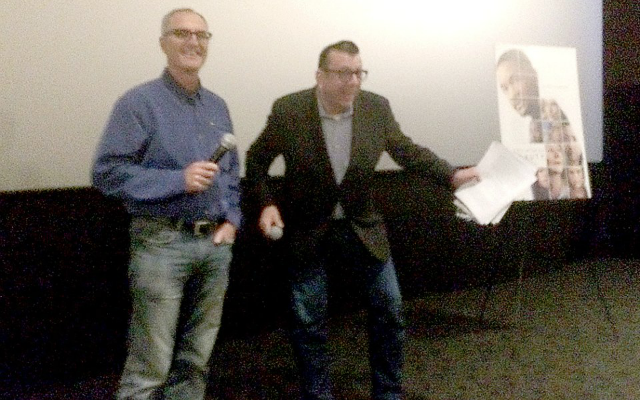
Richard and “Collateral Beauty” director David Frankel spoke in front of an invited audience at a screening of the film in Toronto recently. To hear Frankel (whose other films include “The Devil Wears Prada” and “Marley and Me”) and Richard discuss working with Will Smith, rewriting on the fly and shooting in New York City, keep your ear on the House of Crouse podcast the week of December 16!