A cross between an old school western and a Merrie Melodies cartoon, “The Homesman” is the latest from actor and director Tommy Lee Jones. A rough and tumble look at the harsh realities faced by women in frontier life it sheds light on a little seen aspect of life in the old west. It features a terrific performance from Hilary Swank and a spot on impression of Yosemite Sam from Jones.
Swank is Mary Bee Cuddy, a woman from New York State, now living in Loup City, Nebraska. She’s cultured, wealthy in land and know-how and unmarried. She’s well regarded in the town—one local says she’s “as good a man as many man hereabouts”—but her overtures at romance fall flat. She proposes marriage to Gam Sours (Jesse Plemons) with the caveat, “I won’t take no for an answer,” only to be rebuffed. “You’re as plain as an old tin pale,” he says, “and bossy.”
That may be so, but she has faired better than several other local women (Grace Gummer, Miranda Otto, Sonja Richter) whose fragile mental states have been pushed to the limit by the grim reality of life in Loup City. Cuddy volunteers to transport them on a five-week journey to Iowa where they can be cared for properly.
On the way she meets army deserter, coward and all round scoundrel George “Yosemite” Briggs (Jones). She saves his life and in return he reluctantly agrees to make the journey with them.
“The Homesman” starts off as one thing, a look at Cuddy’s life as it intertwines with these mentally ill women but shifts story wise and tonally with the introduction of Jones’s character. What could have been a tale of female empowerment does a u-turn, shifting the focus to Jones and his cartoonish portrayal of the hard-drinking, jig dancing Briggs. What begins as an unconventional western becomes even less conventional as Jones cuts ghastly scenes of women dumping babies into outhouse holes against more jocular dialogue.
Swank, when she is given something to do, does it extremely well and Tim Blake Nelson as an amorous cowhand is menacing and funny, which seems to be the offbeat tone Jones was searching for, but never quite finds.
Story and character wise “The Homesman” is muddier than the rough terrain it takes place on.
Words like disappointing, dismal and other disparaging words beginning with the letter “d” have been used to describe the summer’s box office yield.
In movieland the summer season is defined as the first Friday in May through Labor Day Weekend, a period that saw revenues fall to an eight year low, down 15% from 2013.
There were some very big hits, like Guardians of the Galaxy and Transformers: Age of Extinction, but even their multi-million dollar grosses weren’t enough to compete with last year’s $4.75 billion overall take.
“We’ve seen this before,” says Michael Kennedy, Executive Vice President, Filmed Entertainment at Cineplex. “Right now everybody’s binging. After a while they will get tired of binge watching TV and say, ‘I’m really tired of being in my house. I want to go out.’”
Kennedy adds that the summer slump could also be attributed to several high profile absences.
“Pixar was originally scheduled to go in the summer with a film that got moved back and Fast and Furious was supposed to go but after Paul Walker’s accident they moved the movie back and nobody replaced it. One or two movies move and millions disappear.”
So how does it work? How do studios and distributors determine a release schedule? Mongrel Media’s Director of Marketing Danish Vahidy says studios put “down the tent pole for flagship properties one, two or sometimes three years in advance. With the success of sequels studios feel more secure planning in advance for franchises rather than an unknown entity.”
That means the wannabe blockbusters from this summer, the X-Men, Godzilla and Teenage Mutant Ninja Turtles et al, probably had release dates attached to them before Prince William walked Catherine Middleton down the aisle at Westminster Abbey.
Kennedy says counterprogramming is one of the keys. “They look at what everybody else does and if they see a Fast and Furious sitting on the second week of July and they have an action movie, they’re staying away from that weekend.”
Mongrel Media took a risk and counterprogrammed a movie that went on to become one of their biggest hits of the summer. “Boyhood was released in July as the summertime nicely captured the notion of childhood set in the film,” Vahidy says. “It was also a great way to counter program with the Hollywood blockbusters and offer movie goers a smart original film as an option.” The critically acclaimed film was aimed at a different audience than the other two big releases that week, Disney’s kid friendly Planes and the raunchy Cameron Diaz comedy Sex Tape. “That move paid off for us as Boyhood is one of our most successful releases ever with a theatrical box-office of over $2.3 million in Canada and growing.”
So why didn’t it work for the big releases this summer? Suggested reasons for the downturn range from a lack of family movies, which traditionally pull in big numbers, too many sequels and superhero movies and even divided attention from the World Cup.
Kennedy adds one more reason. “Everybody has busy lives,” he says. “The one thing we’ve always found is that people always come back. It’s not the price of the movie ticket or the popcorn, it’s putting aside the time to go. People want to go out and we offer the most affordable out-of-home experience there is.”
Since the release of the first Hunger Games novel in 2008, literary sleuths have picked it apart, searching for connections to other books and films.
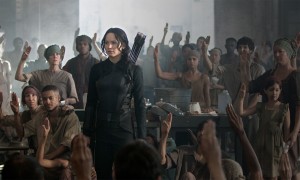
The scrutiny increased when the first film in the tetralogy set records for the biggest opening weekend for a non-sequel in 2012, and continues unabated with the release of this weekend’s The Hunger Games: Mockingjay, Part 1.
Based on Suzanne Collins’s mega-successful series, the movies are set in a dystopian world ruled by a fascist-style president (Donald Sutherland) who presides over The Hunger Games, a televised battle-to-the-death between 24 young players, two from each of the country’s districts, including Katniss Everdeen (Jennifer Lawrence) and Peeta Mellark (Josh Hutcherson).
The series draws on things we’ve seen before, in everything from the human sacrifices of Greek mythology or Survivor-style television shows to news stories of government corruption to create a world with its own rules, style and customs.
The most often-cited influence is Battle Royale, a 2000 Japanese movie based on a book by Koushun Takami. Like The Hunger Games, it’s a story of school kids in a televised government-sanctioned death match.
Battle Royale’s DVD box set even included a quote from a critic suggesting there’d be no Hunger Games without the Japanese film. “This is the movie that started it all,” it reads.
Hunger fans were quick to point out differences in the two films. The Japanese movie is about survival, they said, while Collins wrote about revolution. The author revealed her main influences were reality television and the Iraq war.
“I had never heard of that book or that author until my book was turned in,” she told the New York Times.
It’s worth noting that the idea of humans being preyed upon for the entertainment of the upper classes dates back at least as far as 1932’s The Most Dangerous Game. The story of a big-game hunter who tracks humans for sport on an isolated island is based on a Richard Connell short story that also loosely inspired episodes of everything from Gilligan’s Island to Lost in Space. Since then, Norman Jewison’s Rollerball, Roger Corman’s Deathrace 2000 (and its 2008 Jason Statham remake) and The Running Man have mined similar territory.
As for the author who wrote Battle Royale, he gave ABC News a very diplomatic answer when asked about the similarities between the two stories. “I think every novel has something to offer,” he said. “If readers find value in either book, that’s all an author can ask for.”
Whether they’re invading your condo balcony, blocking the sidewalk, ruining lunch on the patio or bombarding your car, there’s not a whole lot of love out there for pigeons.
But director Scott Harper would like to change all those rat-like perceptions of these noble birds.
“They have a varied and amazing story in service of humankind,” he insists.
“What makes them kind of lovable is that they’ve done all this for us and yet, for the most part, they are greeted with contempt.”
Harper’s documentary, The Secret Life of Pigeons, airs Nov. 20 at 8 p.m. ET on CBC’s The Nature of Things.
“We were looking for a nature story that hadn’t been told yet, and their story was just unbelievable,” he says.
“They are the world’s oldest domestic animal. You see them in ancient Egyptian hieroglyphs, in Mesopotamian tablets,” he notes. “They were the first animals used to communicate. In ancient battles, Genghis Khan, Julius Caesar and the Egyptians used them to send messages across enemy lines.
“They were the first phone service, the first postal service. Before that, they were domesticated as food,” he adds.
“So they’ve been a source of food, they’ve been an amazing source of communication, especially through war, delivering medicines, financial information and, eventually, they also became a source of entertainment; racing the birds, breeding the birds.”
To illustrate the majesty of the city pigeon, Harper strapped a camera on one of them, literally giving us a bird’s eye view of Toronto.
“What you get from that is a perspective on the city, and just how nimble they are.”
Harper’s documentary also profiles Clint Robertson, a Manitoba cattle farmer who has kept birds since he was five, and now has 800 fancy Jacobin pigeons.
His favourite breed is an eccentric-looking bird with “a collar of feathers that grows from the neck and radiates upward, encasing the head. People would not recognize them at all as a pigeon.”
“We don’t know how many varieties there are,” Robertson says. “We are guessing there are in excess of a thousand species of pigeons.”
He notes there are organized pigeon clubs and contests on every continent except Antarctica.
“I’ve judged all over the world. I’ve judged in Saudi Arabia, Bahrain and Qatar. When I go there, it is unbelievable. You walk in and you’re like a rock star. Seven out of 10 men who have hobbies in the Middle East have birds.
Until the early ’80s, worldwide, pigeons were the third-biggest hobby next to stamps and coins.”
Harper isn’t surprised by the popularity of pigeons around the world.
“If you look at them long enough, you’ll see something quite exotic and something quite impressive, as opposed to something dirty.”
Twenty years ago Roger Ebert wrote that a moment in Dumb and Dumber, “made me laugh so loudly I embarrassed myself.”
The movie, starring Jim Carrey and Jeff Daniels as the chicken-brained Lloyd and Harry, made 250 million dollars at the box office and seemed likely to spawn a sequel but nothing happened for almost twenty years. There was a prequel, Dumb and Dumberer: When Harry Met Lloyd, but it was a Carrey-and-Daniel-less exercise in futility I called, “one of the least funny and ineptly made movies to ever play at your local multi-plex,” on its 2003 release.
So why did it take 19 years and 333 days to release a Dumb and Dumber follow-up? Carrey says he wasn’t into doing sequels but softened because everyone kept hounding him, he joked, “even dead people.”
Fans had to wait ages for Dumb and Dumber’s return, but two decades is a mere drop in the bucket when compared to the gap between the 1942 Disney classic Bambi and it’s sequel Bambi II. A ten-year-old who saw the original would have been old enough to send their grandkids to get popcorn refills when the sequel hit theatres overseas (it went direct to DVD in North America) almost sixty-four years later.
Thirty years after Alfred Hitchcock made seagulls menacing in The Birds a made-for television-movie called The Birds II: Land’s End revisited the killer avian story. Tippi Hedren, star of the original, signed on and it was shot in the house from the first film, but that’s where the similarities between the two end. The New York Times called the film “feeble,” and Hedren said, “It’s absolutely horrible, it embarrasses me horribly.”
29 years and 343 days after 1968’s The Odd Couple hit the big screen, writer Neil Simon and stars Jack Lemmon and Walter Matthau reunited for The Odd Couple II. “We always had bad chemistry,” says Oscar Madison (Matthau). “We mix like oil and frozen yogurt.” It marked the last starring roles for each of its leads and the final collaboration between Lemmon and Matthau after making ten movies together.
These days Hollywood seems obsessed with sequels and next year will be no different. Mad Max: Fury Road, starring Tom Hardy in the role that made Mel Gibson famous, returns thirty years after Mad Max Beyond Thunderdome and Jurassic World revisits Jurassic Park III thirteen years later. The biggest sequel news of the year—maybe of the decade—is the December 2015 release of Star Wars: The Force Awakens. In the official Starr Wars chronology the new film follows 1983’s Return of the Jedi after a space of 32 years and 207 days.
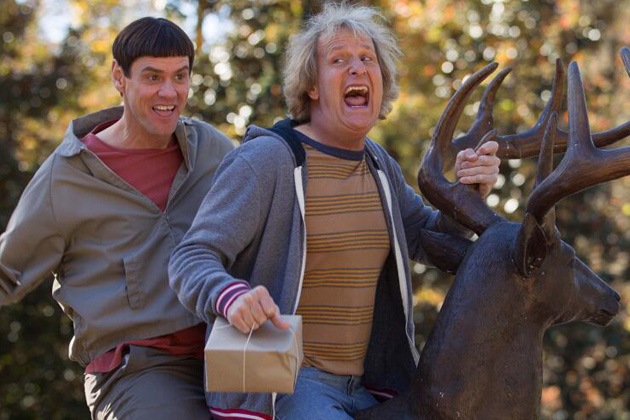
Twenty years ago, in a simpler and sillier time, “Dumb and Dumber’s” Harry Dunne (Jeff Daniels) shrieked at Lloyd Christmas (Jim Carrey), “Just when I thought you couldn’t possibly be any dumber, you go and do something like this… and totally redeem yourself!”
It’s a line that echoes through the sequel, “Dumb and Dumber To.” Can the Farrelly Brothers find redemption after a string of flops by resurrecting their most famous characters and out dumb and out funny the modern sultans of silly, Seth McFarlane and Judd Apatow?
The new film begins in present day. Lloyd has spent two decades at a Baldy View Psychiatric Hospital, traumatized by the loss of his love Mary Swanson. Or is he traumatized? On one of his weekly visits Harry discovers Lloyd has been faking his comatose state for twenty years as a gag. “That’s awesome,” he says. “I feel for it hook, line and sphincter.” Reunited, they hit the road, this time in search of a daughter (Rachel Melvin) Harry never knew he had. She’s the “fruit of his loom” but could also be the kidney donor he needs to save his life.
The experience of watching “Dumb and Dumber To” is like spending the weekend with your hamster brained nephews. It’s super fun to see tem when they first arrive, but by Saturday night their antics have started to grow thin. By Sunday you’re wondering how you can miss them if they won’t go away.
Twenty years later Harry and Lloyd haven’t gotten any wiser but they haven’t gotten much funnier either. There are some astoundingly unPC gags—and I mean that literally—here, but none that reach the otherworldly vulgarity of the original’s laxative overdose scene. Instead it’s wall-to-wall jokes and one-liners, some hit, most don’t and nothing, save for the “Did you hide them in this turkey?” scene reach the level of McFarlane or Apatow outrageousness.
Carrey, however, is on overdrive. When he isn’t flailing about he’s mouthing malapropisms like, “That’s water under the fridge,” and what the material lacks in actual funny lines, Carrey makes up in sheer enthusiasm. For his part, Daniels leaves the dignity of “The Newsroom” behind, showing his behind more times than is comfortable for anyone.
“Dumb and Dumber To” is predictably silly, amiable stuff, which, I suppose, explains why it isn’t called “Dumb and Dumber Quantum Entanglement.”
Hollywood is in the habit of remaking everything these days, relying on brand recognition to sell their movies, so it’s hard to understand why this remake of “The Bodyguard” is called “Beyond the Lights.” Sure, the character names are different, it was written by different people, Kevin Costner is nowhere to be seen and it’s an “original” story but a sense of déjà vu hangs heavy over the movie’s every frame.
When we first meet Noni Jean she’s a young girl with a set of pipes to revival any American Idol contestant. Her mother and manager—her momanger—Macy Jean (Minnie Driver) is a determined presence with her eye set on superstardom for her daughter. Cut to a few years later, Noni (Gugu Mbatha-Raw) is now a hip hop star à la Rihanna. She’s on the cusp of fame, has a rapper boyfriend and a record about to come out that is guaranteed to be a hit. One night, just days before a big performance at the Billboard Awards, the pressure gets to be too much and Noni tries to jump off the balcony of her hotel room. She is rescued by Kaz (Nate Parker), a handsome police officer working on her security detail who grabs her hand just as she is about to tumble in to the tabloid headlines.
A romance blossoms between the two, despite the protests of their parents. Kaz’s father (Danny Glover), a retired police officer is grooming his charismatic son for a career in politics while Macy Jean simply wants sever any ties to the suicide story. Noni and Kaz, however, have a special bond, one born out of an understanding of what it’s like to have pushy parents and wanting to do your own thing.
Director Gina Prince-Bythewood trowels the melodrama on thick in this sensationalistic show-biz fable but that doesn’t stop her from commenting on the downside of notoriety in a way that hasn’t been done since “A Star Is Born” chronicled the decline of singer John Norman Howard (Kris Kristofferson). It’s an occasionally scorching look at the world of fame, but defaults to soap opera theatrics to keep the plot moving forward.
None of this would register if Gugu Mbatha-Raw and Nate Parker weren’t such compelling performers. Mbatha-Raw wowed in last year’s “Belle” and shines here playing both sides of Noni’s personality, the onstage diva and conflicted offstage woman. If anyone sees “Beyond the Lights” a star may be born. Her chemistry with Parker is undeniable and together they overcome the film’s unnecessary plot theatrics.
“The Daily Show’s” brand of satirical political humour has become a legit source of news for many young people and is so influential Barack Obama has been a frequent guest. But being on the show hasn’t always worked out well for guests.
In 2009, Iranian Canadian journalist Maziar Bahari (Gael García Bernal) was arrested and detained for 118 days after an interview he did on “The Daily Show” aired. The tongue-in-cheek piece featured regular correspondent Jason Jones claiming to be an American spy interviewing Bahari. Iranian officials, under the rule of newly “elected president” Mahmoud Ahmadinejad, didn’t get the joke and Bahari was roused from his mother’s home and taken to jail while his pregnant English fiancée (Claire Foy) waited four months not knowing what was to become of the father of her child.
While in solitary at Evin Prison Bahari is blindfolded and interrogated by The Specialist (Kim Bodnia), a zealot who smells of rosewater. Breaking Bahari’s spirit, the interrogator convinces him to make a televised statement denouncing his actions as a “spy” for Iran’s enemies.
This is a true story, based on a memoir written by the main character, so it is no spoiler to mention that after months of physical and mental torture he is released just in time to see his child born in England.
Jon Stewart, stepping out from behind the “Daily Show” desk and into the director’s chair, divides the movie into two halves. The first half concentrates on Bahari’s coverage of the election. It’s fast, frantic and occasionally even funny mix of news and original footage that sets the scene for what is to come.
The second hour, post arrest, is slower, but more intense. It’s a rollercoaster of emotions as Bahari tries to figure out why he is there and what will happen. The blindfold adds to his fear; sightless he can’t see where the next slap might come from. The dynamic between the questioned and his questioner shifts constantly, never more so than in a scene where Bahari, Scheherazade-style, strings the Specialist along with some randy (and untrue) stories of his one thousand and one nights spent in exotic massage parlors.
Their interaction is at the heart of “Rosewater.” Stewart hasn’t opened the story up much in terms of building subtext—unlike his work on “The Daily Show,” the movie is very straightforward—but does bring sincerity and emotion to the film but the over-all “never give up” message seems trite given the backdrop of the story.
Things get hairy for Cayden (Lucas Till) when he discovers a secret about himself. One night, under the light of the silvery moon he turns from high school football star to werewolf fugitive on the run for the grisly murders of his girlfriend and parents.
With the help of lone wolf Wild Joe (John Pyper-Ferguson) he finds refuge in Lupine Ridge, home to farmer and wolf John Tollerman (Stephen McHattie), bar owner Angel (Merritt Patterson) and warring packs of werewolves. Here he hopes to find answers regarding his strange affliction. His presence is welcomed by some of the locals, but pack leader, the big bad wolf Connor (Jason Momoa) doesn’t take kindly to Cayden and wants him gone, one way or another.
“Wolves” is part of the curious genre of teen werewolf movies. There’s romance, mild gore and buff wolves running shirtless through the forest. The only thing missing for teen wolf enthusiasts is Taylor Lautner.
It’s “Twilight”—or maybe should have been called “Tween Wolf”—with characters who have to comb their faces but within its parameters it works well. There aren’t a lot of surprises, but the all-important transformation scenes are furry fun and any horror film with Stephen McHattie is worth a look. On the downside there’s too much narration and Mamoa is a one-note standard issue villain, complete with a top hat and mustache I was surprised he didn’t twirl at least once.