It’s said the people of Pompeii regarded the eruption of Mt. Vesuvius in 79 A.D. with “a response more of curiosity than of alarm.” The volcano had burped and belched as many as 50 times over the years, so most of the city’s 20,000 citizens didn’t pay attention when Vesuvius started to gurgle.
Perhaps they were too busy visiting one of the city’s many brothels — like a proto-Las Vegas, this was the richest city of ancient times, ripe with amenities and vice — or enjoying their lunches of broad beans, olives, dormice (plumped up by chefs in terracotta jars) or even garum, made from the first blood of a still-gasping mackerel, to detect the cloud of deadly volcanic ash headed their way.
By the end of the day the dust “poured across the land,” claiming 2,000 lives. Buried beneath, “a darkness… like the black of closed and unlighted rooms.” The remains of Pompeii and its people were preserved, left untouched for two millennia.
Today the ancient city of Pompeii is one of the most popular attractions in Italy, drawing almost three million tourists annually. But if you can’t make it to the Italian region of Campania, a new movie aims to recreate the experience for you.
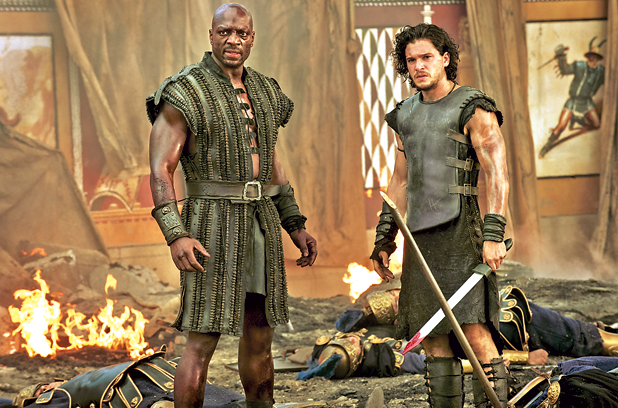
Pompeii stars Kit Harington, Carrie-Anne Moss, Emily Browning and Kiefer Sutherland in a love story about a slave-turned-gladiator (Harington) who must rescue his beloved, Cassia (Browning), before a rolling mountain of lava and ash dooms her to the ages.
The big action adventure take on the story directed by Resident Evil helmer Paul W.S. Anderson has an ancestor in The Last Days of Pompeii, a 1913 silent sword-and-sandal movie based on the Sir Edward Bulwer-Lytton novel of the same name. That book has been remade eight times.
The most famous version came in 1959. The big budget CinemaScope production was to have been directed by Mario Bonnard, but when he fell ill on the first day of shooting, screenwriter Sergio Leone (who would go on to make classics like The Good, the Bad and the Ugly) stepped in. It’s big on pageantry, just as the advertising taglines would suggest. It’s a “Fiery Summit of Spectacle,” the posters screamed, promising an inside look at, “the City that Lived in Sin and Died in Flame!”
Certainly it’s more puffed-up than Up Pompeii, a 1971 Frankie Howerd comedy that featured a speech by emperor Ludicrus Sextus during Vesuvius’ eruption.
“I say, Lurcio, how did my speech go?” he asks his servant as the city crumbles.
We’re celebrating everyone’s favourite award show in true Drake style. Put on your best threads + play our Oscar pool while snacking on free popcorn from the Drake kitchen. Did we mention the evening is hosted by cinema king Richard Crouse? Meet us here + challenge your friends in a match of cinematic trivia. There’s great prizes to be won + even a special bubbly menu to choose from, while cheering on your picks from the silver screen.
Claritas est etiam processus dynamicus, qui sequitur mutationem consuetudium lectorum. Mirum est notare quam littera gothica, quam nunc putamus parum claram, anteposuerit litterarum formas humanitatis per seacula quarta decima et quinta decima.
It’s the second cinematic go-around for David Mamet’s 1974 play, “Sexual Perversity in Chicago.”
The 1980s version was a peak into the lives of yuppified twenty-somethings played by pretty people Demi Moore and Rob Lowe.
The new version, in theatres this weekend, changes the location form Chi-Town to Los Angeles, focusing on singles in their 30s. The story hasn’t changed that much, just the faces; this time around the pretty people are played by Michael Ealy, Regina Hall, Kevin Hart and Joy Bryant.
The story focuses on two couples. Danny (Ealy) and Debbie (Bryant) and Bernie (Hart) and Joan (Hall). The former are lonely hearts who find one another, but don’t discover the passion needed to sustain their relationship. The latter are all passion with no firm commitment outside of kinky sex and “No you didn’t!” one-liners.
Like the original film the story is organized around various holidays and seasons and follows most of the same plot points but that’s where the similarity ends. Keep in mind, this isn’t a remake of David Mamet’s play, it’s a remake of a movie that was based on Mamet’s play, so there is no reverence for the tone established by one of America’s leading playwrights.
The easy sentimentality of the 1986 film has been replaced by raunchy jokes and situations, and if it is possible for a film, outside of the kind that play at The Pussycat Theatre, to have too many sex scenes, “About Last Night” is that movie. Instead of plot we’re handed sex scenes, but the kind of sex scenes that happen under blankets and reveal nothing, physically or story wise.
The story relies on the characters to maintain interest, but although they intersect—one of the movie’s stylish twists is the intercutting of scenes between the men and women to highlight their similarities and contrast their differences—the two couples seem to be from different movies.
Hart and Hall appear to be making a farce, while Ealy and Bryant are entrenched in a more sentimental—and duller—film. Hart and Hall have enough personality to make up for the dreary pretty people, but your enjoyment of the film overall may well be linked to your capacity for Kevin Hart’s wild antics.
“About Last Night” is frisky and a little freaky, but not as funny or insightful as it thinks it is.
Santiago divorcee Gloria (Paulina García) is a character in search of a story. Director Sebastián Lelio has stranded the fifty-eight-year old free-spirited woman in a film that plays like a series of incidents rather than a fully realized story. García brings empathy to the woman, painting a picture of a person making the best of lonely life, but the components of story, like a strange, passionate affair with Rodolfo (Sergio Hernández), are so underdeveloped it’s difficult to feel any connection to the characters or situations. García, complete with her Tootsie glasses, does interesting, brave work, but the story does not support her.
I am not a cold-hearted man. I like love stories as much as anyone and, as a fan of Say Anything, almost well up whenever I hear Peter Gabriel’s “In Your Eyes,” but the sledgehammer romance of “Winter’s Tale” left me feeling bruised rather than buoyed. What is meant to be an uplifting experience about the power of love and the triumph of good over evil felt more like being strapped to a chair and force-fed all nine seasons of “Touched by an Angel.”
Based on the best-selling novel of the same name by Mark Helprin and brought to the screen by Oscar winning writer-turned-director Akiva Goldsman the story begins when Peter Lake (Colin Farrell), a turn-of-the-last century burglar, comes across the love of his life while robbing a mansion he thought was empty.
Beverly Penn (Downton Abbey’s Jessica Brown Findlay) the beautiful-but-doomed daughter of a wealthy newspaper tycoon, is a precocious and philosophical young woman with just months to live. He wants to save her, but first he must save himself from demonic crime lord Pearly Soames (Russell Crowe), a brutal man who wants Lake dead. Then, in a twist suggested by the Brothers Grimm, he finds himself thrust one hundred years into the future with only the faded memory of Beverly and a white guardian angel horse as company.
The opening narration let’s us know that “magic is everywhere around us.” I just wish that some of that magic had spilled into the screenplay. The movie’s mix of metaphysical romance, magic realism and demonic revenge is a strange stew that worked well in the novel but seems to have lost something in the translation to the screen. In other words, perhaps the sight of Colin Farrell flying above New York on a winged Pegasus is best left in the mind’s eye.
As silly as the movie is, and make no mistake, this is what I like to call an S.D.M.—Silly Damn Movie—Farrell and Findlay manage to bring the romantic side of the tale alive. Their first meeting, over a cup of tea, is simple, effective and bristles with sexual tension. The love story, although a bit starry-eyed, works until the magic realism takes over and the story becomes loopier and loopier. By the time the words, “Is it possible to love someone so much they can’t die?” spill from Farrell’s lips all is lost, and that’s not even an hour into the story.
Putting aside the enchanted horses and dime store spirituality for a moment, the story often requires leaps of faith that would have even terrified Evel Knievel. This is the kind of movie where mothers willingly hand over their sick children to scruffy looking strangers on the promise of a miracle. It’s the kind of movie where people accept outlandish events with a tossed off phrase like, “How’s that even possible?” It’s the kind of sloppily plotted movie that involves a level of suspension of disbelieve so off-the-charts it’s almost in outer space.
“Winter’s Tale” is a frustrating movie. It overly complicates a boy-from-the-wrong- side-of-the-tracks-meets-rich-girl story with a bunch of hocus pocus that wastes some good work from Farrell, Findlay and Russell Crowe.
Tune into “Extra Entertainment Extra” on NewsTalk 1010 on Saturday February 15, 2014 at 4:30 pm to hear Stedman Graham speak about his new book “Identity: Your Passport to Success.”
From amazon.ca:
Features a foreword by John Maxwell and afterword from Steven R. Covey.
Have you ever thought about the connection between knowing who you are and success? Identity can serve as your greatest asset. Enduringly successful people know who they are, are clear about what matters to them, have established powerful identities, and create value in the world.
In this book, the process for discovering and understanding your identity is brought to life through Stedman Graham’s personal experiences and the stories of individuals who’ve resolved their questions of identity, building a life that matters to themselves and those around them.
Take control of who you are. Take control of your life. Achieve lasting success.
 By Richard Crouse – Metro Canada