SYNOPSIS: A throwback to the twisty-turny courtroom dramas of the 1980s and 90s, “Juror #2,” now playing in theatres, sees Justin Kemp (Nicholas Hoult) called for jury duty. Like many people, he has a laundry list of reasons why he shouldn’t have to do his civic duty. Nonetheless, he’s chosen to serve at a high-profile murder trial, one that will test his pledge of being fair and impartial in the jury box.
CAST: Nicholas Hoult, Toni Collette, J. K. Simmons, Chris Messina, Zoey Deutch, Kiefer Sutherland. Directed by Clint Eastwood.
REVIEW: Clint Eastwood’s 40th directorial effort is a potboiler, but with the high-minded purpose of examining issues of justice and the price of doing the right thing.
No spoilers here, what follows is the story of the film, but if you want to go in with a blank slate, skip the next paragraph.
Once seated on the jury, Kemp, a man who has pulled his life together since quitting drinking four years previous, realizes that he, and not the accused, is responsible for the death at the center of the prosecution’s case.
That provides the moral dilemma at the heart of “Juror #2.” Kemp’s feelings of self-preservation versus his responsibility to truth and justice hangs over the entire film like a shroud.
Hoult shows us Kemp’s dilemma rather than tell us about it. It’s an introspective performance, one that relies on his anxious exterior and the tortured look behind his eyes. Hoult isn’t flashy, but in his restraint, he paints an effective portrait of a soon-to-be father who is torn up inside.
For the second time in as many months J.K. Simmons, after his bravura work in “Saturday Night,” swoops in and steals every scene he’s in, and then gets out of the way to let Eastwood and Hoult finish the job.
For the most part Eastwood keeps the storytelling taut, allowing Kemp’s quandary to take center stage. It’s not exactly suspenseful, but Eastwood, who turned 94 last May, unfurls the story of conflicted morals in a solidly entertaining, if not exactly innovative, way. The story beats feel reminiscent of the big courtroom dramas of years ago, but Eastwood carefully, and cleverly works his way through moral conundrums to ends up at a restrained, but devastating finale.
“Juror #2” is a little old fashioned, but in all the right ways. Age has not diminished Eastwood’s ability to tell a story, keep the audience engaged and give them something to think about once the end credits have rolled.
The spirit of Steve Reeves lives on. If you aren’t familiar with Mr. Reeves’ oeuvre, he was Hercules before Kevin Sorbo, a legend of beefcake historical drama movies. His movies were all about bulging muscles, swinging swords and damsels in revealing togas.
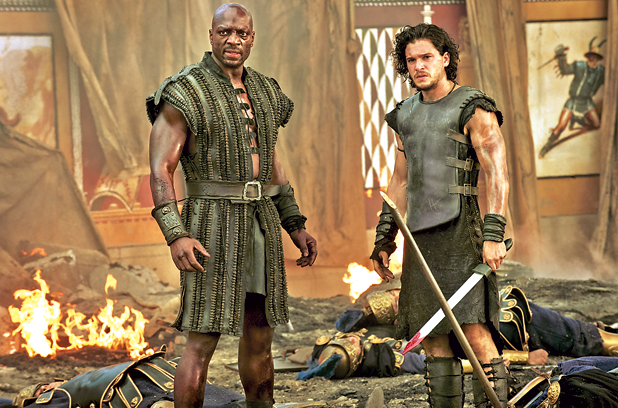
Which brings me to the spiritual cousin to the Reeves movies, Pompeii, which adds spewing lava, but not much else to the sword and sandal genre. Physically Jason Statham sound-a-like Kit Harrington is up to the heroic Reeves role but is slowed down by the thick layer of molten cheese covers almost every frame of this film.
Set in the shadow of the gurgling volcano Mount Vesuvius, Pompeii Game of Thrones heartthrob Harrington is the muscle bound Milo. His tribe, including his entire family, was wiped out by the vicious Roman Senator Corvus (Kiefer Sutherland) dooming him to a lonely life of servitude under the thumb of Roman masters.
Years later as a gladiator in Pompeii’s coliseum he sees a way to exact revenge and save Cassia (Emily Browning), the most beautiful girl in the lush resort town. As warriors Milo and Atticus (Adewale Akinnuoye-Agbaje) battle Roman soldiers in the coliseum the volcano erupts, causing havoc.
Will Milo get vengeance and save Cassia before a rolling mountain of lava and ash covers the city?
Harrington, Sutherland and Browning are the above-the-title stars here, but the real scene-stealer is Mount Vesuvius. Unfortunately it takes way too long for the volcano to to blow its top and when it does the special effects aren’t quite as spectacular as you might hope from a CGI extravaganza. As you might expect there are flying lava meteorites, bubbling lava and crumbling buildings, but it’s mostly just a bombastic CGI fest.
On top of that is muddy looking 3D that would make Steve Reeves squint. The film overall is dark as though the whole thing was shot through a cloud of volcanic ash.
I did get a kick out of a prison guard loudly waking up the jailed gladiators by shouting, “Wake up scum!” but by the time the credits started to roll I felt that slave trader Graecus was speaking directly to me when he said, “You dragged me from a perfectly good brothel for this?”
It’s said the people of Pompeii regarded the eruption of Mt. Vesuvius in 79 A.D. with “a response more of curiosity than of alarm.” The volcano had burped and belched as many as 50 times over the years, so most of the city’s 20,000 citizens didn’t pay attention when Vesuvius started to gurgle.
Perhaps they were too busy visiting one of the city’s many brothels — like a proto-Las Vegas, this was the richest city of ancient times, ripe with amenities and vice — or enjoying their lunches of broad beans, olives, dormice (plumped up by chefs in terracotta jars) or even garum, made from the first blood of a still-gasping mackerel, to detect the cloud of deadly volcanic ash headed their way.
By the end of the day the dust “poured across the land,” claiming 2,000 lives. Buried beneath, “a darkness… like the black of closed and unlighted rooms.” The remains of Pompeii and its people were preserved, left untouched for two millennia.
Today the ancient city of Pompeii is one of the most popular attractions in Italy, drawing almost three million tourists annually. But if you can’t make it to the Italian region of Campania, a new movie aims to recreate the experience for you.
Pompeii stars Kit Harington, Carrie-Anne Moss, Emily Browning and Kiefer Sutherland in a love story about a slave-turned-gladiator (Harington) who must rescue his beloved, Cassia (Browning), before a rolling mountain of lava and ash dooms her to the ages.
The big action adventure take on the story directed by Resident Evil helmer Paul W.S. Anderson has an ancestor in The Last Days of Pompeii, a 1913 silent sword-and-sandal movie based on the Sir Edward Bulwer-Lytton novel of the same name. That book has been remade eight times.
The most famous version came in 1959. The big budget CinemaScope production was to have been directed by Mario Bonnard, but when he fell ill on the first day of shooting, screenwriter Sergio Leone (who would go on to make classics like The Good, the Bad and the Ugly) stepped in. It’s big on pageantry, just as the advertising taglines would suggest. It’s a “Fiery Summit of Spectacle,” the posters screamed, promising an inside look at, “the City that Lived in Sin and Died in Flame!”
Certainly it’s more puffed-up than Up Pompeii, a 1971 Frankie Howerd comedy that featured a speech by emperor Ludicrus Sextus during Vesuvius’ eruption.
“I say, Lurcio, how did my speech go?” he asks his servant as the city crumbles.
The apple, as they say, doesn’t fall far from the tree. Not only has Kiefer Sutherland followed the famous footsteps of his parents, Donald Sutherland and Shirley Douglas, into the acting biz but he seems to have also inherited some of the fire of his grandfather.
When I compliment Sutherland on his glasses, a pair of retro-looking heavy frames, his passion flares.
“In the 30’s Roosevelt made a deal between Moscot and the federal government,” he says. “Anybody who needed glasses during the great depression got these glasses for free. They made millions of them. So anyone who says there was never a National Healthcare in the States is a liar. That was the first national healthcare program where they provided glasses for free for the entire country.”
Echoes of his grandfather, Tommy Douglas the father of Canadian health care, hang in the air.
He’s equally passionate when he speaks of his admiration for his latest director, Lars Von Trier, the controversial filmmaker behind Melancholia.
“I have a great affection for Lars,” he says. “I’ve done eighty some odd films. I’ve done one hundred and ninety eight episodes of 24, which is the equivalent of another 100 movies and this was the most unique experience I’ve had as an actor.”
Von Trier, the outspoken Danish director broke down the way his actors were used to working, doing away with lengthy rehearsals and traditional blocking.
Sutherland explains how, on his first day of shooting, Von Trier threw him and co-star into a complicated scene. “He walks Charlotte Gainsbourg and I to a door. He says, ‘OK this is the room. I want you to play this scene on the other side of this door. We’re all set and ready to go, and you just go do it. ‘
When Sutherland objected Von trier told him to, “Stop talking.”
“We went and did the scene and he deconstructed everything I’ve learned as a technical actor,” he says. “John Hurt has my favorite line in the entire movie. He’s dancing and I’m walking with all the drinks for the table. As I walk by he says, ‘I have no idea what I’m doing!’ We all felt like that. I don’t know what I’m doing either! And that’s exactly how Lars wanted it. That was the spirit of it.
“It’s something that I will carry with me for the rest of my career.”