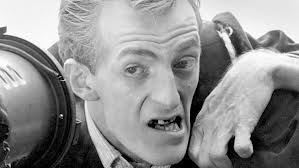
You might imagine that horror maestro George A. Romero’s favorite film is The Exorcist. Or maybe Cannibal Holocaust. Or even The Texas Chainsaw Massacre. It’s easy to picture the twisted mind behind Night of the Living Dead curled up in his Toronto home with the Saw marathon unspooling on his blood splattered DVD player. Easy to imagine, but far from the reality. Most nights you’ll find him rewatching a classic. Maybe The Brothers Karamazov, Casablanca or Dr. Strangelove. Nary a decapitated head or disembowelment in the bunch! He also loves The Quiet Man, High Noon and King Solomon’s Mines but his all time favorite is an obscure 1951 Michael Powell film called The Tales of Hoffman.
“It’s the movie that made me want to make movies,” he says.
“I was dragged kicking and screaming by an aunt and uncle. I wanted to go see the new Tarzan; the new Lex Barker movie to see how he stacked up against Weissmuller and they said, ‘No! We’re going to see this,’ and I fell in love with it. It’s just beautiful. Completley captivating. It’s all sung. It’s all opera. It’s not like The Red Shoes where there is a story running through it and then Léonide Massine does a ballet at the end. I just fell in love with it from the pop.
“He did it on a low budget. You could see the techniques he was using; he was reversing action, doing overprints, double exposures and it seemed accessible. I think at that age if I had seen Jurassic Park I would have said ‘Forget about it, I don’t know how to do this dinosaur thing’ but I could see how Powell made the film and it was accessible to me. It made me think that maybe someday I could do something like this.”
All these years later Hoffman and other films of that vintage still move him—“I’m a sucker for the old movies I loved as a kid,” he says. “I put them on and I get a tear in my eye when the overture starts.”—but don’t think he’s getting soft. The man known to fans as the “Grandfather of the Zombie” has a new gut wrenching (literally) movie called Survival of the Dead in theatres this weekend.
Like his previous movies it works on a couple of levels. “Goremets” will appreciate his signature style with the blood and guts but wipe away some of the red stuff and the social commentary of his work becomes clear. “I bring the zombies out of the closet when I have something I want to talk about,” he says.
His classic Night of the Living Dead touches on Cold War politics and domestic racism, while others in the Living Dead series shine a light on consumerism, the conflict between science and the military and class conflict. The new one, the sixth in the series, is a lesson in the futility of war. Inserting these ideas into the films is very important to Romero whether audiences get it or not. He says he knows most people are “there either to just take the ride or watch the gore, chuckle at the gore, and don’t care about the other stuff,” but his work has had a profound effect on a couple of generations of filmmakers.
Quentin Tarantino, who says the “A” in George A. Romero stands for “A f**king genius,” cites the director’s fierce independent style as an influence and Romero’s blend of speculative fiction and social comment is particularly apparent in the work of Guillermo del Toro.
When I mention this to Romero he says, “Guillermo is my man! He runs a close second to Michael Powell in my mind.”
“The Walk Back,” a new drama from “Master and Commander: The Far Side of the World’ director Peter Weir, is a sprawling epic with a very personal focus. Set against the backdrop of war, inhumanity and an almost insurmountable challenge, it is about that most personal of things, survival.
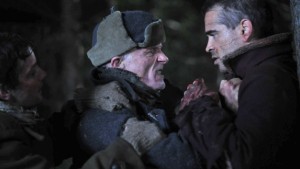
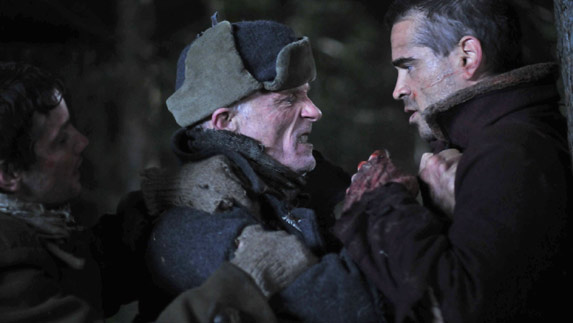
Based on a controversial memoir written by Slavomir Rawicz, the film begins with Polish solider Janusz (Jim Sturgess) sent to a hellish Siberian gulag in 1941 on trumped up charges. Sentenced to ten years—a term he knows he won’t survive—he and a group of prisoners, including a grizzled American soldier (Ed Harris) and a violent Russian criminal (Colin Farrell) make a break for it. Their goal? Freedom. The obstacle? A 4000 kilometer walk through the harsh terrain of Mongolia, China and Tibet on the way to India and a new life. Along the way they pick up one more traveler, a young girl (Saoirse Ronan) whose camaraderie helps bond the ragtag band of escapees.
“The book was published in 1956 and called The Long Walk by Sławomir Rawicz,” Peter Weir said on a recent stop in Toronto to promote the movie. “There is no question from documents that later appeared after the fall of the Soviet Empire when KGB documents were briefly available, that yes, Rawicz had been in a gulag. But did he go on the walk or not? Question mark.
“So the first thing I said was, ‘I can’t do a true story called The Long Walk, but I can fictionalize it based on, or inspired by the book and based on true events if I can prove the walk actually happened.’ We got that proof and I felt comfortable going around the Rawicz question and not saying it’s his personal story.”
To add detail to his fictionalized tale Weir says he became deeply immersed in the subject.
“I became somewhat obsessed with it I think, even though I was fictionalizing it,” he says. “[I learned] through deep background reading, through accounts of those who had gone through the situation in one form or another, including Polish prisoners and soldiers who had been caught up, rather like my central character. I then interviewed survivors in Moscow and Siberia and in London and I just crammed as much as I could into the screenplay.
Weir says that while he strove for absolute authenticity in the film, he had to temper the depiction of life in the gulag for the big screen.
“I did restrain myself from what I was finding in research. Obviously in the worst situations there was a commandant who was a sadist and there were, to a degree, worse situations. So I chose something that I felt was reasonably representative of a number of these hundreds of camps and gulags.”
At the heart of the film is Jim Sturgess as Janusz, the determined and kind-hearted leader of the escapees.
“I’d seen Jim Sturgess for the first time in Across the Universe and thought how well cast he was as a young Beatle as it were,” says Weir. “He has that kind of guilelessness and openness that I needed for my character.
“He’s one to watch. In my film firstly,” he laughs, “and in whatever else is coming up for him.”
I was in Los Angeles last March when Dennis Hopper received his star on the Walk of Fame but decided not to go down and check out the ceremony. It was being billed as his last public appearance and something inside me didn’t want to see him wasted away and frail. As someone who has witnessed, up close and personal, the terrible effects of cancer I thought it would be too much and preferred to remember him as the stoned Billy from “Easy Rider” or “Blue Velvet’s” unhinged Frank Booth. But one photograph from the event made me regretful I didn’t make the trip to Hollywood Boulevard (it’s in front of Grauman’s Egyptian Theater) that afternoon. Most of the coverage focused on Hopper and his frail state; his arm bandaged and wearing a hat that looked a size or two too big for his wizened head, but a photo of the actor with his old buddy Jack Nicholson was filled with such warmth I would have liked to have been there to soak up the vibe. It’s a simple picture, just the two old guys smiling and laughing at some unheard joke. I know it’s the kind of picture that frequently comes out of these events and these men, who have spent their entire lives in the public eye, certainly know the value of putting a happy spin on a melancholy event, but in this case it looks genuine, like two old friends sharing a private moment. I hope it is. I hope in the midst of Hopper’s battle with cancer—and his ex-wife—the moment in the photo is genuine and provided the actor with a respite (however brief) from the pain. I only met Hopper once, but it was a memorable interview for a less than memorable film. It took place at an Italian restaurant in The Grove behind the Farmer’s Market (where Hopper’s old friend James Dean ate his last meal on the day he died) in Los Angeles. It was a junket for “Knockaround Guys” and he was one of three or four interviews, the others being Vin Diesel, Seth Green and maybe one or two others. Unlike most of these junket situations, this time the interviews were out in the open, and the reporters could all watch each other work. I remember watching in horror as one 19 year-old-twinkie, who clearly didn’t know who Hopper was, do her interview. She, I guess, was there to speak to Seth Green and Vin Diesel and was just killing time with Hopper. Her interview started with, “So! How did you get into acting?”—he mentioned Lee Strasberg, Brando and a few other names she didn’t recognize—and went downhill from there. At the time it seemed like I was watching the end of entertainment journalism. Who could do this for a living and not know who Dennis Hopper was? Luckily he was treated with more respect by everyone who came after. I got to him later in the day. He was wearing a three piece banker’s suit and smoking a cigar that must have been a foot-and-a-half long. I honestly don’t remember what we talked about, but I do remember his energy. In real life he seemed powerful, intimidating and edgy, much like many of the characters he played. He was exactly as I imagined him to be and I walked away feeling like I had just met a legend. Like anyone whose career spanned decades Hopper made some great movies, some good ones and some not-so-good ones, but I don’t think we’ll see the likes of him again. Is there an actor working today who could terrify and shock audiences as Frank Booth in “Blue Velvet” and charm them as Shooter in “Hoosiers” in the same calendar year? He had a unique ability to channel his demons into believable and riveting performances. His presence filled the screen and now that his career is over he won’t be remembered as a great leading man—he never quite made that leap—but a great character actor who was a name above the title star. The unpredictability that fuelled his personal life and often sidelined his career informed his characters and unlike so many of his contemporaries he was never less than interesting and certainly never bored the audience. Is there a better tribute to an actor?
During the tent pole seasons, and no that’s not an Anthony Weiner joke, movies are driven by marketing as much as by stars or storyline. Summer and Christmas releases (again, not a Weiner gag) are lavished with marketing budgets that in some cases dwarf the overall cost of the movie. This weekend, for instance, it’s been reported that Super 8 (which I think is super great) cost $45 million before Paramount’s salesmen and women got a hold of it and spent an additional $50 million to raise awareness.
Movie posters are just one way to grab the public’s attention and this week two very different posters caught my eye. They’re weren’t the fancy-dancy new “motion posters” studios are now using to grab bored commuter’s eyes in the subway, but studies in contrast as to how two different advertising campaigns can be used to grab the same audience.
Super 8, J.J. Abrams and Steven Spielberg’s homage to 80s action adventure is aimed directly at the 18 to 45 year-old market and is tracking best among audiences over age 30, who have fond memories of E.T: The Extra-Terrestrial or Close Encounters of the Third Kind.
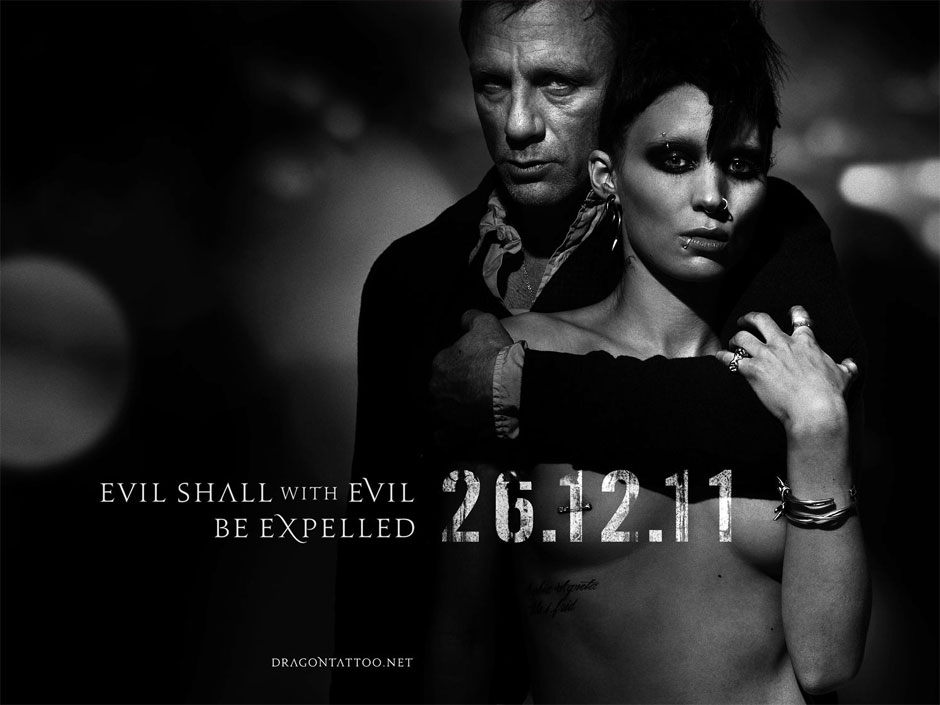
For different reasons David Fincher’s upcoming Christmas release , the R-rated The Girl with the Dragon Tattoo, is also looking for a piece of the 18 to 45 year-old pie. Billed by Sony as “The feel bad film of Christmas” the international poster is so provocative the only fond memories it’s likely to invoke are of an S&M dungeon.
Hence the tale of two posters.
Super 8’s artwork is a throwback to the great hand-painted posters Drew Struzan did for the holy box-office trinity of Lucas-Spielberg-Zemeckis movies. Evoking a late 70’s, early 80s vibe it blows apart the contemporary idea of poster design, replacing one central image with a photo-realistic painted collage of faces placed against a backdrop of locations pulled from the film. It’s a warm and fuzzy illustration that by its connection to the posters of E.T. and Indiana Jones subconsciously promises a Spielbergian good time.
In stark contrast the teaser poster for The Girl with the Dragon Tattoo is a bleak black and white image, complete with star Rooney Mara’s pierced nipples and Daniel Craig’s hangdog facial expression. Unless you live in Sweden you’re unlikely to see this Robert-Mapplethorpe-by-way-of-Helmut-Newton placard hanging in your local multiplex, but it’s available online and has already set tongues waggling. Sex sells—one blogger even posted, “You don’t get to 500 million dollars worldwide without showing a few nipples.”—but it remains to be seen if this brand of hypersexualized art will attract or repel audiences.
Either way, both posters do a great job of contextualizing the appeal of the movies they represent.
Super 8 is all innocence, a throwback to a time before sexting when the world had a beautiful blue camera flare every now and again (on film anyway).
The Dragon Tattoo poster is more a character study. Lisbeth Salander, one of the great female characters of recent years, is portrayed as dangerous, defiant with a flash of menace in her eye. It’s a take no prisoners picture that dares you to see the movie.
These two very different marketing visions prove that even in our busy lives, bombarded as we are by images and information, that pictures can still elicit strong, intuitive feelings.
George Lucas said it brought a tear to his eye, describing it as “one of those moments in history, like the invention of the light bulb or the first telephone call.” Weepy George isn’t talking about the cure for cancer or the map of the human genome. No, the waterworks tuned on at the sight of the test footage of the computer generated dinosaurs created for Jurassic Park, the film that for better and for worse ushered in an era of reliance on computer generated images.
Of course filmmakers have been using computers to manipulate film imagery at least as far back as 1973’s Westworld, the Yul Brenner movie which exposed audiences to the first 2D computerized images, but this photo realistic dinosaur was unlike anything anyone had seen before.
It was exciting, a giant leap forward, and I think, one of the worst things to happen to the film industry since Odor-Rama. It ushered in an anything-is-possible epoch, which gave us The Matrix’s uber-cool bullet time effects, the Toy Story movies and Alien Resurrection’s unsettling accelerated aging of Ripley’s clone.
Striking images every one, but I couldn’t help but think, as I ho-hummed my way through this weekend’s Green Lantern, a movie painted head to toe by unnecessary computer technology—did Ryan Reynolds’s silly little green mask REALLY need to be computer generated?—that the “wow” phase of computer manipulation is over.
We’ve become so used to seeing the impossible on screen that our collective sense of wonder has been eroded away. Look Ryan Reynolds can fly. Who cares? Look Jim Carrey is dancing with penguins. Yawn. Those scenes are simply a collection of binary codes banged together, and because we know there’s nothing real about the action it fails to amaze us.
The main perpetrators of CGI overkill are blockbusters, the silly season movies like the upcoming Transformers: Dark of the Moon. But even director Michael Bay, no stranger to digital trickery, seems to realize that less is more. For sure the movie will be a CGI-fest, but one spectacular set piece features people base jumping off the Sears Tower and gliding through the streets of Chicago for real.
The most exciting images I’ve seen on screen in recent years haven’t been generated via computer algorithms.
The car chase from Death Proof worked because stunt woman Zoë Bell actually hung on for dear life to the hood of a 1970 Dodge Challenger as it careened around the back roads of Lebanon, Tennessee. The real danger translated into excitement.
Christopher Nolan, director of the Batman series, doesn’t like CGI and avoids it whenever possible. His Inception has a fair amount of computer work but the most memorable scene is Joseph Gordon-Levitt’s MC Eischeresque gravity defying fight scene. It was shot on a rotating stage without enhancement and it is a mind blower.
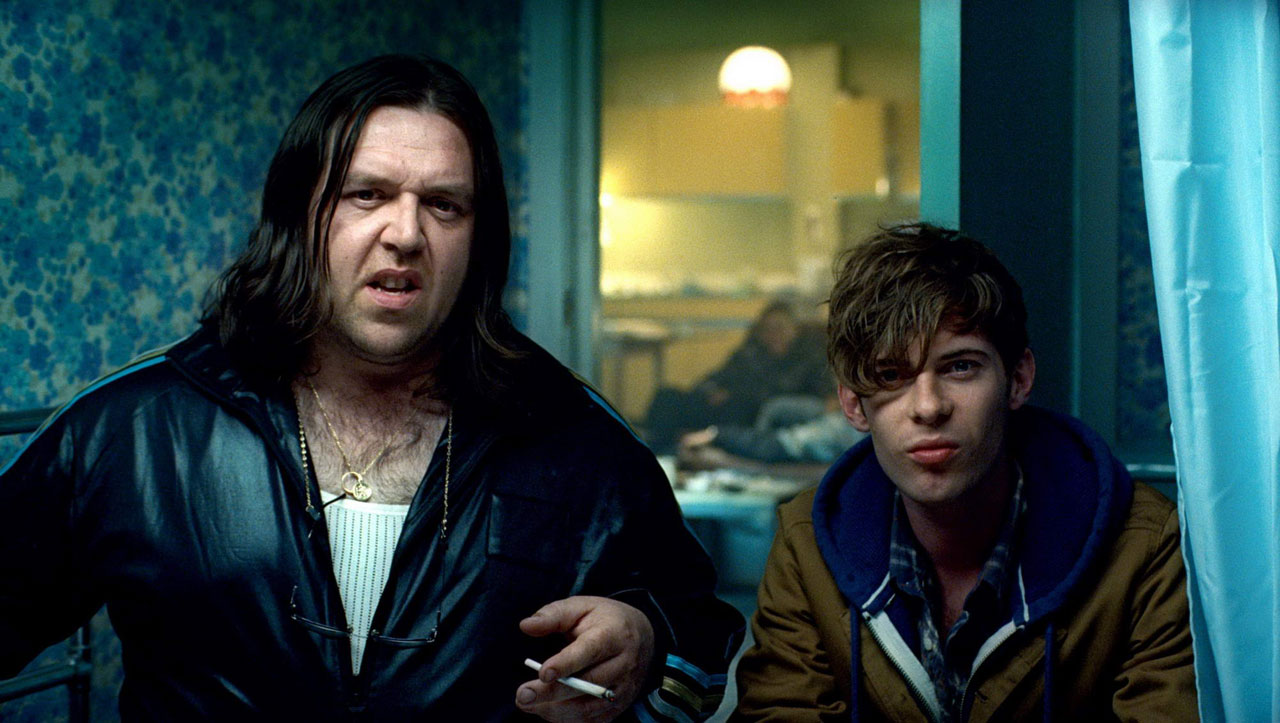
In July Attack the Block, a low budget English stunner of an aliens attack film, opens complete with old school ETs—actors in furry suits resembling the lovechild of a gorilla and a bear with glowing green teeth—which really deliver thrills and chills.
So here! here! to filmmakers who understand audiences recognize when something authentic and organic is happening in front of them. Mazel tov to those trying to bring back the human touch to the big screen.
Dry your eyes George, we shouldn’t shed any tears at the end of overwhelming CGI in movies.
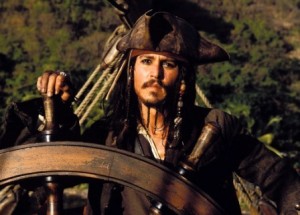
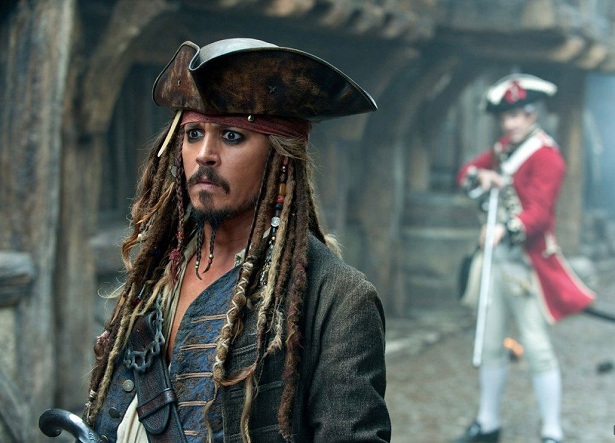
This week Johnny Depp set the twitter-verse aflame with the announcement that he is in talks to star in a fifth Pirates of the Caribbean movie. The news was met glee from fans and a collective arrgghh from critics, some of who have made a career of bashing the PotC movies.
For me the news that Captain Jack Sparrow would once again sashay through another big budget time waster brought up an interesting question: Is Johnny a sell out or simply giving the people what they want?
The case for Depp as crowd pleasing actor is obvious. Only eight movies have earned over one billion dollars at the box office. Two of them are Pirates movies (and a third, Alice in Wonderland, starred Depp as the Mad Hatter).
Personally Depp must feel connected to the franchise. Capt. Jack is a beloved character which earned him an Academy Award nomination and really brought him in to the mainstream. But unlike George Clooney or Matt Damon or Leonardo DiCaprio who balance the big hits with edgier fare Depp seems to have jumped ship.
The Libertine, his last art film was seven years ago, and while he did appear in Terry Gilliam’s The Imaginarium of Doctor Parnassus in 2009 it was out of obligation to the director rather than any kind of career move.
For twenty years he toiled in the trenches, making interesting movies with interesting directors, but the image of outsider Depp has never really been accurate. Few actors could have pulled off Ed Wood and no one wears a hat like Johnny, and but there are a lot of quirky actors out there. Depp has simply been more astute in playing the Hollywood game while maintaining an outsider’s credibility. Now that he’s found a big money outlet for his idiosyncratic style—his cut of the first four Pirates movies is rumored to be $350 million— what ever street cred he once had is taking a long drive down 21 Jump Street. (BTW He has a cameo in the big screen reimagining of the TV show that made him a star.)
Taking on a fifth sequel puts Depp on the level of people who have more than three cats. If you have more than three you may as well have 600. The maintenance is about the same but people think of you differently. No one begrudged Johnny when he signed on for the second and third PotC, he was coming off a career high and a huge nomination and it seemed like the right thing to do. The fourth one raised eyebrows but now it’s official. Depp is for sale to the highest bidder.
As one twitter wit put it: “Johnny Depp on signing up for PIRATES 5: ‘Well you know how it is, gotta send my kids to college… and then buy the moon.’”
Depp is not in Nic Cage territory yet—there’s an actor who has a really hard time saying no to a pay day—but maybe it’s time to put Depp’s well cultivated image as rebel actor to rest.
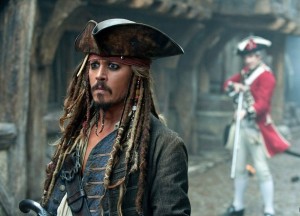
Johnny Depp had upwards of thirty million reasons to sign on for the new Pirates of the Caribbean outing—co-star Ian McShane suggests Depp is “paid more than the national debt of most countries”—and for that kind of money you’d think he could at least pretend to enjoy wearing Captain Jack’s bandana for the fourth time in eight years.
But he doesn’t.
Perhaps he’s just tired of playing pirate, or maybe he has finally realized the limitations of the swishbuckler but what was once a sublime characterization has become nothing more than his children’s (and their children’s) guaranteed annuity. An actor as gifted as Depp needs stimulation, (and frequently a funny hat, see: Alice and Wonderland, Charlie and the Chocolate Factory) and the sooner he abandons the Pirate ship and leaves the family franchise phase of his career behind the better.
It’s hard to imagine that Depp is one of the least interesting aspects of this big budget monstrosity, but it’s true. Geoffrey Rush, fresh off his Oscar nominated turn in The King’s Speech, also takes a paycheck here, but at least tries to shiver the timbers. Ditto Ian McShane. Perhaps they’re both hoping for some spin-off action once Johnny tires of the whole rigmarole, but at least you can’t see them actually reaching for the money.
Not that Depp is entirely to blame for the failure of the movie. Director Rob Marshall shoulders much of the guilt here. People pay money to see the Pirates movies for two reasons, Johnny Depp and the crazy action sequences. The stories have never made any sense, and in that aspect On Stranger Tides doesn’t disappoint, but Johnny’s disinterest and action scenes that are as exciting as you’d imagine an action sequence directed by the guy who made Nine sink the ship.
When I say failure I mean as a piece of entertainment. This is a guaranteed lock for number one with a BO gross that will make Captain Kidd’s legendary buried treasure seem like chump change, but profitability, while important to the suits who green light projects like this, is exactly what’s killing Captain Jack.
Guaranteed licenses to print money don’t come along very often, but when they do Hollywood often takes a counterintuitive approach to their cash cows. Why try that hard, Pirates seems to be saying to us, when people will lay down their money no matter if the story is silly, if the picture is so dark you can’t see the action, if our star has other things on his mind, if this simply plays like a trailer for the inevitable Pirates of the Caribbean 5: Do You Have Any Money Left? Let’s not try to improve or, God forbid, change the formula, the movie gods declare. Let’s stay status quo. Unfortunately status quo kills.
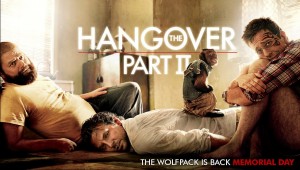
Just got a press release from Warner Brothers trumpeting The Hangover Part 2’s king size box office gross. “The blockbuster comedy has now crossed $200 million worldwide,” it screams, “the fastest of any comedy to surpass that benchmark.” Right now the gross sits at about $205 million, a figure that is no doubt growing by the second, leading Warner Bros. Pictures President of Domestic Distribution Dan Fellman to predict that this Hangover will “last throughout the summer.”
Maybe it will. Still doesn’t mean it’s a good movie, or that the critics got it wrong.
Box office success isn’t always an indication of quality. Can you guess what Night of the Hunter, Metropolis, Blade Runner and Modern Times all have in common? Two things. They’re all classics, films regarded as important cultural artifacts and they all flopped on their original release.
Let’s try that again. What do The Day After Tomorrow, Rush Hour 2, Fantastic Four: Rise of the Silver Surfer and G.I. Joe: The Rise of Cobra share? Two things. There’s not a classic among them, and they all made at least $50 million on their opening weekend.
I don’t begrudge The Hangover Part 2’s gross. I’m sure Todd Phillips and company are nice people but no amount of box office business will ever convince me this is a good movie. Commercial and artistic success are often two mutually exclusive realms. Ask Van Gogh. He only sold one painting during his lifetime.
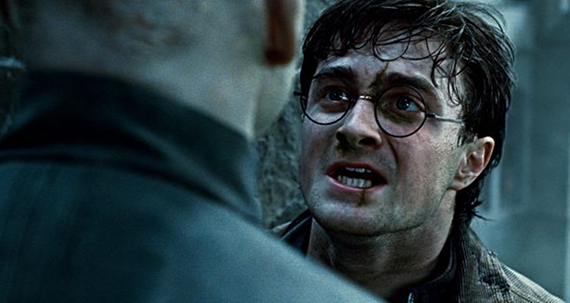
When Harry Potter and the Deathly Hallows Part One opened last year I said the movies, “are a closed club, really for fans only.” I have always felt the films worked best as an addendum to the books; a big screen visualization of J.K. Rowling’s words for Potterphiles who already understood why Harry would have to collect all the Horcruxes before doing battle with “He-Who-Must-Not-Be-Named.”
The movies have been extraordinarily successful—to date, not counting the Deathly Hallows Part 2, or 7B as Potterheads call it, the franchise has raked in more than six billion dollars—and have inspired many spinoff products including video games, replicas of Harry’s wand (complete with light and sound!) and even bootleg books with names like Harry Potter and the Leopard Walk-Up-To Dragon. You know you’ve hit it big when the Chinese are writing unauthorized versions of your books.
But for all their popularity the movies have frequently left me feeling like a Quidditch player with no balls. In other words, an outsider. They are big handsome pictures that leave the faithful swooning but for the uninitiated viewer who plunks down their admission they could be an occasionally frustrating experience. If there is such a thing as being too faithful, I think Potter’s producers are guilty of it.
Generally Hollywood’s inclination is to treat books and movies as two completely separate things with only a passing resemblance to one another.
For instance, The Secret Garden, starring Potter actor Maggie Smith, changed so many details from the Frances Hodgson Burnett novel—among other things the main character loses her parents to an earth-quake instead of cholera and the secret garden was hardly a secret—that the only thing the two had in common was the title.
Some accuse Hollywood of ruining books, but authors like Raymond Chandler are philosophical about it. When asked if he worried about the movies sullying his books, The Big Sleep author replied, “They’re not ruined. They’re right there on the shelf.”
No one will accuse the Potter filmmakers of being disrespectful to the books, but I would suggest that perhaps they may have been a bit too precious with them. The determination to cram as many of the details from the books into the films led to some uneven moments and while the movies kept most of the British Equity actors employed for the better part of ten years, it was occasionally puzzling as to why an actor of Alan Rickman’s stature would bother with the dye job to show up and utter two lines.
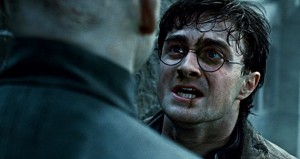
Having said all that the latest film, Harry Potter and the Deathly Hallows Part Two still contains enough Potter-parlance to boggle the muggle mind, but for the first time the insider chat doesn’t get in the way. This go around the Sword of Gryffindor and the like are McGuffins, things that propel the story but in the end aren’t as important as the underlying themes of friendship and good versus evil.
The movie deals with large questions of life and death, examines what goes on in the souls of men (and evil lords) all wrapped up in the comforting Potterverse. It has been a long strange journey with its own set of rules, internal logic and kooky creatures but the Potter cinema saga ends with dignity and without cutting corners or excluding muggles who haven’t read the books.
 You might imagine that horror maestro George A. Romero’s favorite film is The Exorcist. Or maybe Cannibal Holocaust. Or even The Texas Chainsaw Massacre. It’s easy to picture the twisted mind behind Night of the Living Dead curled up in his Toronto home with the Saw marathon unspooling on his blood splattered DVD player. Easy to imagine, but far from the reality. Most nights you’ll find him rewatching a classic. Maybe The Brothers Karamazov, Casablanca or Dr. Strangelove. Nary a decapitated head or disembowelment in the bunch! He also loves The Quiet Man, High Noon and King Solomon’s Mines but his all time favorite is an obscure 1951 Michael Powell film called The Tales of Hoffman.