It’s hard to know whether “Captain Fantastic,” a new drama starring Viggo Mortensen as a task master father raising a brood of philosopher kings in a forested paradise right out of Plato’s Republic, is a condemnation of the American Dream or parody of hippie ideals or both. By the time the unconventional family celebrates Noam Chomsky Day instead of Christmas it’s hard to know whether to giggle at the absurdity of the situation or cry at the earnestness of the film’s intent.
Mortensen is Ben, father of six, husband of Leslie (Trin Miller). They have made their home deep in the forest of the Pacific Northwest. As Leslie lies dying in a faraway hospital, Ben puts his kids through a boot camp of rigorous physical and intellectual training. They rock climb, participate in coming of age rituals, learn about quantum entanglement and at night sit around a campfire eating the days kill and reading books like “The Brothers Karamazov.”
They are a tight unit untouched by the outside world. Home schooled and trained the kids each speak six languages and are all, even the youngest ones, self sufficient, but is Ben helping or hurting the kids? Does his unwillingness to bend in his extreme opinions make him a caring father or a fascist who has not prepared his kids to be out in the world?
The answer to that question comes, sort of, when he makes an announcement. “Last night mommy killed herself. She finally did it. Your mother is dead and nothing is going to change.” A cross-country trip to Leslie’s funeral, a place where Ben is not welcome, makes him confront his ideas on parenting.
The most fantastic thing about “Captain Fantastic” is Mortensen’s performance. As Ben he is a plain spoken, rough-hewn man so convinced of his correctness he is willing to risk the lives of his children. Underneath the bluster, however, is a man who cares deeply about his family and his late wife. He’s a man of extremes—both in beliefs and actions—but his love and his grief are heartfelt, even if they are run through Ben’s unforgiving filter. Mortensen makes an unlikeable character likeable and that goes a long way to making the film enjoyable.
Otherwise the journey to Leslie’s final resting place is an occasionally bumpy ride. The feral kids speak Esperanto, pontificate on the US Constitution and sit, gobsmacked, at the sight of their first videogame and it is in these moments that parody seems to nudge its way into the storytelling. The hippie heaven Ben builds for his kids is less a nirvana than a cage to protect them from what he sees as the evils of the world. He teaches them to survive in the wild, but it seems unlikely any of them could survive a solo subway ride.
“Captain Fantastic” loses more steam in a rushed final act, but luckily Mortensen is there to keep it interesting.
Everybody knows what happens on stage at a big show like this Sunday’s Canadian Screen Awards. A host sings, dances and/or tells jokes, glamorous presenters tear open envelopes and announce award winners who thank everyone from managers to spouses to Jesus. There’s the slapping of backs, bespoke tuxedos and flowing gowns and tears.
Add in some drama, a red carpet and you have the ingredients of a big awards show, but what happens backstage?
Lots, as it turns out. Every year at the Canadian Screen Awards there’s a whole other show that happens offstage in the pressroom. Located deep in the bowels of the Four Seasons Centre for the Performing Arts it’s my domain during the live broadcast. Every year I host the room, interviewing the winners as they come off stage in front of an “audience” made up of local and national reporters there for the free food and access to the celebs. I am the purveyor of sound bites, the compère to the press who take the interviews I do and turn them into stories for the next day’s papers and newscasts.
Over the years Elvis Costello, Tatiana Maslany, William Shatner and many others have passed through, tossing out bon mots like they were candy. Jay Baruchel let it slip he was engaged to Alison Pill on our small stage. Viggo Mortensen proudly waved the Montreal Canadiens flag in the face of a roomful of Leafs fans and Jill Hennessey gushed about the Canadian Screen Awards gift bag, thanking the Academy for the Norman Jewison Maple Syrup.
It’s an easy gig for me. Everyone who comes down from the main stage is a winner, automatically in a good mood and ready to have some fun.
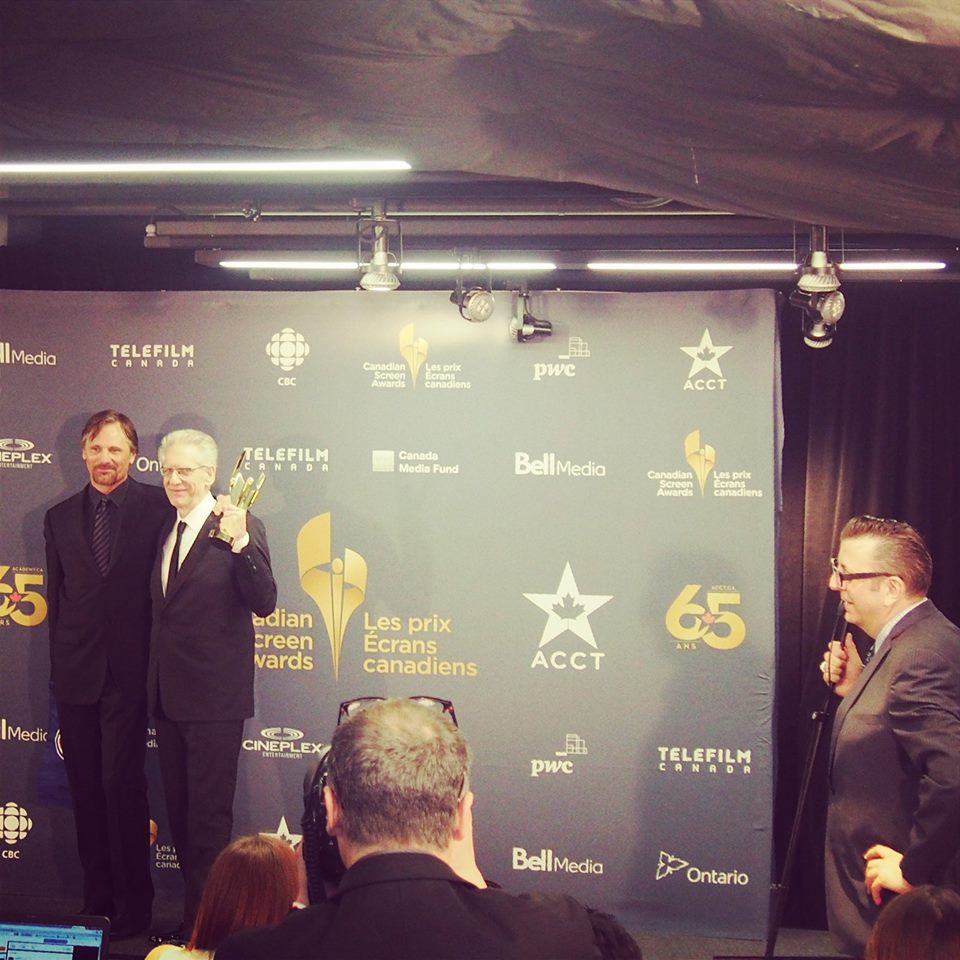
When Lifetime Achievement Award winner David Cronenberg was asked where the inspiration for his movies came from he took a moment to examine the assembled crowd of journalists before deadpanning, “Just standing here is giving me all kinds of ideas for horror films.”
Call Me Fitz star Tracy Dawson picked up a CSA for Best Actress but later told me that awards don’t guarantee work. She won a Gemini in 2011 for playing Meghan Fitzpatrick on the show and thought she had it made. Then her phone didn’t ring for ten months. In the pressroom she joked that she wanted to be clear—she was looking for work. “I’m totally available,” she laughed.
It’s a different show downstairs, less glitzy and more relaxed.
This year Andrea Martin is taking over hosting duties from fellow-SCTVer Martin Short but I’ll never forget last year how Short tore up the pressroom, still jacked up from hosting the show. He was hilarious when I asked if he’d try and top his spectacular flying entrance next year. “I can only fly so many times,” he said. “That harness chafes.”
Thanks to Mr. Will Wong for this photo from the Canadian Screen Awards press room. Richard hosted the night backstage, interviewing everyone after they had won their awards. This is David Cronenberg and Viggo Mortensen with Richard tucked away in the corner. When Cronenberg was asked where the inspiration for his movies come from he looked out at the assembled press and said, “Just standing here is giving me all kinds of ideas for horror films.”
These are the shoes Richard wore to last night’s awards. Thanks to Teddy Wilson for the “F**king dynamite shoes!” tweet and all other who compared them to ruby slippers.
Another press room shot courtesy of Linda Barnard of the Toronto Star:
1.) Technology may have killed off VHS but not before a cursed videotape knocked off a few of its own victims. The Ring, an American adaptation of the 1998 Japanese horror film Ringu, stars Naomi Watts as a journalist investigating the urban legend of a tape that kills viewers seven days after popping it into the VCR. “You start to play it, and it’s like somebody’s nightmare!” No, it’s not a badly dubbed copy of Rhinestone, it’s a series of surreal images from a dead girl’s life. The Ring is creepy and atmospheric until the last half-hour, but that’s when the VCR’s fast forward button comes in handy.
2.) Set in Tromaville, New Jersey The Toxic Avenger is the story of a 90-pound weakling who morphs into the lumpy-headed titular title character. Fighting corruption by spilling loads of fake blood, plunging hands into deep fryers and crushing a head, his methods provide unforgettable b-movie cheap thrills. That last effect—it’s a melon in a wig—is a timeless VHS classic and is actually enhanced by watching it on grainy video tape.
3.) A History of Violence makes the list because it was the last movie to be released on VHS in the golden age of video. Viggo Mortensen is Tom, a mild mannered man who must confront his violent past when local townsfolk start asking, “how come he’s so good at killing people?” An unopened copy of it will set you back $10,000 on eBay, but why would you want an unopened copy of one of director David Cronenberg’s best films?
4.) One of the main benefits of VHS tape is that it always stays at the point at which you left it. Snap it off at the twenty-minute mark, go back to it twenty years later and it will still be EXACTLY where you left off. In a way it’s kind of like hair metal, a genre that has loudly and proudly stayed stalled in the 1980s. Fans of bands like Poison and W.A.S.P. will want to rev up a VHS of The Decline of Western Civilization Part II, The Metal Years, because it rocks too hard to be released on DVD.
5.) The 1980s VHS boom gave us the dreaded direct-to-video movie and produced many bad flicks, countless of which had names that closely echoed those of big theatrical hits. In the down-and-dirty world of the actionsploitation genre, for instance, Schwarzenegger’s hit Commando became Strike Commando—”He’s A War Machine on the Warpath!”—only without the Austrian superstar or a budget for the big action scenes. The lurid cover art is better than the movie, but still, when viewed through a scratchy VHS snowstorm it’s a hoot.
Imagine a world where “each day is greyer than the day before” and cannibalism is a person’s worst fear. Nope, it’s not the latest George A. Romero film—there isn’t a zombie in sight—it’s “The Road,” the new film from the writer Cormac McCarthy. It’s so bleak, so unrelentingly dour it makes the last film adapted from his work, the Coen Brothers’s “No Country for Old Men,” seem positively lighthearted by comparison.
The story is simple. A man and his son (Viggo Mortenson and Kodi Smit-McPhee) are trying to survive in a dystopian world. Everything they knew is gone. In flashbacks we see a wife (Charlize Theron) who cracked under the pressure to survive; killing herself after setting father and son on their journey to “the coast” in an attempt to escape the harsh post apocalyptic weather. Armed with only a gun and two bullets they must scavenge for food amid the ruins and protect themselves from cannibals who roam the desolate land. There’s no Hope (or Crosby) on this road. Their raison d’etre is to maintain their humanity and survive in a world no longer able to support life.
“The Road” doesn’t mimic the dystopian world we’ve seen in bigger budget action movies. For better and for worse this is a movie based on small moments set against a big backdrop. No parent will be able to forget the stark image of a father teaching his son how to commit suicide or seeing a young boy who doesn’t know what a can of Coke is. Equally memorable is the Man visiting his now dilapidated childhood home. There, the simple act of turning over a filthy seat cushion to reveal the clean flipside is a reminder of a life that is gone forever. These are effective moments; the kind of filmmaking that will never occur to Michael Bay.
But having said that, “The Road” could use a little Michael Bay. Bleak is one thing. I can do bleak, but I’d like a bit more entertainment value thrown in. In the 112 minute running time there is too much down time when nothing happens, or when opportunities are blown.
Take the Coke can sequence. The man offers his son a Coke he has found in an abandoned vending machine. For all he knows it could be the last can of soda in the world; a simple pleasure that means much in a world where simply staying alive is a luxury. The boy takes a sip, enjoys the foreign sensation of the bubbles against his tongue before insisting his dad have some. The Man takes a swig. We see a smile begin to form, a sign of the reverie of a familiar sensation in a harsh world. At least I think that’s what it is, but I’ll never know for sure because just as Mortenson begins to turn the scene into something special with the transformative look on his face the camera cuts away to the blank faced boy. In a movie where small things mean a lot, the look on Viggo’s visage could have been a showstopper, but instead is a non-moment.
“The Road” despite offering an unexpectedly touching final sequence is probably too bleak to appeal to a mainstream audience. It’s the feel bad movie of the year.
Are there two more stronger, silenter types in modern movies than Ed Harris and Viggo Mortensen? Each of these actors are a throw back to the days when cowboy stars were manly men who mean what they say and only say what they mean and nothing else.
Harris (who also directs) and Mortensen are gunmen hired to bring law and order to the City of Appaloosa, New Mexico. Their main target is cop killer Randall Bragg (Jeremy Irons), but their job is complicated when a flirtatious woman (Renée Zellweger) comes between them.
Appaloosa comes a year after 3:10 to Yuma and The Assassination of Jesse James gave the western genre a shot in the arm. It’s closer in spirit to the former than the latter—meaning that it is a straightforward genre piece that if it had been made 50 years ago would have starred Alan Ladd and Randolph Scott. Like Clint Eastwood’s The Unforgiven, Appaloosa is a great Western cow opera about men looking inside themselves to discover the true essence of their lives. It doesn’t have the gravitas of Eastwood’s classic, and the economy of dialogue between the leads—there are conversational gaps you could drive a truck through—gets a bit tiresome after a while, but Appaloosa should satisfy viewers who long for the days when men wore chaps and spittoons were a welcome decorative addition to any home.
With the release of “A Dangerous Mind,” the tautly told story of two psychoanalysts you’ve heard of, Dr. Carl Jung (Michael Fassbender) and Sigmund Freud (Viggo Mortensen), plus one you’ve probably never heard of, Sabina Spielrein (Keira Knightley), director David Cronenberg is still exploring uncharted territory in his films.
On the surface the story seems simple enough. Two pioneering figures of psychoanalysis have a falling out over an intelligent, beautiful but troubled patient. In the hands of Cronenberg and writer Christopher “Dangerous Liaisons” Hampton however, the movie becomes an enticing stew of psycho-sexuality and repression that challenges commonly held beliefs about what is normal and what is not.
Cronenberg, always known for his crisp filmmaking, has rarely ever been this simply elegant. Shot compositions and camerawork are kept simple so as not to distract from the star of the show—the dialogue. As you can imagine, in a drama about three therapists (Spielrein became a doctor after her treatment with Jung), there is a great deal of talk. Separately and together they talk about their dreams, their pasts and, in the case of Jung and Spielrein, their future. It may be the most inward looking movie of the year, but in its introspection—and buried in the film’s subtext—is a restrained but fascinating glimpse into the lives and minds of these characters.
Keira Knightley delivers a brave, strange and Oscar worthy performance as Spielrein, while Fassbender expertly plays the repression that plagued Jung. Cronenberg muse Viggo Mortensen may seem an odd choice to play Freud, but he leaves behind the physical performances that have marked his best work to create a convincing portrait of Freud.
“A Dangerous Method” won’t be for everyone. The combo of love story and birth of modern analysis is an odd mix. The almost total lack of physical action—Cronenberg’s fireworks here are in the small moments and the ideas expressed in the script—means the focus is on the words, but where some will see a film rich with dialogue, others will see it as verbose. But that’s just the kind of duality the movie explores.