SYNOPSIS: In “Highest 2 Lowest,” the new film from director Spike Lee, Denzel Washington plays a music mogul faces a moral dilemma as he attempts to protect his friends and family from a kidnapping plot and stave off the takeover of his legendary record label, Stackin’ Hits Records.
CAST: Denzel Washington, Ilfenesh Hadera, Jeffrey Wright, ASAP Rocky, and Ice Spice. Directed by Spike Lee.
REVIEW: When Spike Lee’s “Highest 2 Lowest,” a modern-day reimagining of Akira Kurosawa’s 1963 film “High and Low,” is firing on all cylinders it is a thing of propulsive beauty. A subway chase sequence, based on the car chase in “The French Connection,” is edge of your seat stuff, and a showdown between music mogul David King (Denzel Washington) and rapper Yung Felony (A$AP Rocky), is an acting masterclass with the intensity of a rap battle.
Those scenes represent the movie in full flight, and they are vital and exciting, the kind of filmmaking and performances that jump off the screen. Both scenes up the stakes for everyone involved, which is lucky, because the rest of the film, while fraught with complications, is never imbued with a sense of danger. Sure, there are guns, a kidnapping and a ransom bag filled with 17.5 million dollars, but this isn’t a crime drama.
Not really.
Spike Lee and screenwriter Alan Fox use the kidnapping as a backdrop to explore fatherhood, relevancy in a changing world, ethical dilemmas, legacy and, of course, Lee’s favorite basketball team, the Knicks.
It makes for a dizzying, but uneven film.
The first hour, wallpapered with Howard Drossin’s melodramatic score, paints the gregarious David King as a man who lives up to his last name. He lives, with his wife Pam (Ilfanesh Hadera) and son Trey (Aubrey Joseph) in a NYC penthouse palace, decorated with museum quality art and mementos from King’s illustrious career. His record label, his life’s work, is about to be sold and he’s willing to risk it all to buy it back. “It’s not a risk,” he tells Pam, “it’s a rebirth.”
The business deal is thrown into jeopardy when a kidnapping plot (NO SPOILERS HERE) throws King’s life and finances into limbo. Forced to reckon with his past, present and future, King must make some very difficult choices.
The second hour, as the kidnapping plot kicks in and the financial talk fades, revs up the film’s momentum as King takes action to resolve the kidnapping and kickstart his personal and professional rebirth.
Howard Hawks once said that a great film has three great scenes and no bad ones, and while “Highest 2 Lowest” has great scenes, and the sheer force of Washington’s work ensures there are no bad ones, it feels as if the puzzle pieces don’t quite fit together. As the character work of the first half gives way to the more exciting second half, the film takes on a disjointed, idiosyncratic feel.
It never settles into a groove, it’s restless, idiosyncratic, mixing tones, themes and even film stocks. Even so, it’s compelling to watch Lee and Washington, two lions in winter, strut their stuff.
Washington hands in a bravura performance, almost Shakespearean in its theatricality. Like Washington said at the Cannes Film Festival before a screening of the film, “King Kong ain’t got s— on me.”
Lee captures that work in a movie that feels like a Spike Lee joint. It’s vibrant, in love with its characters and, even though it feels disordered, it’s a film that feels both contemporary and classic. It’s an utterly unique work that only Spike Lee could have made.
Ultimately, “Highest 2 Lowest” is a story about staying relevant for a new generation, about getting your groove back headlined to two artists who have never lost their groove.
Sidney Poitier, who passed away in January 2022, led a remarkable life, one vividly portrayed in the Oprah Winfrey-produced documentary “Sidney,” now steaming on Apple TV+. “He doesn’t make movies, he makes milestones,” says U.S. President Barack Obama in the film, “milestones of America’s progress.”
In an interview shot with Winfrey in 2012, the “To Sir with Love” actor, staring directly into the camera, tells of his childhood in Nassau. A master storyteller, he recalls how he almost died as a baby, shares wonderful stories about his loving parents, recalls seeing a car for the first time, and marvels at his first glance into a mirror.
His move to the United States from a predominantly Black community in the Bahamas, is fraught with racism and threats of violence from the Ku Klux Klan, but tempered by kindness from a waiter who helps him learn to read, using the newspaper as a textbook.
Landing in Harlem, he is introduced to the world of acting, and has the good fortune to go on as an understudy in a New York City stage production on the same night a big-time Broadway producer is in the house. That leg up set on a path that would see him become the first Black man to win the Academy Award for Best Actor (for 1963’s Lilies of the Field), a civil right activist and diplomat.
It is a comprehensive, linear look at Poitier’s life, one that brings Winfrey to tears, and in the retelling of a pivotal scene in “In the Heat of the Night,” where Poitier, as detective Virgil Tibbs responds to being slapped by a white redneck, by slapping him back, brings a delightful response from Morgan Freeman.
Director Reginald Hudlin assembles a mix of archival footage, new interviews with Halle Berry, Denzel Washington, Spike Lee, Winfrey and others, and plenty of film clips, to present a well told story of a well lived and influential life. The result is an entertaining and informative doc about an extraordinary life. “When I die,” Poitier said, “I will not be afraid of having lived.”
Jonathan Demme’s “Stop Making Sense,” his movie of an iconic a 1983 Talking Heads live show is considered one of, if not the greatest concert films of all time. Elegant and exciting, it made everything before it seem old fashioned and everything that came after feel like an imitation.
What “Stop Making Sense” was to the 1980s a new concert film, also starring Talking Heads frontman David Byrne, is to these uncertain times. “American Utopia,” directed by Spike Lee and now playing on HBO Max, is a joyful film about everything from protesting injustice and police brutality to optimism and the celebration of life.
It’s got a good message and you can dance to it.
Filmed during the show’s 2019 Broadway run at New York’s Hudson Theatre, the film captures the cerebral but exuberant concert that features Byrne, alongside eleven musicians, all dressed alike in skinny grey suits, and all unfettered from amplifiers and the like. With wireless guitars, keyboards and all manner of other instruments on an empty stage with no other gear or risers, Byrne and Company fill the space with intricate choreography, eclectic songs, new and old, and an uplifting social message of fellowship and faith in humanity. Byrne’s enthusiasm is infectious and Spike Lee, using a combination of you-are-there camera angles, including a beautiful overhead shot, captures the jubilant postmodernist performance in glorious fashion.
It is so much more than a Talking Heads greatest hits package. There are familiar songs like “Burning Down the House,” “This Must Be the Place” and “Once in a Lifetime,” but they seamlessly blend with Byrne’s originals, written for his 2018 solo album of the same name.
Highlights, and there are many, include “Everybody’s Coming to My House,” Byrne’s ode to inclusivity and a potent cover of “Hell You Talmbout,” Janelle Monae’s protest song about police brutality. The latter song, a call and response featuring names the names of African Americans killed by police, is given extra clout by the addition of Spike Lee’s graphics that update the names mentioned in the song to include dozens of others. It is a powerful moment and an urgent call for change.
“American Utopia” is a gem. A concert film that, like “Stop Making Sense” redefines what live performance can be.
Spike Lee movies are like onions. Peel off a layer and there’s a new one beneath. Take that off and another reveals itself. His latest, “Da 5 Bloods,” now streaming on Netflix, is even more multi-faceted than usual. The director calls it a “gumbo,” a rich stew of varied ingredients. It’s a two-and-half-hour Vietnam War legacy film featuring a Trump supporter in a leading role. It’s a searing look at how African American soldiers fought in a war for a country that didn’t support them and it’s an adventure film, à la “The Treasure of the Sierra Madre” with action scenes and even buried treasure.
Most of all, it feels like a film that only Spike Lee, the auteur, could have made.
The story centers on the Bloods, MAGA-man Paul (Delroy Lindo), Otis (Clarke Peters), Melvin (Isiah Whitlock Jr.) and Eddie (Norm Lewis), four African American vets who return to Vietnam almost fifty years after their last tour of duty. They hope to recover the remains of, “the best damn soldier who ever lived,” their Squad Leader, Stormin’ Norman (Chadwick Boseman).
It’s a noble mission indeed, but there’s more. A lot more in the form of CIA gold bars intended as bribes for the Vietnamese government but hijacked by the Bloods and hidden in the jungle. “We’ve been dying for this country from the very get,” says Norman in a flashback. “We give this gold to our people.”
It seems like a foolproof plan but almost as soon as the men land in Vietnam they are beset with problems, some new, some a product of their past. “Being back here is not easy,” says Paul.
“Da 5 Bloods” weaves archival footage of Rev. Dr. Martin Luther King Jr., Muhammad Ali, Angela Davis and Kwame Ture among others, and 60s era music into the narrative, creating a vivid portrait of time and place. Add to that a study of the effects of PTSD, political corruption and some interpersonal politics between the main characters—including Jonathan Majors as Paul’s estranged son David—action scenes and a slimy banker (Jean Reno) and you have a big, bold movie that aims to entertain and reckon with social issues that linger years after the Vietnam War ended.
“Da 5 Bloods” explores areas of the African American experience in Vietnam that have never been exclusively the subject of a film. Lee and co-writer Kevin Willmott, with whom the director shared an Academy Award for Best Adapted Screenplay for “BlacKkKlansman,” have crafted a poignant, if slightly overlong, look at the lasting effects of fighting a war for freedoms the Bloods and their counterparts were being denied at home. “Black GI,” taunts propagandist Hanoi Hannah (Van Veronica Ngo) on Radio Hanoi, “is it fair to serve more than the white Americans who sent you here?”
Lee makes daring choices—not de-aging the older actors in the flashback scenes, for instance—but never obscures the film’s central message. “Every time I walk out my front door I see cops patrolling my neighborhood like it’s some kind of police state,” Stormin’ Norman says, circa 1971. “I can feel just how much I ain’t worth.” The pain and anger in those words, and in this film, is undiminished by the passing years.
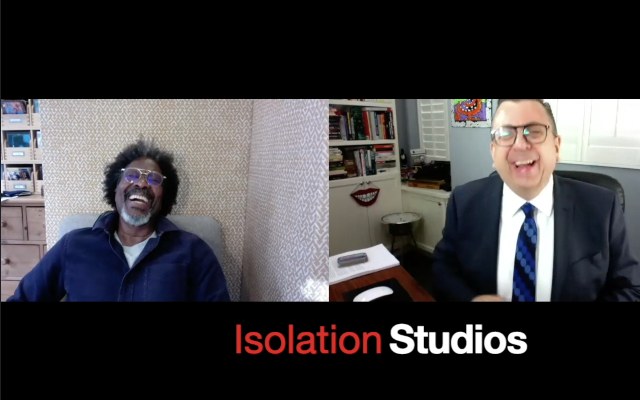
Check out episode eighteen of Richard’s new web series, “In Isolation With…” It’s the talk show where we make a connection without actually making contact! Today, broadcasting directly from Isolation Studios (a.k.a. my home office), we meet Clarke Peters, one of the stars of the new Spike Lee joint “Da 5 Bloods.” It’s an adventure movie that also examines the role of African American soldiers in Vietnam and how that conflict affected the rest of their lives. We talk about how he was accused of draft evasion by the FBI, how life during the pandemic has taught us to think about more than just ourselves and why he considers himself a stage actor first and foremost.
Here’s Clarke Peters on being a stage actor: “For those actors who understand the magic of it, we also understand that there’s a great responsibility in it. It is not about your ego. You are not the star. It’s the story that you’re telling, that’s the star, and you tell that story as best as you can. Through the years you find ways to hone your craft, so that you know that if I hold on for just two seconds longer before saying this next word that a tear is going to come up in somebody’s eyes over there, or that the whole audience is going to fall out and laughter. That’s a hell of a power to have and a hell of a responsibility, but also very necessary service for society in the situation that we’re in now.”
Then, we meet photographer and documentary film maker Paul Perrier. As many of us sheltered in place at the beginning of the pandemic Paul grabbed his camera and hit the streets, taking photos of people and their masks. The result is The Toronto Portrait Project, a series of photographs that document the face… or I guess… faces of the pandemic.
Watch the whole thing HERE on YouTube and HERE on ctvnews.ca!
What to watch when you’ve already watched everything Part Fourteen! Binge worthy, not cringe worthy recommendations from Isolation Studios in the eerily quiet downtown Toronto. Three movies to stream, rent or buy from the comfort of home isolation. Today, going underground, a gang war in rhyme and the beginning of a franchise. #Buried #ChiRaq #FirstBlood
Listen to the whole thing HERE! (Link coming soon)
“BlacKkKlansman” is based on the strange but true story of Ron Stallworth. The true part sees the Colorado Springs, Colorado police officer join the KKK and even act as a bodyguard for Grand Wizard David Duke. The strange part is that Ron Stallworth is African American. Maybe that’s why director Spike Jones chose to open the film with the title credit, “DIS JOINT IS BASED UPON SOME FO’ REAL, FO’ REAL S***.”
When we first meet Stallworth (John David Washington) it’s the mid-1970s and he is an ambitious rookie cop who wants out of the records room and into the action. The overwhelmingly white Colorado Springs police department doesn’t quite know what to do with him until Civil Rights organizer Stokely Carmichael (Corey Hawkins) is booked to speak in town. “We don’t want this Carmichael getting into the minds of the young people of Colorado Springs,” he’s told. Sent undercover to the meeting wearing a wire, he meets local college activist Patrice (Laura Harrier). She calls the police “pigs” but awakens Ron’s dormant activism with her passion.
Back at his desk a recruitment ad for the Ku Klux Klan. On an impulse he dials the number, changes his voice and gets a meeting with a local, high-level Klansman. Now what to do? Stallworth continues wooing the Klan on the phone, spouting racist gobbledegook, while his colleague Flip Zimmerman (Adam Driver) plays the part in person.
“BlacKkKlansman” is set forty plus years ago and comes complete with flared pants, jive talk and other indicators of the time but feels timely and alive. This is not a period piece. It’s a slice of Stallworth’s life that bristles with Lee’s anger, social commentary and humour. Parallels to today’s news are woven throughout, sometimes subtly, sometimes with the delicacy of a slap to the face. For instance, midway through Duke says he’s working, “to get America back on track, to give America its greatness again.” It’s a barbed satire with its feet firmly rooted in the realities of American life.
The use of clips from D.W. Griffith’s “Birth of a Nation” and news footage from Charlottesville compares and contracts a hundred years of filmed racist behaviour, displaying how little has changed in that time.
Terrific performances and fearless storytelling make “BlacKkKlansman” a searing document that defies the viewer not to react.
As the calendar turns the page to 2017 let’s have a look back at the great people I met, wrote about or chatted with in 2016. Warren Beatty gave me his home telephone number, I drank cranberry juice with Denzel Washington, had Elvis’s girlfriend and JFK’s mistress on my radio show and fulfilled childhood dreams by hanging out with Iggy Pop and Cheap Trick. On stages, studios, in hotel rooms, on phones and even in the back of taxis, they spoke and I listened. Here’s some of the best stuff I heard this year:
Casey Affleck on throwing himself into the role of a depressed man in Manchester by the Sea: “It’s what you have to do. You have to go there, show up on set and be prepared to play the scene with the right feelings, the way it is supposed to be. I’m just not good enough to show up in a great mood, say good morning to everybody, check in with the kids and read the paper and then walk into the scene and be believably gutted in the way he is supposed to be. He carries around all this guilt, he’s devastated and filled with self loathing so I have to start way back in preproduction and try to slip into these bad feelings and stay there for as long as I can. If you just showed up and tried to walk through it or do anything but give 100 percent you’d really look like a jackass.”
Warren Beatty talking about casting Lily Collins in Rules Don’t Apply: “I believe very much in what I call ‘the blink,’” says Beatty. “That is the superiority of the unconscious knowledge as compared to conscious knowledge. The knowledge that when we sit and we really give it some thought, the thought we feel it is due. That thought can be misleading when we could have trusted our initial instinct, the blink. I think the unconscious has a lot more intelligence in it than the conscious.
“It was a blink with Lily. I can only say I loved the way she looked. I loved the way she sounded. I loved the way she talked. There was an integrity about her I felt I could believe in this circumstance and at the same time she looked like someone to me who Hollywood would want to exploit.”
Director Uwe Boll on why he’s quitting filmmaking: “I’ve been using my money since 2005 and if I hadn’t made the stupid video game based movies I would never have amalgamated the capital so I could say, ‘Let’s make the Darfur movie.’ I don’t need a Ferrari, I don’t need a yacht. I invested in my own movies and I lost money.”
The Magnificent Seven director Antoine Fuqua on casting Denzel Washington: “I wanted to see Denzel Washington on a horse.” AND “My idea was, if Denzel walks into a room, the room stops. If Clint Eastwood walks into a room, the room stops. Is it because he’s a gunslinger or is it because of the colour of his skin? We’ll let the audience decide.”
Rebecca Hall on playing Christine Chubbuck in Christine: “I don’t think I have given [a role] like it before and I probably won’t again because it is one of those jobs that if you are incredibly lucky you get maybe three of them in a career. And that’s only if you are incredibly successful and lucky and often only if you were a man.”
Jonah Hill on how some people respond to his morally ambiguous characters: “A lot of times Wall Street bros will come up to me as if [Wolf of Wall Street] is their Goodfellas or Scarface. People see what they want to see. It is a little scary sometimes when people misinterpret.” And how he reacted after a crew of South African arms dealers approached Hill in a restaurant after seeing a trailer for War Dogs: “You don’t want to make it an overly uncomfortable environment while that is happening,” he says, “but you also don’t want to lie and be dishonest that you are agreeing with them. You don’t want to make them feel bad about their misinterpretation. It’s an unusual an awkward situation to be sure. In the end, we all want to be seen as heroes in our own story, I guess.”
Isabelle Huppert on the unique tone of her film Elle: “Sometimes you are in a Hitchcock thriller. Sometimes you are in a psychological study. Sometimes you are in a comedy and at the end of the day you are in none of those; you are in a Paul Verhoeven film.”
Riley Keough on what she learned while making American Honey: “I learned not to drink too much.”
Spike Lee on casting Jennifer Hudson as the mother of a slain child in Chi-Raq: “Do you know Jennifer Hudson’s history? It is known knowledge that Jennifer’s mother, brother and nephew were murdered in Chicago. I think that’s extra gravitas that you have with Jennifer Hudson in this film. This is not an act for her. She got hit directly by gun violence on the South Side of Chicago. I didn’t want her to think that I was exploiting her. I knew I wanted her for the part but there was some length of time before I got the courage to approach her. Also, when we did meet I was babbling. She said, ‘Spike, I know why you want me to do this film, so just stop. I’ll do it.’ I was trying to be sensitive and I turned out to just beat around the bush. I said, ‘I’ll just shut up and say thank you.’”
Stan Lee on naming his characters using alliteration —think Peter Parker, Bruce Banner, Matt Murdoch and Reed Richards: “It’s because I have a bad memory. If I could remember one of the names like Spider-Man, if I could remember his first name was Peter then I knew his second name began with a P. That is really the only reason. I have a terrible memory for names and by making the first and second letter the same, if I thought of one name I had a clue as to what the other was.”
T.J. Miller, star of Office Christmas Party: “Let’s talk comedy in a time of tragedy. I have a political obstacle to my social mission statement,” he says. “The social statement was, tragedy permeates our everyday lives, people are lonely, they’re scared, they have death anxiety, they don’t know how to attribute meaning to their own existence, so through comedy we can provide an opiate or distraction that permeates our everyday lives. Through satire we can hopefully frame the world in a way that people can laugh at. Also I aim to help people, through my stand up, to release the death anxiety. I aim to help people not take themselves so seriously.”
Queen of Katwe star David Oyelowo on working with nonactors on the film: “I actually took a bunch of the kids to see Jurassic World while we were doing the film and Madina (Nalwanga), who plays Phiona, sat next to me and was clutching me the whole time, terrified by the movie. She turned to me and said, ‘Is this what we are doing?’ I asked her if she had ever seen a film before and she said no. We were halfway through shooting a film in which she is playing the lead.”
Snowden co-star Zachary Quinto on how says working on Snowden made him think differently about even simple Internet searches: “I had this experience the other night. I was shopping for a washer and dryer online. I was Googling the consumer ratings. I left that search and went to another website and immediately the pop up ads on this other website, which had nothing to do with consumer reports or shopping, were about washers and dryers. What we are willing to sacrifice in our privacy without even thinking about it for convenience sake, what we’re willing to give up in our own freedoms and interests just in sitting down at our computers is shocking. You can take precautions. You can take steps to enact two-step verifications and put tape over your laptop (camera) and strengthen your passwords but all you need to do is shop for appliances and you are exposing yourself to some kind of tracking, a collection of data.”
Arrival director Denis Villeneuve on filmmaking: “It is a privilege when you can take a camera and ask people to sit for two hours in a theatre,” says Villeneuve. “It is nice if you take that privilege to explore something out of our reality, to bring some poetry to it.”
Moon Zappa on how she grew up with a rock star dad: “I longed for structure. When I saw John Hughes films I was, ‘Wait! People sit at a dinner table? Wait! People say sorry?’ Even to this day when I see somebody with a sweater draped over their shoulders, or a loafer or an exposed ankle, I’m like, ‘That is so exotic.’ I think if I had grown up in the repression my father encountered I would also have put two rocket boosters on my back, but growing up like that was too much. It was like fastball pitches every single minute.”
Most of these interviews went well and were a pleasure to do… but not all. Below is the terrible tale of a day wasted waiting for Idris Elba’s phone call.
Can You Hear Me Now? Can You Hear Me Now? Waiting For Idris Elba.
Idris Elba is a busy man. He’s released seven movies this year and has several more on tap for 2017. He’s on track to join Dwayne Johnson, Jennifer Lawrence and Leonardo DiCaprio as one of the world’s highest earning actors after turns in the mega-grossing The Jungle Book, Finding Dory and Zootopia.
If you don’t know the name you haven’t been paying attention. Rev up Netflix and check out his work on TV shows like The Wire or Luther and movies like RocknRolla or Beasts of No Nation and become a fan. You should know he was once voted one of People magazine’s 100 Most Beautiful People in the World and more than one twitter friend of mine refers to him as a “pretend boyfriend.”
Not only busy but good looking as well! I was pleased to be granted a fifteen-minute phone interview to discuss his debut in the Star Trek franchise as Krall, a hostile alien who causes trouble for Kirk, Spock and company in Star Trek Beyond.
I don’t usually write questions but I thought I might ask him if he watched Star Trek as a child. Would he consider himself a Trekker? Did he have a favourite Star Trek character growing up? Did he wonder what Star Trek fans would think of the predatory new character? Are there parallels between the film—and his character—and our world today? Has he considered what being part of the legacy of the show means?
If there was time at the end I might even follow up on the rumours and ask if he even wants to play James Bond.
Then the first call came in. “Idris is running behind.” Cool. This happens all the time on press days. Then another call and another and another. My phone hasn’t gotten this kind of workout since a Nigerian Prince called over and over to solicit my assistance in moving his fortune to North America. Each time a publicist announced another delay with the assurance the interview would still happen. As the time wore on the actual length of my interview began to tumble downhill from fifteen minutes down to seven.
In all two hours passed from my scheduled start time until my phone rang for real.
“Hi Richard, I’ll connect you with Idris,” said the perky voice on the other end of the line.
Silence.
A minute passed before Elba’s familiar husky London accent filled my ear. Hallelujah! Better late than never. We talk over one another. “Hello… HELLO… Can you hear me?” It’s a bad cell phone connection. It sounds as if we’re talking through two tin cans connected by strings but I’ll take it.
I ask him about his childhood memories of Star Trek.
“It was a show me, my mum and my dad watched together,” he says. “They both liked it. It was a show that really took your imagination places. That’s my early memory of it. It was a really imaginative show that showed space travel in a way that was different, you know?”
It took him 23 seconds to speak the 50 words that told me his parents liked Star Trek. I mention this because as soon as he stopped talking and I started asking the next question I heard a strange beep beep sound followed by… nothing. The great void. No more husky voice. And like that, poof. He’s gone.
“Are you still there? I think we just lost him,” the eavesdropping publicist said. “Let me get him back for you. Just one second.”
I had visions of the actor walking around Fifth Avenue desperately yelling into his phone, “Can you hear me now? Can you hear me now?” but in my heart I knew that wasn’t happening.
Minutes later she’s back. “I’m so sorry. We lost him. I know you only had a couple of minutes to speak with him…” actually it was twenty three seconds… “Thank you so much for taking the time to speak with him.”
My interview with Idris was over. Still born. Terminated before it even really began.
Was I mad? Not really. Frustrated? Yes. Not only had I wasted the afternoon waiting for Idris but now I didn’t have a story to file.
My friends on social media didn’t exactly see it my way. “What do you expect?” wrote one person. “He is the hottest man alive.” Another chose to look on the bright side. “That’s 45 seconds more Idris than the rest of us.” (I hadn’t yet timed the actual quote when hit facebook to vent.)
In the end it’s not a big deal. I’m choosing to look at the bright side. I didn’t get to chat with him but I do have a contender for the Guinness Book of World Records for Shortest (And Least Satisfying) Interview Ever.
“The human spirit is a great thing,” says director Spike Lee on what he learned while doing research for his new film. The director spent six months in Southside Chicago, ‘talking to people, meeting people, getting the lay of the land,” before shooting a single frame of his anti gang violence movie Chi-Raq. “It was very important, not just meeting people, but people becoming comfortable with me. People opening up to me.”
The movie draws its story about a neighbourhood woman who convinces the wives and girlfriends of gang members to withhold sex from their men until the guys agree to put down their weapons from a Greek play first performed in 411 BC. but details the very modern problem of gun violence.
“At the end of the movie in that scene where everybody is dressed in white,” says Lee, “those women are not actresses. Those women are members of a group called Pain Over Purpose. They are mothers whose children, whose sons and daughters, have been shot down in the streets of Chicago. Those pictures they are holding up are pictures of their loved ones.
“The pain of a parent who has lost a child in any circumstance is something that no parent should have to go through. They all say that there is a hole in their spirit, in their soul that will never be replaced. Many of those mothers have tried to commit suicide and had various other problems since then but they are holding strong.”
The cycle of violence portrayed in the film, and acted out for real on the streets–during Chi-Raq’s thirty-eight day filming schedule 331 people were wounded and shot, 65 people were murdered in Chicago—was personal for one of the movie’s stars.
“Do you know Jennifer Hudson’s history?” asks Lee. “It is known knowledge that Jennifer’s mother, brother and nephew were murdered in Chicago. I think that’s extra gravitas that you have with Jennifer Hudson in this film. This is not an act for her. She got hit directly by gun violence on the Southside of Chicago.
“I didn’t want her to think that I was exploiting her. I knew I wanted her for the part but there was some length of time before I got the courage to approach her. Also when we did meet I was babbling. She said, ‘Spike, I know why you want me to do this film, so just stop. I’ll do it.’ I was trying to be sensitive and I turned out to just beat around the bush. I said, ‘I’ll just shut up and say thank you.’“
Lee is fearless in his handling of the material, taking chances narratively—the entire film is presented in verse—and visually, to tell the timely and hot button story of a “self-inflicted genocide.” Finding the mix of heartfelt storytelling and satire, says Lee, was crucial to the success of the film.
“It is not an easy thing to do,” he says. “I will make the great leap and say that if Stanley Kubrick was alive he would say it was hard to do it on Strangelove. I’d say the same thing for Kazan in A Face in the Crowd. I would say the same thing for Sidney Lumet for Network. It’s hard to do but it’s a great way to deal with serious subject matter.”