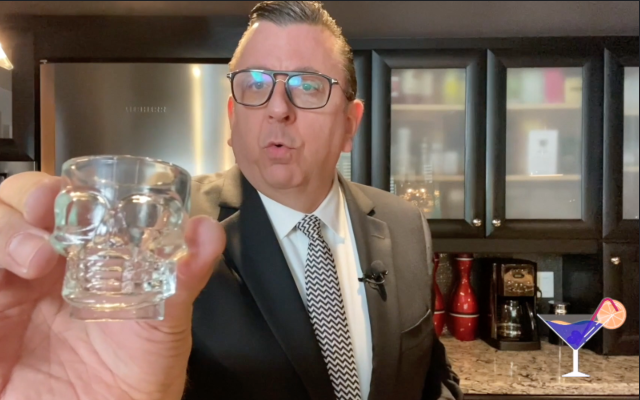
Richard makes a Bloody Mess, the perfect cocktail to enjoy while having a drink and a think about “Spiral: From the Book of Saw,” the latest chapter in the “Saw” franchise.
“And Justice for All,” the last four words of the American Pledge of Allegiance, sum up the dynamic of “Spiral: From the Book of ‘Saw,’” the ninth instalment of the “Saw” franchise, now playing in theatres.
On one hand you have a murderer dispensing their own brand of justice; inventively slaughtering people who have broken a twisted moral code known only to the killer. For instance, a detective who has lied on the stand many times, is given the choice, provide justice by tearing out his own lying tongue, or be killed. “Live or die. Make your choice.”
Then, there are the police who must use more traditional means to enforce their brand of justice.
It might not be exactly what Congress had in mind, but in the “Saw” universe there is more than one definition of the word justice.
Chris Rock is Zeke Banks, an idealistic-but-disillusioned big city detective trying to get out from under the shadow of his father Marcus (Samuel L. Jackson), a decorated, hero cop and retired police chief. When Zeke and his partner, an eager rookie named William Shenk (Max Minghella), catch an unusual, grisly case, the game is afoot.
Literally.
A new serial killer, playing from the same gamebook as the notorious villain Jigsaw, who put his victims through deadly scenarios he referred to as “games” or “tests,” is terrorizing the city’s dirty cops, looking to avenge wrongs perpetrated by the South Metro Police and “reform” the department. “A Jigsaw copycat,” says Marcus. “That could be difficult.”
As the bodies pile up Zeke suspects the killer isn’t just playing around, that he has another motive. Something personal.
After eight instalments of the “Saw” franchise, countless deadly traps and one iconic baddie, “Spiral” finds a newish way in to tell an old story. Billy the Puppet and Jigsaw are gone, as is much of the gore that splattered the screen in earlier incarnations of the series. They’ve been replaced with a timely but underdeveloped subtext regarding police corruption and the addition of humor, an element often sorely lacking from previous instalments.
Directed by Darren Lynn Bousman, who helmed the second, third and fourth “Saw” movies, “Spiral” is as character based as it is consequence based. Bousman, and “Jigsaw” screenwriters Josh Stolberg and Pete Goldfinger, have dialed back the grim stuff. There are still enough traps and gore to keep “Saw” purists happy—there’s a finger ripping machine and some nasty hot wax—but an increased emphasis on character raises the stakes so the gory stuff has more impact. It’s still a horror film, but Bousman structures it like a thriller, even if his reliance on flashbacks and exposition mutes some of the thrills.
There’s also loads of uninspired hard-boiled dialogue and lots of yelling but also just enough of the nasty stuff and deadly game playing to keep fans satisfied.
The spiral logo that gives the movie its name is supposed to be emblematic of change and progress, but the movie doesn’t quite live up to the symbol’s meaning. It shakes some of the dust off the old franchise without reinventing it or doing justice to it.
“The Last Full Measure” is the story of two men who are driven by a sense of duty to people they never met.
Based on a true story of bravery during one of the “bloodiest days” of the Vietnam War, the movie begins thirty-two years later when Pentagon staffer Scott Huffman (Sebastien Stan) takes a meeting with Master Sergeant Thomas Tully, Air Force Rescue, retired (William Hurt). Tully wants Huffman’s help to posthumously upgrade U.S. Air Force Pararescuemen William H. Pitsenbarger’s (Jeremy Irvine) Air Force Cross medal to a Medal of Honor, America’s highest and most prestigious personal military decoration. Huffman, an ambitious Department of Defence lawyer, thinks it is a waste of time but is ordered to, “take a few days and collect some war stories,” by his boss Carlton Stanton (Bradley Whitford).
His research connects him with survivors of the battle, U.S. Army’s 1st Infantry Division soldiers Takoda (Samuel L. Jackson), Burr (Peter Fonda) and Mott (Ed Harris), men whose lives were saved by Pitsenbarger. At first he regards their stories as an exercise in “post traumatic exorcism” but soon comes to realize that Pitsenbarger made what Abraham Lincoln called “gave the last full measure of devotion” to help men he didn’t know. By bravely inserting himself into the middle of an ambush he saved over sixty soldiers, losing his life in the process and yet was not awarded the military’s highest honor. With the support of Pitsenbarger’s parents (Christopher Plummer & Diane Ladd), Huffman risks his professional life to go ona journey of self-discovery and uncover a conspiracy that extends to the highest reaches of power at the Pentagon.
Told in flashbacks to the fateful day on the battlefield, “The Last Full Measure” is part detective story, part examination of what it means to be a soldier. Huffman’s interviews reveal men troubled by the events of a life time ago, riddled with PTSD, unable to sleep or function in regular society. Tully, in particular is wracked by survivor’s guilt, the feeling that he didn’t do enough while Pitsenbarger gave his all. These scenes aren’t subtle but what they lack in finesse they make up for in sheer thought-provoking power.
The film’s strength may be as a conversation starter regarding the psychological price soldiers pay when they return from war. But as well-intentioned as the film’s messages of respect for the sacrifices of the fallen are, “The Last Full Measure” succumbs to melodrama at almost every turn. Clichéd, tough guy dialogue and characters that feel more like a collection of tics than actual fully rounded people, detract from the film’s serious message.
“Spider-Man: Far From Home,” the twenty-third installment in the Marvel Cinematic Universe, is so expansive it’s not only a sequel to “Spider-Man: Homecoming” but to the year’s biggest blockbuster “Avengers: Endgame.”
Set shortly after the events of “Endgame” the new movie sees Peter Parker aka Spider-Man (Tom Holland) on a school trip to Europe with his classmates. Still keenly feeling the loss of his mentor Tony Stark he is recruited by Nick Fury (Samuel L. Jackson), Director of S.H.I.E.L.D., to assist Quentin Beck, also known as Mysterio (Jake Gyllenhaal), in a war against a global threat called the Elementals. They are creatures formed from the primary elements, air, water, fire and earth, myths turned real and deadly. Mysterio is an expert on the extradimensional humanoids but can Peter really trust his new cohort? “Mr. Fury this all seems like big time, huge superhero kind of stuff,” says Peter, “and I’m just the friendly neighborhood Spider-Man, sir.” “Bitch please,” Fury snarls, “you’ve been to space.” And so the adventure to (once again) save the world begins.
“Spider-Man: Far From Home” has the wham-bam-thank-you-ma’am moments we expect from bigtime superhero action films but it is at its best when it zeroes in on the small stuff, an awkward glance between Peter and his crush MJ (Zendaya), or the comic rapport of Peter and best friend Ned (Jacob Batalon), or assistant Happy Hogan (Jon Favreau) watching wistfully as Spider-Man steps into Tony Stark’s shoes. These moments come amid the cataclysmic fireworks, grounding the movie in some much-needed humanity. Peter Parker may have gone to outer space but he’s still a gawky teen who says things like, “It’s really nice to have someone to talk to about superhero stuff,” to Mysterio. If this movie had been made in 1957 it might have been called, “I Was a Teenage Superhero.”
It’s these interactions, the character drama, that make the “Spider-Man” movies the most likable of the superhero genre; they feel authentic even though they’re set in an unreal world where the name Mysterio isn’t just reserved for nightclub magicians.
(VERY MILD SPOILER) But this isn’t a high school drama, it’s a superhero flick so it plays around with ideas of perception in very flamboyant ways. “People want to believe,” says Mysterio, “and nowadays they’ll believe anything.” It fits in nicely with the on-going Avengers storyline but also feels like a sly and timely commentary on manipulation of the masses.
Add to that an eye-popping, up-close-and-personal look at Mysterio’s surreal powers, big dollops of humor and Gyllenhaal having fun hamming it up and you’re left with a movie that feels like part of the bigger Marvel universe but, somehow, retains its own character.
I’ll start this review with a spoiler to a movie that came out almost three years ago. This will be the last spoiler you’ll see here. Here we go, the twist at the end of M. Night “Let’s Twist Again” Shyamalan’s “Split” revealed that his story of serial killer with twenty-three established personalities also had a twenty-fourth, a superhuman character known as The Beast. What’s more—because why settle for one twist when you can have two?—The Beast lives in the same universe as the 2000 film “Unbreakable.”
Shyamalan’s new film “Glass” acts as a sequel for both films, bringing together James McAvoy as “Split’s” Kevin Wendell Crumb and “Unbreakable” stars Bruce Willis as the heroic David Dunn and Samuel L. Jackson’s mass murderer Elijah Price, a.k.a. Mr. Glass.
Here’s the spoiler free synopsis: Dunn, the invulnerable security guard with the extrasensory ability to sense the crimes people have done by touching them, is hot on the heels of Crumb’s collection known as The Horde, looking to end his killing spree. “When I find the Horde,” Dunn says, “I’ll take a mental health day.”
Following a confrontation Crumb and Dunn psychiatrist Dr. Ellie Staple (Sarah Paulson) captures them, placing them in Ravenhill Memorial Pyschiatric Research Hospital, the same institution as Price. “It’s a place for people who think they are comic book characters,” says Hedwig, one of Crumb’s personalities. Convinced they all suffer from delusions of grandeur, her treatment involves convincing them that they are human, not superanything.
That’s all you get from me. Cue the plot twists.
I like a twist as much as the next person. I still remember having my head knocked back by movies like “The Crying Game” and Shyamalan’s “The Sixth Sense” but can we now call a moratorium on multiple twists? Shyamalan has made a career out of subverting people’s expectations but there are more twists in the last twenty minutes of “Glass” than you can shake a Syd Field book at. In this case more is not more.
Leading up to the twist-o-rama is an examination of what would happen if we learned that superheroes are real. To accomplish this Shyamalan has Paulson’s good doctor spend a good portion of the running time trying to convince the superhero that there is nothing special about them. It’s less than dramatic. Worse, the film’s ideas on the existence of extraordinary beings (AGAIN, NO SPOILERS HERE) have been beaten to death in everything from the “X-Men” films to “Watchmen” and “Batman v Superman: Dawn of Justice.”
Despite a bit of fun from McAvoy’s ever shifting characters and Willis’s Gandalf / action hero robe “Glass” is a slog. Talky and meta, it’s being billed as a “film that took 19 years to make,” but doesn’t feel worth the wait.
Fourteen years ago the idea of superheroes with personal lives was novel. The Parrs, the extraordinary nearest-and-dearest at the heart of “The Incredibles,” fought against evil but did so as a family. It felt like a new twist on both the family comedy and superhero movies. Cut to today, The Iron Man Age, and such stories aren’t so fresh. “The Avengers” aren’t blood relations but behave as though they are, bickering and bonding in ways that seem familiar to any family, dysfunctional or not. The release of “The Incredibles 2” raises a question; Will this clan of superheroes seems as special as they once did?
The new film, helmed by returning director Brad Bird, picks up where the last one left off. A villain named The Underminer (John Ratzenberger) and his giant drill are wreaking havoc, threatening to destroy The City of Metroville. Despite a ban on superheroes—in an echo from “Avengers: Age of Ultron” they’ve been outlawed because of the collateral damage caused by their enthusiastic crime-fighting—the Parrs, Mr. Incredible (Craig T. Nelson), Elastigirl (Holly Hunter) daughter Violet (Sarah Vowell), son Dash (Huck Milner) and ally Frozone (Samuel L. Jackson), step in to stop the baddie and his evil screwing machine.
Their efforts put an end to The Underminer but, true to form, leave a path of destruction behind. Arrested and ordered to stop fighting crime, they are given a chance at a comeback when tech wizard and superhero fanboy Winston Deavor (Bob Odenkirk) devises a plan to revamp the public’s opinion of them. He launches a public relations campaign and, aided by some real life heroics on the part of Elastigirl, rehabilitates the Incredibles’s dented reputation.
As Elastigirl earns headlines Mr. Incredible a.k.a. Bob stays home minding the kids and trying to figure out how to cope with the newfound superpowers of infant Jack-Jack, the family’s newest member.
Just as it looks like the Incredibles can finally come out of retirement Screenslaver, a new supervillain, reveals a mass hypnosis technology that will turn the public against all superheroes.
“Incredibles 2” is a fantastic looking movie. Advances in CGI since the first film allow for bigger and wilder, more cinematic action scenes and director Bird mixes-and-matches a variety of influences from silent movies on up to modern day blockbusters to engage the eye. There’s plenty of action of the sort we’re used to in recent live action superhero adventures and therein lies the problem. We’re used to it now and even though Bird stages some inventive work it feels, in a summer of superhero overload, like more of the same.
The emphasis on family is still there, woven into the script. The Parrs may be “supers” but they are a family with all the problems that go along with that. When “Incredibles 2” focuses on family it works best. The character work is strong, with each character’s special power echoing their place within the family unit. Or instance, Elastigirl, the over-extended mother, is extraordinarily flexible, able to multitask with ease. Violet is a shy teen whose power is the ability to disappear and build force fields. It’s a clever way to mix the genres, family drama and superhero action, but the family side feels under developed in favour of action set pieces.
As a sequel “Incredibles 2” doesn’t feel as fresh as it did the first time around but should please fans with the superpower of patience that have waited fourteen years for the continuation of the story.
“The Hitman’s Bodyguard” mixes and matches all the usual action movie flourishes—exotic locations, violence, jokes and romance—but succeeds because of the match between its leads, Ryan Reynolds and Samuel L. Jackson.
Reynolds is Michael Bryce, former executive protection hot shot. He was a man who handled security for the world’s richest and most dangerous people until one of his clients didn’t make it home alive. Losing his AAA status affected him personally and professionally. “I don’t really do high-value anymore,” he says. “These days I’m more in the coked out attorney business.”
Jackson is contract killer Darius Kincaid. With hundreds of notches on his belt he is one of the world’s most deadly killers, but makes a deal with Interpol to testify at The Hague against a former Belorussian dictator (Gary Oldman) in exchange for the release of his wife Sonia (Salma Hayek) from a Dutch prison. Trouble is, there’s a leak at Interpol and the transport, lead by Interpol agent and Bryce’s ex Amelia Roussel (Elodie Yung), is attacked.
Kinciad and Roussel escape, but to sidestep any more leaks and get to The Hague they realize they must bring in someone, “completely out of the loop.” Enter Bryce, who takes the gig because he wants his elite status back. “You’re not good at anything except keeping people alive,” says Roussel.
Cue the bullets, explosions and one-liners.
They say casting is everything and in the case of “The Hitman’s Bodyguard” it’s hard to disagree. The story is a clichénado, a swirling mish mash of countdown clocks, car crashes and a hitman with a conscience, that feels like we’ve seen it before and better in other movies. Then there’s a romantic subplot—apparently without love all the killing and mayhem have no meaning—that gets in the way of the fun stuff.
What changes things up is some clever casting. Reynolds’s crack comic timing and Jackson’s swagger are well tested commodities that reap benefits here. Add to that Selma Hayek’s foul mouthed but funny Sonia and Oldham’s scowling dictator and you have an all-star cast that transforms the so-so material.
“The Hitman’s Bodyguard” is a silly but entertaining movie. It works when it shouldn’t and just when your attention starts to wander it draws you back in. A philosophical twist—”Who is more wicked he who kills evil m******f*****s or he who protects them?”—doesn’t go anywhere but the final shot before the credits marries romance and ultra violence in a way that made me forgive the film’s previous transgressions.
Only two things are sure about Skull Island. First, it is home to Megaprimatus kong a.k.a. King Kong and a menagerie of prehistoric creatures. Second, as Mason Weaver (Brie Larson) says in this weekend’s Kong: Skull Island, “We don’t belong here.”
The latest adventures of King Kong take place almost entirely on the island but what, exactly, do we know about the place?
Not much, because Skull Island is uncharted and changes from film to film.
In the new movie, a digital map image suggests the island derived its intimidating name from its gorilla skull profile shape but originally the isle wasn’t called Skull Island. The best-known versions of the Kong story, the original 1933 Merian C. Cooper film and the 1976 Dino De Laurentiis production, never mention Skull Island.
The first movie and its subsequent novelisation describe a “high wooded island with a skull-like knob” called Skull Mountain while the ‘76 film refers to Beach of the Skull. It wasn’t until 2004’s Kong: King of Skull Island illustrated novel that the name was first used. Since then the moniker has stuck.
The same can’t be said for its location.
Over the years it’s been pegged everywhere from the coast of Indonesia and southwest of Central America to the Bermuda Triangle and the Coral Sea off the east coast of Australia.
In reality many places have subbed in for the island. In 1933 several locations were pieced together to create Kong’s home.
Outdoor scenes were shot at Long Beach, California and the caves at Bronson Canyon near Griffith Park in Los Angeles. Everything else was filmed on a soundstage in Culver City using odds and ends from other sets. The giant Skull Mountain gate was later reused in Gone with the Wind’s burning of Atlanta sequence.
De Laurentiis spared no expense bringing the island to life in 1976, moving the entire crew to the Hawaiian island of Kauai.
The shoot began at the remote Honopu Beach, a place the crew were told was deserted. Arriving in four helicopters laden with equipment they were greeted by a honeymooning couple who, thinking they had the place to themselves, had slept nude on the beach.
The impressive stone arch seen in the film — “Beyond the arch, there is danger, there is Kong!” — was natural and so huge years later when an episode of Acapulco Heat was filmed there a helicopter flew underneath it.
Peter Jackson’s 2005 King Kong reboot used a combination of New Zealand’s picturesque Shelly Bay and Lyall Bay as Skull Island’s “jungle from hell.” In the film’s closing credits the director paid tongue-in-cheek tribute to all the stars of the 1933 movie, calling them, “The original explorers of Skull Island.”
This weekend’s installment was shot in Vietnam, Queensland, Australia and Kualoa Ranch, Hawaii, where giant sets were built near where Jurassic World was filmed.
The scenery, as John Goodman’s character says, is “magnificent,” but there was also a practical reason to shoot in these exotic locations. The Hollywood Reporter stated the production shot in Australia to take advantage of a whopping 16.5% location offset incentive — i.e. tax break — offered by the Australian government.
Kong: Skull Island describes the isle as “a place where myth and science meet.”
On film though, it’s a spot where the imaginations of Kong fans run wild.
Set in 1973, the “Kong: Skull Island” is unrelated to the Kongs that came before. There’s no Empire State Building, no Jessica Lange, no romance between damsel and beast.
John Goodman is Bermuda Triangle conspiracy theorist William Randa, a man with some wild ideas about an uncharted island in the South Pacific. “This planet doesn’t belong to us. Ancient species owned this earth long before mankind. I spent 30 years trying to prove the truth: monsters exist.” With government funding supplied by a senator (Richard Jenkins) Randa leads an expedition to prove his ideas about certain life forms on the planet. Along for the ride are a military helicopter squadron, a handful of scientists, U.S. military commander Preston Packard (Samuel L. Jackson), former British soldier turned mercenary James Conrad (Tom Hiddleston) and antiwar photographer Mason Weaver (Brie Larson).
Arriving at the island they are greeted by the tallest King Kong ever. “Is that a monkey?” gasps Jack Chapman (Toby Kebbell). Some monkey. At over 100 feet he dwarfs his cinematic brothers—1933’s Kong was 24 feet, the 1976 version was 55 feet while Peter Jackson knocked him back to 25 feet for his 2005 adaptation—and easily knocks many of Randa’s helicopters from the air.
The survivors hit the ground running, only to meet up with Hank Marlow (John C. Reilly), a World War II fighter pilot stranded on the island for decades. “You’ve probably noticed a lot of weird things on this island,” he says in the understatement of the century. As they try and brave the treacherous landscape to meet a refuelling team at the north end of the island the motley crew soon realizes Kong isn’t their only or even biggest problem.
At its furry heart “Kong: Skull Island” feels like an anti-war movie. At least half of it does. The opening section, roughly half the movie, suggests the unintentional and deadly consequences that come from dropping bombs were you shouldn’t. “You didn’t go to someone’s house and start dropping bombs and less you’re looking for a fight.” It’s a timely message about unleashing powers we don’t understand in the name of war wrapped in a Vietnam allegory. “Sometimes the enemy doesn’t exist until you show up at his doorstep,” says Cole (Shea Whigham).
Then Reilly enters and with him comes a new shift. What was once a message movie is now a story of survival and giant beasts. Director Jordan Vogt-Roberts pivots at this point, staging a series of action scenes with cool creatures, and it works as pure creature feature entertainment. It’s cool to see Kong tossing military helicopters around as though they were Tonka Toys and another scene will make you think twice about sitting on an old hollowed out log. Fans of bigly beast action will be more than satisfied with the final battle between Kong and a massive subterranean people eater.
“Kong: Skull Island’s” social commentary doesn’t fade away completely but Kong’s mighty roar does drown most of it out. Just below the roar, almost out of earshot, is the idea that displays of force aren’t always the way to deal with conflict, a rare sentiment for an action movie laden with WMDs. Mostly the flick provides a fun romp with some big budget beasts and (secondarily) an Oscar winner or two.
 Richard makes a Bloody Mess, the perfect cocktail to enjoy while having a drink and a think about “Spiral: From the Book of Saw,” the latest chapter in the “Saw” franchise.