The eight-foot-tall, gruesomely ugly creation of Victor Frankenstein has been called many things. In the original Mary Shelley novel he is named The Ogre. In the credits of the Boris Karloff film he is referred to as The Monster. He’s also been called a fiend, the thing and the demon.
All those terms are apt for a creature born of dead body parts but a new movie adds a different name to the list—Adam. As in Adam Frankenstein.
I, Frankenstein, stars Aaron Eckhart as Adam, the prefab man. He’s now an immortal martial arts expert battling a war between rival clans in an ancient city. The character takes the name from the Shelley book. Sort of.
Shelley never gave the monster a name—people often mistakenly refer to him as Frankenstein—but in the novel the creature says to Victor, “I ought to be thy Adam; but I am rather the fallen angel.”
Whatever you want to call him, Frankenstein’s Monster has always been a popular character in the movies.
The most famous film featuring the creature has to be Boris Karloff’s 1931 classic, but it wasn’t the first. Five silent films, one with the dramatic title Life Without Soul and another that featured the brute emerging from a cauldron of fiery chemicals, all played to packed houses.
From those dramatic beginnings dozens of movies followed.
Robert De Niro played the beast in Mary Shelley’s Frankenstein. On the set director Kenneth Branagh banned the word “monster,” insisting instead that everyone refer to the creature the same way he is billed in the credits, as “The Sharp Featured Man.”
Frankenstein: The College Years is basically an unlikely mix of Shelley’s story and Encino Man. Directed by Tom Ace Ventura: Pet Detective Shadyac, this 1991 comedy sees college student Mark (William Ragsdale) reanimate Dr. Frankenstein’s creature who then becomes a football star and a big man on campus known as Frank N. Stein (Vincent Hammond). “He blends right in,” says Mark of the six-foot-nine Frank, “he’s a regular invisible man.”
The movie The Bride, a 1985 remake of The Bride of Frankenstein starring Sting and Jennifer Beals, gave the fiend yet another name. He was dubbed Viktor but not in tribute to his creator Victor Frankenstein. In this retelling the good doctor is known as Baron Charles Frankenstein. The name Viktor was chosen in tribute to the film’s producer Victor Drai.
Schoolyard game: In a fight between Dracula and Frankenstein, who would win?
Both have advantages. Dracula is a shape shifter and Frank has brute strength.
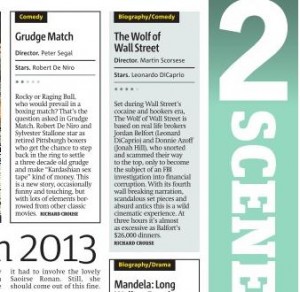
I think of this game and the raging debates it inspired between me and my eight-year-old friends because a new movie asks a similar question: Rocky or Raging Bull, who would prevail in a boxing match?
Billy “The Kid” McDonnen (Robert De Niro) and Henry “Razor” Sharp (Sylvester Stallone) are two retired Pittsburgh boxers with a history and a grudge. Thirty years ago they were at the top of their game, both with undefeated records, save for their fights against one another.
The grudge stems from Razor pulling the plug on their third fight, a championship bout that would have made them both superstars. Razor left the ring permanently, working in a steel mill. Kid, the more flamboyant of the pair, became a businessman, opening a car dealership and performing stand up comedy at his own restaurant, The Knocked Out Dinner and Theatre Club.
When the chance to finally step back into the ring, settle their grudge match and make “Kardashian sex tape” kind of money, it opens up thirty-year old wounds.
“Grudge Match” is a new story but with lots of elements that remind us of other movies. Rocky and Jake LaMotta… er, I mean, Razor and The Kid aren’t so much characters so much as they are brands, borrowed from better known movies to headline an old guy empowerment flick.
For every “If one of you gets knocked down, have you fallen and can’t get up?” gag, there is a scene of Stallone, age 67 or De Niro, age 70, punching someone or seducing a much younger woman.
The ghosts of movies past make appearances throughout. There’s a twist on the Rocky “beats the meat” scene in the original, and De Niro is essentially playing a cheerier version of La Motta.
But despite the echoes of classic movies that reverberate throughout, and obvious lines that make critics like me want to write snarky things—like Kevin Hart asking Stallone, “You know what this is?” and Sly replying, “A bad movie?” or a trainer played by L.L. Cool J telling De Niro, “A great performer knows when to get off the stage.”—“Grudge Match” grew on me.
The first hour feels stilted. Director Peter “Get Smart” Segal spends a bit too much time introducing old lovers (Kim Basinger) and illegitimate kids (former “Walking Dead” star Jon Bernthal) but once the exposition has been disposed of and the emotional foundation has been lain, “Grudge Match” becomes something akin to watching old friends on screen. The mushy stuff doesn’t work so well, but as the movie goes on you’ll find yourself rooting for the old guys to do some damage in the ring.
And they do. The big showdown, the Grudgement Day match is a pretty good fight scene (despite being presented by Geritol), except for the cheeseball montage of the fighter’s loved ones grimacing in the crowd, and despite a sentimental ending, closes the movie with a knockout (and NO that’s not a spoiler, just a turn of phrase).
I think “Grudge Match” will likely appeal to an older audience who can really get behind the idea of two old timers stepping up and reliving past glories. It’s occasionally funny—grandson Trey (Camden Gray) is a scene-stealer—and touching by times, just don’t go expecting any big surprises.
Some will find “Last Vegas,” the new all-star Ovaltine comedy, charming and funny.
Others, like me, may be put in the mind of “A Christmas Carol” with the cast—Michael Douglas, Robert De Niro, Morgan Freeman and Kevin Kline—as the Geriatric Ghosts of What is Yet to Come, providing a terrifying glimpse into the future filled with titanium hips, pill organizers and dinner parties that begin at 4:15 pm.
The Flatbush Four, a quartet of Brooklyn buddies, have been friends since childhood. They now live in different parts of the country, but for the most part the bond they formed on the block fifty-eight years ago is still as strong as the Marlboros they once stole from the corner store. When the deeply-tanned Billy (Douglas) announces his marriage to a much younger woman, Archie (Freeman), Sam (Kline) and Paddy (De Niro) throw him a bachelor party in Vegas. “We’re here to celebrate Billy’s marriage to an infant,” says Archie.
Time has taken its toll on their lives and relationships. The highlight of Archie’s day is organizing his medication, Sam is romantically restless and Paddy is in mourning for his late wife. Complicating things is Paddy’s resentment toward his former best friend Billy.
Friendly faults aside, the four wrangle high roller status, hook up with an obliging saloon singer (Mary Steenburgen) and try to party like it’s 1959.
Imagine a mix of “The Hangover” and “Grumpy Old Men” and you’ll get an idea of the tone of “Last Vegas.” It’s almost two hours of old codger jokes—“The first bachelor party to be covered by Medicare!”—but without the tigers and Mike Tyson set against the glitz of Sin City.
The main enjoyment here comes from watching the headliners create chemistry between their characters given a script that has as much nuance as a game of Keno.
Kevin Kline has most of the funny lines and delivers them well—mistaking Curtis Jackson for a member of the Jackson 5 is funny, a bit of slapstick with a straw, not as much. The rest of the guys make the best of it, gamely strolling through the script on the way to pick up their pay cheques.
The problem with ”Last Vegas” isn’t with the performances—the above the title actors share five acting Oscars among them and Steenburgen won one for “Melvin and Howard”—it’s with a predictable script that takes no chances. No stereotype is left unturned. Dirty old man, check. May-December romance, check. Advice spewing wise old man, check. Viagara joke, check. It’s all here and more, but the movie is content to coast along on the reputations of its stars.
The Good Shepherd is a spy movie without the bells and whistles we’ve come to expect from our favorite undercover operatives. There are no elaborate chase scenes a la James Bond, no cool gadgets like Ethan Hunt’s presto-chango masks in the Mission Impossible movies, not even the great scenery of the Bourne Supremacy. In fact the only thing The Good German shares with any of those movies is star Matt Damon, who has traded his Bourne identity for that of Edward Wilson, one of the (fictional) founders of the CIA.
The Good Shepherd is a movie about secrets and duplicitous men who live in a shady underworld where nothing is as it seems. Director Robert De Niro, in his first stint behind the camera in over a decade, has delivered a long, thoughtful movie about the paper pushers who fought the cold war from behind desks.
Damon is a stone-faced bureaucrat who is involved at the very highest levels of espionage. De Niro dispenses with most of the spy movie conventions to tell a complex story of this man’s career and private life. From a life groomed for clandestine politics first as a member of the Scull and Bones Club at Yale to counter-intelligence in WW2 to the Bay of Pigs to the sexual politics of feeling trapped in an unhappy marriage while feeling guilty about carrying on affairs, The Good Shepherd covers it all.
It’s an ambitious story, but the movie over-reaches in its attempts to present a well-rounded portrait of this man’s life. The time frame leap frogs constantly and it isn’t always clear whether we’re in the past or present, but I found the espionage story interesting enough to keep me engaged in the confusing story.
“Limitless” is a drug movie with Bradley Cooper as a chemically enhanced knowledge junkie. Imagine Keith Richards with a four digit IQ and you get the idea.
Cooper plays a slacker writer with a crappy apartment, an ex-wife and soon-to-be ex-girlfriend. Like the rest of us he’s only using 20% of his brain, and often, not even that. His life changes when he begins taking a drug that allows him to access the other 80%. Suddenly he can learn languages in hours and can retrieve everything he has ever read, seen or thought about. His intellectual ability is, as the title says, limitless. Also limitless are the people who will do almost anything to lay their hands on the drug.
“Limitless” begins with a premise that would make Timothy Leary proud—drugs open up the mind, man—then becomes a Nancy Reagan “Just Say No” drama before winding down to an ambiguous ending. I wasn’t exactly expecting “Reefer Madness,” but I would have liked a clearer point of view.
This is, after all a drug movie. It’s a drug movie with a twist mind you, but at its heart it’s a movie about addiction and the effects of drug use. In this Charlie Sheen world there’s enough images of drug abuse out there for this one to be so noncommittal.
But that’s a quibble when the movie is as entertaining as “Limitless.” Despite the limits of the story it’s a whole lot of fun. The drug haze scenes are effective and the 18 hour blackout sequence is a tour de force, complete with Bruce Lee flashbacks. Neil Burger only oversteps when he tries to illustrate Cooper’s newfound intelligence. Letters falling from the ceiling while he is furiously writing. Really?
No matter, the movie is so adrenaline paced, the gimmicky scenes are over before they have much a chance to register. The movie is as jittery as the drug addicted lead character.
Cooper is in virtually every scene here and proves that he’s leading man enough to carry a movie, charming enough to keep us interested and has the chops to pull off the drama. I’m not sure I could have accepted him in a gritty drug movie like “Last Train to Brooklyn,” but as the upwardly mobile brainiac with an edge he’s perfectly cast.
“Limitless” will be a good gap filler for Cooper fans who are anxiously awaiting the release of “The Hangover 2” scheduled for this May.
Here’s a question. What’s Barbra Streisand’s worst movie? Or Dustin Hoffman’s? Or Robert De Niro’s? How about Harvey Keitel? It’s a trick question. Here’s a hint: It’s just one movie. Another hint? It’s a sequel and it’s in theatres right now. Enough hints. It’s “Little Fockers,” the third in a series of movies about a male nurse named Greg Focker (Ben Stiller) and his overly suspicious father-in-law (De Niro).
In this outing Greg, now moonlighting as a pharmaceutical salesman, must prove to Jack (De Niro) that he isn’t fooling around on Pam (Teri Polo) and is worthy to be the patriarch or Godfokker of the whole family.
“Little Fockers” is an interesting study in what passes for a successful comedy franchise these days. Its producers must be hoping that familiar faces and situations will equal laughs and big box office. They’re probably half right. The Focker mix likely will garner big returns at the box office, but the laughs aren’t there. Three movies in the ideas seem to have run out. Instead of the freshness of the first movie, we’re treated warmed over jokes, innuendo, a series of misunderstandings and the only enema-flirtation scene to ever appear in a Streisand movie. There is the odd laugh and a few giggle worthy scenes but they are few and far between.
It’s ram packed with big stars—even if one of them, Harvey Keitel, seems to only be there to add some heft to the marquee—but to be fair no one is doing their best work. Jessica Alba seems to be having fun playing a wild-child pharmaceutical rep but most of the other performances have a been-there-done-that feel, as if the movie was strung together from outtakes from the past Focker films. We also seem to have reached the self parody stage of De Niro’s career. Please Robert, if there is a fourth movie, no more Godfokker jokes!
“Little Fockers” is proof positive of the sequel law of diminishing returns. It might be time for these Fockers to Fock Off.
“New Year’s Eve” isn’t so much a movie as it is a cavalcade of familiar names in situations geared to make you understand why everybody hates December 31st.
This mishmash of easy sentiment, romance, illness, musical numbers, product placement—Disaronno anyone?—tradition and a version of “I Can’t Turn You Loose” that makes the kids from Glee sound like Otis Redding, flip flops from story to story so often it’s like a five-year-old grabbed the remote and is wildly channel surfing.
There’s Robert De Niro as a terminally ill man; Halle Berry as his kindly nurse. Then there’s Michelle Pfeiffer as a dowdy “executive secretary who decides to tackle her unfulfilled resolutions,” and Zac Efron as the courier who makes her reams come true. Hillary Swank is the acrophobic producer of the Times Square New Year’s Eve show, Katherine Heigl and Jon Bon Jovi are a caterer and a rock star with a romantic history, Ashton Kutcher as a curmudgeonly cartoonist who gets trapped in an elevator with back-up singer Lea Michelle and even Ryan Seacrest pops up playing—who else?—himself.
Have I left anyone out? Probably, there are more stars here than in the heavens, but rest assured, by the end of the movie stories have woven together and no hearts are broken.
Like its predecessor “Valentine’s Day'” “New Year’s Eve” takes a bunch of stars with little or no box office cache on their own—Zac Efron, Jessica Biel—and packages them into one large, over-stuffed package that somehow, in terms of star power, is bigger than the sum of its parts. To quote the movie, “there’s more celebrities here than rehab.”
Too bad they are wasted in a movie that is little more than a collection of clichés salvaged from every romantic comedy, Hallmark holiday special and sitcom you’ve ever seen. From its generic opening song played over generic shots of New York City, every moment of “New Year’s Eve” inspires déjà vu, the feeling of been there and done that.
There are Walmart commercials with more real emotion than director Gary Marshall manages to bring to this manipulative mess. His idea of romance is Josh Duhamel doing the rom com run through the streets of New York as the ball drops in Times Square. His idea of humor is old people saying inappropriate things and by the time Mayor Bloomberg kicks off the New Year’s Eve countdown with the words, “Let’s drop the ball,” its already abundantly clear that Marshall already dropped the ball with this movie.
Bradley Cooper’s continued push to distance himself form his most famous character, the slime-ball Phil of “The Hangover” fame, continues with “Silver Linings Playbook,” a David O. Russell film that pioneers the genre of mental illness rom com.
Cooper is Pat Solitano a separated substitute teacher, jailed for beating his wife’s boyfriend half to death. Now his wedding song, “My Cherie Amour,” sends him into rages and he has severe control issues. After eight months being institutionalized he’s released into the reluctant care of his parents (Robert De Niro and Jacki Weaver). His recovery is slowed by a fixation on his ex-wife, but helped along by a kindred spirit, Tiffany (Jennifer Lawrence) a troubled widow who needs Pat’s help to win a dance competition.
Cooper stretches here, displaying his well-honed comedic skills but tempering the jokes with some serious dramatic chops. He desperate to rebuild his life and Cooper shows us how he slowly gets the building blocks in order to achieve his goal. It’s nice work that turns on a dime from manic to awkward to disheartened, often in the same scene.
Director David O Russell (“The Fighter,” “Three Kings”) visually echoes Pat’s various states, using the camera and zooms and fast cuts to give us an idea of the mental state of the main character.
Vying for attention are Lawrence and De Niro. Lawrence brings considerable charm and chops to Tiffany. Her understanding, but slightly icy stare as Pat meets her for the first time with the greeting, “You look nice. How’d Tom die?” is skilled, subtle and effective.
Ditto De Niro, except for the subtle part. He hands in a broad performance as a father who couldn’t ever relate to his son. Their relationship is based on a mutual love for the Eagles football team and dad’s belief that Pat provides some sort of mojo for the team during the playoffs.
So, good performances all round, but the last half is marred by too much repetitious dialogue—arguments that go nowhere—and football superstition that leads the story far afield from where it began.
Mental illness is a complicated subject that the film doesn’t exactly treat lightly. Instead “Silver Linings Playbook” uses it as a plot device
 By Richard Crouse – In Focus Metro Canada