“Stone,” the new film starring powerhouse method actors Robert de Niro and Edward Norton, is the very definition of an actor’s movie. Richly drawn characters populate the film giving actors a chance to brood, use funny accents and, in the case of Milla Jovovich, deliver a career altering performance. It’s just too bad the story doesn’t give the actors the support they deserve.
De Niro plays parole case worker Jack Mabry. He’s a month away from retirement, and in an effort to cross ts’s and dot i’s he’s clearing his desk of all his outstanding paperwork. One of his final cases is Gerald “Stone” Creeson (Norton), an arsonist looking for spiritual enlightenment and a way out of prison. They engage in an elaborate verbal game but when words fail, Stone resorts to plan B, convincing his wife Lucetta (Jovovich) to seduce Mabry and use blackmail to earn his release from jail. She’s a willing participant, but soon after ethical and moral lines are crossed the deception deepens, revealing the true character of all involved.
First and foremost “Stone” is a movie to be admired for its performances. Norton, corn rows and all, impresses, playing a riff on the sketchy but emotionally layered characters he’s played before in films like “American History X” and “Primal Fear.” Mabry seems like a character De Niro could play in his sleep, a family guy with a reserve of rage hidden just under the surface, but his skilful performance takes Mabry to interesting and unexpected places. The biggest surprise, however, is Jovovich. The queen of the “Resident Evil” series taps into previously unseen reservoirs of talent, hinting that she may soon add Oscar nominee to her imdb listing.
The performances are admirable but as good as they are the story won’t inspire admiration, just frustration. It has the bones of a gripping drama but as the running time approaches the ninety minute mark character motivations become muddled and Norton’s metaphysical transformation seems more like a plot device than a believable life change. It allows Norton to do some interesting work but feels like it belongs in a different movie. Near the end it almost feels as though director John Curran (who worked with Norton before on the period drama The Painted Veil) ran out of time and had to tie up all the story shards in the quickest, most efficient way possible. There is little resolution and a metaphor, at least that’s what I think it is, involving a fly is mystifying.
“Stone” shines when it focuses on the actors but sinks like a, well, stone story wise.
Stardust, a new movie starring Claire Danes and Robert De Niro evokes the fantasy films of the 1980s. Movies with titles like Labyrinth and The Princess Bride were sweeping whimsical epics that combined flights of the imagination with, as Peter Falk says in the latter, “fencing, fighting, torture, revenge, giants, monsters, chases, escapes, true love, miracles…” Stardust, based on a graphic novel by fantasy superstar Neil Gaiman, breathes the same air and is a welcome blast of originality in a summer of remakes and sequels.
The story begins with a young man named Tristran (Charlie Cox) who sets out to win the heart of the beautiful, but shallow Victoria (Sienna Miller). He promises to fetch her a fallen star as a sign of the lengths to which he will go to prove his love. To do so he must cross The Wall, a barrier separating his sleepy village from the strange, supernatural land that lies beyond. To his shock he discovers that the fallen star has assumed human form. Named Yvaine (Claire Danes) she is beautiful, feisty and completely unaware of the trouble she is in.
She is sought after by not only the King’s (Peter O’Toole) ruthless sons, who need her secret power to secure the throne, but also by a powerful witch (Michelle Pfeiffer) who needs the star’s youthful vitality to restore her beauty and achieve eternal youth.
When Yvaine’s cosmic countenance takes a more earthly turn she falls in love with Tristan and as their adventures deepen and become more perilous—they meet a flamboyant pirate captain (Robert De Niro) and shifty merchant (Ricky Gervais)—the young man and former heavenly body discover the true meaning of love and their real destiny.
Usually this kind of thing puts me to sleep before the opening credits have finished. The first mention of forbidden lands or evil witches and I’m out, but Stardust has more going for it than the run-of-the-mill fantasy. It’s quite funny, a welcome change from a genre that often takes itself a little too seriously and has a top-flight cast that includes superstars Ian McKellen, De Niro, O’Toole, Pfeiffer and Gervais in concert with up-and-comers like Claire Danes and Charlie Cox.
Each play to their strengths but it is De Niro who really makes an impression as a cross-dressing pirate. That’s right, he wears a dress and minces across the screen in a way that we have never seen before from the tough-guy actor. He’s made comedies before, but usually playing a riff on his well-established heavy characters. This time out he shakes it up and it is great to see him have some fun on screen in a role that is a polar opposite from the kind of thing he usually does.
Stardust is a beautifully realized fantasy that takes many of the standard features of the genre, dying Kings, a quest to find true love and evil witches and throws them together in a way that avoids cliché. It’s magical and fun, and best of all, it ain’t Rush Hour 3.
In his long and storied career Robert De Niro has made some stone cold classics, won Oscars and made the saying “You talkin’ to me?” a standard punchline for impressionists and psychopaths everywhere.
He’s also made lots of movies like “The Family.”
They’re what I call “new roof” films. Every now and again actors take on work for reasons other than artistic. Say, for instance, when they need a new roof on their castle in the South of France.
“The Family” feels like one of those movies. He’s still Booby D, so he isn’t terrible, neither is his co-star Michelle Pfeiffer, who brings back fond memories of “Married to the Mob,” but the film teases us with visions of De Niro in gangster mode and let’s us down with a paint-by-numbers story.
It’s a basic fish out of water story with a gangland twist. The Manzoni’s, Maggie (Pfeiffer), Belle (Diane Argon), Warren (John D’Leo) and father, hit man turned stoolie Giovanni (De Niro), have spent years in the witness protection program, moving from place to place, overseen by an FBI handler (Tommy Lee Jones). Their newest home is a sleepy little town in Normandy where they try and fit in.
Trouble is, they don’t blend.
The kids take after dad. Belle is a bruiser who beats up her classmates and Warren runs rackets in his school hallways. Maggie has a way with explosives and Giovanni, well, let’s just say you don’t want to get one his bad side. They are living proof that “the family that slays together, stays together.”
Stateside the people he betrayed are on the look out for Giovanni and family with revenge on their minds.
In one of the film’s pivotal moments Giovanni attends a film club screening of (MILD SPOILER) of “Goodfellas.” The mere mention of Martin Scorsese—De Niro’s collaborator on eight films since 1973—only reinforces how lame this movie is. De Niro has a rapturous look on his face as he watches the movie in the movie, as though longing for the good old days when Hollywood still made good gangster pictures. Or at least mob movies that didn’t rely on stereotypes to sell the sadistic dark humor.
Before “The Family” turns into a bullet orgy, it contains a few tense moments but fails to deliver on the comedy or any fresh gangland drama.
I hope De Niro at least got a nice new roof out of the deal.
For every serious mafia drama like Carlito’s Way, there is another film that doesn’t take the La Cosa Nostra as seriously.
Gangster comedies like The Gang That Couldn’t Shoot Straight and Some Like It Hot are early examples of gangland gigglers.
This weekend Robert De Niro, who won an Oscar playing Vito Corleone in The Godfather: Part II, and Michelle Pfeiffer, who played a gangster’s moll in Scarface, team up for The Family, a darkly comedic mafia movie.
The film also features Sopranos’ star Dominic “Junior Soprano” Chianese and Vincent “Big Pussy” Pastore in a story about notorious crime family the Manzoni’s, who find themselves relocated to Normandy, France as part of the witness protection program. Trouble is, they have some difficulty blending in with the locals.
This isn’t the first time De Niro has played his tough guy image for laughs. In Analyze This and its sequel Analyze That, he’s Paul Vitti, a mob boss who suffers from panic attacks. To help him through he hires psychiatrist Dr. Ben Sobel (Billy Crystal). “What is my goal here?” asks the doctor. “To make you a happy, well-adjusted gangster?” The first movie was a big hit—both commercially and critically but the second one didn’t fare as well. Roger Ebert wrote, “what seemed like a clever idea the first time feels like a retread the second.”
In the Whole Nine Yards former hit man Jimmy the Tulip has trouble adapting to life on the right side of the law. As played by Bruce Willis he’s in hiding after ratting out members of Chicago’s deadly Gogolak gang. When his identity is discovered by his neighbor (Matthew Perry) Jimmy has to reluctantly revert to old habits to survive. “It’s not important how many people I’ve killed,” he says. “What’s important is how I get along with the people who are still alive.”
Years before Pride and Prejudice and Zombies became an unexpected literary hit, Hollywood co-opted the marquee value of Jane Austin’s name. Director Jim Abrahams of Naked Gun and Top Secret fame, looked to the underworld for the inspiration of Jane Austin’s Mafia. A spoof movie that draws heavily on Martin Scorsese’s Casino (and not so much on Austin’s oeuvre) it marked Lloyd Bridges’ last appearance on the big screen, playing a Mafia godfather. A quick watch, the film runs for a scant 84 minutes, six of which are taken up with credits.
In What Just Happened Hollywood turns the camera on itself, exposing the day-to-day life of a once hot producer on the verge of a career meltdown. Robert De Niro stars as a movie mover-and-shaker plagued by bad test screening reports, a superstar actor who refuses to shave off a silly Santa-esque beard and low ranking placement on Vanity Fair’s Hollywood Power list. It’s a peek behind the curtain that reveals the dark—and often ridiculous—inner workings of the movie business.
Ben (De Niro) is having a rough two weeks. A test screening for his latest film, a thriller starring Sean Penn, didn’t go well and now the studio is demanding a recut version with a different ending. Bruce Willis’s facial hair is jeopardizing his next production and his ex-wife is involved with a new man. To weather these storms he must use all his skills as a negotiator, father figure, hand holder, problem solver and politician or see himself become yesterday’s news, replaced by someone younger and hungrier.
Despite the film’s catchy advertising tagline, “In Hollywood, everybody can hear you scream,” What Just Happened isn’t a particularly scary look at the business. Based on a memoir by real-life producer Art Linson—whose credits include The Untouchables, Heat, Casualties of War, Fight Club and Into the Wild—it is almost affectionate in its dissection of Hollywood’s foibles. The film’s broad strokes are obvious—stars can be temperamental, directors are self-indulgent brats—but when the director Barry Levinson gets down to brass tacks, as he does in a scene where a studio head (Catherine Keener) coldly orders Ben’s assistant out of a meeting, he more accurately portrays the harsh realities of what life with the Hollywood sharks is really like.
If the film contained more scenes like that What Just Happened might have been able to raise its temperature from tepid to a rapid boil, but unfortunately settles for Hollywood stereotypes and warmed-over industry in jokes.
What Just Happened is aided by an all star cast headlined by De Niro who hands in nice understated work, Stanley Tucci as a slick screenwriter, John Turturro as a neurotic agent and Bruce Willis and Sean Penn who both lampoon their Tinsel Town bad-boy images. It’s fun to see Willis trash a dressing room or Penn nod knowingly when his director commits career suicide at the Cannes Film Festival but even these fourth-wall piercing cameos aren’t as funny or satiric as they should be.
What Just Happened claims to be an insider’s view of what veteran director Norman Jewison called “this terrible business” but lacks any real insight.
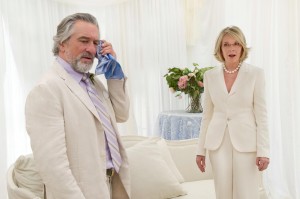
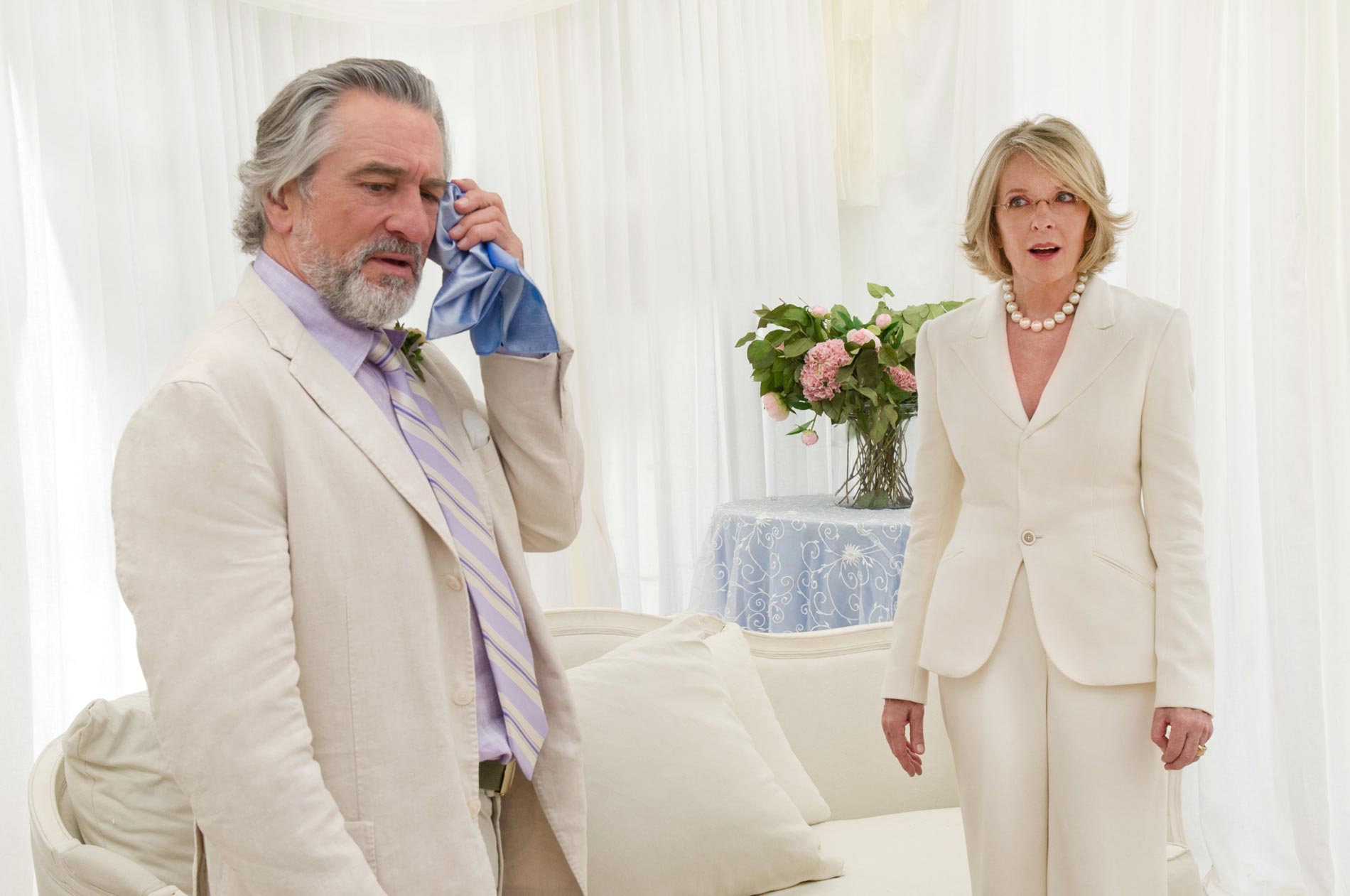
In The Big Wedding a long-divorced couple, played by Robert De Niro and Diane Keaton, pretend to be happily married at their adopted son’s wedding for the benefit of his biological mother.
Hijinks ensue, but like all movies with the word “wedding” in the title, audiences don’t buy a ticket for the shenanigans, they go to see the ceremony. Anything that happens before the walk down the aisle is window dressing, the journey that gets the audience where they really want to be, at the altar.
The famous wedding scene in The Godfather—including the much-quoted Luca Brasi line, “Don Corleone, I am honored and grateful that you have invited me to your home on the wedding day of your daughter. And may their first child be a masculine child.”—featured many Staten Island Italian-Americans as extras. They were invited to the set to enjoy homemade wine, traditional Italian food and enjoy themselves as though it were a real wedding.
Inspiration for the film Four Weddings and a Funeral came when writer Richard Curtis realized he had been to 72 weddings in 10 years. The movie, about a confirmed bachelor who discovers love, made an international star of Hugh Grant, who won the role after auditioning with a tape from when he was best man at his brother’s wedding.
Both those films, plus others like Wedding Crashers, My Big Fat Greek Wedding and Fiddler on the Roof feature wonderful wedding scenes, but what about when nuptials turn nasty?
Who could forget Mr. Robinson howling, “You punk! You crazy punk! I’ll kill you!” at The Graduate’s Benjamin (Dustin Hoffman) after he interrupted the wedding of Elaine Robinson (Katharine Ross) to another man? Elaine leaves her intended at the altar, running off with Ben to an uncertain future, creating one of the classic endings in movie history.
In Runaway Bride Richard Gere plays a reporter investigating the story of Maggie Carpenter, a serial bride who has had multiple disastrous weddings, leaving three men at the altar. “Always a bride,” she says, “never a bridesmaid!”
The biggest bummer wedding in movie history has to be in Kill Bill Vol. 2. “How it happened, who was there, how many got killed and who killed them, changes depending on who’s telling the story,” says The Bride (Uma Thurman). “In actual fact, the massacre didn’t happen during a wedding at all. It was a wedding rehearsal.”
What role do Paul Bettany, Robert de Niro, Rowan Atkinson and Max von Sydow share? Mr. Jennifer Connelly, the Oscar winner, Mr. Bean and the legendary Swedish superstar all have one kind of part in common. They have all played priests on the big screen.
In this weekend’s post-apocalyptic action horror film Priest Bettany plays the title character, a warrior pastor hunting the vampires who kidnapped his niece. Based on Min-Woo Hyung’s graphic novels the movie also features Christopher Plummer as the Monsignor, described by the legendary Canadian actor as “a horrible priest gone wrong—a lovely, stylish villain.”
In the Barry Levinson film Sleepers De Niro was Father Bobby, a Hell’s Kitchen priest who lies in court to prevent four of his parishioners from going to jail for killing a sadistic prison guard. “Most priests like to preach from the pulpit,” says one character. “Father Bobby liked to talk during the bump and shove of a pick-up game.”
Atkinson played Father Gerald, a new vicar performing his first marriage ceremony in Four Weddings and a Funeral. The tongue-tied priest has some of the film’s funniest lines, including, “In the name of the father, the son and the holy goat. Er… ghost.”
Probably the most famous movie celebrant is Father Lankester Merrin, as portrayed by Max von Sydow in The Exorcist. Von Sydow is one of the few actors to have played both God (in The Greatest Story Ever Told) and the Devil (in Needful Things) but it is as Merrin that he is best remembered (unless you are a Great White North hoser who worships his role as Brewmeister Smith in Bob and Doug MacKenzie’s Strange Brew). The statuesque Swedish actor played Merrin twice—he’s seen in flashbacks in Exorcist II: The Heretic—and Stellan Skarsgård played him in two prequels but it is the first movie and the iconic line “The Power of Christ compels you!” that is most memorable.
Many other actors have played clerics. Carl Maldan was Father Barry in the Best Picture winner On the Waterfront, George Carlin was Cardinal Ignatius Glick, the mastermind of Dogma’s ‘Catholicism Wow!’ campaign but the actor most associated with playing priests is Pat O’Brien. He became an actor only after deciding against entering seminary and his devotion to playing priestly characters was so well known it even inspired the name of band, the blues-rockers Pat O’Brien and the Priests of Love.
Last week, the Internet lit up with news that one of the great actor-director teams might reunite to remake one of their classic films.
Rumours (since debunked) had Martin Scorsese and Robert De Niro set to give Taxi Driver the sequel treatment.
It seemed too good to be true — De Niro is busy overseeing the Tribeca Film Festival and Scorsese is occupied with new muse Leonardo DiCaprio — and the rumor turned out to be just that — a rumour.
But for a tantalizing moment it seemed there might be a new film from one of the most dynamic director-actor pairings since Bogart and Huston or Mifune and Kurosawa.
Not that there are any shortage of director-actor teams. Scorsese and DiCaprio’s newest bit of teamwork, Shutter Island, opens this weekend and the latest Pedro Almodóvar-Penélope Cruz film, Broken Embraces, was recently nominated for a Golden Globe.
“I think you find, when you talk about a collaboration between a filmmaker and an actor, that it’s always evolving,” said Shutter Island producer Brad Fischer. “I don’t think it begins and ends with any one movie.”
Diane Keaton cites the evolution of collaboration with Woody Allen — they made seven films together, including the classic Annie Hall, between 1973 and 1993 — with elevating her from a “novice who had lots of feelings but didn’t know how to express herself” to someone who “can be braver and more spontaneous.”
Penélope Cruz is more effusive when discussing her mentor Pedro Almodóvar, who made her an art house darling, international star and claims to have “saved her from Hollywood.”
“He changed the way I looked at the world before I even knew him,” she says.
“There is something that works really well in our relationship that combines both our friendship and the professional side,” says Almodóvar. “We operate like lovers. So while we don’t have the pleasures of sex, we don’t have the complications of sex either. We work really well as a couple who don’t sleep together.”
Sometimes the director- actor relationship extends past the movie set. Four years after shooting The Life Aquatic in Italy, Wes Anderson regular Bill Murray (five films together) asked the director to deliver 10,000 Euros in cash to his former landlord.
“It’s not as weird as it sounds,” said Anderson on paying the rent a little late. “Bill can be a little weird with time.”
Robert De Niro’s newest film, “Being Flynn,” places him back where we first noticed him, behind the wheel of a cab in New York City.
Based on a memoir by writer Nick Flynn, the movie is a dual narrative between its leading characters, a father and son, both wannabe writers, both with addiction problems. It begins with Jonathan Flynn (Robert De Niro), a disturbed man who says there are only three classic American writers, Mark Twain, J.D Salinger and Jonathan Flynn. That he is unpublished does not diminish his grandiose claim to greatness. From behind the wheel of his cab he’ll tell anyone who’ll listen about his masterpiece, but when as his delusions grow more intense, he loses his job, his apartment but not his conviction that he is a great writer.
Running concurrent with Jonathan’s story is his son Nick’s (Paul Dano) tale.
Nick has been drifting through life since his father left, got thrown in jail and disappeared into the ether. Taking a job at a homeless shelter seems to give him purpose–as does a relationship with Denise (Olivia Thirlby–until his father contacts him, looking for a favor, and later a bed at the homeless shelter. The presence of his father forces him to recognize that perhaps he shares more in common with his dad than he cares to admit.
“Being Flynn” is a bleak character study that scrapes by on the strength of its performances. De Niro is looser than we’ve seen him in years, getting underneath the skin of a man who is courtly one moment, deluded, racist and violent the next. It’s vibrant work, that brings humanity to a very unlikeable character.
Dano, best known for his work in “There Will Be Blood,” is properly haunted as a man plagued by memories of his mother’s death and the strained relationship with his father. Gaunt to the point of making Keith Richards look healthy, he is convincing as a man trying to find his way through a fog.
Julianne Moore has a small, but pivotal role, adding to the acting fireworks on display, but the very structure of the film–the dual story telling and an unfortunate sequence where characters comment to camera–is hard going. Add to that a story even Debbie Downer would find depressing and you have a film that rewards the viewer with performances while penalizing them with subject matter.