“The Menu,” a new dark comedy starring Anya Taylor-Joy and Ralph Fiennes and now playing in theatres, pokes fun at the kind of pretentious restaurant experience where customers, willing to pay $1,250 a head for a tasting menu prepared by a famous chef, aren’t diners, but “ingredients in a degustation concept.”
Renowned Chef Slowik’s (Ralph Fiennes) farm-to-table restaurant Hawthorne, situated on its own, remote 12-acre island, is a hot ticket, seating only 12 people a night. The celebrity chef oversees a brigade of highly trained cooks who diligently create artfully composed haute cuisine plates with names bigger than the actual portion sizes. He’s the anti-Guy Fieri, a chef who thinks of food as an intellectual exercise rather than nourishment.
The guestlist for the night’s exclusive dinner is an eclectic grab bag of rich and famous folks. From a movie star (John Leguizamo) and a haughty food writer (Janet McTeer) and her editor (Paul Adelstein) to Anne and Richard (Judith Light and Reed Birney), a rich couple who have been regulars at the restaurant for years and a troika of obnoxious tech bro one percenters (Rob Yang, Mark St. Cyr and Arturo Castro) who toast to “work and money,” they are all under the spell of Chef Slowik. All except Margot (Taylor-Joy), the last-minute date of foodie and Slowik super-fan Tyler (Nicholas Hoult). “Slowik is not just a chef,” says Tyler breathlessly, “he’s a storyteller.”
There are rules to dining at Hawthorne. No photographs. “Chef strongly believes the beauty of the food lies in its ephemeral nature,” says the restaurant’s stern host Elsa (Hong Chau). Also, don’t eat. What? “Taste. Savor. Relish,” commands the chef. “Consider every morsel you place in your mouth. Do not eat. Our menu is too precious for that.”
In a bit of unintentional foreshadowing, Tyler scans the room and announces, “It’s official. Tonight will be madness.”
“The menu and the night,” the chef announces, “has been painstakingly planned.” Before each course Chef Slowik, who Margot sarcastically refers to as the Lord High Emperor of Sustenance, provides a flowery description of the food about to be served. As the evening wears on, chef’s descriptions become increasingly philosophical. Tensions rise in the room as the chef’s food reveals as much about the people eating it as it does about the chef’s intentions.
“The Menu” is for anyone who creates art—whether it is food, writing, paintings, whatever the form—and feels underappreciated. Slowik takes his delicious revenge on the patrons who “drained the mystery from my art” with their arrogance and entitlement, or worse, committing the cardinal sin of asking for a substation on one of his carefully constructed plates. He is done, he says, “trying to satisfy people who can’t be satisfied.”
Like the recent “Triangle of Sadness” the victims of the movie are oblivious, wealthy people who hide behind their wallets. The world, Slowik says, is divided into two groups, those who give—he and his service industry colleagues—and those who take. His elaborate menu is his gruesome retaliation on the latter.
A heaping helping of suspension of disbelief is required to enjoy the satire of “The Menu,” but by the time it makes its intentions clear, the film sates the appetite for dark comedy. It’s as subtle as fermented Surströmming (look it up) but this mix of horror and humor has more to offer than shock value. Food for thought on how art is consumed (literally in this case), it’s about the passion of the artist and what happens when it fades.
“The Menu” is buoyed by terrific performances, particularly from Fiennes as the perfectionist chef and Taylor-Joy as the pragmatic Margot, but most importantly, because all the characters are as sour as vinegar, you never quite know where the story is going. That unpredictability is exciting, leaving the characters, and the audience, walking on eggshells.
The X-Men have a rich and textured history but almost none is more complicated than Jean Grey, the mutant played by “Game of Thrones” star Sophie Turner in this weekend’s “Dark Phoenix.”
A human with the superpower of telepathy, she’s an empath and, for good and for evil, is also the physical manifestation of the cosmic Phoenix Force, “the spark that gave life to the Universe, the flame that will ultimately consume it.” Over the years she has been included on Top 100 Comic Book Heroes and Comic Book Villains lists and been killed off several times.
The action in “Dark Phoenix” begins with the X-Men team heralded as heroes by the public who once feared them. Professor X (James McAvoy) is a celebrity, featured on magazines, getting medals from the president. He sees their do-good work as a way to keep them safe. “It’s a means to an,” he says, “We are just one bad day away from them starting to see us as the enemy again.”
When a group of astronauts find themselves in trouble Prof X sends Storm (Alexandra Shipp), Quicksilver (Evan Peters), Nightcrawler (Kodi Smit-McPhee), Grey and others to space on a daring rescue mission. During the operation Grey is hit by “pure and unimaginably powerful cosmic waves” that will eventually transmute her into the Dark Phoenix, a malevolent force with the potential to tear the world apart. The core of good inside Grey battles for supremacy until repressed pain and anger push her to the dark side. “You’re special, Jean,” says shapeshifting energy sponge Smith (Jessica Chastain), “and if you stop fighting that force inside you, if you embrace it, you will possess the very power of a god.”
The X-Men crew have been always been concerned with the greater good, doing what is best for the masses, but what happens when one of their own turns bad and needs to be stopped? That’s the question at the heart of “Dark Phoenix.” “When I lose control,” Grey says, “bad things happen to the people I love.”
At their best the “X-Men” movies are an ode to outsiders. Ripe with metaphor and nuance, they look at how society treats marginalized people. They also find the humanity in their outsider characters. Whether they have blue fur or can bend metal with their mind, their greatest superpowers are always qualities like forgiveness and loyalty.
Progressive ideas about acceptance are still at the heart of “Dark Phoenix” but all the nuance is consumed in a cosmic bonfire of CGI flames and the messaging is delivered with a mallet. “They can never understand you! What they can’t understand they fear and what they fear they seek to destroy!”
The film’s biggest (and only intentional laugh) comes with a good and timely line courtesy of Jennifer Lawrence. “The women are always saving the men around here,” says a huffy Mystique to Professor X. “You might want to think about changing the name to X-Women.”
Despite the pyro on display “Dark Phoenix” doesn’t catch fire. The tone is flat, passionless even as a hectic CGI-A-Thon of eye blistering action eats up much of the last reel. (MILD SPOILER AHEAD) Long-time fans may get a lump in their throats as one classic character makes their farewell but as Grey says, “emotions don’t make you weak, they make you strong.” Whether you’ll feel stronger or not after the end credits roll will depend on how much attached you are to the X-Men characters. If you’re not already a fan this lackluster movie is unlikely to convert you.
To paraphrase Abraham Lincoln, if you want to test a person’s character, give them power. That maxim is fully on display in “The Favourite,” an Oscar hopeful starring Olivia Colman, Rachel Weisz and Emma Stone, as two women vie for the attention of Anne, Queen of Great Britain.
Set in the early 18th century, “The Favourite” begins as England, under the rule of Queen Anne (Coleman), is at war with France. A clueless and vain monarch stricken with gout from gorging on chocolate and cheese, the Queen is haughty in the style of, “Look at me! How dare you look at me!”
The real power behind the throne ismovie notes the Queen’s close friend and confidant Lady Sarah Churchill, Duchess of Marlborough (Weisz). She’s a stern figure equally at home pampering the Queen or ordering a maid to be whipped for any minor transgression.
Life at the castle is a decadent push-and-pull for favour between those who want the Queen to end the war, like Robert Harley, 1st Earl of Oxford (Nicholas Hoult), and those who feel the battle must continue. The battle for power becomes more intense when Abigail Masham (Emma Stone), Lady Marlborough’s cousin and fallen gentry whose father gambled her away in a card game, arrives looking for a job. Put to work as a maid she quickly moves up the ranks, befriending the Queen and aggressively pushing Lady Marlborough to the fringes. “As it turns out I am capable of much unpleasantness,” Abigail snorts.
Broken into chapters like “What An Outfit“ and “A Minor Hitch,“ the film is a wickedly nasty look at the inner workings of a personal coup d’etat. Smartly written by Deborah Davis and Tony McNamara, it brims with court gossip, quotable lines—“If you do not get out I will start kicking you and I will not stop,” sneers Marlborough.—and machinations enough to make Machiavelli green with envy.
Bringing the intrigue to vivid life are the three leads. At the top of the pyramid is Coleman as Queen Anne. Insecurity and imperiousness are the toxic ingredients that fuel her childlike behaviour. Whether she is stuffing her face to the point of vomiting, faking a seizure at Parliament or indulging in her secret desires, she is unpredictable, ridiculous and, ultimately a sad character. Coleman embraces it all, delivering a beautiful, unsubtle performance.
As Lady Marlborough Weisz is cunning and kind, a power player who knows when to hold ‘em, knows when to fold ‘em. She’s icy hot, calm and collected but quick to temper when threatened. Weisz has rarely been this collected on screen, delivering complex dialogue with panache.
As a woman who admits, “I’m on my side, always,” Stone has the greatest range. From scullery maid to titled Lady her character travels the furthest distance and is capable of the greatest villainy.
Director Yorgos Lanthimos has made a strange and beautiful movie, one that has the twilight zone feel of his other films “The Lobster” and “The Killing of a Sacred Deer.” They all feel like real life, but tilted by 180 degrees. With “The Favourite” he has made a revisionist history that comments not only on personal politics but also how political power is open to the whims of who holds it.
There’s a meme that occasionally pops up on my social media pages. It’s a picture of a person slumped over a typewriter, fists clenched, captioned with the words, “Writing is easy. You just sit at your typewriter until little drops of blood appear on your forehead.”
Anyone who has tried to put words on a page will understand the joke. Writing at a high level requires a combination of talent, study, life experience and dedication; a folio of concrete and ephemeral elements that can blend easily or remain frustratingly difficult to access, depending on the day.
The story of James Joyce’s exasperation while writing his modernist novel Ulysses perfectly illuminates the writer’s frustrating process. As the story goes, a friend dropped by Joyce’s home to find the author upset that after a full day of work he had only written seven words.
“Seven?” his friend says. “But James that’s good — for you, at least.”
“Yes,” Joyce says. “I suppose it is. I’m just not sure what order they go in!”
It should come as no surprise that writers love to write about writing. Screenwriters have tapped out thousands of pages in an effort to illuminate the mysterious process.
From biopics like The End of the Tour and Capote to dramas like Adaptation and Misery, movie after movie has focused on the various ways words make it to the page in the right order.
This weekend Rebel in the Rye is a glossy look at author J.D. Salinger’s unlikely journey from losing a girlfriend to Charlie Chaplin, to the Second World War, from eastern religion to writing the classic novel Catcher in the Rye.
Movies about writers often feature scenes of typewriters clacking, pages crumpled and thrown in the garbage as authors attempt to whip their manuscripts into something readable. Crumpled loose-leaf is a tangible sign of the work, but does little to explain the author’s thought process.
The movie Genius, starring Jude Law as author Thomas Wolfe, does a good job of showing the very lifeblood that flowed through his veins. The You Can’t Go Home Again author creates exciting wordplay that could be compared to the free-flowing fluidity of jazz.
To illustrate the difference between his work and the more staid style of his contemporary Henry James, he pays a jazz band to play a straightforward, traditional version of Flow Gently, Sweet Afton.
“That’s Henry James,” he says as the players plod along. But as the band heats up, splintering off into melodic tangents, he grins and says, describing himself, “That’s Thomas Wolfe.”
The process by which artists go about their work is near impossible to effectively capture on film, but this scene comes close to explaining what it feels like when the creative juices are racing.
Subtler is Paterson, a gentle look at the life of a poetry-writing Paterson, N.J., bus driver played by Adam Driver.
The poems aren’t for publication, simply a way to express his joy in the beauty and art of everyday life. When his dog eats his notebook he has to start again but learns the writer’s greatest lesson.
“Sometimes the empty page presents the most possibilities.” There is great uplift in those words. The blank page isn’t a hindrance to the work but a canvas on which to create something new. It’s the simplest and most beautiful expression of how art is made I’ve ever seen in a movie.
“Rebel in the Rye” is a glossy look at author J.D. Salinger’s unlikely journey from losing a girlfriend to Charlie Chaplin to World War II, from eastern religion to Holden Caulfield. It’s a long strange trip, but would Caulfield label it phoney?
Nicholas Hoult plays Jerome David Salinger, a young man with a talent for words but a father (Victor Garber) who wants him to go into the meat and cheese distribution business. The sharp-tongued teenager isn’t accepted into uptown New York City society and is too square for downtown. The only things he’s good at are getting kicked out of school and writing.
His talent leads him to Columbia University and the Creative Writing class of Whit Burnett (Kevin Spacey). Burnett recognizes Salinger’s gift but isn’t sure of his commitment to the writing life.
Meanwhile, Salinger is a man about town who begins a tumultuous and ill-fated relationship with Eugene O’Neill’s daughter Oona (Zoey Deutch), a pairing that begins his journey towards writing his most famous book.
First though, he yearns to get a short story published. Sights set on Esquire and The New Yorker he receives rejection after rejection until Burnett publishes “The Young Folks,” in a small literary magazine.
Salinger gets some notice, a high-powered agent Dorothy Olding (Sarah Paulson) and a healthy disdain of “phonies,” superficial people who talk one way and behave another. “My father hides the fact that he’s Jewish from our neighbours,” he says. “The first phoney I ever met was on my first day.”
At Burnett’s urging Salinger begins writing a book. “Holden Caulfield deserves a novel all his own,” Burnett drunkenly slurs after a night on the town. “Imagine the book you would like to read and then go write it.”
His burgeoning career is cut short, interrupted by World War II. Overseas he continues to write—he storms Normandy with six chapters of what would become the classic “Catcher in the Rye” in his pack—but when he returns to the United States he suffers PTSD and is unable to continue. “I have nothing left to say about Holden Caulfield,” he says. “Nothing left to say at all.”
Spiralling downward, his life is changed when he discovers meditation as a way to quiet his mind. He picks up the story of a troubled kid during the Christmas holidays, finishing “Catcher in the Rye.” The book is an immediate hit, capturing the consciousness of the nation. Salinger becomes a media star but his newfound fame and interactions with disturbed fans people who think they are Caulfield drive him from public life. In his remote New Hampshire home he built walls, physically around his home and mentally, to keep everyone out. “When people become a distraction,” he says, you remove the distraction.” He dedicates his life to writing—something his mentor Burnett was unsure he’d be able to do—but removes the pressure of having to follow up one of the most popular novels of all time by never publishing another word.
The word “phoney” looms large in the legacy of J.D. Salinger. His process was a search for authenticity, a journey writer and director Danny Strong seems to have veered away from. The handsome production design and period details bring style to a film that is almost completely without substance. The complex issues of innocence, identity, belonging, loss and connection that Salinger loved and brought to his work are reduced to platitudes. Yes, the World War II scenes effectively showcase the horrors of war but Salinger’s reaction to them feel, well, phoney. Later, when he finally begins to create again it’s because he “learns to write not to show off his talent, but to display what is in his heart.” It’s a line that would have made the real life Salinger red faced and the movie is full of them.
From its on-the-nose title to the standard biopic conventions “Rebel in the Rye” could probably best be described by Caulfield himself: “You never saw so many phonies in all your life.”
You’d be forgiven for thinking that “Equals,” the new film starring Kristen Stewart and Nicholas Hoult, was a zombie movie. Characters roam around aimlessly, mumble dialogue and stare at one another as though they’d like to take a bite out of one another.
But it’s not a zombie flick, it’s a high-concept sci-fi love against-all-odds story set in a utopian society where emotions don’t exist. IE, it’s 101 minutes of whispered words and blank stares.
“Equals” is takes place in a place where human emotions have been eradicated. It has resulted in a peaceful, if somewhat dull world. Like small town Ontario, everyone dresses the same and is unfailingly polite. The only disease they have been unable to remedy is S.O.S., a virus that eats away at their icy demeanours and restores their pleasure centers. In other words, it allows people to feel again. Illustrator Silas (Hoult) is infected with feelings, developing romantic thoughts for co-worker Nia (Stewart). She is also sick but undiagnosed. They begin an affair but when a cure is found their new-found feelings and romance are threatened.
Director Drake Doremus has set up an almost impossible situation for himself and his actors. Flat and unaffected, “Equals” is icy in the extreme. The only heat on display comes from several hand-holding sessions which, I suppose, are meant to melt the screen but honestly, there are Amish love stories with more sexual tension.
What could have been an exploration of the very core of what makes us human, a kind of star-crossed sci fi “Romeo and Juliet,” is instead a plodding look at two people experiencing late puberty.
It’s a shame, but perhaps not a surprise, that a movie that aims to sap the emotion out of most of its characters, is a bit of a slog.
“Hope for the best,” says Hank McCoy a.k.a. Beast (Nicholas Hoult) midway through “X-Men: Apocalypse,“ “but prepare for the worst.”
That’s the way I approach the X-Men movies. When a movie series spans a universe of stories—in addition to five X-Men flicks, this is the third “First Class” movie—caution is advised. The general rule of thumb is one of diminishing returns: the further away from the source, the weaker the story.
“Apocalypse” isn’t exactly the best of the X-Men movies, but it’s hardly the worst either. What it lacks in surprises, it makes up for in bombast.
“A gift can often be a curse,” we’re told in the opening narration. “Give them the greatest gift of all, power beyond imagination and they think they should rule the world.” Such is the case with En Sabah Nur (Oscar Isaac) an immortal Egyptian pharaoh betrayed a millennium or two ago, left in a fitful slumber under the rubble of a collapsed pyramid.
Cut to the early 1980s. Series regulars Magneto (Michael Fassbender), Nightcrawler (Kodi Smit-McPhee), Angel (Ben Hardy) and Mystique (Jennifer Lawrence) are going about life as usual… or as usual as they can while shape shifting and instantly transporting from place to place.
Their lives intersect again when En Sabah Nur, now nicknamed Apocalypse (no foreshadowing there) emerges from his sleep, eager to take his place as king of the world. The mutant god absorbs television news to learn about the modern world before assembling his disciples—his four horsemen—and unlocking the one last power he needs to control the planet. With the world’s fate resting in his hands Professor X (James McAvoy) brings a team of X-Men to do battle.
The first X-Men movies were allegories for all manner of twentieth century intolerance but gradually over time the civil rights elements of the story have become more lip service than social comment. “Apocalypse” distances itself even further from the core of what made the originals interesting, leaving behind a serviceable action movie that plays more like a Successories unleash-your-power platitude than a cry for universal liberties.
Instead we are given a villain who melodramatically says things like, “Come! Rescue your weakling!” and a CGI climax that feels lifted from “Batman v. Superman” or “Age of Ultron.” The dumbed down story of friendship and teamwork may not engage the brain but it does, however, have outlandish visuals to dazzle the eye. A show stopping Quicksilver (Evan Peters) scene has the faster-than-light mutant rescue a dozen people from a bombed out building, frozen in time by his supersonic speed. It’s cool and like the movie’s best images has the verve and invention the script lacks.
When the film’s biggest reveal is James McAvoy’s bald Professor X head you know the movie is light on new ideas but “X-Men: Apocalypse“ transcends the law of diminishing rewards by upping the action.
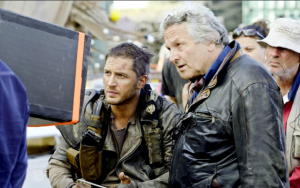
George Miller has made pigs talk and penguins tap dance. He’s been a doctor and a film director. Among the bold faced names on his resume are the titles Babe: A Pig in the City, The Witches of Eastwood, Happy Feet 1 and 2 and Lorenzo’s Oil. One name, however, looms larger than the rest.
Mad Max. Over the course of three films—Mad Max, Mad Max 2: The Road Warrior and Beyond Thunderdome—he introduced the world to post apocalyptic warrior Max Rockatansky, made Mel Gibson a superstar, defined dystopian cinema for a generation or two and created the phrase, “Two men enter, one man leaves.”
This weekend, thirty years after the release of the last Mad Max movie, Miller revisits the character in Mad Max: Fury Road, a reboot starring Tom Hardy and Charlize Theron.
The seventy-year-old director, who raised money to make the first film by working as an Emergency Room Doctor, says the goal of the new movie was to make it “uniquely familiar.”
After years of “following the CG evolution,” using computer generated images to create beautiful animated films, he was keen to go back to “old school” filmmaking “with real cars and real people and real desert.” That means, unlike the Avengers and their ilk, respecting the laws of physics by using practical effects and keeping the action earthbound. In other words, in a call back to the original films, when a car blows up it doesn’t rocket into space. Instead it explodes spectacularly but organically. The wild action you see in Fury Road are actual stunts performed by stunt men and women and not generated by a clever computer operator in a studio.
“It was like going back to your old home town and looking at it anew,” he says.
Miller reveals he originally created Max’s wasteland world while practising medicine.
“I worked for two and half years in a big city hospital. I stayed registered right up past Mad Max 2: Road Warrior. I never even thought there’d be a career. I stayed as a doctor on the first Mad Max because we kept running out of money in postproduction. Then I stayed through to the second Mad Max because if you are doing stunts you are obliged to have a doctor on set. There weren’t big budgets so I ended up running a clinic during lunch time tending to cuts, sunburns, scrapes and all that.”
His two careers have much in common, he says, adding he was “was privileged with a unique point of view as a doctor.”
“I don’t think I’d be the filmmaker I am unless I had that medical education, in two very direct ways. Both of them have a lot of problem solving in there. But the most important way is that as a doctor you are looking at people in extremis from many points of view. You look inside of people. You see people during birth and death and so on. Through microscopes; a lens. So you’re looking from many, many points of view. That’s exactly what you do in cinema. Huge wide shots with massive crowds or you’re looking right down inside someone’s brain, someone’s head.”
As for plans to make another Mad Max right away, he says, “That’s a bit like asking a woman who’s just given birth if she’s going to have another baby.”
The ghostly War Boys of “Mad Max: Fury Road” have a catchy mantra they recite as they go into battle. “I live. I die. I live again!” In some ways it could be the refrain for the series. Begun as a down-and-dirty punk rock vision of a post-apocalyptic Australia, the 1979 no-budget movie made a star out of Mel Gibson and spawned a mini-franchise of two more films, “The Road Warrior” and “Beyond Thunderdome.”
The George Miller films lived, died and now live again courtesy of “Mad Max: Fury Road,” an out-of-control reboot that recreates Max Rockatansky’s dystopian world and then races like hell through it, laying rubber all the way.
Set in an arid, inhospitable world where a snack of raw lizard constitutes a meal, Max (Tom Hardy) is a man who has lost everything, Haunted by “those he could not protect” he is now “a man reduced to a single instinct—survival.” Captured by henchmen of Immortan Joe (Hugh Keays-Byrne, who played Toecutter in the original “Mad Max”), a despot who hoards precious natural resources and only sparingly shares water with his subjects—Don’t take too much water, he says, you will only come to resent it when it isn’t there.—Max is turned into a blood bank for an ailing war boy named Nux (Nicholas Hoult). Subjected to a life of confinement and drained of his own natural resources, Max sees a chance for freedom when Nux and others do battle against Imperator Furiosa (Charlize Theron), a former warrior turned rogue. She’s driving the imposing War Rig—imagine a Monster Truck with an attitude—across the wasteland. With her are Immortan Joe’s five wives—Splendid (Rosie Huntington-Whiteley), Capable (Riley Keough), Toast (Zoë Kravitz), The Dag (Abbey Lee Kershaw) and Fragile (Courtney Eaton)—a natural resource he desperately wants back. Max and Furiosa form an uncomfortable alliance to battle the forces of evil and make it across the desert to Furiosa’s childhood home, a green oasis.
It’s been thirty years since there was a new “Mad Max” movie but “Fury Road” was worth the wait. The years have not stilled Miller’s restless camera or his outrageous way with steampunk influenced design or character names. If Imperator Furiosa isn’t the best character name of the year, I don’t know what is. Her title, however, might as well have been Mad Maxine as she is more the focus of the story than the titular character.
It is a chase movie where characters chase immortality, a new life in a better place, love and one another across a vivid landscape. Gone are the grey tones of dystopian movies like “The Road.” In its place is a dusty but vibrant backdrop that frames the non-stop action. Miller keeps the pedal to the metal but unlike the recent “Avengers: Age of Ultron,” which had a similar angle of attack, he keeps the action earthbound. The laws of physics are respected—when a car blows up it doesn’t rocket into space for instance—by the director’s use of practical effects. Most everything you see on screen are actual stunts performed by real people and not generated by a clever computer operator in a studio later on. The organic nature of most of (but not quite all) the visuals gives the movie extra torque, adding a sense of danger and realism (no matter how unreal the situation) to the large set pieces that make up the bulk of the film.
Hardy pulls his weight as Max. His powerful physicality mixed with a haunted look—maybe we should call him Passive Aggressive Max—and gearbox permanently shifted to survival makes him an imposing center of the film, but it is Theron who dominates.
As Furiosa she lives up to her name as a force to be reckoned with. She’s a one-armed bandit (literally) who not only provides much of the action in the film, but its heart as well.
The real star, however, is Miller. Thirty years after he last played in Mad Max’s world he revisits it with a film that doesn’t feel like a sequel or a reboot, but a fresh look at an familiar character. His off-the-wall sensibility and demented Hot Wheels style designs give the movie a look and feel that no other director could replicate.