The word subtle is never used in reference to Michael Bay. On film the “Transformers” filmmaker has never left a bullet unfired or ever met a building he didn’t want to blow up. His films are frenetic odes to carnage and his latest one, “13 Hours: The Secret Soldiers of Benghazi” takes a page out of the recent past and gives it the Bay Bias.
Based on the 2013 nonfiction book “13 Hours” by Mitchell Zuckoff, the bulk of the film takes place on the eleventh anniversary of the September 11 attacks. Rone Woods (James Badge Dale), Jack Da Silva (John Krasinski), Oz Geist (Max Martini), Bub Doherty (Toby Stephens), Tanto Paronto (Pablo Schreiber) and Boon (David Denman) are tough guys with 1000 yards stares. They are former Navy SEALS, Marine Force Recon and Army Special Forces now working as CIA security contractors in in Benghazi, Libya in a top-secret facility so undercover it doesn’t officially exist.
The city is a hellhole known as the most violent place on earth. When well-armed Libyan militants—using weapons pilfered from former Prime Minister Muammar Gaddafi’s abandoned arsenals—invade the American embassy the contractors, located about a mile away from the attack, want to help but are ordered to stand down by their on-site CIA chief. As the fighting intensifies they spring into action—“Things change fast in Benghazi,” they snarl.—launching a rescue mission for ambassador J. Christopher Stevens and Foreign Service Information officer Sean Smith.
There’s more—things blow up and bullets fly—and it is public record, but there will be no spoilers here.
“13 Hours: The Secret Soldiers of Benghazi” is a fast and furious look at an event the ripples of which are still being felt today, but this is a Michael Bay movie so it is unburdened by the weight of controversy. Instead the politics are downplayed—there is no mention of then Secretary of State Hillary Clinton or President Obama—and it is presented as an action film.
On that level it works. Bay knows how to build tension and entertain the eye. He indulges his artier side with some beautifully composed photography and throws in some interesting details to bring the action alive. For instance, the city is such a chaotic place the locals barely notice the mounting violence as they watch soccer as buildings explode just down the block. “Just another Tuesday night in Benghazi,” says Da Silva.
Unfortunately Bay is so in love with his images he drops the ball on the story. This is a tale of men who stepped up and put their lives on the line despite bureaucratic interference. The contractors should be complex characters, balancing their stateside lives with their training as warriors and while the movie tries to explore that divide, it does so in the most Michael Bay way as possible. Instead of investigating the things that drive them we are treated to an sketchy subplot regarding Da Silva’s family that sheds little light on how his job affects his wife and daughters or vice versa. No amount of scenes showing these men Skyping with their families or lovingly gazing at photos of their babies will do enough to humanize them when they are so underwritten. Bay emphasizes the action in Benghazi, but choses to ignore the emotional side except in the most superficial of ways.
“13 Hours: The Secret Soldiers of Benghazi” could have been a fascinating and timely study of men juggling their jobs with complicated families lives but instead it is just another Michael Bay movie.
The movies have looked to the news for inspiration almost since the first time film was projected on screens.
As far back as 1899, a film called Major Wilson’s Last Stand dramatized scenes from the First and Second Matabele Wars, including the death of Major Allan Wilson and his men in Rhodesia in 1893.
The trend of reel life emulating real life continues this weekend with The 33, an Antonio Banderas film based on a famous mining accident. In 2010, 33 men spent 69 days trapped underground in a copper-gold mine located near Copiapó, Chile when a rock the size of the Empire State Building blocked their exit.
“I can’t think of a better story than this one to bring to the screen,” says producer Mike Medavoy.
The trick is getting the story right. Director Patricia Riggins worked with the miners, Medavoy and screenwriters to create a story that, according to everyone involved, features more fact than fiction.
That isn’t always the case.
According to IMDb the Jim Sturgess movie 21 calls itself a “fact based” story about a group of MIT students who used a complicated card-counting system to fleece Las Vegas casinos for millions of dollars.
The bare bones of the story are true — blackjack was played and MIT students counted cards — but Hollywood diverged from reality when casting the leads. In truth the main players were mainly Asian-Americans, including ringleader Jeff Ma who consulted on the movie.
Ma called the controversy surrounding the casting of Sturgess and Kevin Spacey “over-blown,” adding “I would have been a lot more insulted if they had chosen someone who was Japanese or Korean, just to have an Asian playing me.”
The Michael Bay film Pain & Gain is listed as an action-comedy and stars Mark Wahlberg, Dwayne Johnson and Anthony Mackie certainly play up the jokes. Everyone laughed, except for Marc Schiller, the real-life inspiration for the film’s kidnap victim.
“It wasn’t that funny when they tried to kill me,” he said. “They did run me over with a car twice after trying to blow me up in the car. The way they tell it made it look like a comedy. You also gotta remember that not only I went through this, but certain people were killed, so making these guys look like nice guys is atrocious.”
Last year’s Oscar winner Whiplash saw Miles Teller as a young drummer driven to extremes by a fanatical music teacher played by J.K. Simmons.
The movie draws parallels to the famous story of Jo Jones and Charlie Parker. The legend goes that Jones threw a cymbal at Parker’s head after a lackluster solo, prompting the sax player to go away, practice for a year and return as one of the greatest musicians of the 20th century. Trouble is, the story isn’t true. A cymbal was let loose, but according to eyewitnesses it was dropped on the floor at Parker’s feet and not at his head.
“Not attempted murder,” wrote Richard Brody in the New York Times, “but rather musical snark.”
How does Hollywood get away playing fast and loose with the facts? Black Mass director Scott Cooper says, “I don’t think people come to narrative features for the facts, or for truth. I think you go to documentaries for that. What you do come to narrative features for is psychological truth, emotion and deep humanity.”
Traditional wisdom has it that January is a dumping ground for bad movies.
“Everyone is broke after shelling out for Christmas presents,” the studios say. “The weather is crappy and anyone leaving the house is going to the gym instead of the movies,” complain the suits.
That’s why clunkers like One for the Money, a Katherine Heigl crime drama with a two per cent Rotten Tomatoes rating and Season of the Witch — which saw Nicolas Cage go all medieval on the forces of evil and strain his credibility as an actor — made the lives of critics and audiences miserable on long, cold winter nights in bygone Januarys. Why waste good movies when no one was likely to go?
Years ago studios threw the odd quality film into the January mix — Traffic, Good Will Hunting, Before Sunrise, Dr. Strangelove and Silence of the Lambs—but every good movie like Matinee (92 per cent on RT) was balanced out with a stinker like Body of Evidence and its paltry six per cent rating.
There is still that yin and yang as last week’s releases of The Boy Next Door and Mortdecai (two movies that will decorate Worst Of the Year lists) proves, but the tide seems to be changing. Perhaps that’s why Project Almanac, a time-travel drama from producer Michael Bay, moved from a prime July release date to the barren January slate. Surely Bay, as savvy a player as Hollywood has, wouldn’t allow his movie to be tossed out with the trash.
The reason given for the schedule move was that Bay himself wanted to sprinkle some of his Transformers’ fairy dust to pump up the film’s appeal to young audiences. But it’s also apparent that a micro-budget movie like Project Almanac, even with Bay’s name attached, could get lost in a summer filled with large-scale offerings like Dawn of the Planet of the Apes, so why not release in a less crowded, but increasingly profitable field?
What used to be a time to fill screens with borderline cheesefests has become a viable month to release a movie.
Last year big crowds braved the polar vortex to help the Kevin Hart comedy Ride Along set a January opening record. This year the Oscar-nominated Selma and Still Alice have opened wide in a month usually reserved for Golden Raspberry winners. Perhaps the biggest story of 2015 so far is the success of Clint Eastwood’s Chris Kyle biopic, American Sniper, which has raked in upwards of $170 million in just two weeks. The success of that film is as strong an indicator as Hollywood needs that January is no longer a no-go zone.
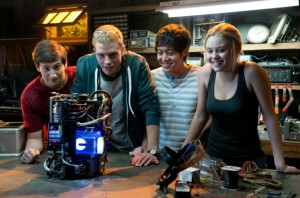
“Project Almanac” has a lot going against it. It’s a found footage movie with loads of nausea inducing wobbly cam, characters who deliver cheeseball lines like, “So you’re telling me dad left a time machine in the basement?” and an over-played climax that drags on too long but it gets one crucial thing right. And that’s enough to earn a recommend for young sci fi enthusiasts.
Boy genius David Raskin (Jonny Weston) inherited his smarts from his late father, an engineer who was working on a top-secret project at the time of his death. Buried away in the basement are the schematics for a time machine David and his best friends Adam (Allen Evangelista) and Quinn (Sam Lerner), under the constant camera surveillance of sister Christina (Ginny Gardner), discover and build.
After a few test runs they do what every teenage boy would do; they allow the most popular girl in school (Sofia Black-D’Elia) to talk them into taking a big risk with the new machine and use themselves as guinea pigs. It’s the power of the pretty girl to influence and shape the actions of teenage boys, and the movie gets this absolutely correct.
Do they use the machine to go back and kill Hitler? Nope. Save JFK? Nuh-uh. They do what young guys would do. They party at Lollapalooza, use their unique powers to get even with bullies and rig the lottery so they can win big, buy Ferraris and “hire Kim Kardashian to have my babies.” They may be geniuses but they are still concerned with the stuff of youth—girls and being popular—not changing the world.
The movie takes a serious turn in the last third when reality skews and the consequences of time travel become apparent. David must take things into his own hands, but even then, as sentiment and sci fi match and mingle, the movie doesn’t lose track of its teen origins.
Part “Groundhog Day,” part “Project X,” “Project Almanac” has all the annoying traits of found footage movies—“You’re getting all this, right?”—and screams out for a tripod, but for the most part is a zippy young adult sci fi story with equal parts brains and heart.
“Ouija” is scary, but not scary like Dracula, Edgar Allen Poe or hungry zombies. No, “Ouija” is scary because as I watched it I could feel my life slipping away, second-by-second, for ninety excruciating minutes.
The first Ouija board with an alphabet on it was patented in 1890. In the late 1960s they became a household item when Hasbro’s Parker Brothers began marketing them in 1966. If you haven’t played with one, you’ve certainly seen a witchboard in the movies and know when teens start ouijiing spiritual strife is just around the corner.
The trouble in “Ouija” begins when Debbie (Shelley Hennig) breaks the first rule of witchboarding: Never play alone. She pays a heavy price for her spiritual disobedience and soon her group of good-looking friends is gathered at her funeral. “She said she’d see us the next day,” says BFF Laine (Olivia Cooke). “Why would she say that?” We’ll never know… unless Laine pulls out the Ouija Board! Using Debbie’s board Laine and pals try and contact their dearly departed’s spirit, but instead unleash a demonic terror that threatens all of their lives.
As scary as you would imagine a horror film inspired by a board game to be, “Ouija” is a mishmash of demonology, Japanese horror and so many slasher movie tropes they owe John Carpenter and Wes Craven a writing credit. The blonde girl dies first, there’s spooky stuff in the attic and the plucky heroine outlives almost everyone. At least there’s very little found footage.
The movie is 5% jump scares, those unexpected loud noises that make you twitch in your seat, 67% set-up and 28% strange glances. As Laine, Debbie’s intrepid best friend, Cooke does most of the heavy lifting. She keeps the action (such that it is) moving forward all the while displaying her mastery of the concerned look. With a furrowed brow and a determined attitude she tracks down the mystery behind her friend’s death, but mostly she just looks concerned.
More annoying than the blank stares is the movie’s habit of telling the audience the most obvious of details. “She played it alone,” whispers Laine in amazement over a shot of, you guessed it, Debbie going solo on the Ouija board. Over footage of Deb saying she found the board in the attic Laine helpfully adds, “She found it in her house!” Instead of telling us something useful, or interesting, the film makes sure that no detail, no matter how small, is commented on.
You won’t need spiritual help to figure out whether to see “Ouija” or not. The planchette (the ouija’s triangular pointer) is aimed at “No.”
There was a time when the Teenage Mutant Ninja Turtles were everywhere.
Stars of movies, comic books, television and video games, they even had action figures and breakfast cereals as part of their reptilian empire. They were 20th Century pop culture icons, which ain’t too bad for four hard-shelled crime fighters named after Renaissance artists.
But, like all pop culture fads, eventually Turtle mania played itself out, and the action figures, the TMNT PJs and coloring books became passé. This weekend producer Michael Bay is hoping to give Leonardo, Raphael, Michelangelo and Donatello a new lease on life at the movies.
The release of the new Teenage Mutant Ninja Turtles is timed to celebrate the 30th anniversary of the first TMNT comic book.
Megan Fox plays April O’Neill, reporter and friend-of-the-turtles, who help the fearless four protect New York City from its greatest threat, Shredder and his evil Foot Clan. “Together,” says Turtles’ mentor Splinter, “you are stronger than he could ever be!”
Turtle groupies have been following the development of the reboot with great interest. They spoke up when it was announced that Bay wanted to streamline the title to Ninja Turtles but an even bigger controversy struck in 2012.
“These turtles are from an alien race,” said Bay, “and they are going to be tough, edgy, funny, and completely lovable.” Seems benign enough, but fans were incensed that the Transformers producer would take liberties with the origin story. Tough and lovable are OK, but alien? Not so much. According to the canon the heroes on the half shell where transformed when they came into contact with toxic ooze.
One internet firestorm later—Robbie Rist, who voiced Michelangelo in the original movies, went so far as to accuse Bay of “sodomizing” the franchise—Bay amended the statement, reassuring fans he would stick to the official origin story. They even poke fun at the controversy in the movie.
“So,” says Vernon (Will Arnett), “they’re aliens?”
“No,” replies reporter O’Neil, “that’s stupid.”
No spoilers here. Whether the Turtles rise from the ooze or not Bay (and director Jonathan Liebesman) have a cinematic legacy to live up to. The TMNT first came to the big screen in 1990, followed quickly by TMNT II: The Secret of the Ooze, 1991 and TMNT III, 1993.
Then, after a decade break the green fighting machines came back in the computer animated TMNT, but was written off as feeling “as stale as one of Mikey’s half-eaten pizzas,” by the New York Daily News.
Can Bay top all the other films? Writer Sean Patrick said, “I can see no good reason why Bay can’t make by far the best Ninja Turtles movie ever. The bar hasn’t exactly been set high.”
The advertising tagline for “Transformers: Age of Extinction” is “This is not war, it’s extinction,” which is catchy enough, I suppose, but having seen it I couldn’t help but think that “Cum on Feel the Noize,” a song lyric by either Slade or Quiet Riot, depending on your age, would have been more appropriate.
Michael Bay’s latest is eardrum shatteringly loud, guaranteed to leave you with ringing ears and a rumbling theatre seat. Visually, expect scorched eyes. Bay has made a movie for three of your five senses—only smell and taste are exempt—but will it entertain your brain while launching an all out assault on your senses?
Picking up four years after the invasion of Chicago seen in the last Transformers film, “Dark of the Moon,” the action begins when unemployed robotic engineer Cade Yeager (Mark Wahlberg) and daughter Tessa (Nicola Peltz) uncover deactivated Autobot, Optimus Prime (Peter Cullen) hidden under a pile of junk. Their discovery puts them in the crosshairs of CIA agent Harold Attinger (Kelsey Grammer) and tech tycoon Joshua Joyce (Stanley Tucci). The two are hatching a plan, fueled by equal parts paranoia and genius, to build man made second generation Transformers to seek out and destroy the Autobots. “A new era has begun,” says Attinger, “and the age of Transformers is over.”
Everybody loves spectacle. The Romans had the Coliseum and we have the “Transformers” movies. Like the gladiatorial shows of yore, in Michael Bay’s movies it doesn’t matter who lives or dies—the films don’t care about their human characters and neither do we—all that matters is the spectacle of the whole thing and at almost frenetic three hours “Age of Extinction” certainly delivers on that score. Like the old Roman emperors many moviegoers will give this movie a thumbs up simply because of the value per minute the film offers.
No one can accuse Bay of skimping on… well anything. “Age of Extinction” is a wide ranging action orgy that plays off of Bush era Homeland Security paranoia and also explains why dinosaurs became extinct. It comments on the ethics of unarmed warfare and blows up most of Hong Kong.
Bay doesn’t do anything by half measures but I found myself wishing the movie was about half as long as it is with half the bombast. It’s stylish—“Why run when you can run in slow motion,” Bay seems to be asking—not unlike a car commercial, but is excessive on almost every level. I don’t expect or want “My Dinner with Optimus Prime,” but in this case I think less would have been more.
Wahlberg brings loads of personality and humor with his over-protective father routine, Tucci is reliable as ever and Grammer is in full-on Dick Cheney mode but who cares? We’re not paying to see them, we’re paying to see Optimus Prime play bucking bronco with a giant dinobot.
Is “Transformers: Age of Extinction” a good movie? Not really. Does it deliver on its promise? Yes, but almost too much so. Either way I doubt Michael Bay much cares what the critics think. He’s built a joke into the movie suggesting that if you don’t like sequels you’re senile.
“We were happy to do whatever was asked of us whenever it was asked of us,” says Transformers: Age of Extinction star Jack Reynor.
The Colorado-born, Irish-raised actor proved he was game for anything when he was given just twenty minutes to prepare for a wild scene that brought him face-to-face with real explosions.
“It is an incredibly intimidating experience in many ways,” he said, “but at the end of the day you have to trust the people around you, that they know what they’re doing that they’re prepared and that you’re safe. We had a great stunt team who worked on this film with us. Those guys really put us at ease.”
Sharing the explosive scene with Reynor were his co-stars Nicola Peltz and Mark Wahlberg.
“They worked so hard to make this huge explosion,” says Peltz, best known for her role as Bradley Martin on Bates Motel. “I think it took a week but we didn’t know about it. We were kind of confused when we got on set and saw ten cameras. (Director) Michael (Bay) told us a few minutes before, ‘You’re going to do this huge stunt. It’s not going to be stunt doubles, it’s going to be you guys and you have to run from here to here in 4.6 seconds.’
“There’s not much acting when there are real explosions behind you,” she says. “You just have to run.”
The experience of sprinting away from live blasts wasn’t exactly what Peltz expected when she signed on for the role in the fourth Transformers film.
“I thought there was going to be more green screen than there actually was but Michael wants everything to be as real as possible so the car chases and the explosions are all real.”
“You can really tell the difference,” says Reynor. “You can tell when a movie is really heavy on CG. It doesn’t really look real. As far as we’ve come with effects and all the advancements we’ve made—some of them are really great—at the end of the day to do it practically and do it for real always looks best on screen. That’s why Michael tries to make it that way. On top of that it makes everything more tangible for us; a lot easier to relate to and react off. That’s why I think these movies have been as incredibly successful as they have because the audience really does feel it.”
Director Michael Bay once said he doesn’t make movies for critics. The auteur behind such hits as The Rock, Armageddon, Bad Boys 1 and 2 and the Transformers movies is best known for making big, loud films that rake it in at the box office but leave critics reaching for the Advil.
Bay acknowledged the adversarial relationship in a 2005 article by Rene Rodriguez.
“They castrate me,” he told Rodriguez. “They call me the devil and all that crap.”
It’s not hard to see why reviewers have a hard time with his films. He never met a building or car or city he didn’t want to blow up in spectacular fashion and critics often feel like they have to slather on SPF 70 to avoid getting get a tan from the glare off the giant fireballs that light up screen in Bay’s films.
Audiences, however, have flocked to his flicks. According to boxofficemojo.com his ten features have grossed $1,898,048,525, or an average of $189,804,853. That’s a lot of beans.
The release this weekend of Transformers: Age of Extinction promises to add to those totals. The fourth installment of the franchise stars Mark Wahlberg as a single father and struggling inventor who discovers the deactivated Autobots leader Optimus Prime.
The movie promises a whole new raft of Transformers, including bounty hunter Lockdown and the rough and tumble Dinobot Grimlock. Bay promises we’ll also see an “angry Optimus Prime.”
Will the critics like Age of Extinction? Who knows? It probably won’t matter, the Transformers movies are as close to guaranteed hits as Hollywood has these days, so reviews most likely won’t matter to the box office.
Not all of Bay’s films have been critically reviled. “The critics were very nice to me when I first began with Bad Boys,” he says and his last movie, the crime drama Pain and Gain was called “the best movie Michael Bay’s ever made,” by the Newark Star-Ledger.
It has a few things going for it. First, there isn’t a robot in sight. Secondly, a great cast—including Wahlberg, Dwayne ‘The Rock’ Johnson and Anthony Mackie—who bring serious star power and third, it doesn’t really feel like a Michael Bay film. And by that I mean there’s only one shot of the three leads walking away from a slow motion explosion.
Years ago I wrote this about his trademarked aural and optical onslaught: “The former commercial director has a knack for making everything look shiny but having great taste doesn’t make a great film director any more than great taste makes a Snicker’s bar a gourmet meal.” I even coined a word for his style: Hullabayloo, but nothing that any critic or I write matters to the director.
“I’ve actually stopped reading (reviews),” he told Rodriguez.