Have you ever heard the saying, “Be careful what you wish for because you just might get it”? It’s a fitting maxim for the new Disneyfied version of Stephen Sondheim’s musical “Into the Woods.” Of course, it is one of the themes of the show, but on another level, for the people who have long hoped to see a screen adaptation of the legendary musical, it may not be a situation of wish fulfillment.
Fans of the stage show will notice a few liberties have been taken with the show’s book. The changes are slight—for instance, the prince does not sleep with the Baker’s Wife, although they do have an encounter—but purists may feel like their beanstalk has been shaken a bit too much.
Casual fans of big screen musical theatre, however, will find a handsomely mounted reworking of the popular show, filled with the stuff of fairy tales: beautiful princesses, handsome but dimwitted princes, witches and even a giant or two.
The story is broken into two halves, a sunnier and irreverent “Once Upon a Time” first half that introduces the Baker (James Corden) and his Wife (Emily Blunt), a couple unable to have children because of a Witch’s (Meryl Streep) curse. The old crone agrees to undo the spell if the pair supply her with four items, a cow as white as milk, a cape as red as blood; hair as yellow as corn and a slipper as pure as gold.
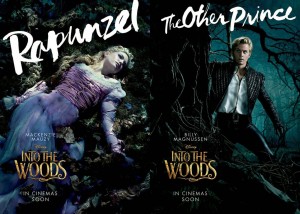
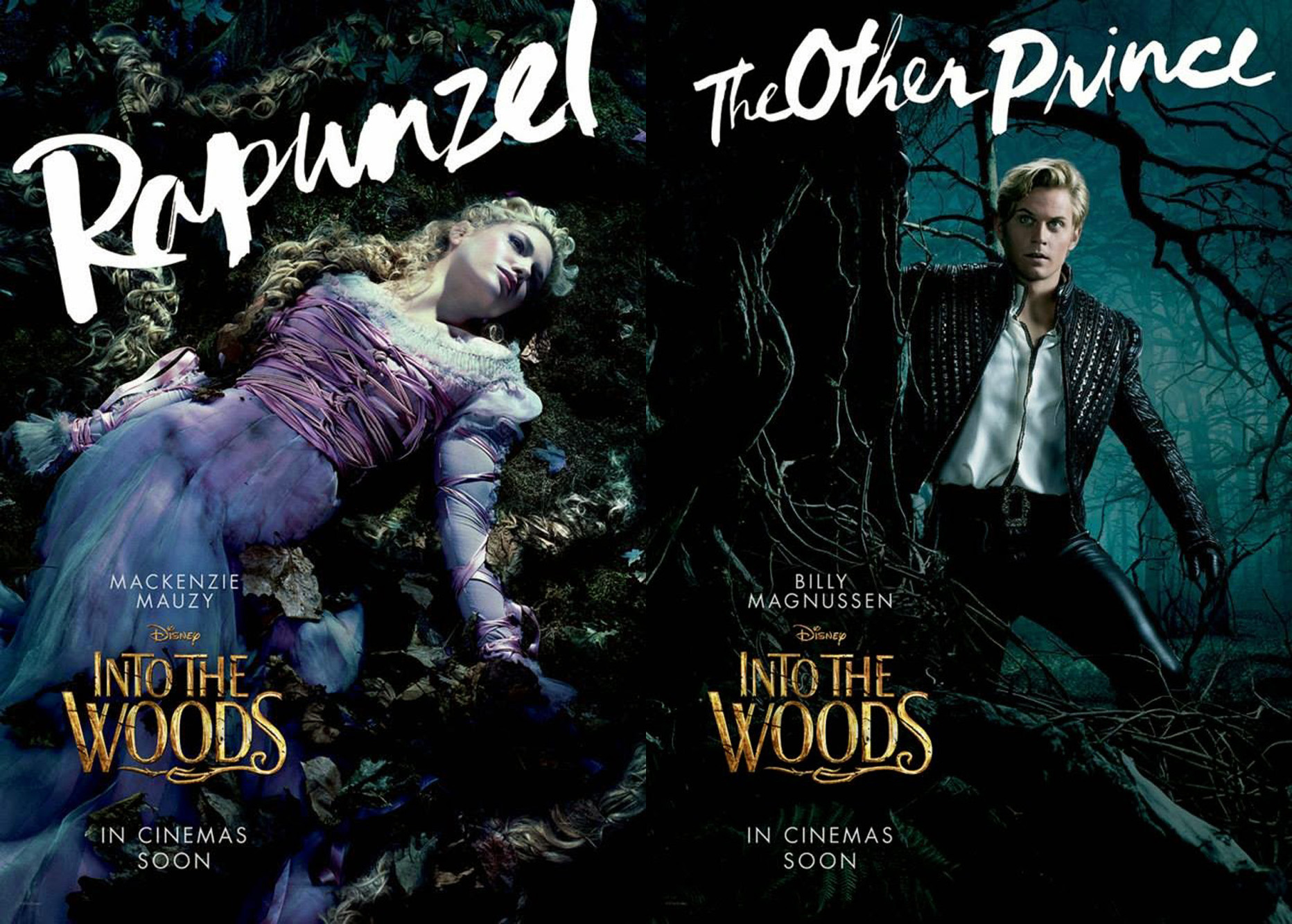
Their search takes them into the woods and in collision (and later in collusion) with Jack (Daniel Huttlestone), later of Beanstalk fame, Little Red Riding Hood (Lilla Crawford) after the Big Bad Wolf (Johnny Depp) has swallowed her whole, Rapunzel (Mackenzie Mauzy) and Cinderella (Anna Kendrick).
The second half, the darker side of the fairy tale world, begins where the happily ever after part usually sits. When a female giant comes to the woods looking for Jack, the boy who killed her husband, the story takes a turn, teaching a lesson about wish fulfillment and responsibility for our actions.
“Into the Woods” has more to do with the original Grimm Brother Fairy Tales—the ones where evil stepmothers sawed the toes off their daughters to fit into golden slippers—than anything Disney has ever attempted before. The stereotypes are all present and accounted for, but under the prince’s brocade jackets or the Witch’s wild mauve wig, are complex characters that veer from comedic to serious to poignant, often in the same scene.
The cast is comprised of actors who can sing, warbling to Sondheim’s rich score. Standouts include “Agony,” an amusing duet between the two princes (Billy Magnussen and Chris Pine) and the Witch’s swansong “Last Midnight.”
On the downside, it feels a bit overlong and the Big Bad Wolf scene could have been renamed the Huge Unctuous Wolf, given Depp’s oily interpretation of the character.
“Into the Woods” survives the script meddling through strong staging, good performances and sheer wish fulfillment to make end up at it’s own kind of happily ever after.
I learned a great deal during my interview with Mackenzie Mauzy and Billy Magnussen. The Manhattan based performers brought me up to speed on the rite of passage for all New York actors, Rapunzel’s hair and whether or not Meryl Streep likes men in blue tights.
The pair play Rapunzel and Rapunzel’s Prince in the big screen adaptation of the legendary Broadway musical Into the Woods. The two relative new comers—she’s best known as Abigail on Forever while he made a memorable appearance on Boardwalk Empire and will soon be seen in an upcoming Steven Spielberg spy thriller—help bring fairy tales to life as part of a large ensemble that includes Johnny Depp, Emily Blunt and Meryl Streep.
Which leads me to the first thing I learned during our chat.
“Meryl’s a beast,” says Magnussen. “She’s the one who got me the job. I was in a play and she saw it and recommended to me [director] Rob [Marshall] and [producer] Mark Platt. The play was Vonya and Sonia and Marsha and Spike and I dress up as a prince because we’re going to a costume party. It’s all about the blue tights.”
“Meryl likes the blue tights,” laughs Mauzy.
Next I discovered the wig Mauzy wears in the film put her at a follicular risk.
“They used my hair and braided it into the extensions,” she says. “It was thirty feet long so I wrapped it around my arm. I had a little fake one for rehearsal but I asked to actually wear [the real one] one day so I could figure out how to be mobile. It’s a tripping hazard! We joke about how I had a really strong left bicep for a couple months.”
Then Magnussen enlightened me on a rite of passage for New York actors, “Once you get on Law and Order,” he says, “you’re really an actor.” Both have done time in the L&O trenches. Mauzy played a child killer named Carly Di Gravia—“It’s weird I remember that name,” she says.—while Magnussen says, “It was one of my first jobs. They bleached my hair white and I was a Southern male prostitute. How do you tell your mom? Hey watch this!”
Finally, one I gleaned one last pearl of knowledge from Mauzy. Apparently it’s OK to call Stephen Sondheim, legendary Into the Woods composer and eight time Tony Award winner, Steve. “Everyone calls him Steve!” she laughs. “He likes to be called Steve! It is weird. Steve Sondheim.”
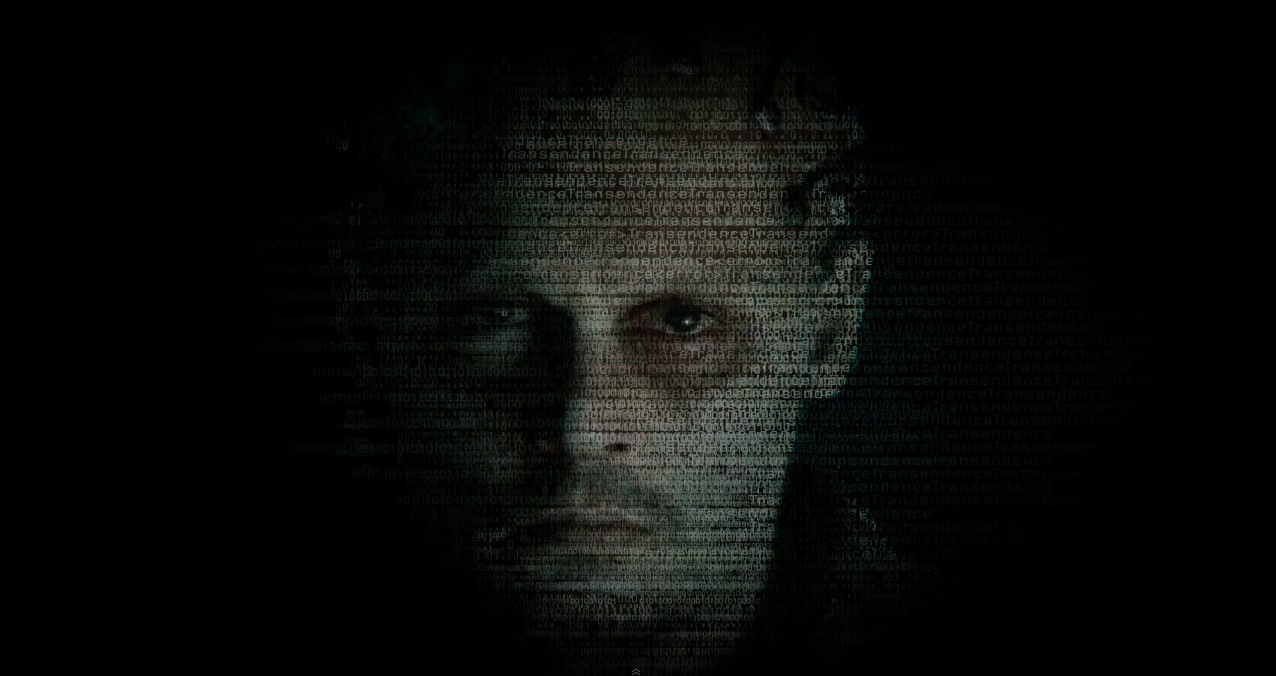
The new Johnny Depp film “Transcendence” will please those who think their cell phones are spying on them while their computers secretly plot to rule the world. Technophobes will find much to like in this high tech thriller—which speaks of “the unstoppable collision between mankind and technology”—but how about those of us who don’t believe in Hard drive Horror?
Depp plays Dr. Will Caster, a bespectacled (so you know he’s smart) scientist whose pet project is an Artificial Intelligence device. It will be, he says, “a sentient machine that will quickly overcome the limits of biology; in a short time, its analytic power will become greater than the collective intelligence of every person born in the history of the world.”
In other words it’s a self-aware computer with feelings and the combined intelligence of all humanity. “Some scientists refer to this as the Singularity,” he says. “I call it Transcendence.”
Call it what you will, but when R.I.F.T. (Revolutionary Independence From Technology) extremists try to end the project by ending Caster with a radiation laced bullet they open the door to a new, dangerous phase of the experiment. As he lay dying his thoughts, knowledge and memories are downloaded into his Artificial Intelligence machine, creating a high tech Frankenstein, only with a better vocabulary.
With binary code coursing through his veins instead of blood, Caster has now transcended, but his wife Evelyn (Rebecca Hall) and best friend Max (Paul Bettany) are left with a conundrum as the scientist becomes more and more advanced. Is this the dawn of a more advanced age or a techno terror controlled by a power mad ghost in the machine?
“Transcendence” asks some interesting questions. Can technology provide some sort of life after death? Does artificial intelligence offer more promise or peril? How much humanity can a computer program possess? Is “Her” a better movie about love in the computer age?
The questions are interesting and might have been thought provoking if “Transcendence” was a better movie. Director Wally Pfister (best known as Christopher Nolan’s DOP of choice) and screenwriter Jack Paglen tackle big questions head on, but in the most perplexing of ways. Weird tonal shifts from sci fi to cyber love to techno terrorism make for a drearily paced film. Add to that unclear character motivations—MILD SPOILER ALERT: exactly who’s side is Max on?—and an underdeveloped love story and you’re left with a film that brims with promise but underwhelms.
So too does Johnny Depp. You have to cut him some slack because for 90% of the film he only appears on computer screens, doing his best HAL impression, but he seems to have checked out long before his character does. Hall and Bettany do some soulful work, but are hampered by a love story that is more about code than contact.
“Transcendence” has style, and it should, Pfister (who used DOP Jess Hall on this film) is a gifted shooter who gave us one of my favorite shots of recent years—The Joker hanging out of the cop car in “The Dark Knight,” surrounded by blurred lights and city scape. Given the choice I’d choose to watch that thirty seconds again and again over spending one more minute in the lackluster world of “Transcendence.”
The news of Philip Seymour Hoffman’s sudden passing was met with a heartfelt outpouring of grief from fans and those who worked with him.
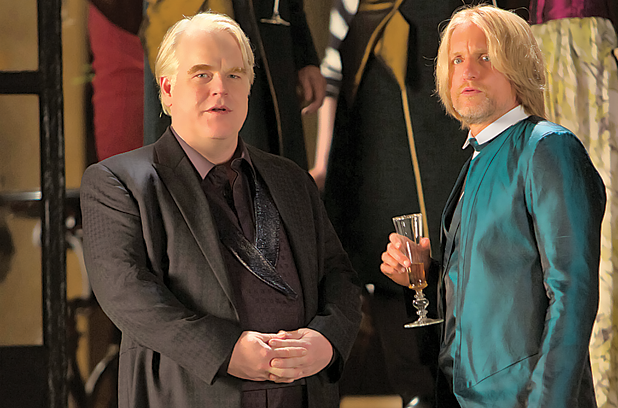
“Philip Seymour Hoffman was a singular talent and one of the most gifted actors of our generation,” Lionsgate, the studio behind the upcoming Hunger Games: Mockingjay Part 1 and 2, said in a written statement. “We’re very fortunate that he graced our Hunger Games family. Losing him in his prime is a tragedy, and we send our deepest condolences to Philip’s family.”
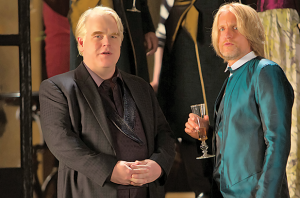
Hoffman played head -games-maker-turned-rebel leader Plutarch Heavensbee in the successful series. It is a pivotal role.
In the wake of the actor’s death, questions arose as to whether the uncompleted blockbusters-in-waiting would be completed in time for their scheduled November 21, 2014 for Part 1 and November 20, 2015 for Part 2 release dates.
Hollywood studios have handled the sudden death of cast members in many different ways. In some cases, films are even abandoned.
Production on Something’s Got to Give was shut down permanently after Marilyn Monroe’s August 1962 barbiturate overdose.
Dark Blood, River Phoenix’s final film, was put into cold storage when the young actor died before filming several crucial scenes. But both movies were eventually resurrected. The documentary Marilyn: The Final Days used footage from Monroe’s aborted film while Dark Blood sat for 19 years before being finished and shown at film festivals.
Father and son Bruce and Brandon Lee both died early, leaving behind unfinished films. The elder martial arts legend had completed 100 minutes of The Game of Death when a cerebral edema took his life.
Even more tragically, Brandon was killed on the set of The Crow in an accident involving a prop handgun.
Both films were salvaged with the use of stand-ins.
When Oliver Reed collapsed of a heart attack at a Malta pub after out-drinking a group of Royal Navy sailors, the editing crew of Gladiator replaced him digitally in the remaining scenes of the film.
More recently, Heath Ledger unexpectedly died during the production of The Imaginarium of Dr. Parnassus. He was replaced in the surreal story by three actors.
“I just started calling friends of Heath,” director Terry Gilliam said. “It’s as simple as that.”
“Johnny (Depp), Colin (Farrell) and Jude (Law) turned up. It was important that they were friends, because I wanted to keep it in the family. I wanted people who were close to him because, as Colin said when he was doing his part, he was channelling Heath part of the time, so Heath was very much still alive in some sense.
“Contractually, it was supposed to be a Terry Gilliam Film,” said Gilliam. “That’s what the lawyers said, but I said, ‘No way it’s going to be that. It’s going to be a film from Heath Ledger and friends.’ The cast sat around one night and that idea came up and I said, ‘This is it. Perfect. That’s how we do it.’”
As for the upcoming Hunger Games films, reports now confirm that Hoffman completed work on Part 1 and had just seven days left of shooting on Part 2.
His absence will not require any recasting, just a rewrite of one scene. And so Mockingjay Part 2 becomes the final film in Hoffman’s remarkable career.
“Words cannot convey the devastating loss we are all feeling right now. Philip was a wonderful person and an exceptional talent, and our hearts are breaking,” reads a statement released by The Hunger Games author Suzanne Collins, the films’ director Francis Lawrence, producers Nina Jacobson and Jon Kilik and star Jennifer Lawrence.
1. Admission: Tina Fey is Portia Nathan, a mildly compulsive Princeton admissions officer—they jokingly call her their “golden retriever” because of her record of recruiting a-plus students—who leads a quiet, ordered life with professor Mark (Michael Sheen). They share a love of poetry, hatred of kids and not much else. Her well ordered life is thrown into disarray when John Pressman (Rudd), a free-spirited former classmate and now teacher at an alternative school, introduces her to Jeremiah Balakian (Nat Wolff), a brilliant young man who may be the child she gave up for adoption seventeen years ago. “Admission” is familiar enough to not jar the sensibilities of undemanding rom com fans, but there is more here than immediately meets the eye.
2. The Bling Ring: Based on actual events, “The Bling Ring” centers around a group of narcissistic Los Angeles area teenagers, Rebecca (Katie Chang), Marc (Israel Broussard), Nicki (Emma Watson), Sam (Taissa Fermiga) and Chloe (Claire Julien).
Their modus operandi? They track the comings and goings of their favorite celebs on via internet. While one-named millennial stars like Paris, Lindsay, Megan or Audrina are out on the town or out of town completely, the Ring “go shopping,” breaking into their homes and help themselves to jewels, designer clothes and loose cash. More than that, they live vicariously through the lives of the rich and famous folks they’re burgling.
“The Bling Ring” plays like a “Law & Order” episode of “The Hills.” The crime spree is device that keeps the story moving forward, but the fascinating thing is the portrait of these self-absorbed kids who aspire to hosting reality shows or becoming a “lifestyle brand” as a career. They want fame and money, but are so tied up with the idea of fame and money they are blind to virtually everything else.
“The Bling Ring” is a fascinating art-house glimpse of fame found, just not the fame the thieving teens sought. They are the robbers TMZ made famous, a group of kids who redefined narcissism in an already narcissistic town.
3. The East: Britt Marling stars as corporate spy Jane Owen, code name Sarah. Her latest job involves going deep undercover to infiltrate a shadowy group of eco-terrorists called The East. The collective—think real life activists Anonymous—run by the charismatic anarchist Benji (Alexander Skarsgård), is on the eve of their biggest demonstration yet, an act of sabotage that will make headlines and make a very public statement of their anti-corporate stance.
Sarah is accepted by the group, save for the truculent Izzy (Ellen Page), and begins to develop Stockholm syndrome. Or does she?
It’s a morally complex movie, with Sarah at the center of the ethical hurricane as she starts to question her role as both a spy and a would-be member of the radical group. She weighs the morality of both sides and… well, go see the movie.
“The East” deliberately paints shades of grey into the story, allowing for good and bad, evil and sympathetic characters on both sides. It may be too nuanced for folks who like their spy stories to take sides, but Sarah, as the source of the plot’s push-and-pull, is too complex a creation to play it straight. Marling brings strength and fighting spirit to Sarah in a performance that could finally make her a star.
4. The Iceman: Based on “The Iceman: The True Story of a Cold-Blooded Killer” by crime writer Anthony Bruno the movie begins on Kuklinski’s first date with his wife to be Deborah (Winona Ryder). He’s quiet and reserved, but charming and she is won over by his charisma. They marry, have kids and lead a normal life. At least at home. Deborah had no idea her mild mannered husband was an expert assassin, who paid for the kid’s private school and her jewels by slicing throats, shooting and choking the enemies of his boss Roy DeMeo (Ray Liotta).
Kuklinski was dubbed the Iceman for two reasons. When he was arrested police found a stash of bodies he had frozen to obscure time of death and because of his icy demeanor. It’s a role Shannon was born to play. From certain angles he looks like an everyman, the kind of guy who goes home at night to his wife and two kids. From other angles he’s menacing, the kind of guy you don’t want to meet in a dark alley.
Shannon is cooler than Mr. Freeze as the title character in “The Iceman,” and he’s joined by Chris Evans in a career making performance as a ice cream truck driving killer, Liotta in mobster mode—between Shannon and Liotta it’s a showdown of the steely stares—the welcome return of Wynonna Ryder and David Schwimmer playing against type as a slimy mafia enforcer.
5. The Last Stand: Near the beginning of the movie the head lawman of the sleepy border town of Summerton Junction, Sheriff Ray Owens (Arnold Schwarzenegger), says, “Should be a quiet weekend.” Of course whenever Arnold, or any eighties action star says, “Should be a quiet weekend,” you know all hell is about to break loose. And break loose it does.
In a parallel story ruthless drug lord Gabriel Cortez (Eduardo Noriega) stages an elaborate escape and heads for the Mexican border, which just happens to lie outside Arnold’s… er… Owens’s town. As Cortez speeds toward the border he has a quick cell phone call with Owens. “Do you wanna play?,” he yells. “Let’s play!” And play they do… with big guns.
Schwarzenegger is moving noticeably slower these days—How are you Sheriff? “Old,” he says.—but his comic timing is still there and no one else can battle through this kind of cheesefest and emerge with his action cred intact.
“The Last Stand” is not a movie to be taken seriously, but it wasn’t made to be taken seriously. Why else would cult director Jee-woon Kim cast Johnny Knoxville?
6. The Lone Ranger: Set against a backdrop of corruption during the building of the railway’s westward expansion through Native American territory, this is the origin story of how attorney John Reid (Armie Hammer), a law and order man who doesn’t believe in vengeance, met Tonto (Johnny Depp) and became the Wild West’s masked crusader.
The unlikely pair are brought together by their mutual enmity toward Butch Cavendish (William Fichtner), a cannibalistic outlaw who Reid wants to bring to justice and Tonto wants dead. That pursuit uncovers massive corruption during the building of the railway’s westward expansion through Native American territory beginning with a conspiracy to start a war between the US Calvary and the Comanche Nation.
“The Lone Ranger” is state of the art nouveau Western, complete with circling vultures, unspoiled landscapes, gruff, unshaven men and even a beer drinking horse. Surprisingly nimble footed for a two-and-a-half hour epic, it is unexpectedly funny but more violent than your typical summer tent pole flick.
7. Pacific Rim: Director Guillermo Del Toro has made an end-of-the-world scenario fun.
In the world he creates in “Pacific Rim” the planet is threatened with destruction by Kaijus, colossal beasts with an appetite for destruction. Coming to our world through a breach in a portal beneath the Pacific Ocean, the earth is losing the war against these beasts. The main of line of defense, giant robots called Jaegers—operated by pilots who mind meld with the metal behemoths; the deeper the connection, the better they fight—are being decommissioned in favor of a giant wall. “Kaijus are evolving,” says one military man, “and we’re losing Jaegers faster than we can build them.”
In the months before the machines are made obsolete a driven colonel, Stacker Pentecost (Idris Alba), assembles a crack team of Jaeger pilots—including burned out former pilot Raleigh Becket (Charlie “Sons of Anarchy” Hunnam) and talented but untested trainee Mako Mori (Rinko Kikuchi) to launch one last attack to close the portal and save the planet.
Del Toro has supersized a Godzilla story, adding in 50s b-movie tropes with state of the art sci fi to create something fresh. It’s a thrill ride from the beginning, a giant action movie that doesn’t just rely on a cool premise.
In other words, “Battleship” this ain’t.
8. Pain and Gain: Near the beginning a voiceover says, “Unfortunately, this is based on a true story.” It’s the real-life tale of three Miami-based body builders (Mark Wahlberg, Dwayne Johnson, and Anthony Mackie) chasing the American Dream. Pumped up and steroid crazy they abduct a prominent local businessman (Tony Shalhoub). They beat and torture the self-made millionaire until he signs over all his wealth—houses, cars, boats and money. The story eventually becomes so outlandish Bay flashes up a graphic in the last half hour reminding us that this is “still a true story.”
This is a seriously weird movie. It’s Bay working with a tiny—for him—budget of just $26 million. The guy has made commercials that cost more than that, but has delivered the darkest comedy—imagine if the Coen Brothers did gruesome slapstick—to come down the pike in a while.
9. Rush: When we first meet Niki Lauda (Daniel Brühl) and James Hunt (Chris Hemsworth) they are third stringers, talented Formula 3 drivers desperate for a chance to move up to the big show. Lauda makes a financial deal that lands him on Team Ferrari while Hunt uses tenacity, charm and a touch of desperation to grab a spot with the McLaren team.
Bad blood flows between the two, stemming back to an incident when Hunt edged Lauda off the track the first time they faced off against one another. That rivalry spills over from the track as the two engage in name-calling and spar in the press.
In the 1976 season Lauda seems unstoppable, a sure bet to reclaim his World Champion title. Then tragedy strikes as Lauda is badly burned in a fiery crash. During his recuperation Hunt rises in the ranks, leading to a showdown, just 50 days after Lauda’s accident, for the World Championship at the Japan Grand Prix.
“Rush” is more than “Rocky” on four wheels, it’s an exhilarating, stylish film with pedal-to-the-metal verve.
10. The Sapphires: The year is 1968. Dave Lovelace is an English (Chris O’Dowd) piano player with a love for Otis Redding and booze. While hosting a talent show in remote Australia hosting he discovers three sisters, Cynthia (Miranda Tapsekll), Gail (Deborah Mailman), Julie (Jessica Mauboy), with amazing voices but a tired country and western style repertoire. Adding cousin Kay (Shari Sebbens) as background singer and dance captain, he molds them into the Australian Supremes and gets them their first gigs—in Vietnam singing for the troops.
“The Sapphires” is a feel good movie that succeeds despite the cliché story. It’s based—one imagines very loosely based—on a true story, but make no mistake, this is a Hollywood-ized (filtered through an Australian sensibility) version of the tale.
Authenticity aside, it’s the performances and the music that make “The Sapphires” worth a look. We first noticed O’Dowd on this side of the Atlantic as the charming love interest in “Bridesmaids.” He brings it again in “The Sapphires,” mixing roguish appeal with bang on comic timing.
“The Sapphires” is a slight, but entertaining take on the effect of music to change people’s lives.
11. The To Do List: High school valedictorian Brandy Klark (Aubrey Plaza) is an overachiever. She’s the publisher of her own magazine, Women With a Y, a straight A student with a full scholarship to Georgetown University and has a Perfect Attendance certificate proudly hanging on her wall.
She’s also a virgin, a status she hopes to change soon with the help of Rusty Waters (Scott Porter), a college surfer stud with a perfect smile. Attacking her new project with the gusto that won her accolades in school, she gets the advice of friends and family (Christopher Mintz-Plasse, Alia Shawkat, Sarah Steele and Rachel Bilson) and makes up a “to do” list, applying the same zeal that made her a mathlete to losing her virginity.
Telling the story from a female point of view is a nice turnaround from the usual boycentric sex comedy story.
“The To Do List” is endearingly off-kilter, a different take on the “Porky’s” style of sexual coming-of-age stories usually that are usually headlined by the male members of the cast. I wish it was a bit shorter—did they really need 100 minutes to tell this story?—and a bit funnier, but for anyone who came of age just as The New Kids on the Block were calling it quits (for the first time) there is much to enjoy here.
12. Warm Bodies: Nicholas Hoult plays R (pronounced “arrgghhgghh”), an existential zombie who wants more out of life… or death, or whatever it is you call his current state. “Why can’t I connect with people?” he wonders in the narration. “Why is my posture so bad? Of yeah, I’m dead.” There’s been a plague of some sort which has left him and most of the population hungry for brains, while the sole human survivors live behind a giant wall.
Zombies and humans alike are terrified of the Bonies—evolved zombies who’ll eat anything with a heartbeat. “So will I,” says R, “but at least I’m conflicted about it.”
On a feeding trip R encounters a team of humans on the search for supplies. One zombie attack later he has eaten the brains of Perry (Dave Franco). When he gets a glimpse of Perry’s girlfriend Julie (Teresa Palmer) he loses his appetite. Perry’s memories come flooding into R’s zombie brain and he begins to feel something he hasn’t felt for a long time—human emotions.
It’s “Walking Dead” meets “Romeo and Juliet” with a twist—it just might be that love and hope can still set hearts a flutter, even ones that haven’t beaten in a while.
Any movie with the line, “I know it’s really hard to meet guys now… in the apocalypse and everything,” is OK by me.
13. You’re Next: On the occasion of their parents 35th wedding anniversary the Davidson kids and assorted wives, girl and boy friends gather at a remote Tudor mansion—is there any other type in these kinds of movies?—to enjoy dinner and one another, but instead end up in a fight for their lives. Only one of the guests, Erin (Sharni Vinson), has the know-how to protect herself, but will it be enough?
It’s hard to discuss “You’re Next,” which had its world premiere at the 2011 Toronto International Film Festival Midnight Madness program, without giving away a major plot twist, but I will say there is a Manson Family aspect to the story that really creeped me out. That plus the anxiety-inducing John Carpenter style score throbbing in the background and the “moist” sound effects accompanying the wet work. It’s all effective but it is the idea behind the movie that is truly disturbing.
There is a rawness to the filmmaking—and let’s just say that there are no future Meryl Streeps in the cast—that although there is very little actual gore, is chilling.
I don’t know what it says about my mental make-up, but I really liked “You’re Next.” It’s disturbing, violent and without any redeeming social value, but I enjoyed sitting in the theatre with my hands over my eyes, afraid of what I might see next. I’m not usually a fan of head trauma, but from what I saw as I peeked through my fingers, it works well.
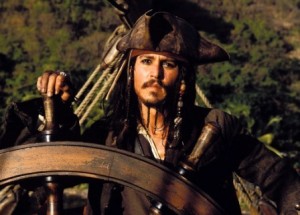
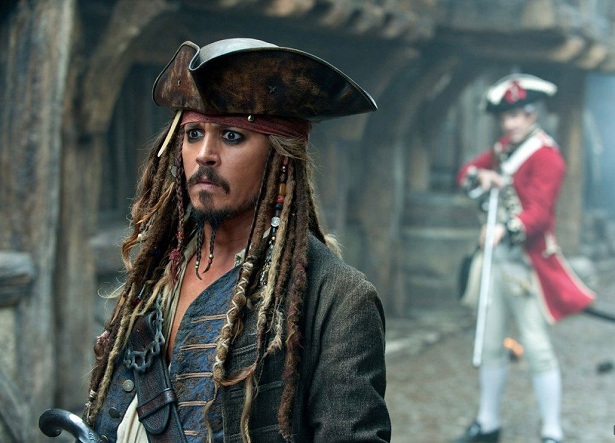
This week Johnny Depp set the twitter-verse aflame with the announcement that he is in talks to star in a fifth Pirates of the Caribbean movie. The news was met glee from fans and a collective arrgghh from critics, some of who have made a career of bashing the PotC movies.
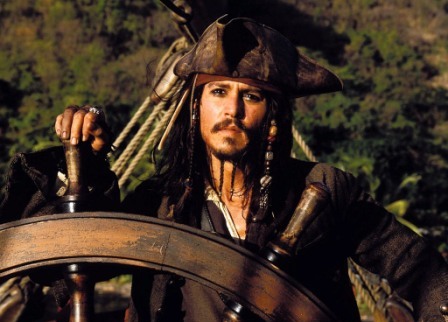
For me the news that Captain Jack Sparrow would once again sashay through another big budget time waster brought up an interesting question: Is Johnny a sell out or simply giving the people what they want?
The case for Depp as crowd pleasing actor is obvious. Only eight movies have earned over one billion dollars at the box office. Two of them are Pirates movies (and a third, Alice in Wonderland, starred Depp as the Mad Hatter).
Personally Depp must feel connected to the franchise. Capt. Jack is a beloved character which earned him an Academy Award nomination and really brought him in to the mainstream. But unlike George Clooney or Matt Damon or Leonardo DiCaprio who balance the big hits with edgier fare Depp seems to have jumped ship.
The Libertine, his last art film was seven years ago, and while he did appear in Terry Gilliam’s The Imaginarium of Doctor Parnassus in 2009 it was out of obligation to the director rather than any kind of career move.
For twenty years he toiled in the trenches, making interesting movies with interesting directors, but the image of outsider Depp has never really been accurate. Few actors could have pulled off Ed Wood and no one wears a hat like Johnny, and but there are a lot of quirky actors out there. Depp has simply been more astute in playing the Hollywood game while maintaining an outsider’s credibility. Now that he’s found a big money outlet for his idiosyncratic style—his cut of the first four Pirates movies is rumored to be $350 million— what ever street cred he once had is taking a long drive down 21 Jump Street. (BTW He has a cameo in the big screen reimagining of the TV show that made him a star.)
Taking on a fifth sequel puts Depp on the level of people who have more than three cats. If you have more than three you may as well have 600. The maintenance is about the same but people think of you differently. No one begrudged Johnny when he signed on for the second and third PotC, he was coming off a career high and a huge nomination and it seemed like the right thing to do. The fourth one raised eyebrows but now it’s official. Depp is for sale to the highest bidder.
As one twitter wit put it: “Johnny Depp on signing up for PIRATES 5: ‘Well you know how it is, gotta send my kids to college… and then buy the moon.’”
Depp is not in Nic Cage territory yet—there’s an actor who has a really hard time saying no to a pay day—but maybe it’s time to put Depp’s well cultivated image as rebel actor to rest.
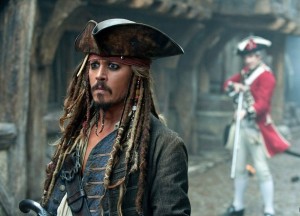
Johnny Depp had upwards of thirty million reasons to sign on for the new Pirates of the Caribbean outing—co-star Ian McShane suggests Depp is “paid more than the national debt of most countries”—and for that kind of money you’d think he could at least pretend to enjoy wearing Captain Jack’s bandana for the fourth time in eight years.
But he doesn’t.
Perhaps he’s just tired of playing pirate, or maybe he has finally realized the limitations of the swishbuckler but what was once a sublime characterization has become nothing more than his children’s (and their children’s) guaranteed annuity. An actor as gifted as Depp needs stimulation, (and frequently a funny hat, see: Alice and Wonderland, Charlie and the Chocolate Factory) and the sooner he abandons the Pirate ship and leaves the family franchise phase of his career behind the better.
It’s hard to imagine that Depp is one of the least interesting aspects of this big budget monstrosity, but it’s true. Geoffrey Rush, fresh off his Oscar nominated turn in The King’s Speech, also takes a paycheck here, but at least tries to shiver the timbers. Ditto Ian McShane. Perhaps they’re both hoping for some spin-off action once Johnny tires of the whole rigmarole, but at least you can’t see them actually reaching for the money.
Not that Depp is entirely to blame for the failure of the movie. Director Rob Marshall shoulders much of the guilt here. People pay money to see the Pirates movies for two reasons, Johnny Depp and the crazy action sequences. The stories have never made any sense, and in that aspect On Stranger Tides doesn’t disappoint, but Johnny’s disinterest and action scenes that are as exciting as you’d imagine an action sequence directed by the guy who made Nine sink the ship.
When I say failure I mean as a piece of entertainment. This is a guaranteed lock for number one with a BO gross that will make Captain Kidd’s legendary buried treasure seem like chump change, but profitability, while important to the suits who green light projects like this, is exactly what’s killing Captain Jack.
Guaranteed licenses to print money don’t come along very often, but when they do Hollywood often takes a counterintuitive approach to their cash cows. Why try that hard, Pirates seems to be saying to us, when people will lay down their money no matter if the story is silly, if the picture is so dark you can’t see the action, if our star has other things on his mind, if this simply plays like a trailer for the inevitable Pirates of the Caribbean 5: Do You Have Any Money Left? Let’s not try to improve or, God forbid, change the formula, the movie gods declare. Let’s stay status quo. Unfortunately status quo kills.
Mr. Cheekbones, Johnny Depp, plays Peter Pan author JM Barrie in this film which was nominated for Best Actor for Depp and Best Picture at this year’s Oscars. It claims to be based on a true story, but in reality has little to do with the real life events that led to the writing of the famous children’s play. Having said that though, it isn’t a history lesson, it’s a movie, and as a movie it works largely because of the performances of Depp in the lead role and Kate Winslet, who plays the mother of the boys who inspire Barrie to write the play. I think it is really easy to be cynical about a movie that is about the enshrining of boyhood, but this movie is more magical than mawkish.
As you may have guessed from the title “The Imaginarium of Doctor Parnassus” is an odd movie. Directed by Terry Gilliam, it is the strange tale of a mysterious immortal who complicates his life by making deals with the devil. Complicating Gilliam’s life during production was the unexpected death of his star Heath Ledger but, the show, as they say, must go on and here we are after the untimely January 2008 passing of the young actor, with a completed film. How did Gilliam finish the movie? A new credit, “A Film from Heath Ledger and Friends” tells the tale. Three of Ledger’s buddies, Johnny Depp (seen dancing on a leaf!), Colin Farrell and Jude Law, stepped in to play “through the looking glass” versions of the late actor.
Set in present day London the film begins with a look at Doctor Parnassus’s (Christopher Plummer) bizarre traveling show which offers people a chance to step through Dr.P’s magical mirror into an alternate reality. He’s selling imagination, but his gift of mind’s eye manipulation came with a heavy price. Eons before he made a trade with the devil (Tom Waits)—remarkable power in exchange for his first born daughter on her sixteenth birthday. That anniversary is now days away but with the help of a mysterious stranger named Tony (played by Ledger, Depp Law and Farrell) and the magic mirror Dr. P just may be able to save her.
“The Imaginarium of Doctor Parnassus” is more a piece of surrealist art than a traditional movie. Imagine watching a Salvador Dali painting come to life and you’ll get the idea. Gilliam, who co-wrote the script as well as directed, has allowed his imagination to run riot. While the story meanders to and fro he fills the screen with unforgettable images; Old Nick dangling Dr. P from the end of a branch or a multi-eyed hot air balloon shaped like a man’s head or the ensemble of skirt wearing, dancing Bobbies. Visually it’ll make your eyeballs do the Watusi.
The story, however, may leave some a bit baffled, but so what if it warps the brain a bit? The film oozes Gilliam’s trademarked anarchic spirit—he might be the only filmmaker who could replace his leading man with three other actors and actually pull it off—and is the most original movie of the year.