Black Mass sees Johnny Depp playing Jimmy ‘Whitey’ Bulger, a crime lord-turned-FBI-informant who ruled South Boston and was also the inspiration for Jack Nicholson’s character in The Departed.
Bulger was a community minded cold-blooded killer. He loved his neighbourhood, kids, cats and choking people to death with his bare hands.
Depp says “a responsibility to history and truth to some degree” was very important to him going into the project.
“When you’re playing someone who exists or existed,” he says, “there’s a tremendous kind of amount of responsibility, at least for me, no matter whether they’re deemed good or bad or whatever. You have a responsibility to that person.”
The fifty-two year old actor’s performance is already earning early Oscar buzz for the chilling authenticity he brings to a man described in the film as “ripened psychopath.”
Director Scott Cooper says, “I don’t think people come to narrative features for the facts, or for truth. I think you go to documentaries for that. What you do come to narrative features for is psychological truth, emotion and deep humanity. I did not want to make a film strictly about criminals who happened to be humans. I wanted to make a film about humans who happened to be criminals.”
Like many underworld figures, Bulger created his own mythology based on his exploits, making it difficult for co-screenwriter Mark Mallouk and Cooper to discern what was true and what wasn’t.
“Jimmy Bulger had his version of the truth which was different from (accomplice) Stephen Flemmi’s,” said the director, “that was different from (henchman) Kevin Weeks and (hitman) John Martorano. I had to determine what was the story I was going to tell… and tell it as accurately as I could from a very emotional place.”
It’s a hard-edged tale to be sure, fuelled by Bulger’s violent and grim behaviour, but Depp found it best not to judge the character.
“I don’t think any of us wake up in the morning and say, ‘I’m so evil. I’m so horrible,’” Depp said. “I approached James Bulger as a human being, who’s multi-faceted and did have a side to him that was human and loving.”
Depp’s performance and the work of his co-stars Dakota Johnson and Joel Edgerton among others, ensure that Black Mass is a complex study of human behaviour, but hopefully, according to Mallouk, not a glamorous one.
“None of wanted anyone walking out of the theatre to go, ‘I want to be Whitey Bulger,’” said Mallouk. “You feel that way after Scarface or Goodfellas or after The Godfather, and I love those movies, but there is a responsibility to not do that here. It feels more like Donnie Brasco. We did not want to create more fuel for the Whitey Bulger myth.”
Cooper says his responsibility as a filmmaker and storyteller was with “the victim’s families because Jimmy Bulger and the men we chronicle in this film left a deep emotional scar on the city of Boston that is still very fresh and widely felt.
“I care what they think about the film and I hope I didn’t trivialize these events.”
In real life Bulger, now eighty-six years old and serving two life terms plus five years at a penitentiary in Florida, was convicted of racketeering, money laundering, extortion, weapons charges and was found to have been involved in 11 murders.
“You talk about six degrees of Kevin Bacon,” says Cooper. “In South Boston or Boston in general it’s two degrees of Whitey Bulger. Everybody had a story and everybody knew him.”
“Southie kids went from playing cops and robbers in the playground to doing it for real on the streets,” says Kevin Weeks (Jesse Plemons), “and like on the playground sometimes it was hard to tell who was who.”
It’s not that hard, really. Not in “Black Mass” anyway. The story of Jimmy ‘Whitey” Bulger (Johnny Depp), the crime lord-turned-FBI-informant who ruled South Boston and was the inspiration for Jack Nicholson’s character in “The Departed,” is populated by bad men who do terrible things.
Bulger himself was a community minded cold-blooded killer. He loved his neighbourhood, kids, cats and choking people to death with his bare hands. He was, in the words of FBI agent Charles McGuire (Kevin Bacon) a “ripened psychopath.”
“It’s not what you do,” Bulger says, “it’s when and where you do it. If no one sees it didn’t happen.”
“Black Mass” is a gangster thriller in the same vein as ”Goodfellas.” It follows a familiar pattern, the rise, fall and eventual ratting out of a crime boss, but provides more than enough underworld intrigue to keep things interesting. Depp is all coiled menace, a dark-eyed malevolent force capable of helping an old neighbourhood woman with her groceries one moment and killing an old friend the next. He’s unpredictable in the most predictable of ways, but Depp makes sure that Bulger isn’t just an echo of Michael Corleone or Tony Montana by giving him some tender moments with his family, son, mother and brother. It’s terrific work and a welcome change from his recent, extended Caribbean trip.
This is very much Depp’s movie but it is populated by an array of interesting and well-performed characters.
Joel Edgerton is John Connolly, a Southie kid who grew up to become the FBI agent who convinced Bulger to become an informant. Edgerton is always interesting, often in supporting roles. Here in a large, showy part he is all swagger and Brut cologne.
As the assorted bad guys and crooked FBI agents Jesse Plemons, Rory Cochrane, Peter Sarsgaard bring the scuzz, but while this is a very male movie, there are three solid performances from the female cast. As Connolly’s wife Julianne Nicholson brings the right amount of scepticism about being airlifted into a world she doesn’t understand and Juno Temple is heartbreaking as a street waif who makes the mistake of trusting Whitey. Dakota Johnson, as Bulger’s common law wife Lindsey Cyr, stands out, riding the line between steeliness and sweetness in her scenes with Depp.
The gangster saga may be the great American movie genre. From Howard Hawks and William A. Wellman to Martin Scorsese and Francis Ford Coppola, bullets and bangers have been a staple on the big screen. “Black Mass” is another piece of that puzzle, but unlike “Scarface” or “The Godfather” it doesn’t glamourize gang life—this is the underworld’s more down-and-dirty side—but neither does it break much new ground. Perhaps given the extensive Hollywood history of on-screen thuggery there aren’t many new ways to present the rise-and-fall story but director Scott Cooper, Depp and cast at least keep it compelling.
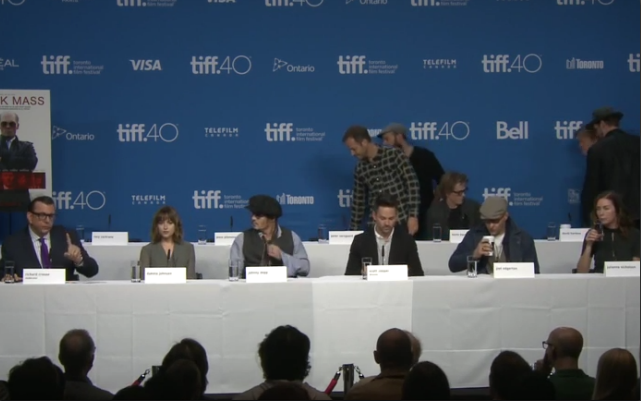
Richard hosted the press conference for the movie Black Mass held during the 2015 Toronto International Film Festival on Monday September 14 with Dakota Johnson, Johnny Depp, Joel Edgerton, Peter Sarsgaard, Kevin Bacon, Julianne Nicholson, Jesse Plemons, Rory Cochrane, as well as director Scott Cooper.
Jason Bateman shares a first name with one of modern horror’s most famous villains, but as an actor he’s best known as a comedic actor. In “The Gift,” however, he explores the dark side of his horror icon namesake.
Simon (Bateman) and Robyn (Rebecca Hall) are a married couple recently relocated back to Simon’s Los Angeles hometown. Work prospects are good, they live on one of those airy, open concept houses that rich movie characters often own and are even trying for a baby to complete their perfect Southern Californian life.
Things change when the past, in the form of Gordo (Joel Edgerton, who also wrote the script and directed), an old school mate of Simon’s, becomes a little too pushy in rekindling their acquaintance. Unwelcome encounters and unexpected “gifts” bring to light a decades old slight and expose cracks in Simon and Robyn’s relationship.
A study in allowing bygones to be bygones, “The Gift” is a tightly wound psychological thriller that takes it time getting to the surprises. Instead of delivering quick thrills Edgerton concentrates on character. He weaves a linear but complex story that will leave some viewers pointing the finger of blame for all the trouble at Gordo, some at Simon. It’s rich storytelling that sees both sides of the argument and burrows itself under the audience’s skin.
Much of the success of the film is due to Bateman’s startling performance. Years of comedic roles have labelled him the good-natured everyman, long on charm, short on malice. “The Gift” effectively turns that persona on its head, giving Bateman the chance to get dramatic as the heavy, a man content to ruin people’s lives to get what he wants. Bateman is perfect as Simon, presenting him as a caring, giving man before he taking a bone-chillingly sinister shift.
Hall adds to an already impressive resume, evolving the character of Robyn from naïve to gritty. Caught in limbo between Simon and Gordo, she is the film’s emotional core, showing apprehension, betrayal and anger in equal measures.
In front of and behind the camera Edgerton shows a steady hand doling out character and story information in small doses. Each revelation builds tension until the climax, which packs a mighty psychological wallop. No spoilers here, but near the end the thriller aspect of the story gives way to an unsettling Machiavellian revenge angle, but not a Tarantino style bloodbath. Instead it’s a high-minded stab at the heart that cuts deeply to the core of what the movie is really about—should facts get in the way of a good rumour?
“The Gift” is a sophisticated European flavoured scene spinner with fine performances that will have you asking, Who is the real villain?
As fans of Charlton Heston are well aware, Moses (Christian Bale) was a one-time Prince of Egypt raised as a brother to Pharaoh Ramses (Joel Edgerton) and exiled to the desert when his Jewish heritage was revealed. He should have perished but instead found a new life, with a wife, a son and a flock of goats.
It’s during this rather uneventful time that God speaks to Moses, commanding him to liberate his people, the Hebrew slaves, from under the tyranny of Ramses’s rule. “He has lost his mind,” says the Pharaoh. “He has found a god. His god. Not one of ours.” Moses supposes that the slaves are Egyptians and should be treated as such, with fare pay and the rights of any other citizen.
Cue the burning bush, plagues and the (almost) parting of the Red Sea.
Director Ridley Scott is the anti-Cecil B. DeMille. Like “The Ten Commandments,” “Exodus: Gods and Kings” is a huge movie with thousands of extras, two very important tablets and plagues galore. The stories are basically the same (although Scott takes liberties, making God appear as a young, tart-tongued boy) but the approaches are very different.
Scott’s film eschews all the Hollywood glam of DeMille’s biblical epic. It’s humanistic and so gritty you’ll feel like taking a bath afterwards, but not in the Nile, which is turned a lurid blood red as one of the ten plagues. Scott also makes good use of 3D, staging big screen dioramas with amazing detail, depth and even the odd spear that shoots off the screen.
The director pulls out all the stops in the large-scale action scenes and when the movie is raging it works. When he slows the pace in the more introspective scenes it flattens. Character development is one thing. Bad dialogue is another.
The eager cast is up for almost anything, but it’s unlikely that many actors, when asked, “Do you know where we are?” could keep a straight face when replying, “Yes. We are somewhere at a point on earth where there is a sea in front of us and an army behind.” Bale gives it his best, and does a noble job, but the script stymies even this fine actor from time to time.
The film’s climax—and this is NOT a spoiler—is the parting of the Red Sea sequence. Like the plague scenes—wild crocodile attacks, locusts, frogs, pustules etc—the parting is quite stunning visually, but ultimately feels a bit less than miraculous. For one thing it’s more of a wave than an actual parting, and while that may be splitting hairs, it is one of the best-known parts of the story and Scott turns it into an Irwin Allen moment.
“Exodus: Gods and Kings” does share one main thing with “The Ten Commandments” in that there is a noticeable lack of Middle Eastern faces among the cast. The days where Heston and Edward G. Robinson could pass for Egyptian slaves and Pharaohs is apparently not too far in the rearview mirror.
If Tim Burton had directed “The Odd Life of Timothy Green” instead of Peter “Dan in Real Life” Hedges it might have been called something like “The Strange and Sad Tale of Mr. Pencil and the Chlorophyll Kid.” This bizarre tale could have used a dose of Burton’s off-kilter sensibility to mute Hedges’s heart-string tugging.
Jennifer Garner and Joel Edgerton are Cindy and Jim Green, a good-looking couple from Stanleyville, the Pencil Capitol of the World. She works at the Pencil Museum, he’s a foreman at the pencil factory. Childless, they have been trying for years to get pregnant. After a specialist tells them that it won’t be possible for them to have a child, they commiserate in an unusual way. Over a bottle of wine they write down all the characteristics they’d like their idea child to have; a heart like his mother, to score the winning goal and to be able to rock out on an instrument. Sealing their wishes in a box, they bury it—along with their hope of having a child—in the garden and go to bed. Soon there’s a commotion outside, and they become the proud parents of… a plant. Well, a boy named Timothy (Cameron Adams), complete with leaves where his socks should be, who sprung from the “seeds” they planted.
There is no denying the sweet tone of “The Odd Life of Timothy Green.” Garner has likeability on her side, so you empathize with Cindy and her “You can’t let anyone see your leaves!” protectiveness and Edgerton pulls it off as a confused and confounded dad, but the fantasy aspects of the story come off as twee instead of sweet.
It’s fertile ground for a fantasy about fertility, shame and acceptance but it feels a bit too clever for its own good. It’s hard not to identify with the choices new parents have to make when Jim send Timothy off to school with a cheerful, “Have a great day,” only to have Cindy scold him, “That’s a lot of pressure…” Those bits the movie gets right but the rest of it, the story of leaf boy and the pencils is, pardon the pun, drawn out.
Add to that a series of unnecessary connective scenes at an adoption agency and you have a movie with likeable performances, and a timely message in our bullying age, but one that also feels overgrown with sun-dappled sentiment.