August Strindberg’s play 1888 “Miss Julie” comes with a preface stressing several key points in the staging of the work. Liv Ullmann, director of the newest film adaptation of the show—the first appeared in 1912—changes the location of the story from the tradition Swedish setting to Ireland, but other than that, for better and for worse, has adhered to Strindberg’s instructions to keep the text natural, the conflict significant and the staging simple.
The action takes place on Midsummer Night 1890 in a mansion owned by Miss Julie’s (Jessica Chastain) aristocratic father. The rambling place is empty save for maid Cathleen (Samantha Morton), John the valet (Colin Farrell) and the count’s daughter.
The films follows a fiery and complex cat-and-mouse as Miss Julie attempts to seduce the handsome and intelligent John despite the presence of his fiancée Cathleen. It’s a power struggle between the well-born Julie and servant John—who reveals he’s been infatuated with her since childhood—that examines, challenges and upends the traditional notions of 19th century class and gender.
Ullmann’s take on “Miss Julie” is conventional. With the exception of a handful of scenes she remains “stage-bound,” presenting most of the action in kitchen of the manse. It is here the fireworks fly, but they come from the feisty performances and not the filmmaking. For the most part the camera stays out of the way, capturing the action as discreetly as possible. It’s a voyeuristic approach that captures the naturalism and simplicity Strindberg hoped for, even though much of the dialogue and situations (a “kiss the boot” scene feels like it might not have been out of place in “50 Shades of Grey”) are hopelessly theatrical.
By the end you’re left with the feeling that watching the latest “Miss Julie” is less a cinematic experience than it is a heightened theatrical one. I’m not sure it is exactly what Strindberg had in mind.
Don’t let the title fool you. “A Most Violent Year” doesn’t have fight scenes, much gunfire or even a Steven Seagal cameo. The violence implied in the title refers to the time. Set in 1981 New York, statistically one of the most brutal years in the city’s history, it’s really the story of a man trying to sidestep violence and grab the American Dream by the tail.
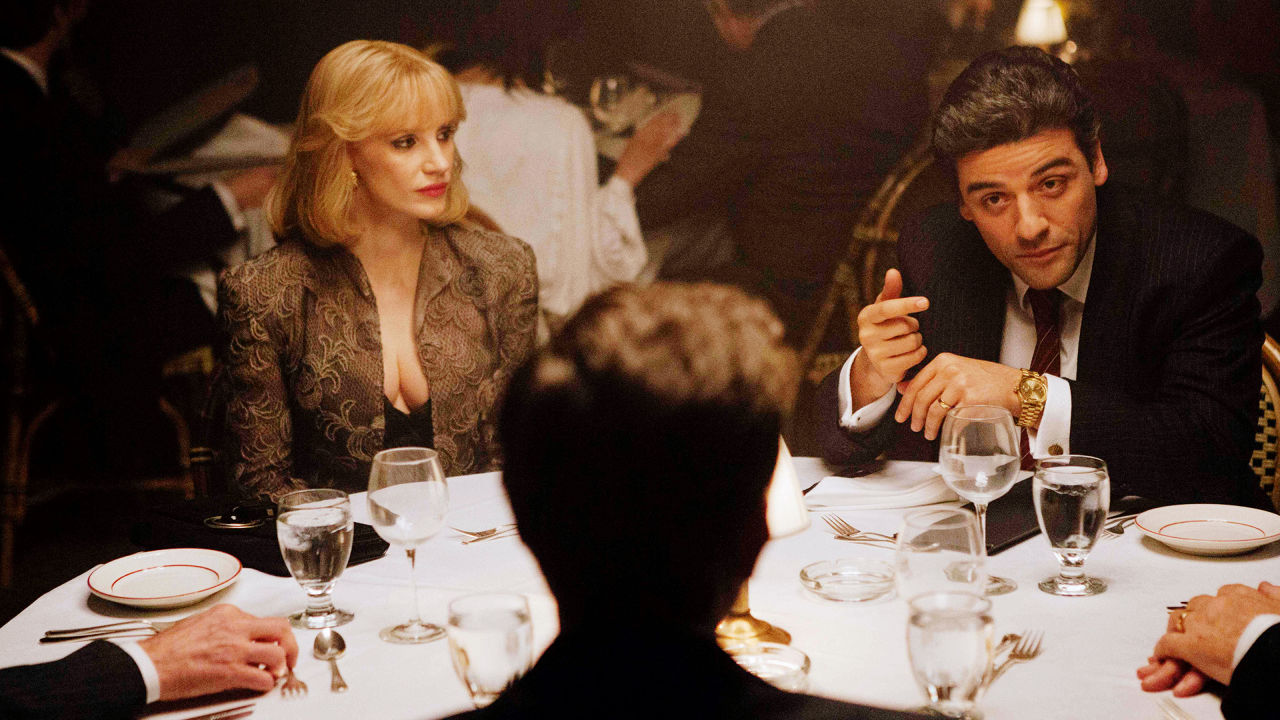
Oscar Isaac is Abel Morales, a young man in an old and dangerous game—the oil business. His distribution business is successful and about to expand, but there are problems. An aggressive city attorney (David Oyelowo) is sniffing around his finances while someone—a business rival perhaps—is systematically hijacking his trucks. Each time a truck loaded with oil disappears it erodes his bottom line and puts his dream of a waterfront distribution depot further out of reach. At home the violence and corruption of the times seeps into his personal life as his wife Anna (Jessica Chastain) the daughter of a Brooklyn gangster, gets restless.
Director J.C. Chandor is unafraid to take his time telling this story. Some will find his deliberately paced film a bore, others a slow burn. He concentrates on the characters, not the situations, putting Abel’s honesty and entrepreneurial spirit front and center. Much time is given to overcoming setbacks through sheer strength of will. His iron resolve is the character’s cornerstone, and much dialogue is devoted to it, but Isaac’s nicely delivered, understated performance keeps it from becoming repetitive.
The fireworks (such that they are) come later when Abel is at the end of his rope. Chastain (in a far more interesting performance than her work in “Interstellar”) on one side, corruption and violence on the other, the film pushes Abel, building to a satisfying climax. Still, Chandor doesn’t allow “A Most Violent Year” to live up to its name. A truck chase is pulse racing and a sub-plot about driver traumatized by a hijacking adds a hint of character-driven action, but the real tension comes from the fraught atmosphere Chandor creates with ruthless efficiency behind the camera and the restrained performances in front of it.
Don’t let the title fool you. “A Most Violent Year” doesn’t have fight scenes, much gunfire or even a Steven Seagal cameo. The violence implied in the title refers to the time. Set in 1981 New York, statistically one of the most brutal years in the city’s history, it’s really the story of a man trying to sidestep violence and grab the American Dream by the tail.
Oscar Isaac is Abel Morales, a young man in an old and dangerous game—the oil business. His distribution business is successful and about to expand, but there are problems. An aggressive city attorney (David Oyelowo) is sniffing around his finances while someone—a business rival perhaps—is systematically hijacking his trucks. Each time a truck loaded with oil disappears it erodes his bottom line and puts his dream of a waterfront distribution depot further out of reach. At home the violence and corruption of the times seeps into his personal life as his wife Anna (Jessica Chastain) the daughter of a Brooklyn gangster, gets restless.
Director J.C. Chandor is unafraid to take his time telling this story. Some will find his deliberately paced film a bore, others a slow burn. He concentrates on the characters, not the situations, putting Abel’s honesty and entrepreneurial spirit front and center. Much time is given to overcoming setbacks through sheer strength of will. His iron resolve is the character’s cornerstone, and much dialogue is devoted to it, but Isaac’s nicely delivered, understated performance keeps it from becoming repetitive.
The fireworks (such that they are) come later when Abel is at the end of his rope. Chastain (in a far more interesting performance than her work in “Interstellar”) on one side, corruption and violence on the other, the film pushes Abel, building to a satisfying climax. Still, Chandor doesn’t allow “A Most Violent Year” to live up to its name. A truck chase is pulse racing and a sub-plot about driver traumatized by a hijacking adds a hint of character-driven action, but the real tension comes from the fraught atmosphere Chandor creates with ruthless efficiency behind the camera and the restrained performances in front of it.
What’s a wormhole anyway? According to Wikipedia it’s a “postulated method, within the general theory of relativity, of moving from one point in space to another without crossing the space between.” Huh? Maybe it’s easier to think of them as a cosmic shortcut to the past or future. If Bill and Ted could figure these things out—their first “excellent adventure” saw them sucked into a wormhole to assemble historical figures for a high school project—then so should we.
Christopher Nolan uses these theoretical bridges through time as the bridge through his new space opera “Interstellar.”
In the earthbound portion of the story crop blight has led to a food shortage and a worldwide ecological disaster. Cooper (Matthew McConaughey), is a pilot-turned-farmer trying to find a way for his family to survive the impending apocalypse. An answer to his problems arrives in the form of Professor Brand and his daughter Amelia (Michael Caine and Anne Hathaway) who believe a new planet with the possibility of supporting life exists on the other side of a wormhole near the planet Saturn. “We’re not meant to save the world,” Brand says. “We’re meant to leave it.”. Cooper, Amelia and a team of astronauts embark on a year-year quest to find the planet and find humanity’s salvation.
“Interstellar” is twice as long as the similarly themed “Gravity,” but only half as enjoyable. It’s larger in scope—this is Christopher “Billion Dollar Baby” Nolan after all—than the Sandra Bullock movie, and more ambitious too, but it’s a strange mix of sci fi and sentimentality that plays up the idea of the power of love. The only thing missing is a Celine Dion over the final credits.
Nolan reaches for the stars with beautifully composed shots and some mind-bending special effects, but the dime store philosophy of the story never achieves lift off.
McConaughey’s been down this road before in “Contact,” and acquits himself well enough, but the interesting actor who anchored “True Detective” gets lost in space for much of the 169-minute-running time.
On the upside “Interstellar” earns points for not being based on a novel or video game. On the downside, it’s not based on good sci fi either.
Fear of the end of the world is a predominant theme at this year’s Toronto International Film Festival. I blame the Mayans. Lars Von Trier’s “Melancholia” is a study of depression and family dysfunction set against a backdrop of impending disaster and “Taking Shelter,” starring “Boardwalk Empire’s” Michael Shannon and Jessica Chastain explores pretty much the same thing but from a much different point of view.
Shannon plays Curtis a hard working husband and father who begins to have visions the apocalypse.
Plagued by nightmares, hallucinations and panic attacks, the terror he feels extends beyond his dreams. “It’s a feeling,” he says. “Something is coming.” He can’t describe what it is coming but finds solace by building a storm cellar in his backyard, a sort of panic room for him and his family to hide in when the end of the world comes. But a question remains: Is he mentally ill or is he a prophet?
“Take Shelter” is a strong effort that is marred by a disingenuous ending that feels like a cheat compared to the rest of the film. I won’t tell you what it is, and it didn’t sour me on the whole film, but it was a disappointment.
Other than that—maybe go and get a popcorn refill I the last five minutes of the film!—there’s much to enjoy here. Shannon has usually been seen playing larger-than-life characters so it’s refreshing to watch his empathic work as an everyman who doesn’t understand what is happening to him. Motivated by a great fear we feel his anxiety grow as the character surrenders his self control.
Chastain in her fourth movie this year once again proves she is as versatile as anyone working today. She brings strength, resilience and purpose to a character that could have been very one note.
“Take Shelter” is an interesting movie with beautiful cinematography, effective performances and an intriguing story. Too bad it sells itself short in the closing minutes.
Mothers in movies are often portrayed as warm, loving nurturers, unless the movie is produced by horror meister Guillermo Del Toro. In “Mama,” a new supernatural thriller starring Jessica Chastain, the title character is a vengeful spirit, more Mommie Dearest than Mother Goose.
“Mama” begins with the meltdown of a businessman who kills his partners, his ex-wife and kidnaps his two small kids, Victoria (Megan Charpentier) and Lily (Isabelle Nélisse) Desange, (rhymes with derange), taking them to a remote cabin in the woods. The first clue that something ghostly is going on comes when little Victoria says, “Daddy, there’s a woman outside and she’s not touching the floor!”
Soon Dada is out of the picture and the girls are presumed missing by everyone except their Uncle Luke (Nikolaj Coster-Waldau) who spends five years searching for them. When they’re found they’re worse for wear—feral kids who have survived with the help of a supernatural nanny they call Mama. Uncle Luke and Aunt Annabelle (Chastain) try to give them a normal life, but Mama is still a nightmare.
The people you expect in this kind of movie—the expert, the meddler, the spooky record clerk who knows more about the supernatural than the average person (“A ghost is an emotion bent out of shape… looking to right a wrong.”)—are all present and they do the things people do in these kinds of movies—explore remote haunted places at night with only a flashlight for protection, and stare creepily into space.
So no surprises there, but “Mama” does have some nice subtle creepy reveals—all is not what it appears to be—a vivid dream sequence and, of course, the ethereal Mama, who occasionally resembles a giant hairball on the floor, but is eerie nonetheless.
“Mama” is spooky rather than scary, but has appropriately creepy kids—the little one even scurries around the floor on all fours like a tiny silverback gorilla—and enough jolts to earn a recommend.
Terrence Malick is probably the biggest name director whose movies you’ve never seen. His is the kind of name filmy types like to toss into conversations as a test to see how deep your knowledge of movies runs. Having made just five movies since 1973 he is less productive than a four toed sloth, but as a chef I know used to say, “do you want it fast, or do you want it good?”
His latest, “Tree of Life,” is a star studded look at life, death and the birth of the universe. He compresses the history of the world, mankind and the lives of a Waco, Texas family into two hours and twenty minutes. This coming of age story—or more rightly a coming of the ages story—is impressionistic storytelling, nonlinear, non-story based but not nonsensical.
It’s a deeply spiritual movie—from the Job quote that begins the story to the Amen chorus at the end—that asks the big questions—Why do awful things happen? Are we always in God’s hands?—often in reverential, whispered tones. Style wise Malick constantly tilts the camera upwards, keeping an eye on the heavens.
This is not light summer entertainment. In fact, some will think this is pretentious twaddle, while others will see a movie that replaces traditional storytelling with deep seated feelings.
I’m leaning ever so slightly toward the pretentious twaddle camp, certainly in the film’s first hour, where Malick inserts a long sequence detailing the abovementioned birth of the universe. Faces and lifelike shapes appear in the primordial goop that makes up much of this extended creation scene, and by the time the dinosaurs appear it is hard to remember this is a movie starring Brad Pitt and Sean Penn.
What does it mean? Not sure. Narratively it adds little to the film and as artful as it may be it feels too new agey by half. But as pretentious twaddle goes, it’s really beautiful. If this movie was made in 1968 it would have been a “head” movie, delighting stoners at midnight screenings.
But it’s not 1968, so luckily the first forty minutes gives way to a slightly less impressionistic mid section, based mostly in the family home of Mr. and Mrs. O’Brien (Brad Pitt and Jessica Chastain) and their three kids. It’s a feel, a hazy look at growing up.
Pitt impresses as the upwardly mobile, but thin skinned tyrant father; a man who thought he did everything right only to discover his instincts were off. There’s also a surprising character arc in a movie that is more about intuition than arcs. The family story is effective, its Malick’s struggle to place it within a much larger context and the constantly shifting points of view that obscure the film’s main point, a questioning of faith in the light of great personal tragedy.
Obscured though the point may be, this is one seriously beautiful film. Malick has his characters talk about living in a state of grace—love everyone, every leaf, every ray of light—and it’s not hard to imagine that is an echo of his filmmaking ethos. He finds splendor in the things we don’t see onscreen very often anymore, a pure shot of fireflies flittering in the darkness, landscapes and nature, unadulterated, left alone to speak for themselves.
Critics will use words like textural, nuanced to describe “Tree of Life.” I’ll add a few more. Heartfelt, willfully obscure and intriguing.
Alfred Hitchcock famously described how to create tension in a movie. “There’s two people having breakfast and there’s a bomb under the table,” he said. “If it explodes, that’s a surprise. But if it doesn’t…” I’ll finish the sentence he so anticipatorily left undone: “…that’s suspense.”
“Zero Dark Thirty” (refers to the military time for thirty minutes after midnight) operates on this premise, creating suspense even though many of the bombs do go off and we know how the story ends. The whole movie is the bomb under the table, leading up to an explosive, although protracted, climax.
The film begins on 9/11 with audio of calls coming from the Twin Towers. Stage set, the movie leaps forward two years to the brutal waterboarding and torture of an Osama bin Laden relative by Dan (Jason Clarke) a CIA expert in extracting information. “In the end everybody breaks,” he tells his subject. “It’s biology.” Overseeing the waterboarding and humiliation techniques is Maya (Jessica Chastain), a newly recruited officer charged with helping to track down terrorist leader bin Laden and dismantle al-Qaeda.
This is Maya’s story. It’s a carefully plotted espionage tale that flows from the clues that lead to the death of bin Laden at the hands of the Navy S.E.A.L. Team 6 in May, 2011.
“Zero Dark Thirty” is not a who dunnit, or why dunnit, but a how dunnit.
It’s a detailed look at the step-by-step process that resulted in locating and exterminating bin Laden. The story begins before President Obama’s famous, “We don’t torture,” speech about regaining “America’s moral stature in the world,” so it presents the uncomfortable, controversial truth that pitiless persuasion like sleep deprivation, boxing and waterboarding—so simple, yet so brutally, terrifyingly effective—was used to gain information.
That queasy feeling from the film’s opening torture scene–that unethical techniques were used to gain information—evaporates during the daring Abbottabad raid sequence. While there’s a political discussion to be had regarding the ethics of waterboarding, that’s for another column. Dramatically it helps to provide a starting place for what is essentially a procedural.
Director Kathryn Bigelow and journalist-turned-screenwriter Mark Boal have focused on the details, shying away from delving into the personal lives of the characters.
Chastain’s Maya is a cipher, we know little about her except she was recruited out of school by the CIA and has spent a decade chasing one goal. Her selfless, obsessive dedication has perhaps cost some of her humanity, but Chastain manages to create an interesting character even when she has to mouth hyperbole about her noble quest. “A lot of my friends have died,” she says. “I believe I was spared so I could finish the job.” That’s a line straight out of any generic action movie.
But this isn’t a generic action movie. It’s a nuanced, suspenseful and terrifically exciting look at recent history.
Frequent overwriting—the inevitable “then I’m gonna kill bin Laden” moment and CIA honchos who say things like “Do your jobs and bring me people to kill,”—seems too easy for a movie this clever, but Bigelow’s virtuosic handling of the climatic raid scene overpowers the film’s weaker moments.