“This may well be our last mission,” says the Impossible Mission Force head honcho William Brandt (Jeremy Renner). “Let’s make it count.”
Five minutes into “Mission: Impossible – Rogue Nation” Tom Cruise is seen hanging off the side of an airplane as it takes flight. His hair whipped by the wind, grip tightening as the craft puts space between him and the ground, Cruise kicks off the fifth instalment of the popular series with a stunt that proves he’s making it count. Despite what Brandt says, if audiences react expect more missions and wilder stunts.
“Rogue Nation” is set in a world where villains are really villainous, prone to theatrical evil doings like arranging an assassination during an opera so it can be scored by the dramatic operatic stylings of Giacomo Puccini’s “Turandot.” Music swelling, bullets flying, it’s an over-the-top set piece in a movie that revels in its large canvas. Taking place all over the world—Vienna! London! Minsk! Casablanca!—it’s action adventure writ large, with wild stunts that would make Jackie Chan envious, cold-blooded bad guys, hot-blooded agents and double-crosses galore. At one point Hunt even swims through an underground tunnel with the speed of a Cruise Missile. This isn’t the quiet backroom intrigue of “Tinker Tailor Soldier Spy,” its James Bond on steroids.
Cruise is Ethan Hunt, über action-man described by CIA head Hunley (Alex Baldwin) as “the living manifestation of destiny.” He’s also the hands-on lead agent of the IMF, a super secret group formed to fight against the dastardly Syndicate. Their missions have taken them around the world, leaving a trail of chaos and mayhem in their wake. So much so that Hunley wants to shut them down permanently.
Instead of coming in from the field Hunt goes rogue to infiltrate the Syndicate. With the help of his old IMF cohorts—Benji Dunn (Simon Pegg), Luther Stickell (Ving Rhames)—and a possible double-agent, the fantastically named Ilsa Faust (Rebecca Ferguson), Hunt performs feats of derring-do and uncovers the serpentine truth behind the evil organization. Fortunately the good guys get lucky while the bad guys can’t shoot straight.
This year we have seen a very welcome return to real stunts, old school action that packs a much bigger punch than all the pixels in all the “Avengers” movie put together. Frequent Cruise collaborator and “Rogue Nation” director Christopher McQuarrie keeps the pace up, weaving loads of action into the conspiracy chicanery. More importantly he keeps the stunts organic. With hardly a green screen in sight, you can feel the danger in the stunts. Everyone has had the sensation of sitting inside a plane as it takes flight, and the land below starts to shrink as the craft gains altitude. Now imagine the same thing with Cruise on the outside of the plane. The stunt feels real and grounds the movie, and while old-school in execution, raises the bar for modern action sequences.
Despite the stunts and violence “Mission: Impossible – Rogue Nation” has a surprisingly light touch. Funnier and with a more linear storyline than previous entries, the movie’s mission is to entertain, and in that it succeeds.
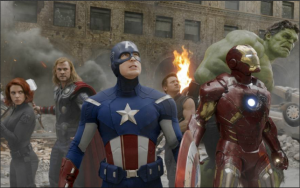
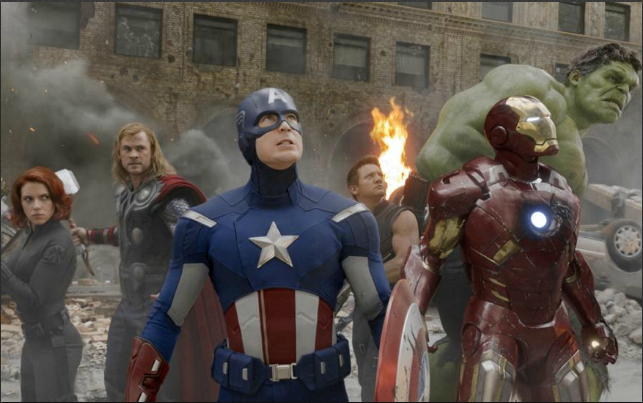
It’s not a spoiler to let you know the Avengers save the world in The Age of Ultron. The spectacular six have rescued the planet before and, no doubt, will save it again in future. In superhero movies the globe is always on the eve of destruction.
The original movie, 2012’s The Avengers, saw the team protect the planet from Thor’s evil brother Loki while in Superman II the Man of Steel battles three Kryptonian criminals set to obliterate our orb. A baddie named M tries to wage world war in The League Of Extraordinary Gentlemen and recently the Fantastic Four prevented a giant cosmic entity called Galactus from gobbling up the earth.
“I see a suit of armour around the world,” says Tony Stark in Age of Ultron. “Peace in our time, imagine that.”
The movies get bigger every time out and with thirty more superhero flicks scheduled for the five years—including Deadpool, Doctor Strange and Gambit—the mind reels at the ways villains might endanger our world. It sounds entertaining but haven’t we’ve already been there? Where do you go from the threat of total annihilation?
Diminishing returns in terms of audience reaction, that’s where. We all know The Avengers will pull out all the stops to save the earth. Buildings will crumble, trucks will go airborne and giant cracks will appear where city streets used to be but by the end credits you know everyone will emerge relatively unscathed, with the bad people vanquished and the good guys grinning from ear to ear. Viewers are left with CGI fatigue, but dammit a catastrophe was averted. Again.
But we’ve been there, done that. Why not freshen things up and turn back the hands of the doomsday clock a few minutes to create tension in the form of different kinds of situations? It sounds counter intuitive—bigger is always better, right?— but imagine Captain America going mano a mano with Kim Jong-un or Iron Man shrinking down to the size of a microbe to battle cancer from the inside à la Fantastic Voyage.
The real world is a very complicated place. Every day the news delivers more bad information than all the tragedies of Aeschylus and Sophocles combined. Stories of beheadings, terrorism and all manner of terrible behaviour flood the airwaves aching to be corrected by some sort of superhero. How great would it be to see warrior princess of the Amazons Wonder Woman unleash the Lasso of Truth on the Canadian Senate or weather maven Storm get all medieval on climate change?
An injection of real world issues might not make for big box office, but it certainly would infuse the movies with a sense of unpredictability—just like real life events. Real life is messy and volatile and that’s what keeps it interesting.
I understand one of the reasons we go to movies like The Avengers: Age of Ultron is to see things we’ll never witness in real life, but it’s hard not to agree with Hawkeye (Jeremy Renner) when he says, “We’re fighting an army of robots and I have a bow and arrow—it makes no sense!” These movies try to dazzle our eyes—and they do!— but bringing them down to earth, literally, might help us engage our brains as well.
“Can we hold them?” asks evil scientist Baron Wolfgang von Strucker (Thomas Kretschmann) as a team of superheroes tear up his supposedly impenetrable HYDRA lair.
“They’re the Avengers,” comes the reply. The only thing missing is the “Duh!” at the beginning of the sentence.
Not only does the exchange answer the question of every film producer who has a movie opening opposite “Avengers: Age of Ultron” this weekend but it also sets a loose, funny tone for the film.
Twenty seconds into the movie we’re already engaged in a wild action scene that puts them in possession of an ancient gem containing artificial intelligence. Tony Stark (Robert Downey Jr.) and Bruce Banner (Mark Ruffalo) intend to use the technology to build a peacekeeping army—“I see a suit of armour around the world,” says Stark. “Peace in our time, imagine that.”—but the plan backfires and instead of creating a global peace initiative they create a robot monster named Ultron (voice of James Spader). “I really miss the days when the weirdest thing science created was me,” says Captain America (Chris Evans). Hell-bent on improving the world by exterminating humanity, Ultron says, “When the dust settles the only things left will be metal.”
Cue the metalocalypse.
While many superhero movies have chosen a dark road—think Christopher Nolan’s ennui ridden “Batman” movies or the dour looking “Batman v Superman: Dawn of Justice”—director Joss Whedon delivers action with a grin. There’s always time for a quip in “Age of Ultron.” The wisecracks are the glue that hold the film together, acting as a bridge between the battle scenes.
Stark is his old cocky self with none of the insecurity of the emo “Iron Man 3” in sight. Gone is the introspection of “Winter Solider.” Sure, Banner is still tormented by his Hulk alter ego—but let’s be honest, if you take away his torment, you take away his character—but nonetheless finds time to do a faceplant into Scarlett Johansson’s chest and Black Widow (Johansson) shows more of her feminine side than ever before, but the film is less interested in the characters than how carnage the characters can cause.
There are action scenes galore. If all you want are trucks flying through the air, buildings crumbling and Iron Man assembling and disassembling, look no further. It’s a smorgasbord of skirmishes, a constant barrage of action scenes, many of which appear in a blur, just glints of metal and flashes of colour. These sequences are stuffed to bursting with an overload of CGI that becomes less interesting the more you watch.
One of the reasons we go to the movies like “Avengers: Age of Ultron” is to see things we’ll never see in real life, but it’s hard not to agree with Hawkeye (Jeremy Renner) when he says, “We’re fighting an army of robots and I have a bow and arrow—it makes no sense!” Whedon has tried to dazzle our eyes—and he does!— but has forgotten about engaging our brains.
Behind every good scandal there is a good journalist. Washington Post reporters Bob Woodward and Carl Bernstein gave us Watergate while muckraker Nick Davies of The Guardian uncovered the phone hacking scandal that proved the News of the World had ears and eyes in the cell phones of some very famous and powerful people. Lesser known is Gary Webb, an investigative reporter for the San Jose Mercury News played by Jeremy Renner in the new film “Kill the Messenger.”
When we meet Webb he’s just broken the biggest story of his career. An exposé on the inequity of the justice system’s habit of stripping suspected drug dealers of their homes and vehicles, whether they are proven guilty or not. The article attracts the attention of Coral Baca (Paz Vega), the girlfriend of a drug dealer. She contacts Webb with some the potentially explosive information that the government has drug dealers on their payroll.
Following the clues he travels to Nicaragua to meet drug lords (Andy Garcia) and crooked bankers (Brett Rice) and to Washington to meet DC insiders (Michael Sheen) to piece together the story of CIA involvement in the smuggling of cocaine into the U.S., and how that money was laundered and used arm rebels fighting in Nicaragua. His articles won him acclaim, but also started a campaign to discredit him by some very powerful people. “Some stories,” he is warned, “are too true to tell.”
Crusading journalists make good characters. They says cool tings like, “The bad guys are usually more honest than the good guys,” put themselves in peril and refuse to take no for an answer. Renner embodies the swagger necessary to play Webb the journalist and, as things fall a part for him professionally and personally, is suitably hangdog. Why then, is “Kill the Messenger” such an endurance test to sit through?
It starts off well enough, piecing the clues together, building to the aha moment when the complicated clues begin to make sense as a whole, but then loses momentum when the movie becomes more about lionizing Webb than it does following the Nicaragua story. Thrown into the mix is a sad indictment of what passes for courage in the journalism racket, which only serves to move Webb closer to the glow of the heroic spotlight.
Renner and the supporting cast, including Rosemarie DeWitt (who is good but wasted in an under-written “wife” role), Tim Blake Nelson as a lawyer whose favorite word is “allegedly” and Ray Liotta (who has an all-too-brief cameo) perform admirably but are weighed down by the script. Webb would have reported the facts and only the facts and “Kill the Messenger” would be a better movie if it took his example and stuck to the truth without the prosthetizing on journalistic ethics.
“American Hustle, ” the new film from “Silver Linings Playbook” director David O. Russell, bristles with energy.
Imagine the love child of “The Sting” and “Ocean’s Eleven” infused with the verve of the frenetic last thirty minutes of “Goodfellas” and you get the idea.
Branded with the disclaimer, “Some of this actually happened,” “American Hustle” is a fictionalized retelling of the Abscam scandal, an elaborate FBI takedown of corrupt government officials.
Christian Bale plays Irv Rosenfeld, a low level con man with a paunch and Trump-esque comb over. He makes a comfortable living, enough to support his wife Rosalyn (Jennifer Lawrence), their son and his mistress and partner-in-crime Sydney (Amy Adams).
His life goes sideways when Richie DiMaso (Bradley Cooper), an ambitious FBI agent, threatens them with arrest unless they help him run a complicated corruption investigation involving New Jersey mayor Carmen Polito (Jeremy Renner) and other high ranking officials.
There’s a zany tone to “American Hustle.” It plays like a heightened version of real life. Perhaps it is the outrageous 1970s styles—all big hair, wide collars and flared pants—or the edgy, slightly larger-than-life performances from the top-notch cast, but the film feels one step removed from reality. Settle into “American Hustle’s” world and the darkly humorous ride is an enjoyable journey.
Bale leads the cast, but it is very much an ensemble. As the dumpy Irving he is a mass of contradictions. He’s a confidence man with a conscience; a man who feels it’s wrong to entrap politicians so soon after the public cynicism about elected officials after Watergate and Vietnam. Trapped in a loveless marriage, he’s a philanderer who is reluctant to leave Rosalyn because he wants to do the right thing for his son. He genuinely likes Carmine even though he’s about to set him up to do some real jail time.
Bale brings some real complexity to a character who could easily have been a stunt. Some actors might have relied on the weight gain and the bad hair to do the work, but Bale brings him to life and even makes you feel sorry for him.
The standout, in a smaller role, is Lawrence. Realistically she may be too young for the part, but as “the Picasso of passive-aggressive karate,” she’s perfectly cast. With a thick Long Island and perfectly lacquered lips, she plays Rosalyn as a creature of pure emotion, passionate one second, needy the next, driven by jealousy and dysfunction and one too many self-help books.
Adams, Renner and Cooper also distinguish themselves playing preposterous characters with one thing in common—they aspire to be something they are not. Everyone on display is on the hustle, looking to reinvent themselves, and that desperation is what gives the movie its dynamism.
As a backdrop Russell hits all the right period notes, particularly with the music. He uses archival music from the likes of Elton John, Electric Light Orchestra and The Bee Gees to set the mood, but instead of acting as a greatest hits collection of the Me Decade through clever editing it sounds like a soundtrack.
“American Hustle” is one of the year’s best. It’s an entertainingly audacious movie that will doubtless be compared to “The Wolf of Wall Street” because of the similarity in tone and themes, but this time around David O. Russell has almost out-Scorsese’d Scorsese.
Many fairy tales end with the line, “and they lived happily ever after,” but have you ever wondered exactly what that means? What happens after the happily ever after?
Does Cinderella grow up to blow her inheritance on Jimmy Choo glass slippers? Did Sleeping Beauty find a second career as an expert in sleep disorders?
A new take on the classic fairy tale suggests what the future might have held for two famous fairyland siblings.
The backstory of “Hansel & Gretel: Witch Hunters” is familiar. Dumped in the forest by their father, little Hansel and sister Gretel stumble across a welcoming looking gingerbread house. Inside, however, waits a cannibalistic witch with plans to lure them in and have them for dinner—literally. Luckily the clever duo outsmart, outwit and outplay her.
So far it sounds like the story Mrs. Rice read to us in kindergarten.
But here is where the fairy tale fractures. After the happily ever after of the original Hansel (Jeremy Renner) and Gretel (Gemma Arterton) become bounty hunters specializing in the tracking and extermination of witches. Immune to witch spells and curses, they are uniquely qualified for the job, but as the human sacrifice of the deadly Blood Moon approaches, Hansel and Gretel learn why their father abandoned them in the forest so many years ago.
If you watch the opening credits carefully you’ll notice the names Will Ferrell and Adam McKay—the team behind comedies like the upcoming “Bachelorette”—listed as producers. “Could this possibly be a comedy?,” you might ask. Well, no. It’s more a funny idea than a funny movie. There are some hints of humor sprinkled throughout, but it can’t rightfully be called a comedy. Or a horror movie. Or an action movie.
In fact, I’m not exactly sure what to call it. It contains elements of all those things and yet it doesn’t really work at being any of them. Sure, there is a cool looking troll named Edward, a giggle or two and some raucous fight scenes, but unlike “Zombieland,” which took a genre film and subverted it into something else entirely, “Hansel & Gretel: Witch Hunters” doesn’t really work.
Renner and Arterton are serviceable as seventeenth Bavarian bounty hunters who speak like they have there own A&E reality show. “The only good witch is a dead witch,” says Hansel in a line that feels paraphrased from the lips of the most famous bounty hunter of all, Duane “Dog” Chapman. All that’s missing is his ridiculous bleached hair and a can of mace.
“Hansel & Gretel: Witch Hunters” is set up for a sequel, but somehow I doubt this will spawn a franchise. Now “Little Bo Peep: The Modern Prometheus,” that’s a story I’d pay to see for a movie or two.
In the last couple of years a number of movies about the Iraq War have come and gone, barely making an impact with audiences. Well intentioned, but earnest movies like Lions for Lambs, Redacted and In the Valley of Elah were box office poison to a public inundated by images of the war on television. That downward spiral may be stopped by a movie from action director Kathryn Bigelow, a character study placed against the backdrop of the Iraq War called The Hurt Locker.
Set in 2004 Baghdad, The Hurt Locker follows a series of missions with the Bravo Troop as they dismantle IEDs (improvised explosive devices) on the last 38 days of their rotation in Iraq.
What emerges is more a wartime character study than a war movie. There are shoot outs and terrifically tense moments, but the action is, by and large, low key and realistic. Bigelow stages effective action scenes but they don’t have the over-the-top bluster we’re used to in modern war movies, instead they rely on intensity and the shocking randomness of wartime violence to make them memorable.
At the center of the action is Staff Sgt. William James (Jeremy Renner) an adrenaline addicted bomb diffuser who revels in risk taking. His team members, Sgt. J.T. Sanborn (Anthony Mackie) and Spc. Owen Eldridge (Brian Geraghty), still rocked by the sudden passing of their previous team leader, see James as a reckless troublemaker who may kill himself, or worse, get them killed. The tension in the film comes from their relationship with the showboating bomb expert as much as the battle scenes.
The film is episodic; not so much a story as it is a series of events, but as the clock ticks down toward the end of their stay in Iraq and the end of the movie it becomes clear that Bigelow is letting the pictures tell a bigger story. The relationship of the men is the main thrust but her use of “show me don’t tell me” shots of life in Iraq in the midst of the unrest tell us a broader tale. The wordless way life in the background plays out shows us the uneasy relationship between the soldiers and the locals. It’s subtle, evocative filmmaking that binds the whole thing together.
The Hurt Locker isn’t a typical Iraq War film and that’s probably a good thing. By focusing on the people fighting the war and the effect of soldiering Kathryn Bigelow has made the most effective and most harrowing movie about the consequences of the war since Coming Home.
Writer Robert Ludlum died a year before Jason Bourne, his most famous character, was brought to life on the big screen by Matt Damon. He didn’t get to enjoy Damon’s take on the action hero, but he did see another version of The Bourne Identity and the famous superspy.
The writer reportedly enjoyed the 1988 300-minute, two-part made-for-television movie of The Bourne Identity starring mini-series king Richard Chamberlain in the role Damon later made famous. Despite a cheeseball love scene between Chamberlain and co-star Jaclyn Smith the TV special (now available on DVD) was a faithful adaptation of the first Bourne novel and even earned its lead actor a Golden Globe nomination.
These days Ludlum would be hard pressed to recognize his character, however. He wrote the first three Bourne books but after his death the series was kept alive by writer Eric Van Lustbader, who has made slight, but noticeable changes to the character over the course of seven subsequent novels.
Moviegoers may also find themselves a tad confused this weekend when Jeremy Renner takes over the lead from Damon in The Bourne Legacy. Renner, who beat out Jake Gyllenhaal, Michael Fassbender, Taylor Kitsch and Josh Hartnett for the gig, isn’t playing Jason Bourne, but a reasonable facsimile—a trained assassin brainwashed into taking part in covert government activities.
In Hollywood they call that expanding “the franchise mythology.” In other words Damon didn’t want to return to the franchise but the studio still wanted another Bourne movie.
Ludlum’s books—he wrote 23 thrillers with sales estimated between 290-500 million—have also provided the basis for several movies without the name Bourne in the title.
The Osterman Weekend is a confusing movie about a television journalist who becomes convinced his friends are a threat to national security. Ludlum apparently offered to rewrite the perplexing script at no charge, but was rejected by the movie’s producers. The result is an entertaining mess the New York Times said, “has a kind of hallucinatory craziness to it.”
The Holcroft Covenant was another troubled production. Star James Caan walked out the day before filming was to begin, unhappy with the script. His replacement, Michael Caine, carries the espionage story, but the action scenes are more entertaining than the spy story.
In development is the Chancellor Manuscript, Ludlum’s story about J. Edgar Hoover’s alleged “secret files.” Leonardo DiCaprio is rumored to be in talks to star.