Fast reviews for busy people! Watch as I review three movies in less time than it takes to tune a violin. Have a look as I race against the clock to tell you about the music doc “Nash the Slash Rises Again!,” the audio horror of “undertone” and the romantic melodrama of “Reminders of Him.”
SYNOPSIS: “Nash the Slash Rises Again!,” a new documentary now playing at Hot Docs, unwraps the story of an enigmatic musical pioneer who borrowed his name from a Laurel and Hardy silent film and hid his face but not his talent behind surgical bandages.
CAST: Jeff Plewman, Iggy Pop, Gary Numan, Youth, Gary Topp, Owen Pallett, Paul Myers, Valerie Buhagiar, Don McKellar, Danielle Dax, Steve Hillage, Nathanael Chadwick, Jaymz Bee, Jeanne Beker, Marilyn Burns, Corpusse, Michael Dent, Rodrigo Gudiño, Gunnar Hansen, Oliver Hardy, Cameron Hawkins, Randy Johnston, Stan Laurel, Tony Malone, Ron Mann, David Marsden, Paul A. Partain, Tom Plewman, Stephen Pollard. Directed by Tim Kowalski.
REVIEW: Nash the Slash, a.k.a. Jeff Plewman, is one of the most singular musical acts to ever emerge from Toronto, or anywhere. A multi-instrumentalist with a focus on electric violin and electric mandolin, he wrapped his face in surgical bandages, à la The Invisible Man, wore dark glasses, and a tuxedo finished off by a top hat.
His theatrical music, usually performed solo when he wasn’t touring with the band FM, was an unholy blend of prog rock, new wave, experimental electronic influenced by everything from Beethoven and Krautrock to Hawkwind and old horror movies. His music, often augmented by synths, drum machines, harmonica, glockenspiel and other sounds, was unclassifiable, groundbreaking and destined for cult status.
A new documentary, “Nash the Slash Rises Again!,” fondly remembers the man behind the mystery, the musician Iggy Pop called “unusual and brilliant.”
Director Tim Kowalski understands that to get to know Nash, you first must understand where he came from. He paints a picture of Toronto, circa 1970s and 80s, as an outwardly staid city, unfriendly to outsiders, particularly the LGBTQ+ community, but with a vibrant underground art scene.
It was from this incubator of rebellion that Nash emerged, a product of classical training, rock ‘n roll and an artistic temperament. Through archival footage, interviews with the man himself and exciting performance footage, Kowalski places Nash in context as a musician who walked his own path, strove for fame but never at the cost of his artistic integrity.
It’s a loving portrait that doesn’t shy away from the darker details, like Nash’s bad temper and an arrest for domestic incident, but it succeeds best as a nostalgic celebration of a trailblazer who didn’t get his due during his lifetime.
I think it’s time Terrence Malick and I called it quits.
I used to look forward to his infrequent visits. Sure, sometimes he was a little obtuse and over stayed his welcome, but more often than not he was alluringly enigmatic. Then he started coming around more often and, well, maybe the old saying about familiarity breeding contempt is true.
For most of his career he was a tease, a mythic J.D. Salinger type who burst on the scene in a blinding flash of brilliance, made two of the best films of the 1970s, then left us hanging. Like spurned lovers we waited for him to return for two decades and at first were happy to see him again. He told wondrous stories about personal connections and the nature of relationships.
Then he started repeating himself. In the beginning I didn’t mind but soon his whispered philosophical asides became tiresome and I began to look for reasons to avoid him.
Now I have one.
It’s been said that the essence of cinema is beautiful people saying interesting things. In his new film Malick gets it half right, parading good-looking heart throbs like Ryan Gosling, Rooney Mara, Michael Fassbender and Natalie Portman around in a pointless exercise called “Song to Song.”
Fassbender plays a Machiavellian a record producer who uses his wealth and power to seduce those around him, including aspiring musician Mara, rising star Gosling and waitress-turned-wife Portman. The willowy women and mumbling men run barefoot through the loose story—which often feels cobbled together from scraps of film found on the editing room floor—pondering philosophical questions in hushed tones. “How do you know when you were lying to yourself?” they whisper. “Is any experience is better than no experience?” All the while Malick’s camera, light as a feather, floats above it all capturing his puzzling whims. For the entire running time nobody looks like they’re having any fun even when they’re dancing, being goofy or laughing. They’re not having any fun and neither will you.
Airy and disjointed, it’s a collage of feelings and shards of life strung together on a fractured timeline. Malick indulges himself to the point that the film is less a movie and more like an experience, like going to “Laser Floyd.”
There are highlights. Val Kilmer singing to a festival crowd, “I got some uranium! I bought it off my mom!” before hacking off his hair with a giant Bowie knife is a memorable moment and cameos from Patti Smith and John Lydon are welcome, but at its heart “Song to Song” is a movie about people trying to connect that keeps its audience at arms length.
There’s a quick shot of a tattoo in the movie that sums up my feelings toward my relationship with Malick. Written in flowery script, the words “Empty Promises” fill the screen, reminding us of the promise of the director’s early work and amplifying the disappointment we feel today. “Song to Song” is the straw that broke the camel’s back, the Terrence Malick movie that put me off Terrence Malick movies.
I’ll be nice though and say, it’s not him, it’s me.
By 1973 Iggy and the Stooges had imploded, leaving behind three commercially unsuccessful records and a slug trail of decadence and unfulfilled expectations across two continents. “Gimme Danger,” Jim Jarmusch’s grotty documentary about the life, death and influence of The Stooges is a first hand account of what the director calls “the greatest rock and roll band ever.”
The Stooges’s story is the stuff of rock and roll legend. Jim Osterberg a.k.a. Iggy Pop started his musical career as a drummer in Ann Arbor garage rock bands like The Iguanas and The Prime Movers but switched from drums to front man when he got tired of looking at people’s bums. As a singer he formed an avant garde rock band originally known as the Psychedelic Stooges. Early experiments with homemade instruments like rigged-up vacuum cleaners and oil drums, lead to a more streamlined, although not commercial sound, that is now seen as the noise that birthed punk rock.
Three albums—a self-titled debut produced by former Velvet Underground bassist John Cale, “Fun House,” and “Raw Power”—and a handful of now classic songs like “I Wanna Be Your Dog” and “No Fun” established their legend, even if the band almost drowned in a sea of sex, drugs and rock ‘n roll clichés.
“Gimme Danger” is an affectionate look at a band of rebels. A tour through 70s rock and roll landmarks and legends like the Chelsea Hotel, Elektra Records, Nico and Andy Warhol, who asked Iggy, “Why don’t you just sing what’s in the newspaper,” it paints a picture of a band on the outside of the mainstream looking in. They wanted to make hit records but guitarist James Williamson says, “We were delusional. We really only liked the things we liked.”
Along the way we learn that John Wayne almost ran Iggy over in Los Angeles, that his “25 words or less” lyrical style was inspired by Soupy Sales and that one time manager Tony DeFries wanted Iggy to play Peter Pan on Broadway. DeFries suggested it, Iggy rejected it. He thought he should play Charles Manson.
Iggy Pop tells the tale, a rock and roll survivor who surprisingly outlived most of his band. He’s eloquent, funny and has a surprisingly good memory for a sixty-nine-year-old who lived on the edge for most of his life. The doc is perhaps a little too slickly made to really flaunt it’s garage rock ethos but Pop is an engaging storytelling who has always walked his own path, and that is the stuff of legend.
“I don’t want to belong to the glam people,” he says at the end of the film. “I don’t want to belong to the hip hop people. I don’t want to belong to any of it. I don’t want to belong to the TV people, alternative people. I don’t want to be punk. I just want to be.” Amen.
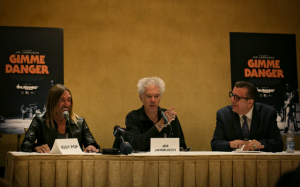
It’s a House of Crouse extra! Here is the raw and unedited audio from a press conference Richard hosted with ‘Gimme Danger” director Jim Jarmusch and his subject, Iggy Pop. By 1973 Iggy and the Stooges had imploded, leaving behind three commercially unsuccessful records and a slug trail of decadence and unfulfilled expectations across two continents. “Gimme Danger” is Jarmusch’s grotty documentary about the life, death and influence of The Stooges. It’s a first hand account of what the director calls “the greatest rock and roll band ever.” Cover photo by Elizabeth Beddall.
Richard’s contribution to the Toronto Star’s 16th Annual Chasing the Buzz poll!
Gimme Danger (Jim Jarmusch): Director Jarmusch attempts to harness the skull-crushing punk rock power of Iggy and the Stooges in a documentary that promises to bring anarchy to the festival. —Richard Crouse, film critic, CTV NewsChannel, film writer, Metro.
Hilly Kristal became known as the Grand Curator of Punk. As the owner of CBGB, the American birthplace of punk rock, he auditioned hundreds of bands and gave groups like The Ramones, Blondie and The Talking Heads their first big breaks. When he liked a band he’d say his now legendary catchphrase, “There’s something there…”
After watching “CBGB,” the Alan Rickman movie based on his life and club, I was reminded of Gertrude Stein’s famous catchphrase, “There is no there there.”
When we first met Hilly (Rickman) he’s a divorced father with two failed clubs to his credit. When he stumbles across a dive bar on New York City’s Bowery he sees an opportunity. Taking over the lease, he befriends the neighborhood’s junkies, bikers and musicians, even if his original idea of presenting country, blue grass and blues (hence the acronym CBGB) gets passed over in favor of underground music by bands like Television and The Ramones.
The club is a hit, but Kristal is a terrible businessman who never pays his rent or liquor distributors. That job falls to his daughter Lisa (“Twilight’s” Ashley Greene) who pays the bills as an endless parade of musicians with names like Iggy Pop (Taylor Hawkins), Joey Ramone (Joel David Moore), Cheetah Chrome (Rupert Grint) and Debbie Harry (Malin Akerman) create a new youth movement on the club’s rickety stage.
Punk rock was a glorious racket, a stripped-down music designed put a bullet in the head of the Flower Power generation. Loud, fast and snotty, the music was ripe with energy and rebellion.
In other words it was everything that “CBGB” is not.
Director Randall Miller gets period details mostly right—the film’s set features artifacts from the punk rock shrine, including the bar, the pay phone, the poster filled walls and the infamously funky toilets—but entirely misses the spirit of the times and the music.
A movie about punk rock should crackle with energy. Despite a rockin’ soundtrack, “CBGB” feels inert. The story focuses on Kristal but Rickman barely registers. The actor reduces the flamboyant character to a morose monotone; a man at the center of a hurricane but who doesn’t feel the breeze.
The impersonations of the musicians are mostly quite good. The surprising stand-out is Rupert Grint as Dead Boys bassist Cheetah Chrome. It’s as un-Harry Potter a performance as you could imagine and he enthusiastically embraces Daniel Radcliffe’s post-Potter habit of showing his bum as often as possible.
Others acquit themselves in suitable snotty fashion, but the recreations mostly made me wish “CBGB” was a documentary and not a feature film. It has interesting tidbits about the time. For instance when Hilly first meets the Ramones he asks if they have any original songs. They say they only have five tunes, four of which have “I Don’t Wanna” in the title while the fifth is called “I Wanna Sniff Some Glue.” It’s a funny story, whether true or not, it hints at the kind of details that may have fleshed out a film that spends far too much time focused on the club and not on the music.
Not that there is a shortage of music, but it feels more “Rock of Ages” than “Raw Power.”
“CBGB” takes an exciting story of an important time and shaves all the rough edges away, leaving behind smoothed over vision of a rough-and-ready time.