SYNOPSIS: Set in 1984, “The Luckiest Man in America,” a new drama now playing in theatres, stars Paul Walter Hauser as Michael Larson, an unemployed ice cream truck driver who was accused of cheating, to the tune of $110,237, by the producers of the game show “Press Your Luck.”
CAST: Paul Walter Hauser, Walton Goggins, Shamier Anderson, Brian Geraghty, Patti Harrison, Haley Bennett, Damian Young, Lilli Kay, James Wolk, Shaunette Renée Wilson, David Rysdahl, Ricky Russert, David Strathairn, Johnny Knoxville, and Maisie Williams. Directed and co-written by Samir Oliveros.
REVIEW: Loosely based on real life events, “The Luckiest Man in America” is a slight story with a kitschy 1980s sheen.
A thriller set against the backdrop of “Press Your Luck,” “the most Vegas game on television,” the action hinges on Paul Walter Hauser and his itchy performance as Michael Larson. “He’s got nerves of steel, this guy,” says showrunner Bill Carruthers (David Strathairn) as Larson’s jackpot grows. Thing is, he’s more desperate than confident. “All I want to do is have breakfast with my family,” he says, “but the only way I can do that is if I’m on the television set. Tune in on the right time, on the right day.”
Show host Peter Tomarken (Walton Goggins) calls Larson “an ordinary man from Ohio,” but there’s more to him than meets the eye. Estranged from his family, Larson figures out how to game the system by memorizing the so-called “random” patterns on the game board. As the prize money grows Larson sees a way out of his financial hole and a way back into his family’s embrace.
But, as the jackpot swells, so do suspicions about his “lucky” streak.
As we learn more about Larson, director Samir Oliveros structures the story as a thriller, carefully doling out info and clues. But Hauser’s character study is the film’s most interesting aspect. Although “The Luckiest Man in America” smooths down some of Larson’s real-life edges, he’s still not particularly likeable. Instead, he’s a delusional dreamer, a guy who has messed up his life and found a far-fetched way to fix things.
Hauser gives him layers. He’s cocky and confident, desperate and determined. Most of all, he’s in over his head. When Carruthers accuses him of memorizing the board, Larson sheepishly replies, “Is that cheating?” He is, as “Press Your Luck” host Tomarken says, “dumbly great,” a guy who stumbles into his fifteen minutes of fame. Hauser embraces Larson’s brokenness, his heartbreak and awkwardness, but adds in a dollop of optimism to add a layer of emotional complexity. He’s a cypher, but an interesting one.
“The Luckiest Man in America” succeeds because of Hauser and the strong supporting cast. Oliveros vividly fashions the flash and trash of the game show set, paying careful attention to the period details, to create a slightly surreal backdrop for this human story of dreams, hope and greed.
SYNOPSIS: Set in France during the Napoleonic Wars, “Widow Clicquot,” now playing in theatres, stars Haley Bennett, as Madame Clicquot, a fiercely independent vintner who spurned convention by continuing to run the fledgling wine business she and her husband nurtured before his death. Steering the company, which still bears her name, through hard times, personally and professionally, she defies critics and revolutionizes the champagne industry. “When they struggle to survive, they become more reliant on their own strength,” says the Widow Clicquot of her grapevines. “They become more of what they were meant to be.”
CAST: Haley Bennett, Tom Sturridge, Sam Riley, Anson Boom, Leo Suter, Ben Miles, Natasha O’Keeffe. Directed by Thomas Napper, from a screenplay by Erin Dignam and Christopher Monger based on the book “The Widow Clicquot” by Tilar J. Mazzeo.
REVIEW: Like the vines she so lovingly cares for, Madame Clicquot’s struggles—against weather, the patriarchy and restrictive Napoleonic trade embargoes—make her stronger. It’s a bit of an overworked metaphor, but screenwriters Dignam and Monger make it work in context to this very specific story.
At the heart of it all is Bennett, who not only highlights Clicquot’s determination and talent, but also the passion it took to stay firm, in the face of adversity, to become a successful female entrepreneur in a male dominated industry. What could have been a one-note performance, all determination, or all grief, is instead, a powerhouse mix of emotion. Passion, for her late husband, their dream and their grapes, drives her, but Bennett plays all the notes on the scale. Her Clicquot contains multitudes, beginning with heartbreak that bubbles up to become triumph by the time the end credits roll.
Handsomely photographed, with fine period details, excepting the English accents favored by the actors playing French roles, “Widow Clicquot” spends a bit too much time on the ins-and-outs of wine making, but, at an economical ninety minutes, it’s a toast-worthy testament to the Grand Dame and her indomitable spirit.
Despite its explosive historical topic, “Till,” now playing in theatres, is a quiet movie, an understated look at how a mother’s grief can change the world.
Set in 1955, the true story (Jalyn Hall) begins in Chicago with 14-year-old Emmett Till (Jalyn Hall) preparing to visit his uncle and cousins in Mississippi. He’s a little kid with a big personality who likes to sing along with Louis Prima records, wear a fedora and act out scenes from horror movies.
His loving mother Mamie Till-Mobley (Danielle Deadwyler) urges him to be careful in the South. “Be small down there,” she says as he boards the train. She has a sense of foreboding that reads in flashes on her face. “He just doesn’t know how different things are down there.”
On August 24 Emmett, called Bo by his family and friends, hangs out with his cousins at Bryant’s Grocery and Meat Market, the local general store. Inside, he buys candy from white shopkeeper Carolyn Bryant (Haley Bennett). Making conversation he says, “You look like a movie star.” Later, outside the store, Emmett playfully wolf-whistles her. As she scrambles for her gun, Emmett and cousins flee, hoping that is the end of Bryant’s racist rage.
The historical record shows what happened next. Young Emmett was kidnapped in the middle of the night from his uncle’s home by Roy Bryant, Carolyn’s 24-year-old husband, and his half-brother J.W. Milam. Taken to another location, the teenager was beaten, shot and hanged before being dumped, unceremoniously in a river, where his bloated body was discovered days later.
In Chicago, when the tragic news arrives, Mamie is thrust into a national conversation on civil rights as Emmett’s killers are placed on trial.
“Till” is a historical period piece that resonates with ripped-from-the-headlines urgency. While true to the timeframe, the story contains all too familiar and current themes. This is the story of Emmett Till and his mother, but it reverberates with the names of George Floyd, Breonna Taylor and many others.
Director Chinonye Chukwu’s movie walks the line between historical record and urgent cry for action, but does so in an elegant film anchored by a remarkable performance. As Mamie, Deadwyler is a mix of love, grief and fury in a performance that vibrates with authenticity.
On her way to becoming a civil rights icon, Mamie withstood not only the loss of her son but also a biased judge who calls Mrs. Bryant “dear” as she prepares to fabricate the story of her interaction with Emmett on the stand, and a Mississippi sheriff who accuses her and the NAACP of staging the entire event. “That boy is still alive somewhere,” he says. In the face of each of these scenarios, and others, Deadwyler is vulnerable and steely but never sentimental in her work.
Stuck between her duty as a mother and the opportunity to use Emmett’s death as a catalyst for change, Mamie uses her grief as a powerful tool and Deadwyler’s resolve is self-evident in every frame of the film.
“Till” is a thoughtful film that showcases Mamie’s humanity and push for change over the inhumane action of Emmett’s murderers. It is a tragedy, but it doesn’t sensationalize events. It mines the real feelings left in the aftermath of the Emmett’s death by way of beautiful, quiet scenes. The solace Mamie feels, for instance, while reading an unfinished letter from her late son, is unforgettable, as is the film.
The story of French army soldiers Cyrano de Bergerac and Christian and the beautiful Roxanne is probably the history’s most case of catfishing. Written as a play in 1897 by Edmond Rostand, the love story of “Cyrano” has been reimagined as a musical by director Joe Wright.
When we first meet Roxanne (Haley Bennett), she is prepping for a date with Duke De Guiche (Ben Mendelsohn). She’s not enthusiastic; she’s holding out for real love, but the family is broke, and as her nanny says, “Children need love. Adults need money.”
What she doesn’t know is that her lifelong friend, King’s Guard swordsman Cyrano (Peter Dinklage), a little person with a larger-than-life personality, has been in love with her since the first time he laid eyes on her. “Even her imperfections are perfect,” he says to his best friend Le Bret (Bashir Salahuddin).
He has never told her—“My fate is to love her from afar,” he says—and may not get the chance to once she gets an eyeful of King’s Guard recruit Christian (Kelvin Harrison Jr) and falls instantly in love.
Trouble is, Christian has no idea how to speak to her. For that, he turns to the brilliant and eloquent Cyrano to be his voice. Cyrano provides the words of love for Christian to woo Roxanne. He pens letters, provides lists of conversational witticisms and even literally provides Christian’s voice in the story’s famous balcony scene. Roxanne is utterly smitten with Christian, thinking he has the body of a warrior and the soul of a poet. “Every day I think can’t love him more,” she says, “then another letter arrives and my heart expands to love him more.”
It’s a bizarre love triangle, one that seems destined to leave Cyrano heartsick and alone.
“Cyrano” is an adaptation of the original Rostand play and the Off-Broadway musical by Bryce and Aaron Dessner of The National, with lyrics by Matt Berninger and Carin Besser. Director Wright dovetails the two expertly, creating a film that pays tribute to its 124-year-old roots and the modern adaptation.
The bones of the story are intact but the presentation feels fresh. Wright is a stylist, creating the 17th century setting in a swirl of camera movement, interesting settings and sumptuous costumes. His trademarked baroque style has been dialed back from the (admitted beautiful) excesses of “Anna Karenina” and “Pan,” but his visions are as memorable as ever. One sequence, where Cyrano dispatches ten adversaries, is a startling bit of uncut camera choreography that will make your eyeballs dance.
The director weaves the music into the dialogue sequences seamlessly, avoiding the abrupt song-and-dance reality-breakers of so many musicals. The actors don’t suddenly start high-stepping either. It’s a more naturalistic approach that focusses attention, for better and for worse, on the emotion of the songs. As much as I liked many of the tunes, the lyrical quality varies, from the eloquent to the elementary.
Dinklage stretches his wings here as the romantic lead, the comedian and warrior. Cyrano is an outsider with a big heart who has resigned himself to being a background player in love. It’s a wonderful performance, made all the more poignant in the film’s closing minutes (NO SPOILERS HERE!).
“Cyrano” is a deeply romantic movie, a musical and a testament to the importance of real human connections, rendered in high style but always with a real, beating heart.
The first time most of us noticed Emily Blunt she was “’on-the-edge of sickness thin.” To play Emily Chalton, the prickly first assistant to the editor in The Devil Wears Prada, Blunt dropped pounds from her already slight frame. “It wasn’t like doughnuts were snatched out of my hand,” laughs the 5’ 7½’’ actress, but she was encouraged to slim down. So much so she would occasionally cry from hunger during the shoot. Luckily, though rake thin, she still had the energy to steal the movie from her more seasoned co-stars, Meryl Streep and Stanley Tucci.
Although the character fell directly into the love-to-hate-her category, audiences found Blunt irresistible. Her mix of vulnerability and fork-tongued charm—crowned by crystal clear blue eyes and a face anchored with a cleft chin that would make Kirk Douglas envious—earned the title Best Female Scene-Stealer from Entertainment Weekly and nominations for everything from a Teen Choice Award to a Golden Globe.
This weekend she plays a much different character in the much-anticipated thriller The Girl on the Train. Based on the Paula Hawkins bestseller—11 million copies sold and counting—it’s a dark cinematic journey into a missing person’s case. The thirty-three year old actress says playing an alcoholic divorcée who witnesses a crime from a train window, “the most challenging thing I’ve ever done.”
Early reviews are strong. Variety raved she “excels as the broken-down heroine.” Those kind of kudos are an echo of her much-admired, though lesser seen work, in the UK.
After dabbling in drama at age 12 to help conquer a stutter she jumped to the small screen with praised performances in British television period pieces. It was, however, only when she left the lace-bonnets behind and took on a role in the critically-acclaimed My Summer of Love that she really made a splash. The story of a teenage infatuation between Mona (Nathalie Press) and the manipulative and cynical Tamsin (Blunt) earned both Press and Blunt equal shares in an Evening Standard British Film Award for Most Promising Newcomer.
Since then we’ve seen her as an oversexed young women opposite Tom Hanks in Charlie Wilson’s War, warbling Stephen Sondheim’s rich Into the Woods score, riding a polar bear in The Huntsman: Winter’s War and dressed as Princess Diana in the quirky rom com Five-Year Engagement.
She’s done action in both Sicario and Edge of Tomorrow (later renamed Live. Die. Repeat. for home release). Big budget blockbusters don’t usually make room for female characters unless they are sidekicks or girlfriends. In Edge of Tomorrow Blunt avoids being objectified and is as strong, if not stronger than co-star Tom Cruise.
In Sicario she’s part of an elite task force stemming the flow of drugs between Mexico and the US. A multifarious mix of vulnerability, stone cold confidence and outrage, she delivered the most interesting female action star since Mad Max: Fury Road’s Imperator Furiosa.
Next up her diverse career is the lead in Mary Poppins Returns. She says she’s nervous because the flying nanny is “such an important character in people’s childhood,” but has been given the thumbs up by the original Mary, Julie Andrews. “It was lovely to get her stamp of approval. That took the edge off it, for sure.”
In recent years we’ve seen Emily Blunt warbling Stephen Sondheim’s rich “Into the Woods” score, riding a polar bear in “The Huntsman: Winter’s War” and dressed as Princess Diana in the quirky rom com “Five-Year Engagement.” She’s done big budget action, sci fi, period dramas and now she adds Hitchcockian thriller to her list of conquered genres.
In the much-anticipated thriller “The Girl on the Train” she is Rachel a woman whose life has taken a downward dive since her divorce from Tom (Justin Theroux). Alcoholic, unemployed and despondent, she obsesses about Tom, Anna (Rebecca Ferguson), his new girlfriend—and former mistress—and their new baby.
To pass the time on her extended Lost Weekend she drinks vodka and rides a commuter train from the suburbs into Manhattan, even though she lost her high paying PR jobs ages before. Sitting in the third car from the front affords her the perfect view of her favourite house. It’s the home of Megan and Scott Hipwell (Haley Bennett and Luke Evans), a good looking couple with a seemingly perfect life to match their optimistic last name. “She’s everything I want to be,” says Rachel of Megan.
One afternoon as Rachel looks out the train window at the Hipwells she is enraged what she sees. A blur of booze later, she wakes up the next day, hungover and foggy, covered in bruises, to discover Megan has gone missing. Brain beating, blocking memories of the night before, she tries to piece together the events of the night before. Enter Mr. Hitchcock.
Based on the Paula Hawkins bestseller—11 million copies sold and counting—“The Girl on the Train” is not so much a psychological drama as much as it is a boozological one. Rachel is hammered for much of the first half of the film, making her an extremely unreliable narrator. What’s true and what’s not? That would involve giving away plot details that are best left unspoiled, but suffice to say that while there are ups and downs, they are more red herrings and misremembered clues filtered through a haze of booze. There are no “Gone Girl” flourishes here, just straightforward thriller elements banged together to point to an inevitable conclusion.
“Girl on the Train” has some elegant moments, and aspires to be an art house thriller/morality tale—no action, lots of internal dialogue—but to properly tell the story of infidelity and murder it should have embraced its down-and-dirty summertime beach reading origins.
Rising above the languid pacing and uneventful storyline is Blunt whose gut-wrenching, vanity-free performance carries the movie through its slow patches. She’s a raw nerve and if the movie had followed her lead and been just a bit more bleary eyed and blotchy, it may have been a more effective thriller.
Why did director Antoine Fuqua decide to remake the legendary 1960 western The Magnificent Seven? “I wanted to see Denzel Washington on a horse,” he jokes.
The story of seven men who come together to protect a town from a vicious robber baron looks back further than the 1960 film to the 1954 epic Japanese historical drama Seven Samurai. Often cited as one of the greatest films ever made, Akira Kurosawa’s Seven Samurai provided what Fuqua described as the DNA of his film, but he also noted, “Westerns change with the time we’re in, so we made our film based on the world we are living in.”
To that end he has assembled the most diverse cast for a western ever. In addition to top billed stars Washington, Chris Pratt, Ethan Hawke and Vincent D’Onofrio the seven magnificent leading actors include South Korean star Lee Byung-hun, the Mexican born Manuel Garcia-Rulfo and Martin Sensmeier, an American actor of Tlingit, Koyukon-Athabascan and Irish descent.
“You can’t do the same thing every era,” says Fuqua. “Westerns change all the time. If we were sticking to just one way of doing something then all westerns would be all white guys looking like John Wayne in a John Ford movie.”
“My idea was, if Denzel walks into a room, the room stops,” he says. “If Clint Eastwood walks into a room, the room stops. Is it because he’s a gunslinger or is it because of the colour of his skin? We’ll let the audience decide.”
When asked if The Magnificent Seven is proof that Hollywood is becoming more diverse the director says, “You have to give the studio credit when they do something like this. This becomes the new definition of what a western is.”
Chris Pratt, who plays gunslinger Josh Faraday says despite the film’s title The Magnificent Seven has more to do with another well known western.
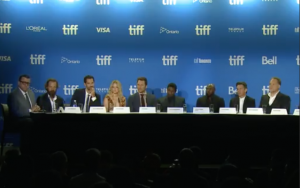
“I don’t know how many movies there are in the world,” he said at the TIFF opening night press conference. “What would you guess, several hundred thousand? Millions? Eventually you just run out of names. If I have a son and name him Chad, is he a remake of somebody else who was named Chad? No. We could have called this The Cowboys or something, but [The Magnificent Seven title] has reach,” he continued, “it gets people engaged. But [this movie] is probably more Wild Bunch than it is [1960’s] The Magnificent Seven. We use the title, we use the story. It’s a bunch of guys. There are seven of us. And we’re all [bleeping] magnificent. We’ve got that going for us, but let that movie be that movie. This is a different movie.”
Star Denzel Washington says he’s never seen the 1960 film. “I didn’t keep away from it,” he says. “I just didn’t know how it would help me. I had never seen it as a kid or whatever. People say, ‘You’re the so and so character,’ I don’t even know who that is. I think it allowed me to do whatever I wanted to do instead of trying to not do what someone else did.”
Why did he sign on? “Well, Antoine asked me. It’s as simple as that. Obviously, it’s a good story and a good script but most importantly it was Antoine.”
Director Antoine Fuqua’s remake of “The Magnificent Seven” literally starts with a bang.
A series of mine explosions echo through Rose Creek, signalling unrest in the tiny mining town. Bartholomew Bogue (Peter Sarsgaard) has taken over, terrorizing the town with hired goons. He’s a cruel man who guns down citizens and says to his henchmen, “Leave the bodies where they lie. Let them look at them for a few days.” Bad Bart wants the land but is only will to pay a pittance per parcel. “Those of you who signed the deeds will get your $20,” he sneers. “And those who don’t, God help you.”
The townsfolk are helpless. Bogue has killed a half dozen men and with the sheriff on his payroll will continue to do as he pleases. Fed up and recently widowed, Emma Cullen (Haley Bennett) turns to hired gun Sam Chisolm (Denzel Washington) for help. “You don’t need a bounty hunter,” he says, “you need an army.” Despite the massive odds against them Chisolm assembles a rag tag team of killers, gamblers and outlaws—Josh Farraday (Chris Pratt), Goodnight Robicheaux (Ethan Hawke), Jack Horne (Vincent D’Onofrio), Billy Rocks (Byung-hun Lee), Vasquez (Manuel Garcia-Rulfo), and Red Harvest (Martin Sensmeier)—to go up against the ruthless robber baron in what promises to be a better than OK gunfight at the corral.
“The Magnificent Seven” is a classic looking western with a modern pace. Fuqua chooses not to mess with the key oater elements. He papers the screen with acres of open land, seven tough men, one or two resilient women and a sea of cowboy hats. He is respectful to the form and doesn’t try to bring the genre into the twenty-first century with frenetic editing—I’m looking at you Timur “Ben-Hur” Bekmambetov—or contemporary language. It’s a western, with all that entails; good vs. evil with some moral ambiguity thrown in for good measure.
Also thrown in for good measure is a heap of star power. Washington is a cool character, quietly deadly. He says cool stuff—“Chisolm, should I know that name?” he’s asked. “You should know it from your obituary,” he replies.—and is the movie’s charismatic center. Chris Pratt’s easy charm gives Washington a run for his money, but this is really Denzel’s movie from top to bottom.
Hawke and D’Onofrio do interesting character work. As the shell-shocked Robicheaux Hawke is equal parts swagger and skittishness while D’Onofrio is practically unrecognizable as the squeaky-voiced Jack Horne.
The remaining member of the seven aren’t given much to do other than pull triggers and nod in agreement to Chisolm’s plans, but they are an interesting bunch nonetheless.
At a little over two hours “The Magnificent Seven” could be leaner and well, maybe not meaner—I would not be surprised if it had the highest body count in a western ever—but tighter. There is a mid-movie sag as the plans for the final shootout are being finalized but the ballet of bullets at the end is epic, if not a little excessive, putting a fitting cap on a story that is slight but entertaining for most of the running time.
Richard hosts the “Magnificent Seven” TIFF press conference with (from left to right) Richard, Peter Sarsgaard, Manuel Garcia-Rulfo, Haley Bennett, Chris Pratt, Denzel Washington, Antoine Fuqua, Ethan Hawke, Vincent D’Onofrio, Lee Byung-hun and Martin Sensmeier.