What is it with Mexicans and death?” asks a youngster in the new kid flick from producer Guillermo Del Toro.
It’s a legit question in light of the content of a film that takes place in and around the Day of the Dead, a national bank holiday in Mexico. “Is that National Zombie Day?” asks the same kid.
No it isn’t. Instead its refreshingly dark but delightful story based on folklore with sumptuous visuals and good messages about family, fate and gender dynamics.
The story begins with a bet between spirits La Muerte (Kate del Castillo) and Xibalba (Ron Perlman) on who will win the heart of the beautiful Maria (Zoe Saldana), warrior Joaquin (Channing Tatum) or bullfighting musician Manolo (Diego Luna). The stakes are high. If she marries Joaquin the devious Xibalba will rule in the Land of the Remembered, while La Muerte will be banished to the Land of the Forgotten. As part of a double cross Manolo is plunged into the underworld, only to have to fight his way back to his hometown and the woman he loves.
“Finding Nemo” and “Bambi” aside, mortality is not a big topic in children’s movies. “Book of Life,” however, embraces it; weaving an entrancing story that toggles back-and-forth between the land of the living and dead. It celebrates the vibrancy of the Day of the Dead celebrations, complete with skeletons in dazzlingly costumes and a character with a disembodied head. “The Walking Dead” this ain’t.
For some children the demonic bulls and Xibalba’s grandly goth appearance might be the stuff of nightmares, but the fanciful creations are for the most part kid friendly in a “Nightmare Before Christmas” kind of way.
For parents the scariest thing about the movie may be the appropriation of songs by Mumford & Sons and Radiohead for a kid’s movie.
Director Jorge R. Gutierrez updates traditional mythology with modern storytelling, making sure that the movie moves along at the speed of light. It occasionally feels a bit too jam-packed, with a noisy finale that isn’t nearly as interesting or inventive as the unconventional stuff that came before it, but the pandering to predictability in the final moments doesn’t diminish “Book of Life’s” impact as a beautifully crafted fantasy.
1. Admission: Tina Fey is Portia Nathan, a mildly compulsive Princeton admissions officer—they jokingly call her their “golden retriever” because of her record of recruiting a-plus students—who leads a quiet, ordered life with professor Mark (Michael Sheen). They share a love of poetry, hatred of kids and not much else. Her well ordered life is thrown into disarray when John Pressman (Rudd), a free-spirited former classmate and now teacher at an alternative school, introduces her to Jeremiah Balakian (Nat Wolff), a brilliant young man who may be the child she gave up for adoption seventeen years ago. “Admission” is familiar enough to not jar the sensibilities of undemanding rom com fans, but there is more here than immediately meets the eye.
2. The Bling Ring: Based on actual events, “The Bling Ring” centers around a group of narcissistic Los Angeles area teenagers, Rebecca (Katie Chang), Marc (Israel Broussard), Nicki (Emma Watson), Sam (Taissa Fermiga) and Chloe (Claire Julien).
Their modus operandi? They track the comings and goings of their favorite celebs on via internet. While one-named millennial stars like Paris, Lindsay, Megan or Audrina are out on the town or out of town completely, the Ring “go shopping,” breaking into their homes and help themselves to jewels, designer clothes and loose cash. More than that, they live vicariously through the lives of the rich and famous folks they’re burgling.
“The Bling Ring” plays like a “Law & Order” episode of “The Hills.” The crime spree is device that keeps the story moving forward, but the fascinating thing is the portrait of these self-absorbed kids who aspire to hosting reality shows or becoming a “lifestyle brand” as a career. They want fame and money, but are so tied up with the idea of fame and money they are blind to virtually everything else.
“The Bling Ring” is a fascinating art-house glimpse of fame found, just not the fame the thieving teens sought. They are the robbers TMZ made famous, a group of kids who redefined narcissism in an already narcissistic town.
3. The East: Britt Marling stars as corporate spy Jane Owen, code name Sarah. Her latest job involves going deep undercover to infiltrate a shadowy group of eco-terrorists called The East. The collective—think real life activists Anonymous—run by the charismatic anarchist Benji (Alexander Skarsgård), is on the eve of their biggest demonstration yet, an act of sabotage that will make headlines and make a very public statement of their anti-corporate stance.
Sarah is accepted by the group, save for the truculent Izzy (Ellen Page), and begins to develop Stockholm syndrome. Or does she?
It’s a morally complex movie, with Sarah at the center of the ethical hurricane as she starts to question her role as both a spy and a would-be member of the radical group. She weighs the morality of both sides and… well, go see the movie.
“The East” deliberately paints shades of grey into the story, allowing for good and bad, evil and sympathetic characters on both sides. It may be too nuanced for folks who like their spy stories to take sides, but Sarah, as the source of the plot’s push-and-pull, is too complex a creation to play it straight. Marling brings strength and fighting spirit to Sarah in a performance that could finally make her a star.
4. The Iceman: Based on “The Iceman: The True Story of a Cold-Blooded Killer” by crime writer Anthony Bruno the movie begins on Kuklinski’s first date with his wife to be Deborah (Winona Ryder). He’s quiet and reserved, but charming and she is won over by his charisma. They marry, have kids and lead a normal life. At least at home. Deborah had no idea her mild mannered husband was an expert assassin, who paid for the kid’s private school and her jewels by slicing throats, shooting and choking the enemies of his boss Roy DeMeo (Ray Liotta).
Kuklinski was dubbed the Iceman for two reasons. When he was arrested police found a stash of bodies he had frozen to obscure time of death and because of his icy demeanor. It’s a role Shannon was born to play. From certain angles he looks like an everyman, the kind of guy who goes home at night to his wife and two kids. From other angles he’s menacing, the kind of guy you don’t want to meet in a dark alley.
Shannon is cooler than Mr. Freeze as the title character in “The Iceman,” and he’s joined by Chris Evans in a career making performance as a ice cream truck driving killer, Liotta in mobster mode—between Shannon and Liotta it’s a showdown of the steely stares—the welcome return of Wynonna Ryder and David Schwimmer playing against type as a slimy mafia enforcer.
5. The Last Stand: Near the beginning of the movie the head lawman of the sleepy border town of Summerton Junction, Sheriff Ray Owens (Arnold Schwarzenegger), says, “Should be a quiet weekend.” Of course whenever Arnold, or any eighties action star says, “Should be a quiet weekend,” you know all hell is about to break loose. And break loose it does.
In a parallel story ruthless drug lord Gabriel Cortez (Eduardo Noriega) stages an elaborate escape and heads for the Mexican border, which just happens to lie outside Arnold’s… er… Owens’s town. As Cortez speeds toward the border he has a quick cell phone call with Owens. “Do you wanna play?,” he yells. “Let’s play!” And play they do… with big guns.
Schwarzenegger is moving noticeably slower these days—How are you Sheriff? “Old,” he says.—but his comic timing is still there and no one else can battle through this kind of cheesefest and emerge with his action cred intact.
“The Last Stand” is not a movie to be taken seriously, but it wasn’t made to be taken seriously. Why else would cult director Jee-woon Kim cast Johnny Knoxville?
6. The Lone Ranger: Set against a backdrop of corruption during the building of the railway’s westward expansion through Native American territory, this is the origin story of how attorney John Reid (Armie Hammer), a law and order man who doesn’t believe in vengeance, met Tonto (Johnny Depp) and became the Wild West’s masked crusader.
The unlikely pair are brought together by their mutual enmity toward Butch Cavendish (William Fichtner), a cannibalistic outlaw who Reid wants to bring to justice and Tonto wants dead. That pursuit uncovers massive corruption during the building of the railway’s westward expansion through Native American territory beginning with a conspiracy to start a war between the US Calvary and the Comanche Nation.
“The Lone Ranger” is state of the art nouveau Western, complete with circling vultures, unspoiled landscapes, gruff, unshaven men and even a beer drinking horse. Surprisingly nimble footed for a two-and-a-half hour epic, it is unexpectedly funny but more violent than your typical summer tent pole flick.
7. Pacific Rim: Director Guillermo Del Toro has made an end-of-the-world scenario fun.
In the world he creates in “Pacific Rim” the planet is threatened with destruction by Kaijus, colossal beasts with an appetite for destruction. Coming to our world through a breach in a portal beneath the Pacific Ocean, the earth is losing the war against these beasts. The main of line of defense, giant robots called Jaegers—operated by pilots who mind meld with the metal behemoths; the deeper the connection, the better they fight—are being decommissioned in favor of a giant wall. “Kaijus are evolving,” says one military man, “and we’re losing Jaegers faster than we can build them.”
In the months before the machines are made obsolete a driven colonel, Stacker Pentecost (Idris Alba), assembles a crack team of Jaeger pilots—including burned out former pilot Raleigh Becket (Charlie “Sons of Anarchy” Hunnam) and talented but untested trainee Mako Mori (Rinko Kikuchi) to launch one last attack to close the portal and save the planet.
Del Toro has supersized a Godzilla story, adding in 50s b-movie tropes with state of the art sci fi to create something fresh. It’s a thrill ride from the beginning, a giant action movie that doesn’t just rely on a cool premise.
In other words, “Battleship” this ain’t.
8. Pain and Gain: Near the beginning a voiceover says, “Unfortunately, this is based on a true story.” It’s the real-life tale of three Miami-based body builders (Mark Wahlberg, Dwayne Johnson, and Anthony Mackie) chasing the American Dream. Pumped up and steroid crazy they abduct a prominent local businessman (Tony Shalhoub). They beat and torture the self-made millionaire until he signs over all his wealth—houses, cars, boats and money. The story eventually becomes so outlandish Bay flashes up a graphic in the last half hour reminding us that this is “still a true story.”
This is a seriously weird movie. It’s Bay working with a tiny—for him—budget of just $26 million. The guy has made commercials that cost more than that, but has delivered the darkest comedy—imagine if the Coen Brothers did gruesome slapstick—to come down the pike in a while.
9. Rush: When we first meet Niki Lauda (Daniel Brühl) and James Hunt (Chris Hemsworth) they are third stringers, talented Formula 3 drivers desperate for a chance to move up to the big show. Lauda makes a financial deal that lands him on Team Ferrari while Hunt uses tenacity, charm and a touch of desperation to grab a spot with the McLaren team.
Bad blood flows between the two, stemming back to an incident when Hunt edged Lauda off the track the first time they faced off against one another. That rivalry spills over from the track as the two engage in name-calling and spar in the press.
In the 1976 season Lauda seems unstoppable, a sure bet to reclaim his World Champion title. Then tragedy strikes as Lauda is badly burned in a fiery crash. During his recuperation Hunt rises in the ranks, leading to a showdown, just 50 days after Lauda’s accident, for the World Championship at the Japan Grand Prix.
“Rush” is more than “Rocky” on four wheels, it’s an exhilarating, stylish film with pedal-to-the-metal verve.
10. The Sapphires: The year is 1968. Dave Lovelace is an English (Chris O’Dowd) piano player with a love for Otis Redding and booze. While hosting a talent show in remote Australia hosting he discovers three sisters, Cynthia (Miranda Tapsekll), Gail (Deborah Mailman), Julie (Jessica Mauboy), with amazing voices but a tired country and western style repertoire. Adding cousin Kay (Shari Sebbens) as background singer and dance captain, he molds them into the Australian Supremes and gets them their first gigs—in Vietnam singing for the troops.
“The Sapphires” is a feel good movie that succeeds despite the cliché story. It’s based—one imagines very loosely based—on a true story, but make no mistake, this is a Hollywood-ized (filtered through an Australian sensibility) version of the tale.
Authenticity aside, it’s the performances and the music that make “The Sapphires” worth a look. We first noticed O’Dowd on this side of the Atlantic as the charming love interest in “Bridesmaids.” He brings it again in “The Sapphires,” mixing roguish appeal with bang on comic timing.
“The Sapphires” is a slight, but entertaining take on the effect of music to change people’s lives.
11. The To Do List: High school valedictorian Brandy Klark (Aubrey Plaza) is an overachiever. She’s the publisher of her own magazine, Women With a Y, a straight A student with a full scholarship to Georgetown University and has a Perfect Attendance certificate proudly hanging on her wall.
She’s also a virgin, a status she hopes to change soon with the help of Rusty Waters (Scott Porter), a college surfer stud with a perfect smile. Attacking her new project with the gusto that won her accolades in school, she gets the advice of friends and family (Christopher Mintz-Plasse, Alia Shawkat, Sarah Steele and Rachel Bilson) and makes up a “to do” list, applying the same zeal that made her a mathlete to losing her virginity.
Telling the story from a female point of view is a nice turnaround from the usual boycentric sex comedy story.
“The To Do List” is endearingly off-kilter, a different take on the “Porky’s” style of sexual coming-of-age stories usually that are usually headlined by the male members of the cast. I wish it was a bit shorter—did they really need 100 minutes to tell this story?—and a bit funnier, but for anyone who came of age just as The New Kids on the Block were calling it quits (for the first time) there is much to enjoy here.
12. Warm Bodies: Nicholas Hoult plays R (pronounced “arrgghhgghh”), an existential zombie who wants more out of life… or death, or whatever it is you call his current state. “Why can’t I connect with people?” he wonders in the narration. “Why is my posture so bad? Of yeah, I’m dead.” There’s been a plague of some sort which has left him and most of the population hungry for brains, while the sole human survivors live behind a giant wall.
Zombies and humans alike are terrified of the Bonies—evolved zombies who’ll eat anything with a heartbeat. “So will I,” says R, “but at least I’m conflicted about it.”
On a feeding trip R encounters a team of humans on the search for supplies. One zombie attack later he has eaten the brains of Perry (Dave Franco). When he gets a glimpse of Perry’s girlfriend Julie (Teresa Palmer) he loses his appetite. Perry’s memories come flooding into R’s zombie brain and he begins to feel something he hasn’t felt for a long time—human emotions.
It’s “Walking Dead” meets “Romeo and Juliet” with a twist—it just might be that love and hope can still set hearts a flutter, even ones that haven’t beaten in a while.
Any movie with the line, “I know it’s really hard to meet guys now… in the apocalypse and everything,” is OK by me.
13. You’re Next: On the occasion of their parents 35th wedding anniversary the Davidson kids and assorted wives, girl and boy friends gather at a remote Tudor mansion—is there any other type in these kinds of movies?—to enjoy dinner and one another, but instead end up in a fight for their lives. Only one of the guests, Erin (Sharni Vinson), has the know-how to protect herself, but will it be enough?
It’s hard to discuss “You’re Next,” which had its world premiere at the 2011 Toronto International Film Festival Midnight Madness program, without giving away a major plot twist, but I will say there is a Manson Family aspect to the story that really creeped me out. That plus the anxiety-inducing John Carpenter style score throbbing in the background and the “moist” sound effects accompanying the wet work. It’s all effective but it is the idea behind the movie that is truly disturbing.
There is a rawness to the filmmaking—and let’s just say that there are no future Meryl Streeps in the cast—that although there is very little actual gore, is chilling.
I don’t know what it says about my mental make-up, but I really liked “You’re Next.” It’s disturbing, violent and without any redeeming social value, but I enjoyed sitting in the theatre with my hands over my eyes, afraid of what I might see next. I’m not usually a fan of head trauma, but from what I saw as I peeked through my fingers, it works well.
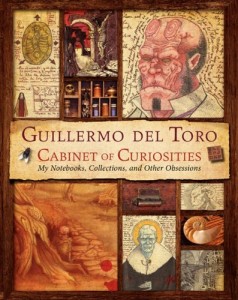
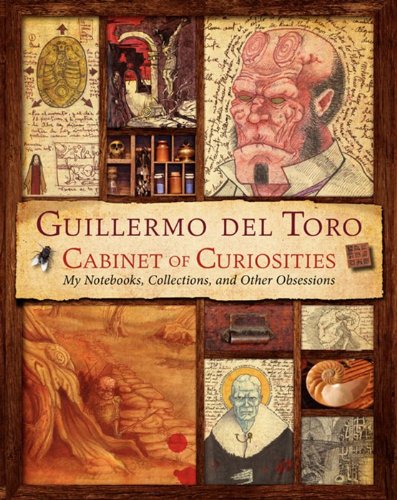
Have a curious and curiouser Christmas with a copy of “Cabinet of Curiosities,” a new book from director Guillermo Del Toro.
From amazon.ca: Over the last two decades, writer-director Guillermo del Toro has mapped out a territory in the popular imagination that is uniquely his own, astonishing audiences with Cronos,Hellboy, Pan’s Labyrinth, and a host of other films and creative endeavors. Now, for the first time, del Toro reveals the inspirations behind his signature artistic motifs, sharing the contents of his personal notebooks, collections, and other obsessions. The result is a startling, intimate glimpse into the life and mind of one of the world’s most creative visionaries. Complete with running commentary, interview text, and annotations that contextualize the ample visual material, this deluxe compendium is every bit as inspired as del Toro is himself.
Contains a foreword by James Cameron, an afterword by Tom Cruise, and contributions from other luminaries, including Neil Gaiman and John Landis, among others.
Why not celebrate the big day a few days early with the gift of tickets to a unique and one time only event featuring the films of Studio Ghibli AND commentary from the one and only Guillermo Del Toro!
Here’s some info from TIFF:
Following its spectacularly popular run in the spring of 2012, Spirited Away: The Films of Studio Ghibli returns from December 13, 2013 to January 3, 2014 to delight new and familiar audiences. This dazzling 18-film showcase, including a blend of new 35mm prints and digital presentations in both subtitled and dubbed versions, pays homage to the legendary animation studio whose trademark visual style, deeply felt humanism and powerful storytelling has made them “the Disney of Japan.” TIFF is honoured to finally feature the rarely-screened masterpiece Grave of the Fireflies (1988), one of Ghibli’s supreme accomplishments and regarded by many as the greatest animated film of all time. Other highlights include beloved classics such as My Neighbor Totoro (1988), Princess Mononoke (1997) and Kiki’s Delivery Service (1989); the rarely seen titles Only Yesterday (1991) and The Ocean Waves (1993); and Hayao Miyazaki’s Academy Award®–winning Spirited Away (2001). To kick off the series, celebrated director Guillermo del Toro leads a Master Class session on December 12 with an extended introduction and post-screening discussion of Castle in the Sky (1986). The Master Class is currently off sale, however a limited number of tickets may be available to the rush line 10 minutes before the start of the screening on a first come first served basis.
What did Guillermo Del Toro say after reading “Raising Hell: Ken Russell and the Unmaking of The Devils”? Well, let me tell you…
“An exhaustive, vivd and passionate account of one of the most powerful and transgressive films ever made. This is not only a great book, it’s a necessary book.”
What did Guillermo Del Toro say after reading “Raising Hell: Ken Russell and the Unmaking of The Devils”? Well, let me tell you…
“An exhaustive, vivd and passionate account of one of the most powerful and transgressive films ever made. This is not only a great book, it’s a necessary book.”
In the hands of anyone but director Guillermo Del Toro Hellboy could have turned out to be just another cinematic superhero. Thankfully Michael Bay and his soulless Hollywood brethren didn’t get their hands on the story of a little demon baby from the dark side who grows up to be a Baby Ruth-loving warrior battling the forces of hell.
Del Toro, the visionary behind a string of beautifully realized fantasy and horror films, including the Oscar nominated Pan’s Labyrinth, first brought Hellboy to the screen four years ago in a film that played up the horror aspects of the character’s comic book roots. This time around he plays on a bigger canvas, adding elements of fantasy and not one, but two love stories.
The action in Hellboy II: The Golden Army begins when an ancient truce between humans and the citizens of the underworld is broken by the ruthless Prince Nuada (Luke Goss) and an array of mythical creatures. “Let this remind you why you once feared the dark,” he says as the quest to reclaim all three pieces of a magical crown that will reunite the mighty Golden Army begins. That’s where Hellboy (Ron Perlman) and his colleagues at the Bureau for Paranormal Research and Defense come in. Comprised of Hellboy’s pyrokinetic girlfriend Liz Sherman (Selma Blair), aquatic empath Abe Sapien (Doug Jones), and ectoplasmic mystic Johann Krauss (James Dodd), the BPRD are the only government agency who have a chance against the evil netherworld soldiers.
Complicating matters is a PR problem—the public doesn’t take well to the irresponsible knucklehead Hellboy, with his red skin and horns—and matters of the heart as Abe discovers unexpected love in the elf princess Nuala (Anna Walton) and Liz’s relationship with Big Red hits a rough patch.
Hellboy II: The Golden Army is one of the rare sequels that is better than the original film. Working with a bigger budget this time around Del Toro has the money to fully realize his vision for the film; and what visions they are. He’s opened up his fertile imagination to create some unforgettable images like a Troll Market underneath the Brooklyn Bridge that rivals the famous Star Wars cantina scene, a new ectoplasmic character and a myriad of strange and wonderful creatures from the underworld.
These stunning images will make your eyeballs dance, but the amazing thing about Hellboy II: The Golden Army isn’t Del Toro’s astonishing visual sense, or his equally impressive way of choreographing large action scenes like the battle between Big Red and a vine creature on the streets of New York. No, it is his ability to balance the two with a really compelling story and not allow his characters to get lost in the din.
Despite setting the film in a fantastic world where mystical creatures interact with humans Del Toro doesn’t skimp on characterization, wit or believable (and in some cases heartbreaking) relationships. Abe Sapien’s amphibian love for a princess he can never have could easily have fallen flat, but Del Toro and actor Doug Jones give Abe enough humanity that even though he’s basically a giant fish with ESP the audience still feels for him when his heart is broken. The kicker comes when he gets drunk and sings Barry Manilow’s Can’t Smile Without You. Who among us hasn’t done that at least once?
At the center of it all is Ron Perlman in the title role. Perfectly cast, he plays the character as an everyman with an attitude to create one of the most fun and entertaining superheroes to come along in a movie summer chock full of beings with extraordinary powers.
Mothers in movies are often portrayed as warm, loving nurturers, unless the movie is produced by horror meister Guillermo Del Toro. In “Mama,” a new supernatural thriller starring Jessica Chastain, the title character is a vengeful spirit, more Mommie Dearest than Mother Goose.
“Mama” begins with the meltdown of a businessman who kills his partners, his ex-wife and kidnaps his two small kids, Victoria (Megan Charpentier) and Lily (Isabelle Nélisse) Desange, (rhymes with derange), taking them to a remote cabin in the woods. The first clue that something ghostly is going on comes when little Victoria says, “Daddy, there’s a woman outside and she’s not touching the floor!”
Soon Dada is out of the picture and the girls are presumed missing by everyone except their Uncle Luke (Nikolaj Coster-Waldau) who spends five years searching for them. When they’re found they’re worse for wear—feral kids who have survived with the help of a supernatural nanny they call Mama. Uncle Luke and Aunt Annabelle (Chastain) try to give them a normal life, but Mama is still a nightmare.
The people you expect in this kind of movie—the expert, the meddler, the spooky record clerk who knows more about the supernatural than the average person (“A ghost is an emotion bent out of shape… looking to right a wrong.”)—are all present and they do the things people do in these kinds of movies—explore remote haunted places at night with only a flashlight for protection, and stare creepily into space.
So no surprises there, but “Mama” does have some nice subtle creepy reveals—all is not what it appears to be—a vivid dream sequence and, of course, the ethereal Mama, who occasionally resembles a giant hairball on the floor, but is eerie nonetheless.
“Mama” is spooky rather than scary, but has appropriately creepy kids—the little one even scurries around the floor on all fours like a tiny silverback gorilla—and enough jolts to earn a recommend.
We generally think of fairy tales as the domain of young people—sweet fables to send the kids off to sleep, or feed their imaginations during their waking hours. Mexican director Guillermo del Toro, however, has a more old school approach. His most recent film harkens back to the pre-politically correct days when Grimm’s fairy tales emphasized the “grim” part. In Pan’s Labyrinth he skilfully weaves a dark adult fairy tale set against the backdrop of the Second World War, creating a fairy tale that will likely keep the kids up at night, terrified rather than soothed.
Del Toro uses parallel worlds to tell the tale. In the mortal world it is 1944 Spain just after Franco’s fascists have taken over the country. In this cold, cruel and violent place a young girl, the soon-to-be-stepdaughter of a sadistic fascist general, escapes into a fantastic world populated by a pasty white creature known as The Pale Man and a half-man, half-goat Pan. The horned creature tells her she is a lost princess, and the only way to return to her underground kingdom is by completing three difficult tasks. Her harsh fantasy becomes a harsh reality when she is forced to endure the dire truths of her dual worlds.
The word masterpiece is thrown around rather casually these days, but in this case I think it applies. Pan’s Labyrinth is a beautifully realized film that vividly paints both worlds using broad strokes of beauty and dread. Del Toro’s vision of fascist Spain is uncompromising. Violence lurks around every corner and death can come in cruel and unexpected ways. When young Ofelia disappears down the rabbit hole she doesn’t find a world of comfort, but a place fraught with danger, almost as perilous as the “real” world she is running from. Del Toro effortlessly intertwines these realities, creating one whole that is emotionally complex and as satisfying as the age-old fairy tales that inspired it.
The fantastic new two disc DVD release includes a prologue and commentary track from del Toro, featurettes about the making of the film, storyboards, and interviews with the cast and crew.