There are many types of movies about people who deal in death to make a living. There’s the cold-blooded killer story, the revenge drama and even comedic takes on killing for fun and profit. Assassins can be men, women, children and even robots.
In this weekend’s American Assassin Michael Keaton is the teacher, a Cold War veteran who trains undercover executioners. He teaches counter-terrorism operative Mitch Rapp, played by Dylan O’Brien, the ropes of the killing game.
A quick look back at decades of death merchant movies reveals a set of rules and philosophies assassins will always follow.
When we first met John Wick he resembles the Sad Keanu meme. He’s a broken hearted man whose wife has recently passed away. He’s a loner until a package arrives at his door. It’s a puppy, sent by his wife just before she died, in the hopes that the dog’s love will help ease his pain. For a time it works, but when some very bad men break into his house to steal his Mustang, the dog winds up as collateral damage. With the last living touchstone to his late wife gone, Wick reverts back to his old ways as a mad, bad and dangerous to know assassin bent on revenge. We learn that you can quit, but you’ll always get pulled back in.
“People keep asking if I’m back and I haven’t really had an answer,” says Wick. “But now, yeah, I’m thinkin’ I’m back. So you can either hand over your son or you can die screaming alongside him!“
Charles Bronson, as the skilled slayer in The Mechanic teaches his young protégé, played by Jan-Michael Vincent, some basic hitman lessons. “Murder is only killing without a license,” he says, adding that when you shoot someone do it right. “You always have to be dead sure. Dead sure or dead.”
That’s key killer advice, but slow down, there is a progression to becoming a hitman.
In The Professional Leon (Jean Reno) details the system. “The rifle is the first weapon you learn how to use,” he says, “because it lets you keep your distance from the client. The closer you get to being a pro, the closer you can get to the client. The knife, for example, is the last thing you learn.”
Along the way movie assassins also learn that relationships are verboten.
Remember what happened to Mr. and Mrs. Smith (Brad Pitt and Angelina Jolie)? “Your aim’s as bad as your cooking sweetheart,” taunts John to Jane, “and that’s saying something!”
Day of the Jackal’s would-be Charles de Gaulle assassin (Edward Fox) adds, “In this work you simply can’t afford to be emotional,” although sometimes feelings inevitably get in the way. Just ask Prizzi’s Honor’s Charley Partanna (Jack Nicholson) who memorably said, “Do I ice her? Do I marry her?”
Once they’ve learned the ropes, one question remains: Why do movie assassins kill?
Max Von Sydow plays one of the great movie killers in Three Days of the Condor, Sydney Lumet’s classic story of conspiracies and murder. His reasoning for doing what he does is chillingly simple. “The fact is, what I do is not a bad occupation,” he says. “Someone is always willing to pay.” The Matador’s Julian Noble (Pierce Brosnan) agrees, “My business is my pleasure,” he said.
Your interest in seeing “mother!,” the new psychological thriller from “Black Swan” director Darren Aronofsky, may be judged on your keenness to watch American sweetheart Jenifer Lawrence flush a beating heart down a toilet. Doesn’t appeal? Perhaps get your pulse racing with “It” instead. If it does, read on.
Lawrence and Javier Bardem are “mother” and “him,” a May-December married couple living in a remote and rambling countryside Victorian mansion. It’s a house with a history. Partially destroyed by a fire—which also claimed him’s first wife—the place has memories. Him, a poet, has been blocked ever since the fire, but finds solace in one of the few things to survive the blaze, a crystal that he now displays in his home office. Despite mother’s efforts to make the house a home—“I want to make a paradise,” she says.—a pall hangs over her wannabe Eden.
The weird factor amps up when a man (Ed Harris) shows and is invited by him to stay the night. He’s oddly antagonistic and inappropriate—“Your wife? I thought it was your daughter!”—but him treats him well, like a long lost friend. She feels like a third wheel in her own home.
The next day the stranger’s wife (Michelle Pfeiffer) arrives, making herself at home. She asks unusual, probing questions—“Why don’t you want to have kids? I have kids. That is what’s gonna keep your marriage is growing.”—and likes to booze it up during the day. Mother, unable to understand the new guests or her husband’s behaviour toward them, is further alienated when their aggressive, argumentative sons (real life siblings Brian and Domhnall Gleeson) show up. It begins to feel like a home invasion rather than a visit.
Paranoia grows as Mother becomes pregnant and a celebratory dinner turns to violence and murder. That’s not a spoiler. ‘mother!” is so bonkers mere words on a page can barely do it justice. Is that my failing or the film’s?
Aronofsky makes movies that refuse to cater to audience expectations. “mother!” is an uncomfortable watch, an off-kilter experience that revels in its own madness. As the weight of the weirdness and religious symbolism begins to feel crushing, you may wonder what the hell is going on. Are these people guilty of being the worst houseguests ever or is there something bigger, something biblical going on?
Aronofsky is generous with the biblical allusions—the house is a paradise, the sons are clearly echoes of Cain and Abel, and there is a long sequence that can only be described as the Home-style Revelation—and builds toward a crescendo of wild action that has to be seen to be believed, but his characters are ciphers. Charismatic and appealing to a member, they feel like puppets in the director’s apocalyptic roadshow rather than characters we care about. Visually and thematically he doesn’t push button so much as he pokes the audience daring them to take the trip with him, it’s just too bad we didn’t have better company for the journey.
“mother!” is a deliberately opaque movie. Like looking into a self-reflective mirror you will take away whatever you put into it. The only thing sure about it is that it is most confounding studio movie of the year.
“Run All Night” plays like an alternate universe “Taken” set in a world where a killer played by Liam Neeson actually feels remorse for all the havoc he has created.
Once again Neeson is a father who will do almost anything to protect his family, including using his very special set of skills, but the situation is very different from the ones that saw him traverse the globe as kick-ass dad Bryan Mills.
In “Run All Night” he plays Jimmy Conlon, a hitman for the Irish mob. His boss is his childhood friend—his only friend, in fact—kingpin Shawn Maguire (Ed Harris). They have a bond forged by decades of having one another’s backs. The pair are like brothers, until a disagreement between their sons (Boyd Holbrook and Joel Kinnaman) spirals out of control the two best friends become mortal enemies.
Action man du jour Neeson goes mano a mano with Ed Harris and faster than you can say, “Tell everyone to get ready, Jimmy’s coming,” he goes then mano a mano a mano a mano a mano a mano against everyone else in an exhibition of extreme, grunting manliness. Jimmy is a man who has done some very bad things, and continues to, using a very particular set of skills to nullify anyone who gets between him and the safety of his son.
Unlike the “Taken” series, which is content with straight-ahead action, “Run All Night” attempts to deepen the story by examining Jimmy’s conscious, delving into themes of atonement and guilt, topped off with a “I wanted to save you from having the same kind of life I had” subplot. Neeson really wants us to know that Jimmy is a killer but not a bad dad and the emphasis on adding psychological layers to the character drags the movie down in the last forty minutes.
It’s great fun to see Harris and Neeson ooze testosterone and the movie does have some very stylish action scenes plus a relentless hitman (Common) but its efforts to examine Neeson’s Irish guilt aren’t nearly as interesting or well done as the action story.
Look! Up in the sky! It’s a bird! It’s a plane! No, its Dane Cook in “Planes: Fire & Rescue,” an animated aerial adventure that aims to fly high, but instead crashes and burns.
This sequel to 2013’s “Planes” begins where the last one left off, with Dusty Crophopper (Cook) flush with success from his round the world race. He’s a champion but a mechanical malfunction is about to put an end to his racing career. His gearbox is shot and no replacement can be found. Looking to change careers, (and help save his local firehouse from being shut down), Dusty takes a crash course in wildfire air attack. “They fly in when other fly out.” Training under rugged fire and rescue helicopter Blade Ranger (Ed Harris) Dusty’s new skills are tested when a wildfire burns out of control.
It’s easy to see why kids love the “Planes” movies. They’re fast paced, the characters are cute-and-cuddly bigger-than-life talking machines, like Transformers for the preteen set and there are a surprising number of flatulence jokes. What’s harder to understand is what anyone over the age of 5 sees in them.
For every thing that works, like Julie Bowen’s sassy voice work as the flirty Lil’ Dipper, or bad puns that raise a smile (“Did you just fall out of a B-17? Cuz you’re the bomb…” “Oh, those pick-up trucks.”) there are many things that irk. Take for instance the monotone vocalizations of star Dane Cook who sounds even more bored by the story than I was or the musical montages that pad out the scant 75 minute running time.
Despite the action scenes, “Planes: Fire & Rescue” doesn’t feel like a big screen must see. The conquering adversity messaging is worthy enough, but the direct-to-DVD story never takes flight.
The old song says the look of love is in your eyes, but a new movie starring Anette Benning and Ed Harris suggests otherwise. In this movie the look of love is in the genes.
Love makes you do strange things. Gareth (Ed Harris) was the love of Nikki’s (Annette Bening) life. They led a charmed life, with a beautiful daughter (Jess Weixler) until in a terrible twist of fate, he was drowned while on vacation. The suddenness of his passing left Nikki with no closure until five years later when she catches a glimpse of Tom (Harris again), who is a real live dead ringer for her late husband.
She charms him and soon they are in love, or are they? Nikki never tells Tom about his resemblance to Gareth raising the question, Is she in love with Tom or a memory?
“The Face of Love” is a grown up look at grief, love and aging.
There will be as many reactions to Nikki ‘s actions as there are audience members. Is she a selfish conniver, a grief stricken widow or one brick short of a load? She sincerely says things like, “I’ve always loved you,” which in context, is open to a variety of interpretations.
The movie allows for interpretation, and regardless of your take, AB’s performance is so raw and vulnerable it’s difficult to completely condemn her behavior.
Harris is an open book–“I could take a bath in how you look at me,” he coos–and coming to grips with aging–which he describes as “walking backwards into the sunset. Thinking about the good times… and the bad times.”–as he loses his heart to her. It’s a nimble, warm, endearing performance and its great to see Bening and Harris spark off one another.
“The Face of Love” also features good work from Robin Williams as a lovesick neighbor but the star of the show are Nikki ‘s unresolved feelings that haunt every frame.
“The Walk Back,” a new drama from “Master and Commander: The Far Side of the World’ director Peter Weir, is a sprawling epic with a very personal focus. Set against the backdrop of war, inhumanity and an almost insurmountable challenge, it is about that most personal of things, survival.
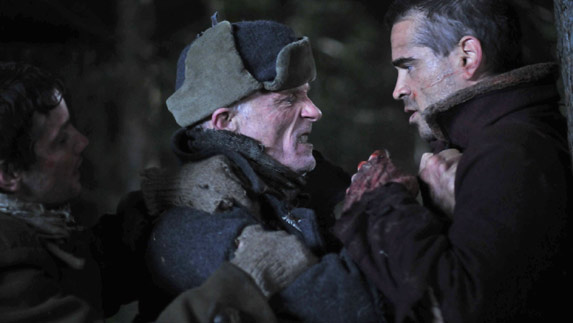
Based on a controversial memoir written by Slavomir Rawicz, the film begins with Polish solider Janusz (Jim Sturgess) sent to a hellish Siberian gulag in 1941 on trumped up charges. Sentenced to ten years—a term he knows he won’t survive—he and a group of prisoners, including a grizzled American soldier (Ed Harris) and a violent Russian criminal (Colin Farrell) make a break for it. Their goal? Freedom. The obstacle? A 4000 kilometer walk through the harsh terrain of Mongolia, China and Tibet on the way to India and a new life. Along the way they pick up one more traveler, a young girl (Saoirse Ronan) whose camaraderie helps bond the ragtag band of escapees.
“The book was published in 1956 and called The Long Walk by Sławomir Rawicz,” Peter Weir said on a recent stop in Toronto to promote the movie. “There is no question from documents that later appeared after the fall of the Soviet Empire when KGB documents were briefly available, that yes, Rawicz had been in a gulag. But did he go on the walk or not? Question mark.
“So the first thing I said was, ‘I can’t do a true story called The Long Walk, but I can fictionalize it based on, or inspired by the book and based on true events if I can prove the walk actually happened.’ We got that proof and I felt comfortable going around the Rawicz question and not saying it’s his personal story.”
To add detail to his fictionalized tale Weir says he became deeply immersed in the subject.
“I became somewhat obsessed with it I think, even though I was fictionalizing it,” he says. “[I learned] through deep background reading, through accounts of those who had gone through the situation in one form or another, including Polish prisoners and soldiers who had been caught up, rather like my central character. I then interviewed survivors in Moscow and Siberia and in London and I just crammed as much as I could into the screenplay.
Weir says that while he strove for absolute authenticity in the film, he had to temper the depiction of life in the gulag for the big screen.
“I did restrain myself from what I was finding in research. Obviously in the worst situations there was a commandant who was a sadist and there were, to a degree, worse situations. So I chose something that I felt was reasonably representative of a number of these hundreds of camps and gulags.”
At the heart of the film is Jim Sturgess as Janusz, the determined and kind-hearted leader of the escapees.
“I’d seen Jim Sturgess for the first time in Across the Universe and thought how well cast he was as a young Beatle as it were,” says Weir. “He has that kind of guilelessness and openness that I needed for my character.
“He’s one to watch. In my film firstly,” he laughs, “and in whatever else is coming up for him.”
“The Walk Back,” a new drama from “Master and Commander: The Far Side of the World’ director Peter Weir, is a sprawling epic with a very personal focus. Set against the backdrop of war, inhumanity and an almost insurmountable challenge, it is about that most personal of things, survival.
Based on a controversial memoir written by Slavomir Rawicz, “The Way Back” begins with Polish solider Janusz (Jim Sturgess) sent to a hellish Siberian gulag in 1941 on trumped up charges. Sentenced to ten years—a term he knows he won’t survive—he and a group of prisoners, including a grizzled American soldier (Ed Harris) and a violent Russian criminal (Colin Farrell) make a break for it. Their goal? Freedom. The obstacle? A 4000 kilometer walk through the harsh terrain of Mongolia, China and Tibet on the way to India and a new life. Along the way they pick up one more traveler, a young girl (Saoirse Ronan) whose camaraderie helps bond the ragtag band of escapees.
Visually Weir and cinematographer Russell Boyd have created a film in which the surroundings really become as much a part of the fabric of the story as the characters. The breathtaking shots of the terrain the travelers pass through add much to the story, emphasizing the isolation and hardship of the journey. Their choice to showcase the backgrounds echoes David Lean and gives the film an epic feel as the story narrows and focuses on the characters.
The acting is uniformly excellent, with Ed Harris and Colin Farrell handing in tremendous work, but the most memorable performance belongs to Saoirse Ronan, the sixteen-year-old Irish actress. Here she plays an orphan whose enthusiasm and spirit gives the men the will to go on. She brings heart to a film that occasionally is a bit dour for its own good.
“The Way Back” is compelling stuff, a nicely painted portrait of the will to outwit, outlast and outplay against all odds.
Are there two more stronger, silenter types in modern movies than Ed Harris and Viggo Mortensen? Each of these actors are a throw back to the days when cowboy stars were manly men who mean what they say and only say what they mean and nothing else.
Harris (who also directs) and Mortensen are gunmen hired to bring law and order to the City of Appaloosa, New Mexico. Their main target is cop killer Randall Bragg (Jeremy Irons), but their job is complicated when a flirtatious woman (Renée Zellweger) comes between them.
Appaloosa comes a year after 3:10 to Yuma and The Assassination of Jesse James gave the western genre a shot in the arm. It’s closer in spirit to the former than the latter—meaning that it is a straightforward genre piece that if it had been made 50 years ago would have starred Alan Ladd and Randolph Scott. Like Clint Eastwood’s The Unforgiven, Appaloosa is a great Western cow opera about men looking inside themselves to discover the true essence of their lives. It doesn’t have the gravitas of Eastwood’s classic, and the economy of dialogue between the leads—there are conversational gaps you could drive a truck through—gets a bit tiresome after a while, but Appaloosa should satisfy viewers who long for the days when men wore chaps and spittoons were a welcome decorative addition to any home.