“Fences,” August Wilson’s rumination on race, masculinity, betrayal and dissatisfaction, won four Tony Awards, including best actor for James Earl Jones, when it first played on Broadway in 1983. The 2010 revival was also lauded, winning Tonys for Denzel Washington and Viola Davis, who now reunite in a big screen version of the popular play.Set in 1950s Pittsburgh, Washington (who also directs) is Troy Maxson, a former Negro League baseball player now working as a garbage man. Each Friday he turns over his $76 weekly paycheck to wife Rose Maxson (Viola Davis) before his co-worker and best friend Jim Bono (Stephen Henderson) blow off some steam with a bottle of gin. Troy drunkenly tells wild stories about beating up the Devil and lectures about the virtues of self-reliance and responsibility to himself and his family. Always teetering on the edge of a blow-up, he’s a thin-skinned man in a world that is changing rapidly around him, who builds a literal and metaphorical fence between him and the outside world.
Troy has a combative relationship with Lyons (Russell Hornsby), his son from a previous marriage, and a strict, disciplinarian rapport with Cory (Jovan Adepo), his youngest who still lives at home. Tension builds as Cory decides he wants to take a football scholarship in favour of learning a trade.
It’s tempting to suggest that “Fences” doesn’t have a plot. Certainly it presents a slice of Troy and Rose’s life that isn’t necessarily driven by story in the strictest sense, but the through lines from scene to scene create a loose narrative that paints a vivid picture of a man whose resentments and bitterness will soon have a palpable effect on everyone around him.
As a director Washington doesn’t do much to open the story up. It takes place on a handful of sets and feels very much like a play, but when the words are this good there isn’t a need to spice it up with flashy production work. Washington focuses on the script and the performances, allowing the power of Wilson’s ideas carry the movie. “Fences” may be set in 1957 but the Troy’s sense of fighting against almost constant injustice feels as timely as it ever has.
Towering in the center of all this is Washington’s performance. His Troy is beaten down but not beaten. He’s hardened to the cruel realities of his life, that integration in baseball came just a few years too late for him to make a go of it, that hope is for dreamers too lazy to get a real job. He settles into the character with remarkable ease, erasing any residual memory of his big movie star turns in films like “American Gangster” or “Flight.” It is as though we’re seeing him for the first time, and yet, to many his story will feel all too familiar.
He finds his equal in Davis who brings a quiet dignity to the often put upon Rose. Her transformation from stay-at-home wife to independent woman as she realizes the eighteen years spent with Troy have not meant what she thought is as remarkable as it is subtle.
As Mr. Bono New York stage and screen actor Henderson rounds out the main cast in a performance brimming with wit and wisdom.
As a showcase for ideas and performances “Fences” hits a home run, offering fodder for Oscar talk and intellectual discourse. As a movie going experience, however, it feels a tad overlong. As much of a pleasure as it is to watch Washington, Davis and Henderson interact, the film loses steam as it enters the final third.
Why did director Antoine Fuqua decide to remake the legendary 1960 western The Magnificent Seven? “I wanted to see Denzel Washington on a horse,” he jokes.
The story of seven men who come together to protect a town from a vicious robber baron looks back further than the 1960 film to the 1954 epic Japanese historical drama Seven Samurai. Often cited as one of the greatest films ever made, Akira Kurosawa’s Seven Samurai provided what Fuqua described as the DNA of his film, but he also noted, “Westerns change with the time we’re in, so we made our film based on the world we are living in.”
To that end he has assembled the most diverse cast for a western ever. In addition to top billed stars Washington, Chris Pratt, Ethan Hawke and Vincent D’Onofrio the seven magnificent leading actors include South Korean star Lee Byung-hun, the Mexican born Manuel Garcia-Rulfo and Martin Sensmeier, an American actor of Tlingit, Koyukon-Athabascan and Irish descent.
“You can’t do the same thing every era,” says Fuqua. “Westerns change all the time. If we were sticking to just one way of doing something then all westerns would be all white guys looking like John Wayne in a John Ford movie.”
“My idea was, if Denzel walks into a room, the room stops,” he says. “If Clint Eastwood walks into a room, the room stops. Is it because he’s a gunslinger or is it because of the colour of his skin? We’ll let the audience decide.”
When asked if The Magnificent Seven is proof that Hollywood is becoming more diverse the director says, “You have to give the studio credit when they do something like this. This becomes the new definition of what a western is.”
Chris Pratt, who plays gunslinger Josh Faraday says despite the film’s title The Magnificent Seven has more to do with another well known western.
“I don’t know how many movies there are in the world,” he said at the TIFF opening night press conference. “What would you guess, several hundred thousand? Millions? Eventually you just run out of names. If I have a son and name him Chad, is he a remake of somebody else who was named Chad? No. We could have called this The Cowboys or something, but [The Magnificent Seven title] has reach,” he continued, “it gets people engaged. But [this movie] is probably more Wild Bunch than it is [1960’s] The Magnificent Seven. We use the title, we use the story. It’s a bunch of guys. There are seven of us. And we’re all [bleeping] magnificent. We’ve got that going for us, but let that movie be that movie. This is a different movie.”
Star Denzel Washington says he’s never seen the 1960 film. “I didn’t keep away from it,” he says. “I just didn’t know how it would help me. I had never seen it as a kid or whatever. People say, ‘You’re the so and so character,’ I don’t even know who that is. I think it allowed me to do whatever I wanted to do instead of trying to not do what someone else did.”
Why did he sign on? “Well, Antoine asked me. It’s as simple as that. Obviously, it’s a good story and a good script but most importantly it was Antoine.”
Director Antoine Fuqua’s remake of “The Magnificent Seven” literally starts with a bang.
A series of mine explosions echo through Rose Creek, signalling unrest in the tiny mining town. Bartholomew Bogue (Peter Sarsgaard) has taken over, terrorizing the town with hired goons. He’s a cruel man who guns down citizens and says to his henchmen, “Leave the bodies where they lie. Let them look at them for a few days.” Bad Bart wants the land but is only will to pay a pittance per parcel. “Those of you who signed the deeds will get your $20,” he sneers. “And those who don’t, God help you.”
The townsfolk are helpless. Bogue has killed a half dozen men and with the sheriff on his payroll will continue to do as he pleases. Fed up and recently widowed, Emma Cullen (Haley Bennett) turns to hired gun Sam Chisolm (Denzel Washington) for help. “You don’t need a bounty hunter,” he says, “you need an army.” Despite the massive odds against them Chisolm assembles a rag tag team of killers, gamblers and outlaws—Josh Farraday (Chris Pratt), Goodnight Robicheaux (Ethan Hawke), Jack Horne (Vincent D’Onofrio), Billy Rocks (Byung-hun Lee), Vasquez (Manuel Garcia-Rulfo), and Red Harvest (Martin Sensmeier)—to go up against the ruthless robber baron in what promises to be a better than OK gunfight at the corral.
“The Magnificent Seven” is a classic looking western with a modern pace. Fuqua chooses not to mess with the key oater elements. He papers the screen with acres of open land, seven tough men, one or two resilient women and a sea of cowboy hats. He is respectful to the form and doesn’t try to bring the genre into the twenty-first century with frenetic editing—I’m looking at you Timur “Ben-Hur” Bekmambetov—or contemporary language. It’s a western, with all that entails; good vs. evil with some moral ambiguity thrown in for good measure.
Also thrown in for good measure is a heap of star power. Washington is a cool character, quietly deadly. He says cool stuff—“Chisolm, should I know that name?” he’s asked. “You should know it from your obituary,” he replies.—and is the movie’s charismatic center. Chris Pratt’s easy charm gives Washington a run for his money, but this is really Denzel’s movie from top to bottom.
Hawke and D’Onofrio do interesting character work. As the shell-shocked Robicheaux Hawke is equal parts swagger and skittishness while D’Onofrio is practically unrecognizable as the squeaky-voiced Jack Horne.
The remaining member of the seven aren’t given much to do other than pull triggers and nod in agreement to Chisolm’s plans, but they are an interesting bunch nonetheless.
At a little over two hours “The Magnificent Seven” could be leaner and well, maybe not meaner—I would not be surprised if it had the highest body count in a western ever—but tighter. There is a mid-movie sag as the plans for the final shootout are being finalized but the ballet of bullets at the end is epic, if not a little excessive, putting a fitting cap on a story that is slight but entertaining for most of the running time.
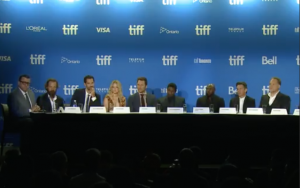
Richard hosts the “Magnificent Seven” TIFF press conference with (from left to right) Richard, Peter Sarsgaard, Manuel Garcia-Rulfo, Haley Bennett, Chris Pratt, Denzel Washington, Antoine Fuqua, Ethan Hawke, Vincent D’Onofrio, Lee Byung-hun and Martin Sensmeier.
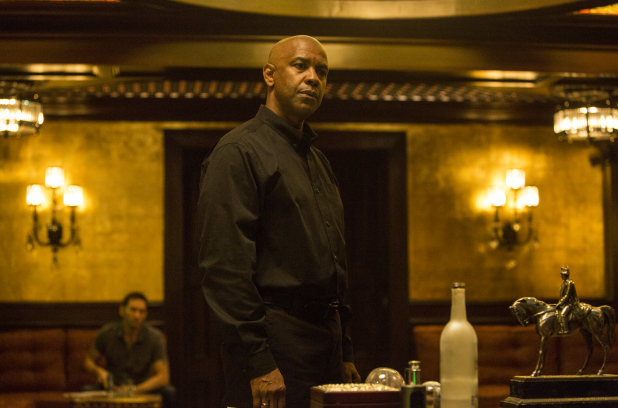
At the beginning of “The Equalizer,” a remake of the cult 1980s television show, Robert McCall (Denzel Washington) pontificates on “The Old Man and the Sea,” summing up Hemingway’s take on human nature.
“The old man gotta be the old man,” he says. “The fish gotta be the fish. Got to be who you are in this world no matter what.”
Of course this is a movie, so he’s actually talking about himself and not Ernest’s adversarial fisherman.
Washington plays a home improvement store worker by day, righter of wrongs by night. He’s a former black ops commando trying to leave his violent ways in the past but just when he thought that part of his life was over, the Russian mob leans on him because he tried to protect a young woman (Chloë Grace Moretz) from her violent pimp.
When he singlehandedly wipes out the east coast wing of the Russian mob Teddy (Marton Csokas), an enforcer from Moscow arrives to put an end to McCall’s one man search for justice.
“The Equalizer” is more elegant than Liam Neeson’s recent action movies but less viscerally satisfying. All the elements of Neeson’s Euro-trash thrillers are in place—tattooed bad guys and the “seasoned” hero with a “special set of skills”—but the pace is much slower.
The point of the story is that McCall equalizes situations, using his talents to help the down trodden but it takes about thirty minutes before any settling of scores happens. We meet McCall, learn about his orderly life—his shirts are immaculately pressed, he likes to read the classics and is particular about the placement of cutlery at his local diner—but we don’t learn anything about his past. He’s Denzel and ergo, a badass, but the first thirty minutes of this movie could have snapped things up a bit by illuminating his past.
The slow burn does build some tension, and by the time McCall unleashes hell on the Russia mobsters it comes as a bit of a catharsis. Now the movie is rolling! Except that it isn’t. It takes ages for McCall to open another can of whoop ass. Instead director Antoine Fuqua has elected to gradually build up to a wild showdown in a massive hardware store. Who knew those places were so dangerous? The climax is tense and inventive, apparently there is no home improvement device that cannot be turned into a WMD, but it is a more standard blockbuster-movie ending than you might expect from a movie so stingy with the action in the first hour.
It’s a good movie and Denzel is, as always, charismatic and interesting, but if “the old man gotta be the old man,” then “The Equalizer” gotta be more of an action movie to be completely satisfying.
In 2001 Denzel Washington won his first Best Actor Academy Award. The movie was Training Day and Washington’s performance as the corrupt Los Angeles Police Department narcotics officer Alonzo Harris established the actor’s propensity for playing ambiguous antiheroes.
Is there another A-list leading man who explores the dark side of his characters as often as Washington? Will Smith and Tom Cruise occasionally let the heroic side of their on-screen personas take a back seat, but Washington revels in mucking around in the mud. From Training Day to American Gangster, Safe House to Flight, he has crafted complex characters you wouldn’t want to sit next to on the bus.
This weekend he’s back as Robert McCall, home improvement store manager by day, equalizer of odds by night. Based on the cult 1980s television show The Equalizer starring Edward Woodward, the film begins with the former black ops commando trying to leave his violent ways in the past. He meets his greatest adversary just when he thought that part of his life was over. Namely, the Russian mob leans on him after he tries to protect a young woman (Chloë Grace Moretz) from her pimp.
No other superstar seems as comfortable with moral haziness as Washington. In American Gangster, for instance, he was Frank Lucas, the one-time driver for a Harlem mob boss who rose to the top of the drug world by flooding the streets of Manhattan with cheap, high-grade heroin smuggled into the United States in the coffins of dead soldiers returning from Vietnam. He’s a dichotomy — bloodthirsty and ruthless, but he also attends church every Sunday with his mother.
In Flight, he played troubled pilot Whip Whitaker, an anti-hero who is functional in day-to-day life despite his predilection for wine, women and cocaine. He’s charming one minute, enraged the next and passed out on the floor the minute after that. Washington manages to subtly capture the ego and hubris that allows Whitaker to present a sober face to the public while bringing us into the messy world of addiction.
The actor has played his share of assorted good guys over the years — Ricochet’s cop-turned-attorney and Don Pedro of Aragon in Much Ado About Nothing — but it is his willingness to mine the heroism of the nasty men he plays that makes him one of the most interesting A-listers.
Nervous flyers will not enjoy the first half hour of “Flight,” the new film from “Castaway” director Robert Zemeckis and star Denzel Washington. If the nervous nellies can make it through the highflying plane crash that serves as the catalyst for the personal story of a troubled pilot (Washington), however, they are in a more earthbound tale of excess and expectation.
When we first meet Whip (Washington) it’s 7:14 in the am and he is hours away from piloting short haul flight Southjet 227 from Orlando to Atlanta. He’s also simultaneously arguing with his ex-wife on the phone, drinking beer, snorting cocaine and watching his girlfriend, a flight attendant get dressed after a wild night in a generic hotel room.
Hours later he’s behind the wheel of a jet, piloting it and the 102 on-board souls. After successfully navigating around a patch of brutal turbulence a mechanical malfunction threatens to down the plane. It is Whit’s expertise, and the audacious move of inverting the plane so it can glide to relative safety, that saves 96 of the 102 passengers and crew.
Hailed as a hero at first, soon his unsavory personal habits bring him under suspicion. Was it a malfunction of a mechanical or personal nature that brought the plane down?
Is there another a-list leading man who explores the dark sides of their characters as often as Washington? Will Smith and Tom Cruise will occasionally let the heroic side of their on-screen personas take a back seat, but Washington revels in mucking around in the mud. From “Training Day” to “American Gangster” and “Safe House” he crafts complex characters you wouldn’t want to sit next to on the bus.
Whit is a different take on this theme, however. This time around the anti-hero is functional in day-to-day life despite his predilection for wine, woman and cocaine. He’s charming one minute, enraged the next and passed out on the floor the minute after that.
Denzel manages to subtly capture the ego and hubris that allows Whit to present a sober face to the public, even though the film’s visual language is frequently not as refined. A close-up of Washington’s hand grasping a mini bottle of vodka and the accompanying swoosh sound looks like something that should be in a commercial not in a film about the effects of alcoholism.
“Flight” is a quiet movie about troubled people, acts of god, ethical questions about accepting responsibility and the callousness of business in the wake of tragedy. It’s about a lot of things, many of which Zemeckis simply flits around before moving on, but at its core is Washington, who despite an unnecessary redemptive ending, effectively brings us into the messy world of addiction.
Inside Man is director Spike Lee’s take on a heist film, and predictably he puts his own spin on an old genre and offers up something unpredictable. It’s like an episode of Law and Order minus the order.
Lee forgoes the usual set-up for movies like this and gets us directly into the action. Five minutes into the movie we are inside the bank and the bad guys—led by the charismatic Clive Owen—have already taken control, closing off the building and taking hostages. On the outside a team of detectives led by Spike Lee regular Denzel Washington—they’ve made four movies together—tries to keep the situation under control.
It sounds rather standard, but Lee crafts a story in which the moral compass can’t find true north, and the good guys aren’t always good and maybe the bad guys aren’t as bad as they seem.
Also unexpected for a thriller of this kind is how much humor Washington and Owen bring to their roles. Their conversations crackle with sharp one-liners that diffuse some of the tension of the story.
In one effective scene Owen spends some time with the youngest hostage as the street-wise kid plays with a violent videogame on his PSP. Owen inspects the game that includes drive-by shootings, stabbings and most outrageously, a hand grenade stuffed into the mouth of a pedestrian. As the videogame character’s head explodes Owen says, “I’ll take you back to your Father. I think should have a word with him about that game.” It’s a humorous moment, but one also laden with social comment. In earlier films Lee has employed a heavier hand when trying to get his message across, but it seems he has learned that a spoonful of sugar can sometimes more effectively help the medicine go down.
Inside Man will keep you guessing until the end, and maybe even after you leave the theatre. Lee chooses not to tie up all the loose ends, and the film is more intriguing because of it.
If not for Denzel Washington’s charismatic performance John Q wouldn’t even cut it as a TV movie of the week. Bombastic, predictable and utterly unbelievable, the story of a man who takes a hospital hostage to get his son’s name on a heart transplant list, has its priorities skewed. The hospital officials, the doctors and the police are the bad guys, while the guy who waves around a gun, kidnaps an emergency room full of people and generally makes a nuisance of himself is hailed as a hero. He does it for the love of his son, so I guess that is supposed to make everything OK. James Woods and Robert Duvall do some grade “A” scenery chewing and seem to be having a good time despite the lousy dialogue. Ray Liotta, on a bit of a career comeback these days overacts his way through his scenes, while Anne Heche seems to be almost completely without any emotion whatsoever.