One writer called the director of Pee Wee’s Big Adventure, Beetle Juice, Batman, Edward Scissorhands and this weekend’s Miss Peregrine’s Home For Peculiar Children, “the most widely embraced loner in contemporary cinema.”
“I always try to at least spend time, as much as I can everyday, staring out into space; staring out a window,” the director says. “I find that sometimes you get the most ideas and the most feelings when you’re not involved in things you have to do everyday; especially these days when technology is such that you can be reached any time. I try and avoid that.”
Unsurprisingly as a filmmaker the characters he champions tend to echo his sensibility. From warped Mad Hatter in his Alice in Wonderland to the grieving child in Frankenweenie who reanimated a dog’s corpse, Burton’s heroes are often misfits and outsiders.
From his debut, Pee-Wee’s Big Adventure, Burton has showcased people on the fringes of society. “You don’t wanna get mixed up with a guy like me,” says man-child Pee-Wee (Paul Reubens), “I’m a loner. A rebel.” Loosely based Vittorio De Sica’s classic film The Bicycle Thief, Burton’s story sees Pee-Wee on a mission to retrieve his stolen fire engine-red customized 1940s Schwinn. David Letterman was a fan, describing the anti-social character as having, “the external structure of a bratty little precocious kid, but you know it’s being controlled by the incubus, the manifestation of evil itself.”
In his next film Burton breathed life into Betelgeuse‘s rancid lungs. In the haunted-house comedy Beetlejuice Michael Keaton plays a “bio-exorcist” with crazy hair, giant teeth and an attitude, hired by two ghosts to scare away the insufferable new owners of their old house.
“I think Beetlejuice shows the complete positive side of being misperceived and being categorized as something different,” Burton says. “He can do whatever he wants! He’s horrible and everybody knows it, so he’s a complete fantasy of all of that.”
Burton’s two greatest misfits, his most intrepid folks on the outside looking in, are the off-kilter Eds—Wood and Scissorhands.
Edward Scissorhands is the strange-but-sweet story of a man with scissors for hands. The first collaboration of Tim Burton and Johnny Depp, the movie is a funny, romantic and moving fantasy was inspired by a sketch Burton created as a teenager. “One look at that drawing was all I needed to understand what Edward was about,” says Depp. “I felt very tortured as a teenager,” says Burton. “That’s where Edward Scissorhands came from. I was probably clinically depressed and didn’t know it.”
Ed Wood, played by Depp in the film of the same name, is the story of one of Hollywood’s great outcasts. Wood wrote, produced and directed low-budget anti-classics like Plan 9 from Outer Space and Glen or Glenda. Burton says he was a fan of Wood’s films and after reading some of the director’s letters was touched by how Wood, “wrote about his films as if he was making Citizen Kane, you know, whereas other people perceived them as, like, the worst movies ever.”
Burton links his best-known creations, labelling them as “semi-antisocial, [having] difficulty communicating or relating, slightly out of touch,” and adds, “I feel very close to those characters. I really do. I feel like they are mutated children.”
“The Program,” a biopic of disgraced Tour de France racer Lance Armstrong begins like a fairy tale, although one with doping and cancer, but ends as a Shakespearean tragedy.
Ben Foster plays the cyclist as an athlete obsessed with winning. A rising star on the race circuit, he looks to Dr. Medecin Michele Ferrari (Guillaume Canet), an Italian doctor with a “scientific” approach to training to create a routine—the program—involving exercise, growth hormones, erythropoietin, cortisone and testosterone patches that will turn him into a champion. “You just tell me what to do,” Armstrong says eagerly, “and I’ll do it.” The doctor tells Lance that under his care you’ll, “no longer confined to earth now you can fly.”
In other words: OK Racer + Performance Enhancing Drugs = Great Racer.
When his career momentum is slowed by testicular cancer it seems as though everything will be lost but he beats the disease and comes back stronger than ever. Almost too strong. Sunday Times sports reporter David Walsh (Chris O’Dowd) notes that during one race Armstrong is moving so quickly he has to use his brakes…going uphill. “He recovered from cancer and turned into Superman,” he says. Suspicious, he puts Armstrong and his team, the U.S. Postal Service Pro Cycling Team, under a journalistic microscope. “I have no interest in watching chemists racing up a hill,” says Walsh.
As Armstrong and Co begin a streak that will eventually see them win seven Tour de France races Walsh raises an “unwelcome question,” Is it real or is it dope? Meanwhile Armstrong becomes an American hero, supporting cancer research through his charity, all the while denying any wrong doing in the dope department.
As the pressure increases so does his ego. He starts referring to himself in the third person—“Will he passed every test?” he says. “Yes he will because he doesn’t use performance-enhancing drugs.”—and launches lawsuits against the Sunday Times and Walsh in an effort to intimidate them into silence. It isn’t until a former teammate, Floyd Landis (Jesse Plemons), comes clean about the doping that Lance’s empire crumbles.
Like its subject “The Program” moves quickly. So quickly, in fact, it plays like a montage, never settling on one thing long enough for the audience to care. Racing scene! Doping scene! Inspirational chatter like “Say to yourself, I’m flying”! Director Stephen Frears races through Lance’s life—his cancer is dispensed with in minutes while in another scene he meets a woman and in the next they’re walking out of a church, married—touching down here and there on the greatest hits of the man’s life. It’s a face paced but unsatisfying way to learn about the rise and fall of the most famous bicyclist in the world.
That he was a doper and a cheat is not in question but what got him there? Winning is everything to Lance, but why? Is it hubris? The movie doesn’t let us know. It is content to zip through the details without too much commentary on how or why we got there. It’s a story of hubris, heroics and hypocrisy that is more interested in broad strokes of how Armstrong created his own legend than the details.
“The Program” falls somewhere between a biopic, sports movie and the investigative reporting of “Spotlight,” but never gels as any one thing. Foster is fine in the lead role but the film doesn’t allow him to really inhabit the ski of his character. For a more complete and interesting look at Lance check out Alex Gibney’s documentary “The Armstrong Lie.”
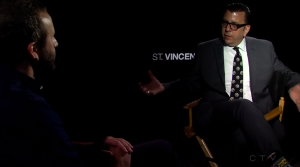
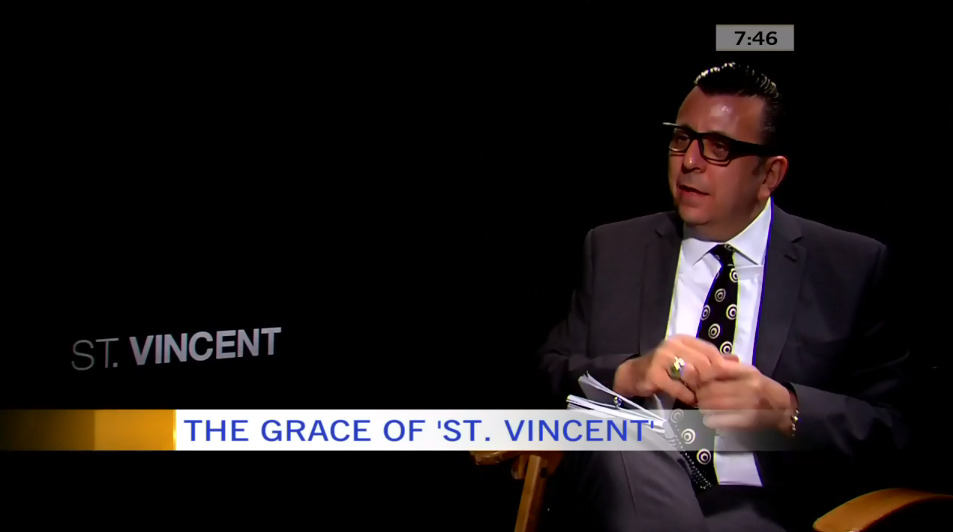
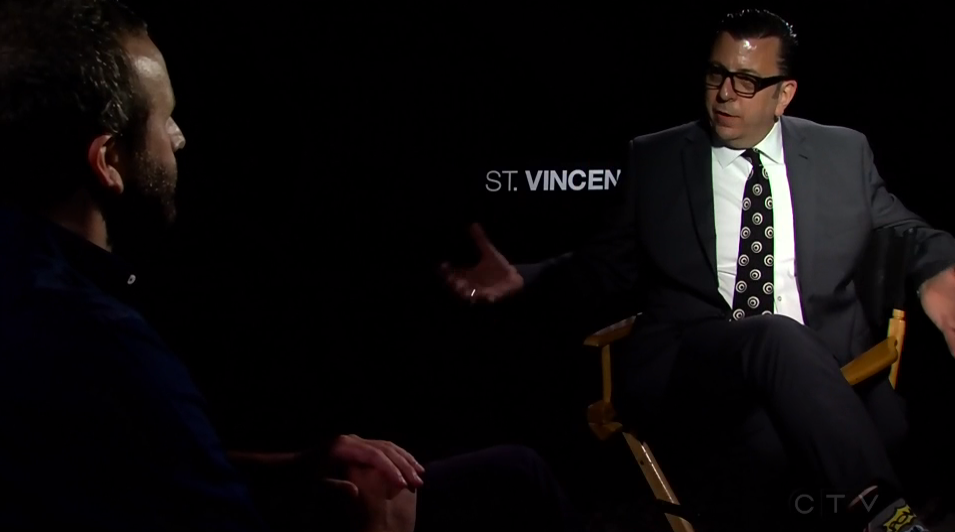
“Canada AM” Web Exclusive: Richard’s interview with “St. Vincent” star Chris O’Dowd.
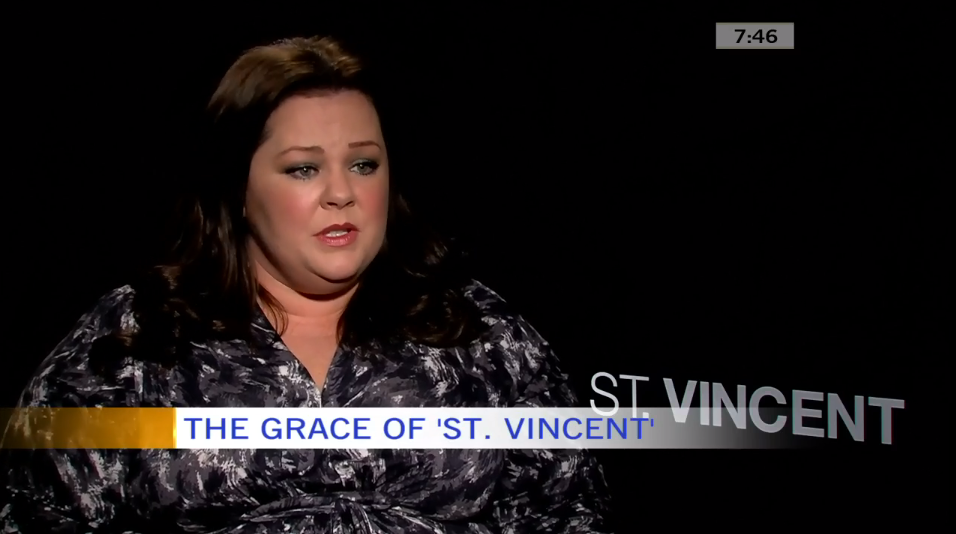
A synopsis: Bill Murray plays Vincent, a Sheep’s Head, New York guy whose life is in as bad a shape as his jokes. He’s usually drunk or trying to get drunk. His house is second mortgaged to the hilt, his bank account in overdraft and his only friends are a Himalayan cat and the pregnant working girl he pays for company. His new neighbors, single mom Maggie (Melissa McCarthy) and ten year old Oliver (Jaeden Lieberher) are a nuisance to him, until he discovers he can make a few extra bucks babysitting the boy. “Is that our new neighbor,” says Oliver when he first spies Vincent. “It’s going to be a long life.” The pair, however, form a bond. Vinnie passes along valuable life experience, like how to fight, bet on horses and order a drink in a bar, but when Oliver’s dad sues for co-custody it turns out Vinnie’s life lessons may have been ill advised.
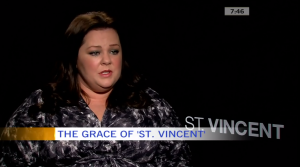
Richard’s “Canada AM” interview with “ST. Vincent” star Melissa McCarthy!
“[Bill Murray] is an icon. It’s less about him being one of the funniest human beings, and more about that he’s such a good actor. I thought this role was right in his wheelhouse because I knew he wasn’t going to overplay it. Then to see him do it so subtly and so underplayed, makes you love that character so much. It was a master class for me.”
Appearing in one of the movies! I was in Red Alert, a short that played before the movie Wet Bum. IT’s not enough that I cover 100 movies during the fest, now I have to be in them too! I even got a review. “@richardcrouse is great in Red Alert…” Mike Bullard wrote on twitter. “I’d like to tell you I didn’t know he was a redhead but I knew… I just knew ok.”
In person Benedict Cumberbatch’s voice sounds like hot melting wax. I liked Sherlock well enough and have seen him in several movies, but for me, and I know I’m the last to get it, his performance in The Imitation Game is a game changer. He plays real-life character Alan Turing, a Cambridge mathematician who volunteers to help break Germany’s most devastating WWII weapon of war, the Enigma machine. It was a top-secret operation, classified for more than 50 years, but that wasn’t Turing’s only secret. Gay at a time when homosexuality was illegal, punishable by jail or chemical castration, he was forced to live a world of secrets, both personal and professional.
Robert Pattinson telling me about how Hollywood was before camera phones: “When I first started going to LA everyone was underage and if you were a famous actor the rules did not apply. You could be a sixteen-year-old and go into a club but now that there are camera phones everywhere that doesn’t exist anymore. That period was so weird. You’d see a fourteen-year-old actor wasted, doing lines of blow on the table. It was crazy. Now they just do it at their parent’s house.”
Julie Taymore telling me that A Midsummer Night’s Dream “It was the first play I ever saw. I saw it here in Canada at the Stratford Festival…”
Michael Moore’s answer to my question about his reaction to all the celebrity he gained after appearing at TIFF 25 years ago with Roger and Me: Asked what was going through his head while all this was swirling around him, Moore says: “Why didn’t I go to Jenny Craig three months ago?”
“I don’t know where they are,” Kingsley says about his characters, “if they’re inside me waiting to come out or whether they are outside of me. Are they hunting me or am I hunting them? I don’t know.”
Repairing Dustin Hoffman’s watch. During a roundtable interview the alarm on his watch went off several times. He gave it to me and I looked up the instructions on how to fix it on Google. “How did it you look it up on line? They have instructions to fix Timexes on line? I don’t automatically go to those things,” he said. During the interview he said: “I was told to take acting. Nobody flunks acting.” Later he said that it wasn’t such a bad choice because, for instance, “No one ever says, ‘I want to be a critic when I grow up.’”
Lowlight… waiting for BIll Murray for seven hours. (Although I love this from @ZeitchikLAT: Bill Murray, offering implicit proof on the merits of Bill Murray Day: “If this is really my day, why do I have to do so much work?”)
Sitting next to next to Boo Radley, Bill Kilgore and Tom Hagan. (Robert Duvall!)
Most quotable actors of the festival? Robert Duvall who said, about acting, “There’s no right or wrong just truthful or untruthful.” He calls Billy Bob Thornton “The hillbilly Orson Welles…” and said “Brando used to watch Candid Camera.” Jane Fonda was a close second when she said acting is great for the heart but terrible for the nerves… “Butts have become more in fashion… (since Barbarella) and “Television is forgiving to older women and making it possible for us to have longer careers.”
“I have distilled socialism in this box and am taking it back to America.” – Robert Downey Jr in my roundtable interview.
#TIFF14 socks day 3. Chris O’Dowd called them “powerful.” and Rosamund Pike said, “I’m enjoying your socks. They make me happy.”
Watching “Whiplash” knock the socks off an audience at an IMAX P&! screening. It is part musical—the big band jazz numbers are exhilarating—and part psychological study of the tense dynamics between mentor and protégée in the pursuit of excellence. The pair is a match made in hell. Teacher Fletcher, played by J.K. Simmons is a vain, driven man given to throwing chairs at his students if they dare hit a wring note. He’s an exacting hardliner who teaches by humiliation and fear. This movie doesn’t miss a beat.
Love this quote: “Being in the military,” said Adam Driver of This Is Where I Leave You, “believe it or not, is very different than being in an acting school.”
1. Admission: Tina Fey is Portia Nathan, a mildly compulsive Princeton admissions officer—they jokingly call her their “golden retriever” because of her record of recruiting a-plus students—who leads a quiet, ordered life with professor Mark (Michael Sheen). They share a love of poetry, hatred of kids and not much else. Her well ordered life is thrown into disarray when John Pressman (Rudd), a free-spirited former classmate and now teacher at an alternative school, introduces her to Jeremiah Balakian (Nat Wolff), a brilliant young man who may be the child she gave up for adoption seventeen years ago. “Admission” is familiar enough to not jar the sensibilities of undemanding rom com fans, but there is more here than immediately meets the eye.
2. The Bling Ring: Based on actual events, “The Bling Ring” centers around a group of narcissistic Los Angeles area teenagers, Rebecca (Katie Chang), Marc (Israel Broussard), Nicki (Emma Watson), Sam (Taissa Fermiga) and Chloe (Claire Julien).
Their modus operandi? They track the comings and goings of their favorite celebs on via internet. While one-named millennial stars like Paris, Lindsay, Megan or Audrina are out on the town or out of town completely, the Ring “go shopping,” breaking into their homes and help themselves to jewels, designer clothes and loose cash. More than that, they live vicariously through the lives of the rich and famous folks they’re burgling.
“The Bling Ring” plays like a “Law & Order” episode of “The Hills.” The crime spree is device that keeps the story moving forward, but the fascinating thing is the portrait of these self-absorbed kids who aspire to hosting reality shows or becoming a “lifestyle brand” as a career. They want fame and money, but are so tied up with the idea of fame and money they are blind to virtually everything else.
“The Bling Ring” is a fascinating art-house glimpse of fame found, just not the fame the thieving teens sought. They are the robbers TMZ made famous, a group of kids who redefined narcissism in an already narcissistic town.
3. The East: Britt Marling stars as corporate spy Jane Owen, code name Sarah. Her latest job involves going deep undercover to infiltrate a shadowy group of eco-terrorists called The East. The collective—think real life activists Anonymous—run by the charismatic anarchist Benji (Alexander Skarsgård), is on the eve of their biggest demonstration yet, an act of sabotage that will make headlines and make a very public statement of their anti-corporate stance.
Sarah is accepted by the group, save for the truculent Izzy (Ellen Page), and begins to develop Stockholm syndrome. Or does she?
It’s a morally complex movie, with Sarah at the center of the ethical hurricane as she starts to question her role as both a spy and a would-be member of the radical group. She weighs the morality of both sides and… well, go see the movie.
“The East” deliberately paints shades of grey into the story, allowing for good and bad, evil and sympathetic characters on both sides. It may be too nuanced for folks who like their spy stories to take sides, but Sarah, as the source of the plot’s push-and-pull, is too complex a creation to play it straight. Marling brings strength and fighting spirit to Sarah in a performance that could finally make her a star.
4. The Iceman: Based on “The Iceman: The True Story of a Cold-Blooded Killer” by crime writer Anthony Bruno the movie begins on Kuklinski’s first date with his wife to be Deborah (Winona Ryder). He’s quiet and reserved, but charming and she is won over by his charisma. They marry, have kids and lead a normal life. At least at home. Deborah had no idea her mild mannered husband was an expert assassin, who paid for the kid’s private school and her jewels by slicing throats, shooting and choking the enemies of his boss Roy DeMeo (Ray Liotta).
Kuklinski was dubbed the Iceman for two reasons. When he was arrested police found a stash of bodies he had frozen to obscure time of death and because of his icy demeanor. It’s a role Shannon was born to play. From certain angles he looks like an everyman, the kind of guy who goes home at night to his wife and two kids. From other angles he’s menacing, the kind of guy you don’t want to meet in a dark alley.
Shannon is cooler than Mr. Freeze as the title character in “The Iceman,” and he’s joined by Chris Evans in a career making performance as a ice cream truck driving killer, Liotta in mobster mode—between Shannon and Liotta it’s a showdown of the steely stares—the welcome return of Wynonna Ryder and David Schwimmer playing against type as a slimy mafia enforcer.
5. The Last Stand: Near the beginning of the movie the head lawman of the sleepy border town of Summerton Junction, Sheriff Ray Owens (Arnold Schwarzenegger), says, “Should be a quiet weekend.” Of course whenever Arnold, or any eighties action star says, “Should be a quiet weekend,” you know all hell is about to break loose. And break loose it does.
In a parallel story ruthless drug lord Gabriel Cortez (Eduardo Noriega) stages an elaborate escape and heads for the Mexican border, which just happens to lie outside Arnold’s… er… Owens’s town. As Cortez speeds toward the border he has a quick cell phone call with Owens. “Do you wanna play?,” he yells. “Let’s play!” And play they do… with big guns.
Schwarzenegger is moving noticeably slower these days—How are you Sheriff? “Old,” he says.—but his comic timing is still there and no one else can battle through this kind of cheesefest and emerge with his action cred intact.
“The Last Stand” is not a movie to be taken seriously, but it wasn’t made to be taken seriously. Why else would cult director Jee-woon Kim cast Johnny Knoxville?
6. The Lone Ranger: Set against a backdrop of corruption during the building of the railway’s westward expansion through Native American territory, this is the origin story of how attorney John Reid (Armie Hammer), a law and order man who doesn’t believe in vengeance, met Tonto (Johnny Depp) and became the Wild West’s masked crusader.
The unlikely pair are brought together by their mutual enmity toward Butch Cavendish (William Fichtner), a cannibalistic outlaw who Reid wants to bring to justice and Tonto wants dead. That pursuit uncovers massive corruption during the building of the railway’s westward expansion through Native American territory beginning with a conspiracy to start a war between the US Calvary and the Comanche Nation.
“The Lone Ranger” is state of the art nouveau Western, complete with circling vultures, unspoiled landscapes, gruff, unshaven men and even a beer drinking horse. Surprisingly nimble footed for a two-and-a-half hour epic, it is unexpectedly funny but more violent than your typical summer tent pole flick.
7. Pacific Rim: Director Guillermo Del Toro has made an end-of-the-world scenario fun.
In the world he creates in “Pacific Rim” the planet is threatened with destruction by Kaijus, colossal beasts with an appetite for destruction. Coming to our world through a breach in a portal beneath the Pacific Ocean, the earth is losing the war against these beasts. The main of line of defense, giant robots called Jaegers—operated by pilots who mind meld with the metal behemoths; the deeper the connection, the better they fight—are being decommissioned in favor of a giant wall. “Kaijus are evolving,” says one military man, “and we’re losing Jaegers faster than we can build them.”
In the months before the machines are made obsolete a driven colonel, Stacker Pentecost (Idris Alba), assembles a crack team of Jaeger pilots—including burned out former pilot Raleigh Becket (Charlie “Sons of Anarchy” Hunnam) and talented but untested trainee Mako Mori (Rinko Kikuchi) to launch one last attack to close the portal and save the planet.
Del Toro has supersized a Godzilla story, adding in 50s b-movie tropes with state of the art sci fi to create something fresh. It’s a thrill ride from the beginning, a giant action movie that doesn’t just rely on a cool premise.
In other words, “Battleship” this ain’t.
8. Pain and Gain: Near the beginning a voiceover says, “Unfortunately, this is based on a true story.” It’s the real-life tale of three Miami-based body builders (Mark Wahlberg, Dwayne Johnson, and Anthony Mackie) chasing the American Dream. Pumped up and steroid crazy they abduct a prominent local businessman (Tony Shalhoub). They beat and torture the self-made millionaire until he signs over all his wealth—houses, cars, boats and money. The story eventually becomes so outlandish Bay flashes up a graphic in the last half hour reminding us that this is “still a true story.”
This is a seriously weird movie. It’s Bay working with a tiny—for him—budget of just $26 million. The guy has made commercials that cost more than that, but has delivered the darkest comedy—imagine if the Coen Brothers did gruesome slapstick—to come down the pike in a while.
9. Rush: When we first meet Niki Lauda (Daniel Brühl) and James Hunt (Chris Hemsworth) they are third stringers, talented Formula 3 drivers desperate for a chance to move up to the big show. Lauda makes a financial deal that lands him on Team Ferrari while Hunt uses tenacity, charm and a touch of desperation to grab a spot with the McLaren team.
Bad blood flows between the two, stemming back to an incident when Hunt edged Lauda off the track the first time they faced off against one another. That rivalry spills over from the track as the two engage in name-calling and spar in the press.
In the 1976 season Lauda seems unstoppable, a sure bet to reclaim his World Champion title. Then tragedy strikes as Lauda is badly burned in a fiery crash. During his recuperation Hunt rises in the ranks, leading to a showdown, just 50 days after Lauda’s accident, for the World Championship at the Japan Grand Prix.
“Rush” is more than “Rocky” on four wheels, it’s an exhilarating, stylish film with pedal-to-the-metal verve.
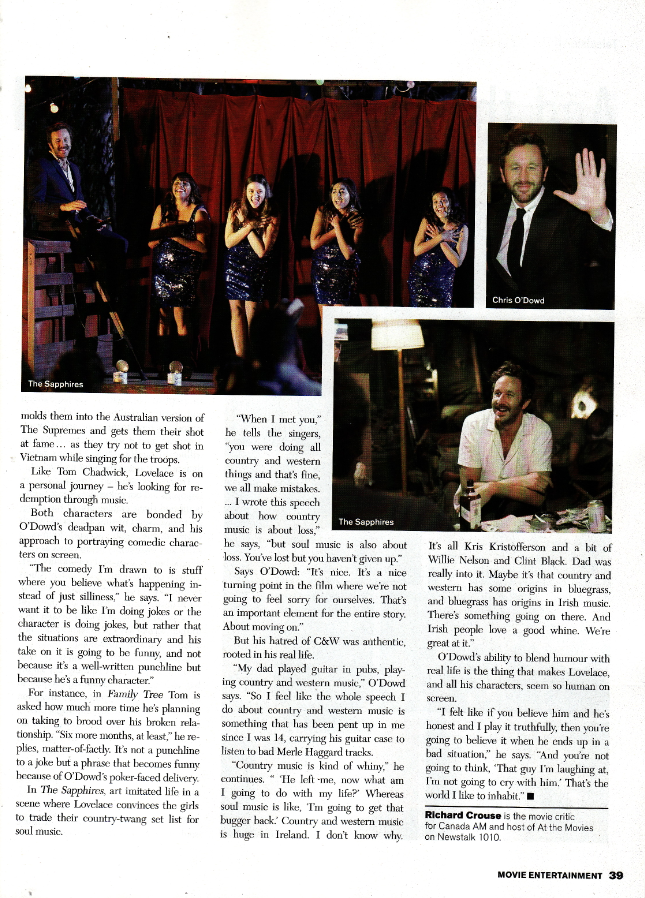
10. The Sapphires: The year is 1968. Dave Lovelace is an English (Chris O’Dowd) piano player with a love for Otis Redding and booze. While hosting a talent show in remote Australia hosting he discovers three sisters, Cynthia (Miranda Tapsekll), Gail (Deborah Mailman), Julie (Jessica Mauboy), with amazing voices but a tired country and western style repertoire. Adding cousin Kay (Shari Sebbens) as background singer and dance captain, he molds them into the Australian Supremes and gets them their first gigs—in Vietnam singing for the troops.
“The Sapphires” is a feel good movie that succeeds despite the cliché story. It’s based—one imagines very loosely based—on a true story, but make no mistake, this is a Hollywood-ized (filtered through an Australian sensibility) version of the tale.
Authenticity aside, it’s the performances and the music that make “The Sapphires” worth a look. We first noticed O’Dowd on this side of the Atlantic as the charming love interest in “Bridesmaids.” He brings it again in “The Sapphires,” mixing roguish appeal with bang on comic timing.
“The Sapphires” is a slight, but entertaining take on the effect of music to change people’s lives.
11. The To Do List: High school valedictorian Brandy Klark (Aubrey Plaza) is an overachiever. She’s the publisher of her own magazine, Women With a Y, a straight A student with a full scholarship to Georgetown University and has a Perfect Attendance certificate proudly hanging on her wall.
She’s also a virgin, a status she hopes to change soon with the help of Rusty Waters (Scott Porter), a college surfer stud with a perfect smile. Attacking her new project with the gusto that won her accolades in school, she gets the advice of friends and family (Christopher Mintz-Plasse, Alia Shawkat, Sarah Steele and Rachel Bilson) and makes up a “to do” list, applying the same zeal that made her a mathlete to losing her virginity.
Telling the story from a female point of view is a nice turnaround from the usual boycentric sex comedy story.
“The To Do List” is endearingly off-kilter, a different take on the “Porky’s” style of sexual coming-of-age stories usually that are usually headlined by the male members of the cast. I wish it was a bit shorter—did they really need 100 minutes to tell this story?—and a bit funnier, but for anyone who came of age just as The New Kids on the Block were calling it quits (for the first time) there is much to enjoy here.
12. Warm Bodies: Nicholas Hoult plays R (pronounced “arrgghhgghh”), an existential zombie who wants more out of life… or death, or whatever it is you call his current state. “Why can’t I connect with people?” he wonders in the narration. “Why is my posture so bad? Of yeah, I’m dead.” There’s been a plague of some sort which has left him and most of the population hungry for brains, while the sole human survivors live behind a giant wall.
Zombies and humans alike are terrified of the Bonies—evolved zombies who’ll eat anything with a heartbeat. “So will I,” says R, “but at least I’m conflicted about it.”
On a feeding trip R encounters a team of humans on the search for supplies. One zombie attack later he has eaten the brains of Perry (Dave Franco). When he gets a glimpse of Perry’s girlfriend Julie (Teresa Palmer) he loses his appetite. Perry’s memories come flooding into R’s zombie brain and he begins to feel something he hasn’t felt for a long time—human emotions.
It’s “Walking Dead” meets “Romeo and Juliet” with a twist—it just might be that love and hope can still set hearts a flutter, even ones that haven’t beaten in a while.
Any movie with the line, “I know it’s really hard to meet guys now… in the apocalypse and everything,” is OK by me.
13. You’re Next: On the occasion of their parents 35th wedding anniversary the Davidson kids and assorted wives, girl and boy friends gather at a remote Tudor mansion—is there any other type in these kinds of movies?—to enjoy dinner and one another, but instead end up in a fight for their lives. Only one of the guests, Erin (Sharni Vinson), has the know-how to protect herself, but will it be enough?
It’s hard to discuss “You’re Next,” which had its world premiere at the 2011 Toronto International Film Festival Midnight Madness program, without giving away a major plot twist, but I will say there is a Manson Family aspect to the story that really creeped me out. That plus the anxiety-inducing John Carpenter style score throbbing in the background and the “moist” sound effects accompanying the wet work. It’s all effective but it is the idea behind the movie that is truly disturbing.
There is a rawness to the filmmaking—and let’s just say that there are no future Meryl Streeps in the cast—that although there is very little actual gore, is chilling.
I don’t know what it says about my mental make-up, but I really liked “You’re Next.” It’s disturbing, violent and without any redeeming social value, but I enjoyed sitting in the theatre with my hands over my eyes, afraid of what I might see next. I’m not usually a fan of head trauma, but from what I saw as I peeked through my fingers, it works well.
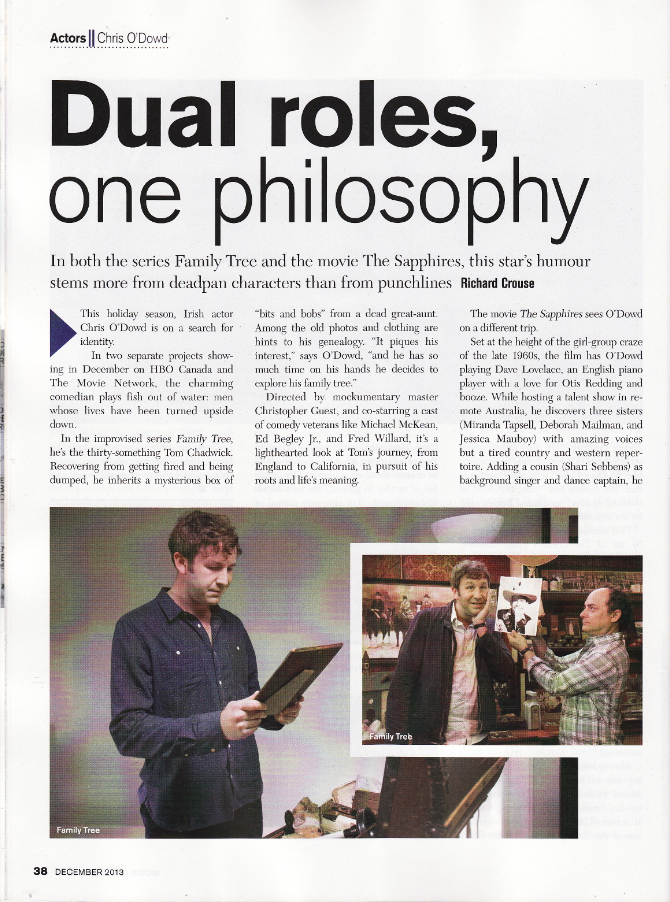
This Christmas season Irish actor Chris O’Dowd is on a search for identity.
In two separate projects airing in December on HBO Canada and the Movie Network the charming comedian plays a fish out of water; men whose lives have been turned upside down.
In the improvised series Family Tree he’s the thirty-something Tom Chadwick. Recovering from getting fired and being dumped, he inherits a mysterious box of “bits and bobs” from a dead great aunt. Among the old photos and clothing are hints to his genealogy. “It peaks his interest,” says O’Dowd, “and he has so much time on his hands he decides to explore his family tree.”
Directed by mockumentary master Christopher Guest, and co-starring a cast of comedy vets like Michael McKean, Ed Begley Jr. and Fred Willard, it’s a lighthearted look at Tom’s journey, from England to California, in pursuit of his roots and life’s meaning.
The movie The Sapphires sees O’Dowd on a different trip…
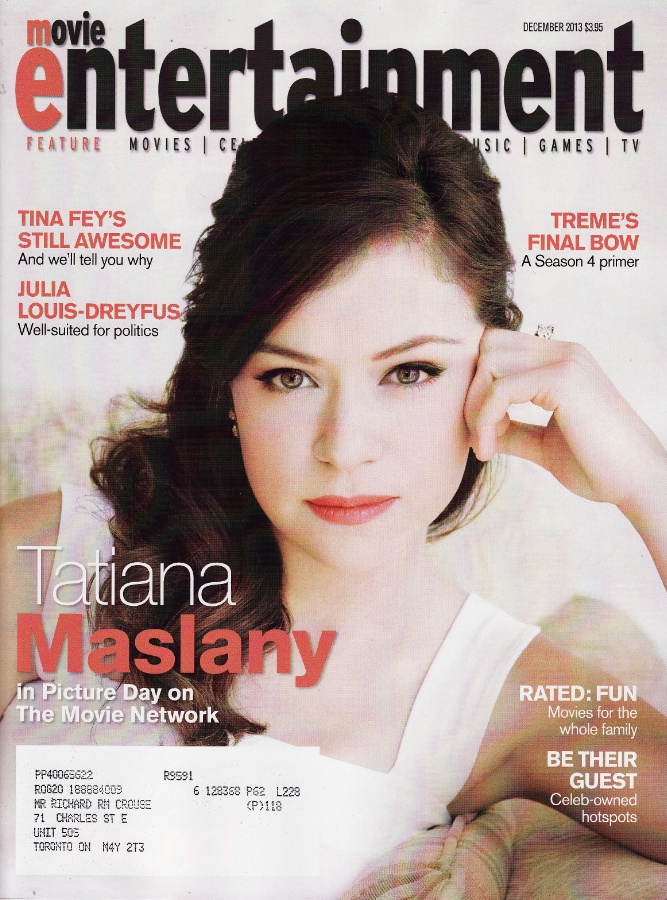
Pick up a copy of the magazine at a newsstand near you to read the whole thing!
In “Friends with Kids” a platonic couple are forced to examine the true nature of their relationship after they decide to have a child with no strings attached. The premise sounds familiar but, like “Bridesmaids” from last year, “Friends with Kids” takes a tired premise in a tired genre and breathes some new life into it.
Writer / director Jenifer Westfeldt also stars as Julie, a hip New Yorker who, like her best friend Jason (Adam Scott of “Parks and Recreation”) is looks at their married-with-kids- friends with a mixture of amusement and disgust. From their point of view their pals have traded freedom for lives of quiet desperation. Worse, when the babies came they all moved to Brooklyn, a seventy-dollar cab ride away.
One night after shots of expensive tequila they decide that even though they aren’t attracted to one another they could still beat the system and have baby “without all the problems that come with marriage.” Their social experiment bears fruit, so to speak, with the birth of their son. They successfully co-parent until jealousies and the possibility of true love rear their heads.
A study of self-centered people afraid to give up their independence “Friends with Kids” is rescued from a sitcom premise by an engaging cast who keep the laughs coming but can also delve into drama when necessary.
Maya Rudolph and Chris O’Dowd play the disheveled and over-tired Leslie and Alex to snarky perfection, while Jon Hamm (Westfeldt’s longtime partner) and Kristin Wiig provide the bulk of the film’s edge. It’s all fun and games until Hamm gets drunk at a dinner party and lets his true feelings about Julie and Jason’s arrangement be known.
It is moments like that which give the movie some depth. The raw emotion on display is uncommon for a rom com like this, but it works. Unfortunately its mostly downhill from there.
The final twenty minutes of the movie reverts to a sitcom-rom com formula, ending with the absolute worst seduction speech in the history of cinema.
It’s not enough to ruin the movie, but the preceding hour was so full of charm, wit and insight, it’s a shame to see it squandered before the credits roll.
At the height of the girl group craze of the late 1960s four Australian Aboriginal teens take a shot at fame. And try not to get shot at.
The year is 1968. Dave Lovelace is an English (Chris O’Dowd) piano player with a love for Otis Redding and booze. While hosting a talent show in remote Australia hosting he discovers three sisters, Cynthia (Miranda Tapsekll), Gail (Deborah Mailman), Julie (Jessica Mauboy), with amazing voices but a tired country and western style repertoire. Adding cousin Kay (Shari Sebbens) as background singer and dance captain, he molds them into the Australian Supremes and gets them their first gigs—in Vietnam singing for the troops.
“The Sapphires” is a feel good movie that succeeds despite the cliché story. It’s based—one imagines very loosely based—on a true story, but make no mistake, this is a Hollywood-ized (filtered through an Australian sensibility) version of the tale.
Authenticity aside, it’s the performances and the music that make “The Sapphires” worth a look. We first noticed O’Dowd on this side of the Atlantic as the charming love interest in “Bridesmaids.” He brings it again in “The Sapphires,” mixing roguish appeal with bang on comic timing.
He’s complimented by the women who each distinguish themselves, even though most aren’t given much to do except sing and dance. As the fiery Gail Deborah Mailman is the standout.
“The Sapphires” is at its best when it embraces its light and fluffy soul. Romances swirl, as do glittery costumes. That’s the good stuff. Less convincing is the examination of race and discrimination. We hear them called “bloody monkeys” by a bigot at the talent show, and there is subplot about Kay’s “stolen” childhood but it feels tacked onto the Motown groove that propels much of the action.
“The Sapphires” is a slight, but entertaining take on the effect of music to change people’s lives.