As the calendar turns the page to 2017 let’s have a look back at the great people I met, wrote about or chatted with in 2016. Warren Beatty gave me his home telephone number, I drank cranberry juice with Denzel Washington, had Elvis’s girlfriend and JFK’s mistress on my radio show and fulfilled childhood dreams by hanging out with Iggy Pop and Cheap Trick. On stages, studios, in hotel rooms, on phones and even in the back of taxis, they spoke and I listened. Here’s some of the best stuff I heard this year:
Casey Affleck on throwing himself into the role of a depressed man in Manchester by the Sea: “It’s what you have to do. You have to go there, show up on set and be prepared to play the scene with the right feelings, the way it is supposed to be. I’m just not good enough to show up in a great mood, say good morning to everybody, check in with the kids and read the paper and then walk into the scene and be believably gutted in the way he is supposed to be. He carries around all this guilt, he’s devastated and filled with self loathing so I have to start way back in preproduction and try to slip into these bad feelings and stay there for as long as I can. If you just showed up and tried to walk through it or do anything but give 100 percent you’d really look like a jackass.”
Warren Beatty talking about casting Lily Collins in Rules Don’t Apply: “I believe very much in what I call ‘the blink,’” says Beatty. “That is the superiority of the unconscious knowledge as compared to conscious knowledge. The knowledge that when we sit and we really give it some thought, the thought we feel it is due. That thought can be misleading when we could have trusted our initial instinct, the blink. I think the unconscious has a lot more intelligence in it than the conscious.
“It was a blink with Lily. I can only say I loved the way she looked. I loved the way she sounded. I loved the way she talked. There was an integrity about her I felt I could believe in this circumstance and at the same time she looked like someone to me who Hollywood would want to exploit.”
Director Uwe Boll on why he’s quitting filmmaking: “I’ve been using my money since 2005 and if I hadn’t made the stupid video game based movies I would never have amalgamated the capital so I could say, ‘Let’s make the Darfur movie.’ I don’t need a Ferrari, I don’t need a yacht. I invested in my own movies and I lost money.”
The Magnificent Seven director Antoine Fuqua on casting Denzel Washington: “I wanted to see Denzel Washington on a horse.” AND “My idea was, if Denzel walks into a room, the room stops. If Clint Eastwood walks into a room, the room stops. Is it because he’s a gunslinger or is it because of the colour of his skin? We’ll let the audience decide.”
Rebecca Hall on playing Christine Chubbuck in Christine: “I don’t think I have given [a role] like it before and I probably won’t again because it is one of those jobs that if you are incredibly lucky you get maybe three of them in a career. And that’s only if you are incredibly successful and lucky and often only if you were a man.”
Jonah Hill on how some people respond to his morally ambiguous characters: “A lot of times Wall Street bros will come up to me as if [Wolf of Wall Street] is their Goodfellas or Scarface. People see what they want to see. It is a little scary sometimes when people misinterpret.” And how he reacted after a crew of South African arms dealers approached Hill in a restaurant after seeing a trailer for War Dogs: “You don’t want to make it an overly uncomfortable environment while that is happening,” he says, “but you also don’t want to lie and be dishonest that you are agreeing with them. You don’t want to make them feel bad about their misinterpretation. It’s an unusual an awkward situation to be sure. In the end, we all want to be seen as heroes in our own story, I guess.”
Isabelle Huppert on the unique tone of her film Elle: “Sometimes you are in a Hitchcock thriller. Sometimes you are in a psychological study. Sometimes you are in a comedy and at the end of the day you are in none of those; you are in a Paul Verhoeven film.”
Riley Keough on what she learned while making American Honey: “I learned not to drink too much.”
Spike Lee on casting Jennifer Hudson as the mother of a slain child in Chi-Raq: “Do you know Jennifer Hudson’s history? It is known knowledge that Jennifer’s mother, brother and nephew were murdered in Chicago. I think that’s extra gravitas that you have with Jennifer Hudson in this film. This is not an act for her. She got hit directly by gun violence on the South Side of Chicago. I didn’t want her to think that I was exploiting her. I knew I wanted her for the part but there was some length of time before I got the courage to approach her. Also, when we did meet I was babbling. She said, ‘Spike, I know why you want me to do this film, so just stop. I’ll do it.’ I was trying to be sensitive and I turned out to just beat around the bush. I said, ‘I’ll just shut up and say thank you.’”
Stan Lee on naming his characters using alliteration —think Peter Parker, Bruce Banner, Matt Murdoch and Reed Richards: “It’s because I have a bad memory. If I could remember one of the names like Spider-Man, if I could remember his first name was Peter then I knew his second name began with a P. That is really the only reason. I have a terrible memory for names and by making the first and second letter the same, if I thought of one name I had a clue as to what the other was.”
T.J. Miller, star of Office Christmas Party: “Let’s talk comedy in a time of tragedy. I have a political obstacle to my social mission statement,” he says. “The social statement was, tragedy permeates our everyday lives, people are lonely, they’re scared, they have death anxiety, they don’t know how to attribute meaning to their own existence, so through comedy we can provide an opiate or distraction that permeates our everyday lives. Through satire we can hopefully frame the world in a way that people can laugh at. Also I aim to help people, through my stand up, to release the death anxiety. I aim to help people not take themselves so seriously.”
Queen of Katwe star David Oyelowo on working with nonactors on the film: “I actually took a bunch of the kids to see Jurassic World while we were doing the film and Madina (Nalwanga), who plays Phiona, sat next to me and was clutching me the whole time, terrified by the movie. She turned to me and said, ‘Is this what we are doing?’ I asked her if she had ever seen a film before and she said no. We were halfway through shooting a film in which she is playing the lead.”
Snowden co-star Zachary Quinto on how says working on Snowden made him think differently about even simple Internet searches: “I had this experience the other night. I was shopping for a washer and dryer online. I was Googling the consumer ratings. I left that search and went to another website and immediately the pop up ads on this other website, which had nothing to do with consumer reports or shopping, were about washers and dryers. What we are willing to sacrifice in our privacy without even thinking about it for convenience sake, what we’re willing to give up in our own freedoms and interests just in sitting down at our computers is shocking. You can take precautions. You can take steps to enact two-step verifications and put tape over your laptop (camera) and strengthen your passwords but all you need to do is shop for appliances and you are exposing yourself to some kind of tracking, a collection of data.”
Arrival director Denis Villeneuve on filmmaking: “It is a privilege when you can take a camera and ask people to sit for two hours in a theatre,” says Villeneuve. “It is nice if you take that privilege to explore something out of our reality, to bring some poetry to it.”
Moon Zappa on how she grew up with a rock star dad: “I longed for structure. When I saw John Hughes films I was, ‘Wait! People sit at a dinner table? Wait! People say sorry?’ Even to this day when I see somebody with a sweater draped over their shoulders, or a loafer or an exposed ankle, I’m like, ‘That is so exotic.’ I think if I had grown up in the repression my father encountered I would also have put two rocket boosters on my back, but growing up like that was too much. It was like fastball pitches every single minute.”
Most of these interviews went well and were a pleasure to do… but not all. Below is the terrible tale of a day wasted waiting for Idris Elba’s phone call.
Can You Hear Me Now? Can You Hear Me Now? Waiting For Idris Elba.
Idris Elba is a busy man. He’s released seven movies this year and has several more on tap for 2017. He’s on track to join Dwayne Johnson, Jennifer Lawrence and Leonardo DiCaprio as one of the world’s highest earning actors after turns in the mega-grossing The Jungle Book, Finding Dory and Zootopia.
If you don’t know the name you haven’t been paying attention. Rev up Netflix and check out his work on TV shows like The Wire or Luther and movies like RocknRolla or Beasts of No Nation and become a fan. You should know he was once voted one of People magazine’s 100 Most Beautiful People in the World and more than one twitter friend of mine refers to him as a “pretend boyfriend.”
Not only busy but good looking as well! I was pleased to be granted a fifteen-minute phone interview to discuss his debut in the Star Trek franchise as Krall, a hostile alien who causes trouble for Kirk, Spock and company in Star Trek Beyond.
I don’t usually write questions but I thought I might ask him if he watched Star Trek as a child. Would he consider himself a Trekker? Did he have a favourite Star Trek character growing up? Did he wonder what Star Trek fans would think of the predatory new character? Are there parallels between the film—and his character—and our world today? Has he considered what being part of the legacy of the show means?
If there was time at the end I might even follow up on the rumours and ask if he even wants to play James Bond.
Then the first call came in. “Idris is running behind.” Cool. This happens all the time on press days. Then another call and another and another. My phone hasn’t gotten this kind of workout since a Nigerian Prince called over and over to solicit my assistance in moving his fortune to North America. Each time a publicist announced another delay with the assurance the interview would still happen. As the time wore on the actual length of my interview began to tumble downhill from fifteen minutes down to seven.
In all two hours passed from my scheduled start time until my phone rang for real.
“Hi Richard, I’ll connect you with Idris,” said the perky voice on the other end of the line.
Silence.
A minute passed before Elba’s familiar husky London accent filled my ear. Hallelujah! Better late than never. We talk over one another. “Hello… HELLO… Can you hear me?” It’s a bad cell phone connection. It sounds as if we’re talking through two tin cans connected by strings but I’ll take it.
I ask him about his childhood memories of Star Trek.
“It was a show me, my mum and my dad watched together,” he says. “They both liked it. It was a show that really took your imagination places. That’s my early memory of it. It was a really imaginative show that showed space travel in a way that was different, you know?”
It took him 23 seconds to speak the 50 words that told me his parents liked Star Trek. I mention this because as soon as he stopped talking and I started asking the next question I heard a strange beep beep sound followed by… nothing. The great void. No more husky voice. And like that, poof. He’s gone.
“Are you still there? I think we just lost him,” the eavesdropping publicist said. “Let me get him back for you. Just one second.”
I had visions of the actor walking around Fifth Avenue desperately yelling into his phone, “Can you hear me now? Can you hear me now?” but in my heart I knew that wasn’t happening.
Minutes later she’s back. “I’m so sorry. We lost him. I know you only had a couple of minutes to speak with him…” actually it was twenty three seconds… “Thank you so much for taking the time to speak with him.”
My interview with Idris was over. Still born. Terminated before it even really began.
Was I mad? Not really. Frustrated? Yes. Not only had I wasted the afternoon waiting for Idris but now I didn’t have a story to file.
My friends on social media didn’t exactly see it my way. “What do you expect?” wrote one person. “He is the hottest man alive.” Another chose to look on the bright side. “That’s 45 seconds more Idris than the rest of us.” (I hadn’t yet timed the actual quote when hit facebook to vent.)
In the end it’s not a big deal. I’m choosing to look at the bright side. I didn’t get to chat with him but I do have a contender for the Guinness Book of World Records for Shortest (And Least Satisfying) Interview Ever.
Why did director Antoine Fuqua decide to remake the legendary 1960 western The Magnificent Seven? “I wanted to see Denzel Washington on a horse,” he jokes.
The story of seven men who come together to protect a town from a vicious robber baron looks back further than the 1960 film to the 1954 epic Japanese historical drama Seven Samurai. Often cited as one of the greatest films ever made, Akira Kurosawa’s Seven Samurai provided what Fuqua described as the DNA of his film, but he also noted, “Westerns change with the time we’re in, so we made our film based on the world we are living in.”
To that end he has assembled the most diverse cast for a western ever. In addition to top billed stars Washington, Chris Pratt, Ethan Hawke and Vincent D’Onofrio the seven magnificent leading actors include South Korean star Lee Byung-hun, the Mexican born Manuel Garcia-Rulfo and Martin Sensmeier, an American actor of Tlingit, Koyukon-Athabascan and Irish descent.
“You can’t do the same thing every era,” says Fuqua. “Westerns change all the time. If we were sticking to just one way of doing something then all westerns would be all white guys looking like John Wayne in a John Ford movie.”
“My idea was, if Denzel walks into a room, the room stops,” he says. “If Clint Eastwood walks into a room, the room stops. Is it because he’s a gunslinger or is it because of the colour of his skin? We’ll let the audience decide.”
When asked if The Magnificent Seven is proof that Hollywood is becoming more diverse the director says, “You have to give the studio credit when they do something like this. This becomes the new definition of what a western is.”
Chris Pratt, who plays gunslinger Josh Faraday says despite the film’s title The Magnificent Seven has more to do with another well known western.
“I don’t know how many movies there are in the world,” he said at the TIFF opening night press conference. “What would you guess, several hundred thousand? Millions? Eventually you just run out of names. If I have a son and name him Chad, is he a remake of somebody else who was named Chad? No. We could have called this The Cowboys or something, but [The Magnificent Seven title] has reach,” he continued, “it gets people engaged. But [this movie] is probably more Wild Bunch than it is [1960’s] The Magnificent Seven. We use the title, we use the story. It’s a bunch of guys. There are seven of us. And we’re all [bleeping] magnificent. We’ve got that going for us, but let that movie be that movie. This is a different movie.”
Star Denzel Washington says he’s never seen the 1960 film. “I didn’t keep away from it,” he says. “I just didn’t know how it would help me. I had never seen it as a kid or whatever. People say, ‘You’re the so and so character,’ I don’t even know who that is. I think it allowed me to do whatever I wanted to do instead of trying to not do what someone else did.”
Why did he sign on? “Well, Antoine asked me. It’s as simple as that. Obviously, it’s a good story and a good script but most importantly it was Antoine.”
Director Antoine Fuqua’s remake of “The Magnificent Seven” literally starts with a bang.
A series of mine explosions echo through Rose Creek, signalling unrest in the tiny mining town. Bartholomew Bogue (Peter Sarsgaard) has taken over, terrorizing the town with hired goons. He’s a cruel man who guns down citizens and says to his henchmen, “Leave the bodies where they lie. Let them look at them for a few days.” Bad Bart wants the land but is only will to pay a pittance per parcel. “Those of you who signed the deeds will get your $20,” he sneers. “And those who don’t, God help you.”
The townsfolk are helpless. Bogue has killed a half dozen men and with the sheriff on his payroll will continue to do as he pleases. Fed up and recently widowed, Emma Cullen (Haley Bennett) turns to hired gun Sam Chisolm (Denzel Washington) for help. “You don’t need a bounty hunter,” he says, “you need an army.” Despite the massive odds against them Chisolm assembles a rag tag team of killers, gamblers and outlaws—Josh Farraday (Chris Pratt), Goodnight Robicheaux (Ethan Hawke), Jack Horne (Vincent D’Onofrio), Billy Rocks (Byung-hun Lee), Vasquez (Manuel Garcia-Rulfo), and Red Harvest (Martin Sensmeier)—to go up against the ruthless robber baron in what promises to be a better than OK gunfight at the corral.
“The Magnificent Seven” is a classic looking western with a modern pace. Fuqua chooses not to mess with the key oater elements. He papers the screen with acres of open land, seven tough men, one or two resilient women and a sea of cowboy hats. He is respectful to the form and doesn’t try to bring the genre into the twenty-first century with frenetic editing—I’m looking at you Timur “Ben-Hur” Bekmambetov—or contemporary language. It’s a western, with all that entails; good vs. evil with some moral ambiguity thrown in for good measure.
Also thrown in for good measure is a heap of star power. Washington is a cool character, quietly deadly. He says cool stuff—“Chisolm, should I know that name?” he’s asked. “You should know it from your obituary,” he replies.—and is the movie’s charismatic center. Chris Pratt’s easy charm gives Washington a run for his money, but this is really Denzel’s movie from top to bottom.
Hawke and D’Onofrio do interesting character work. As the shell-shocked Robicheaux Hawke is equal parts swagger and skittishness while D’Onofrio is practically unrecognizable as the squeaky-voiced Jack Horne.
The remaining member of the seven aren’t given much to do other than pull triggers and nod in agreement to Chisolm’s plans, but they are an interesting bunch nonetheless.
At a little over two hours “The Magnificent Seven” could be leaner and well, maybe not meaner—I would not be surprised if it had the highest body count in a western ever—but tighter. There is a mid-movie sag as the plans for the final shootout are being finalized but the ballet of bullets at the end is epic, if not a little excessive, putting a fitting cap on a story that is slight but entertaining for most of the running time.
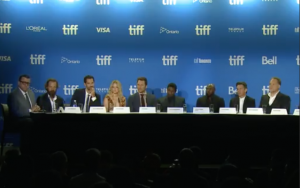
Richard hosts the “Magnificent Seven” TIFF press conference with (from left to right) Richard, Peter Sarsgaard, Manuel Garcia-Rulfo, Haley Bennett, Chris Pratt, Denzel Washington, Antoine Fuqua, Ethan Hawke, Vincent D’Onofrio, Lee Byung-hun and Martin Sensmeier.
At the beginning of “The Equalizer,” a remake of the cult 1980s television show, Robert McCall (Denzel Washington) pontificates on “The Old Man and the Sea,” summing up Hemingway’s take on human nature.
“The old man gotta be the old man,” he says. “The fish gotta be the fish. Got to be who you are in this world no matter what.”
Of course this is a movie, so he’s actually talking about himself and not Ernest’s adversarial fisherman.
Washington plays a home improvement store worker by day, righter of wrongs by night. He’s a former black ops commando trying to leave his violent ways in the past but just when he thought that part of his life was over, the Russian mob leans on him because he tried to protect a young woman (Chloë Grace Moretz) from her violent pimp.
When he singlehandedly wipes out the east coast wing of the Russian mob Teddy (Marton Csokas), an enforcer from Moscow arrives to put an end to McCall’s one man search for justice.
“The Equalizer” is more elegant than Liam Neeson’s recent action movies but less viscerally satisfying. All the elements of Neeson’s Euro-trash thrillers are in place—tattooed bad guys and the “seasoned” hero with a “special set of skills”—but the pace is much slower.
The point of the story is that McCall equalizes situations, using his talents to help the down trodden but it takes about thirty minutes before any settling of scores happens. We meet McCall, learn about his orderly life—his shirts are immaculately pressed, he likes to read the classics and is particular about the placement of cutlery at his local diner—but we don’t learn anything about his past. He’s Denzel and ergo, a badass, but the first thirty minutes of this movie could have snapped things up a bit by illuminating his past.
The slow burn does build some tension, and by the time McCall unleashes hell on the Russia mobsters it comes as a bit of a catharsis. Now the movie is rolling! Except that it isn’t. It takes ages for McCall to open another can of whoop ass. Instead director Antoine Fuqua has elected to gradually build up to a wild showdown in a massive hardware store. Who knew those places were so dangerous? The climax is tense and inventive, apparently there is no home improvement device that cannot be turned into a WMD, but it is a more standard blockbuster-movie ending than you might expect from a movie so stingy with the action in the first hour.
It’s a good movie and Denzel is, as always, charismatic and interesting, but if “the old man gotta be the old man,” then “The Equalizer” gotta be more of an action movie to be completely satisfying.
As soon as I saw the name of director Antoine Fuqua in the opening credits I sensed that “Brooklyn’s Finest” probably wasn’t going to celebrate the up side of policing in the NY borough. The “Training Day” director is a specialist when it comes to portraying dirty cops on screen, and here he showcases the “finest” policemen in Brooklyn’s 65th precinct, that is, if by “finest” you mean alcoholic, angsty, murderous and suicidal.
Mixing three stories Fuqua introduces Sal (Ethan Hawke), Eddie (Richard Gere) and Tango (Don Cheadle), three cops at different stages of their careers. The only thing that connects them is a station house in the 65th Precinct and severe dysfunction. Sal is a narco cop, tormented by the things he must do to support his growing family. Eddie is a burn out who clearly hasn’t taken his own advice of “not taking the job home” after work and Tango is an undercover cop who is close to being consumed by the job. The three struggle both personally and professionally until a fateful night when they end up in the same apartment block.
The bad cop drama became popular in the seventies and with only a few tweaks story wise has persevered to this day. Fuqua focuses on three characters straight out of Central Casting—the cop with nothing to live for, who is just days away from retirement, the policeman who turns bad to make extra money to help his family and the undercover officer who gets too close to the criminals he is supposed to arrest.
Clichés one and all, but the bad cop genre is one big gun toting cliché, and like romantic comedies, another formula based species, the trick is to make the characters as interesting as possible to disguise the banalities of their story arcs. On this score “Brooklyn’s Finest” is two thirds successful.
First, the good. Don Cheadle takes a hackneyed character—the angry street cop—and gives him some fire; a cliché, yes, but an unpredictable one. Cheadle deserves better material than this but he makes the best of it.
Ditto Ethan Hawke who can do desperate on-screen as well as any actor working today.
The weakest of the three is Gere’s Eddie. Gere isn’t an exactly magnetic actor at the best of times but here he simply isn’t believable as a man who wakes up, has a shot of scotch with a gun barrel chaser. The early morning drinking and pseudo suicide attempts are meant to give us insight into the character but come off as tired images recycled from better movies.
“Brooklyn’s Finest” is not a return to form for Fuqua after the career high of “Training Day” nine years ago and the professional sink hole he’s been in ever since.