Wondering what “Kidnapping Mr. Heineken” is all about? The title says it all, which is too bad because it feels like they left out the most interesting part of the story.
Set in 1982, this true crime drama stars Sam Worthington as Willem Holleeder, Jim Sturgess as Cor van Hout, Ryan Kwanten as Jan Boellaard and Mark van Eeuwen as Frans Meijer, down-on-their-luck owners of a construction company. To raise some quick cash they turn to a life of crime and kidnap one of the richest people in the Netherlands, Freddy Heineken (Anthony Hopkins), chairman of the board of directors and CEO of Heineken International. They’re chuffed when the news refers to them as dangerous, professional crooks but amateur mistakes and personality clashes ultimately put an end to their newfound criminal careers.
Since this is based on true events, the movie ends with updates as to what all the characters got up to after the kidnapping caper. Some went to jail, one escaped from a mental institution and fled to Paraguay while Holleeder and van Hout went on to become the notorious Godfathers of the Netherlands, as in Dutch crime kingpins. That sounds more interesting than the kidnapping story and yet it is only alluded to in the film’s closing moments.
Instead we’re told a movie-of-the-week kidnapping story about a group of wannabes torn apart by greed and paranoia. Heineken, trying to get under the skin of his captors, tells them, “There are two ways to be rich in this world. You can have a lot of money or you can have a lot of friends—but you can’t have both.” He’s right. The 35 million guilder ransom cleaves the tight knit group, but despite the film’s prominent heart-pounding score, there’s no real drama to much of it. There are car chases and rubber masks, which all feel like movie action circa 1982 when the film is set, but the story is as flat as an open Heineken left in the midday sun.
The spooky new supernatural thriller Deliver Us From Evil sees Eric Bana play a jaded NYC police officer. “I’ve seen some horrible things,” he says, “but nothing that can’t be explained by human nature.”
That changes when he meets a renegade priest (Édgar Ramírez) who convinces him a plague of demonic possession has infected the Big Apple. Working together, they combat the evil forces with exorcism and faith.
Deliver Us From Evil is based on a nonfiction book of the same name authored by Ralph Sarchie (with Lisa Collier Cool), a sixteen-year NYPD veteran who investigates “cases of demonic possession and (assists) in the exorcisms of humanity’s most ancient—and most dangerous—foes,” in his spare time.
“Before going out on a case,” he writes, “I put aside my gun and police badge and arm myself with holy water and a relic of the True Cross.”
Sarchie’s story joins a long list of exorcism movies with roots in true events.
The Exorcist, the granddaddy of all demon possession movies, is based in part on the 1949 case of an anonymous Maryland teenager dubbed Roland Doe. He was determined by the Catholic Church to be under a diabolical spell when strange things started happening — levitating furniture and holy water vials crashing to the ground — after he played with a Ouija board.
Exorcist author William Peter Blatty first heard about Doe’s story when he was a student at Georgetown University in Washington, D.C. in 1950. He drew from newspaper reports and a diary kept by the attending priest, Fr. Raymond Bishop, as the backbone of his novel.
The character of Father Lankester Merrin, the elderly priest and archeologist played by Max von Sydow in the movie, was based on British archaeologist Gerald Lankester Harding. Blatty said Harding “was the physical model in my mind when I created the character, whose first name, please note, is Lankester.”
In recent years hits like The Rite, starring Anthony Hopkins as a real life exorcist tutor, and The Exorcism of Emily Rose with Tom Wilkinson as a priest accused of murder when a young woman died during an exorcism, are based on true events.
Finally in The Possession, a haunted antique carved “Dybbuk” box — containing an evil, restless spirit — turns the behaviour of a young girl (Natasha Calis) from angelic to animalistic. The owner of the real-life box offered to send it to producer Sam Raimi but the filmmaker declined. “I didn’t want anything to do with it,” he said. “I’m scared of the thing.”
According to Genesis God said to Noah, “I am going to put an end to all people, for the earth is filled with violence because of them.”
Noah, a righteous man, was commanded to build an ark and stock it with “two of every kind of bird, of every kind of animal and of every kind of creature that moves along the ground will come to you to be kept alive.”
For forty days and forty nights Noah, his family and precious cargo withstood a flood so severe it submerged the tops of mountains until “every living thing on the face of the earth was wiped out.”
Once the flooding stopped and the Earth dried, God commanded Noah to come out of the ark and release the animals, “so they can multiply on the earth and be fruitful and increase in number on it.”
The story of Noah’s Ark and the flood is one of mankind’s most famous tales and Hollywood has retold it a number of times.
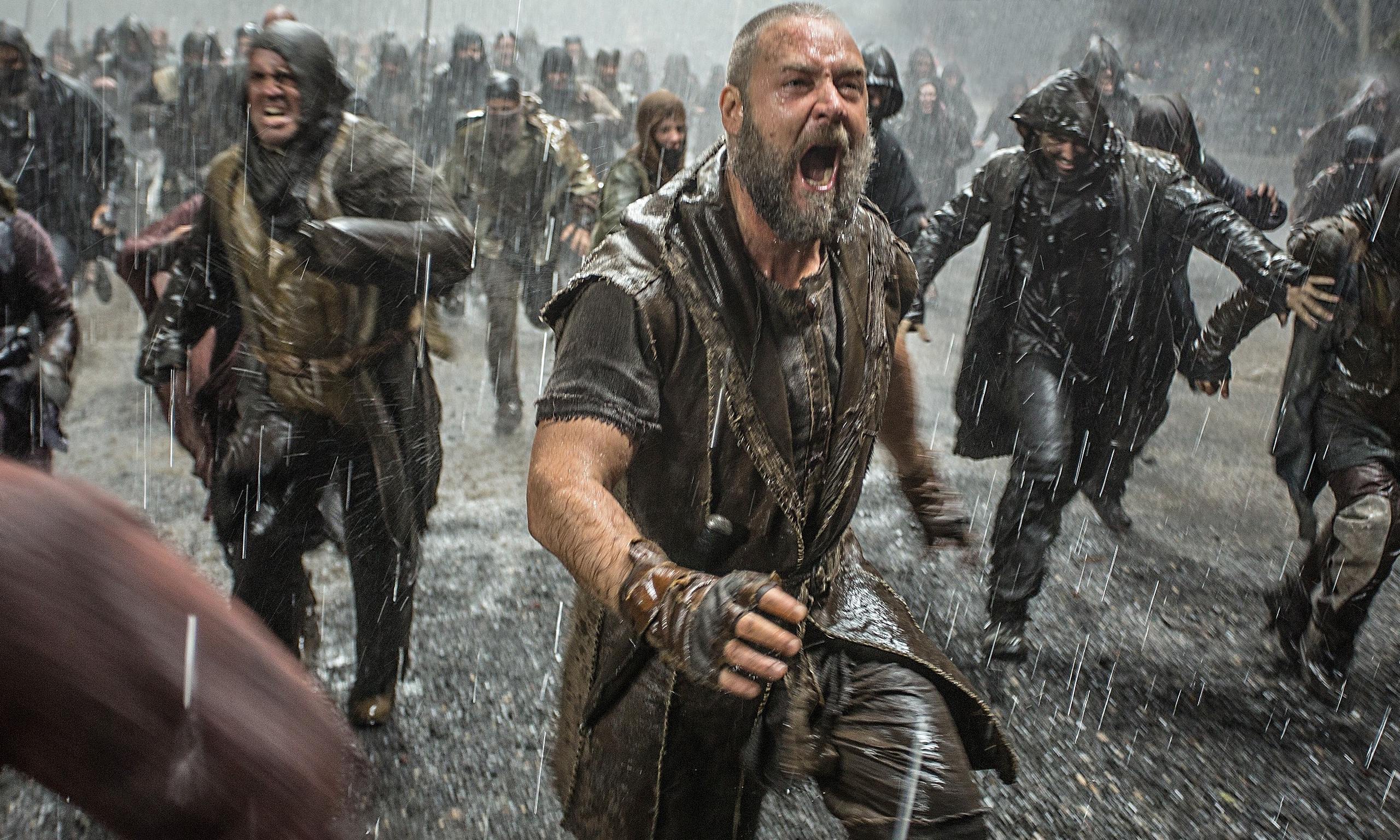
This weekend Russell Crowe plays the title role in Noah, co-starring with Jennifer Connelly, Anthony Hopkins and Emma Watson. Director Darren Aronofsky says he has been obsessed with the story since he was thirteen, calling it “the first apocalypse story.” Nonetheless, he has added his own spin to the tale.
“When we first started working on the project, we were very clear not to have sandals and robes and long white beards,” he told Rolling Stone. “The first thing I said to Russell Crowe was, ‘I’ll never shoot you on a houseboat with two giraffes standing behind you.’”
More traditional are two Disney short films. Father Noah’s Ark is a 1933 “Silly Symphony” for children that tells the narrative in song. Lively animation shows how the animals may have helped build the ship and why skunks almost didn’t make it on board.
In 1959 Disney released the twenty-minute Noah’s Ark, their first stop motion animated film. A jazzy score accompanies equally jazzy animation as pencils, pipe cleaners and other household items are inventively used to create the animals.
Shooting the flood scene in the 1928 version of Noah’s Ark endangered the life of a future Hollywood icon. John Wayne was a swimmer in the famous scene, and emerged unhurt, but other weren’t so lucky. Three extras drowned and a dozen others suffered broken limbs.
Finally, a 1977 documentary claims to shed some light on the real story. In Search of Noah’s Ark is an investigation into the speculation that Turkey’s Mt. Ararat in is the landing place of Noah’s Ark. “This may be the most incredible film you will ever see,” says narrator Brad Crandall, “but the facts that will be presented are true.”
Playing Odin, the one-eyed king of Asgard and father to the main character in Thor: The Dark World, was a part time job for Oscar winner Anthony Hopkins.
“I was doing another movie at the same time, Red 2 with Bruce Willis,” he says. “So I didn’t know where I was. Sometimes, while I was waiting for the pick up I’d wonder what I was doing that morning. Today I’m with Bruce until 4 o’clock in the afternoon and then go do a little bit of Thor.”
Although he says Thor’s Marvel comic book roots “is a world that is alien to me” he relished the chance to play Odin for one simple reason. “I love acting,” he says.
“It’s interesting, you go from one actor in a different kind of movie to playing a god in another. I love it.
“People always ask me this, ‘What drew you to the part?’ I say, ‘Well, they offered it to me.’
“The generic answer is, I just like to work. I can’t analyze why a part is good or not. Dress me in the armor and cloak and it makes me look handsome, I guess. I hope.”
He adds the new film “feels different, in a good way,” from the original 2011 installment. “No better, no worse, just different. More earthbound because we filmed in England and the weather is always very dreary and grey there. That’s why I live in California.”
In the first “Thor” movie Marvel superhero (Chris Hemsworth) and his magical hammer fell in love with Natalie Portman, argued with his father Odin, the one-eyed King of Asgard (Anthony Hopkins) and saved Earth from the super chill Frost Giants.
This time around he’s still in love with Portman (who plays astrophysicist Jane Foster) and fighting with pops but now he must not only save Earth but all Nine Realms from an ancient enemy.
Led by Malekith (Christopher Eccleston) these evil Dark Elves have a bone to pick with Odin. Thousands of years ago Odin’s father banished the Elves and seized their secret weapon, the Aether, a deadly WMD with the power to destroy the universe. Unable to extinguish the Aether the folks of Asgard bury it in a secret location “between the realms.”
Eons later Thor’s girlfriend Foster discovers the Aether in an abandoned warehouse in London, attracting the attention of the vengeful Malekith and his army of angry Elves.
You know what comes next. Hammer time! Thor makes a deal with his untrustworthy (but undeniably compelling) brother Loki (Tom Hiddleston) and hatches an elaborate plan to save Jane, defeat the Dark Elves and save the universe from the Aether.
“Thor: the Dark World” is a much better movie than 2011’s “Thor.” The love story that bogged down the middle of the first movie is replaced with more double crosses, vengeance and daddy issues into its two hours than any three Norse myths.
There’s a lot going on, but “Game of Thrones” director Alan Taylor nimbly juggles the mythology and the action, peppering the movie with amusing cameos from Stan Lee and a certain other superhero and some light comedy.
It feels slightly generic, as though bits and pieces were cribbed from the Superhero Blockbuster Playbook, but redeems itself in the inevitable showdown between Thor and Malekith. It’s wildly entertaining as they zip to and fro through wormholes, literally punching one another into next week—or at least into a new dimension. It’s tighter and way more fun—check out Thor on the subway!—than the endless dustup that bogged down the last forty-five minutes of “Man of Steel.”
Hemsworth and Hiddleston, the film’s yin and yang, are charismatic and while they don’t do anything much different than they did in the first movie or in “The Avengers,” they both seem to really grasp the film’s semi-serious tone.
“It’s not that I don’t enjoy our little chats,” Loki says to Odin. “It’s just… that I don’t.” It’s a good line and Hiddleston delivers it with perfect timing, half villain, half comedian.
Unless you’re a comic book geek you might need a quick trip to https://marvel.wikia.com/Thor to make sense of the first twenty minutes of “Thor: The Dark World” but once the movie gets the exposition out of the way and gets into the gags and the action it hammers home the good stuff.
Despite starring in two movies based on a Marvel hero Natalie Portman says, “I’ve never gotten in to comic books.”
This weekend she reprises the role of Jane Foster, scientist and love interest to the God of Thunder in the Thor: The Dark World.
Portman may not have spent time reading comics but she can understand the obsession fans have with Thor’s characters because she was once a fangirl herself.
“The one thing I ever got into like that is really dorky,” she says. “Until I was twelve or thirteen I was obsessed with the Babysitter’s Club, a series of books for girls. There was a new book every month and the day the book would come out I had to go to the bookstore and get it and read it on the way home.
“The writer’s name was Ann M. Martin and my friends and I would look in the phone book and call every Ann Martin trying to get her.
“One time she came to our bookstore and did a signing. The week before I wrote a packet about what her next book should be about, with drawings, and I waited in line for three hours and gave it to her and she was like, ‘OK weirdo.’”
Playing heroine Jane Foster is miles away from her Academy Award winning role in the dark psychological drama Black Swan. Portman admits she “never thought I’d get the chance” to act in a superhero movie, “which is why whenever they ask I say yes.”
Also appealing is the chance to work with Anthony Hopkins, who she describes as “a giant among actors.” She shares several scenes with the veteran actor and says she was “completely intimidated” by him.
“I kept messing up lines around him because I was so nervous but he was so sweet about it. He’d say, ‘That’s a really hard line to say.’”
Many of her scenes with Hopkins take place on Asgard, the celestial planetoid home to Thor and family, which raises the question, Do you believe there is life on other planets?
“That question makes me think of another movie. In Antz all the insects are around a campfire,” she says, laughing, “and they say, ‘Do you think there’s something bigger than us out there?’
“It totally feels like that. Of course there has to be something else out there. I don’t know what it is but it would be completely silly to think that we’re ‘it.’”
Thor: The Dark World opens in theatres, bringing with it Chris Hemsworth as the sledgehammer wielding superhero with his rippling muscles, crazy mythology and Dark Elves.
The Marvel comic series borrowed the character from Norse mythology, coopting the God Of Thunder’s most famous weapon, the Mjölnir. In myth the name translates to “that which smashes,” and refers to his hammer, a fearsome club capable of leveling mountains, causing lightning flashes and boomeranging back when he throws it.
“The power within Mjölnir,” he says, “doth rage like the winter storms bursting upon the shore in furious assault!”
According to Nordic legend the mallet was forged by dwarven brothers Sindri and Brokkr but Marvel embroidered the lore, adding to the story the fictional Asgardian metal uru as the main component of the basher and an inscription that reads, “Whosoever holds this hammer, if he be worthy, shall possess the power of Thor.”
The image of Thor flying through the air, propelled by Mjölnir, is the iconic picture from the comics and movies, but not from mythology.
According to legend Thor’s preferred mode of transport was a chariot drawn by two 1700-pound warrior goats named Toothgnasher and Toothgrinder. But they didn’t just provide transport, they also frequently provided dinner as well—literally.
After a long day of battle a tired Thor would be too tired to hunt for food, so he’d kill and eat the goats. When he was done, he’d carefully wrap the bones in their pelts, wave Mjölnir over the bloody mess, and before you could say “By the Hammer of Thor!” the goats would come back to life, ready for more adventures.
In the comics Thor has unlimited power when it comes to controlling the mighty hammer, unlike in mythology where he often used a magical belt called a Megingjörð and iron gloves to give him the strength to employ Mjölnir to its full effect.
The hammer has also had an influence outside of the movies, mythology and comics. The sci fi show Stargate SG-1 used the Mjölnir as a plot device, The Thor’s Hammer Organization are the bad guys of the Silent Storm video game series and the dramatic lyrics “And out of the forge of dwarfs, To hold in your hand now, And for evermore, I give you the Hammer of Thor,” came from the Viking folk rock band Týr.
Here’s the dilemma: You’re a young assistant DA who is something of a wizard in the courtroom. In your last case before leaving public service for a high paying job at a fancy legal firm you are faced with a man who is clearly guilty, but you just can’t put your finger on the crucial piece of evidence that will put him on death row. How far do you go to put him behind bars? Such is the question facing Oscar nominated Canadian Ryan Gosling in the new courtroom thriller Fracture.
Fracture doesn’t exactly break new ground in the legal drama genre—Primal Fear, also from director Gregory Hoblit, tread the same ground a decade ago—but there’s no grounds for a dismissal either. The movie’s premise may be a little frayed around the edges and the are more than a couple of fissures in Fracture’s plot, but the performances of the film’s leads, Gosling and Anthony Hopkins, make it worth the price of admission.
Hopkins plays Ted Crawford, a wealthy aeronautical engineer, who discovers his wife is having an affair. When she returns home one night after some afternoon delight with her cop lover, Hopkins calmly and coolly shoots her in the face. The police arrive, he confesses and is arrested. It should be an open and shut case, but of course there’d be no movie if it were that simple. What may look like a crime of passion was actually a well thought out execution, and difficult to prove.
Hopkins plays Crawford as though he was portraying Hannibal Lecter’s creepy brother—he’s cunning, has a genius level IQ and an annoying condescending tone. When he bests Gosling’s smarty-pants Willie Beachum in a game of wits, he sneers by way of consolation, “Even a broken clock gets the time right twice a day.”
There is an echo of the Lecter – Starling tension in the interaction between Hopkins and Gosling, and while nothing in this movie comes close to the atmosphere of dread in Silence of the Lambs it is fun to watch these two great actors spar.
They really are the main reason to see Fracture. The big twist at the end is pure Jessica Fletcher and not particularly shocking—anyone schooled in the Law and Order brand of courtroom maneuvering could figure out Beachum’s next move before he does—but the stylishly shot movie does offer interesting character studies and a satisfying finale.
At one point in “Hitchcock,” the master of suspense (played by Anthony Hopkins), says, “Audiences want to be shocked—they want something different.” He’s referring to the content of “Psycho,” his ground breaking 1960 horror film, but while 2012 audiences may not be shocked by the content of this new biopic, they will get something different. At least if they are expecting a blow-by-blow of the shooting of the story of Norman Bates and the infamous shower scene. It’s not a retelling of the making of a movie it’s the story of the most important relationship in Hitch’s life.
Following the release of “North by Northwest” Alfred Hitchcock was struggling to make a change from the big budget, elegant thrillers he was known for to something shocking. Trouble is, nothing grabbed his attention. Novels sent over for his approval are dismissed as “sleeping pills with dust jackets,” until he picks up a down-and-dirty book by Robert Bloch called “Psycho.” It’s “low budget, horror claptrap,” says his wife Alma (Helen Mirren), but he’s determined to make it, even if he has to pay for it himself.
That’s the Hollywood portion of the movie, the part Hitchcock would have called “MacGuffin,” the story element that gets the rest of the plot in gear, but isn’t terribly important to the overall story. The main thrust of the movie is Hitchcock’s quest to be relevant, to take risks, to be free—like he was before the fame—and the effect this has on his relationship with Alma.
Based on Stephen Robello’s book “Alfred Hitchcock and the Making of Psycho,” “Hitchcock” is a fast-paced and surprisingly touching marital drama peppered with lots of insider Hollywood legend.
We learn about Hitch’s troubled relationship with Vera Miles (Jessica Biel) who chose motherhood over the director’s offer to make her a star. We see his cordial relationship with Janet Leigh (Scarlett Johansson), who says, “Compared to Orson Welles, he’s a sweetheart,” and get an up-close look at familiar Hitchcock themes of voyeurism, sexual repression, betrayal, obsession and identity.
What is unexpected is the depth of the relationship between Hitch and Alma. She is seen her in a professional capacity as an assistant director, screenwriter and editor, but it is as muse, lifeblood and lone redhead in the sea of blondes that so bewitched Hitch, which is the most important part of the story.
The role of Alma is underwritten, but Mirren brings it to vibrant life, creating a character that is not supplemental to Hitchcock’s success, but the very reason for it.
It is Hopkins, however, who has the most fun here. There’s a playfulness in the performance from the fourth wall breaking narration that opens and closes to the movie to the little ballet he does as he listens to the opening night audience shriek and scream to the infamous shower scene.
Hopkins doesn’t exactly look like Hitchcock but gets the essence in a buoyant performance that betrays the fun the actor must have had creating it. He has the movie’s best lines—“I only wish (“Psycho” inspiration) Ed Gein looked more like William Holden and less like Elmer Fudd,” he says to reporters.”—but also provides many subtle shadings of the sadness Hitchcock carried with him. It is a performance that ironically could earn the Oscar that was denied to the director during his lifetime.
“Hitchcock” is a stylish film that pays homage to not only “Psycho,” but to Hitchcock’s other films, most notably the umbrella scene in Foreign Correspondent, but is also a tribute to one of the great film partnerships in Hollywood history.