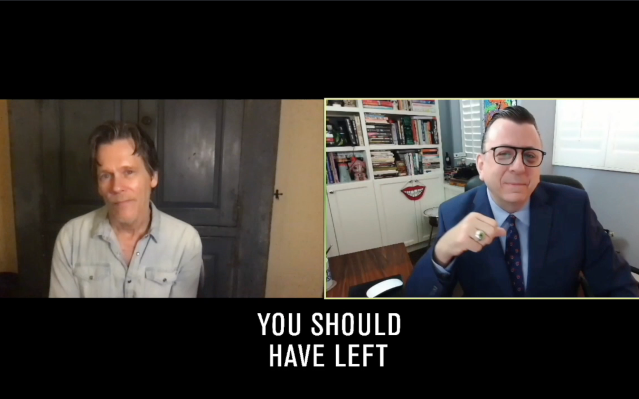
Richard Zooms with “You Should Have Left” star Kevin Bacon. They talk about the movie’s portrayal of psychological drama, what dreams really mean and why the movie is more timely now than when they filmed it. Then Richard asks the “Footloose” star about Ontario’s recent “no dancing, no singing” on patios rule.
YOU SHOULD HAVE LEFT SYNOPSIS: What should have been a distraction free vacation at a remote house in Wales for husband and wife Theo (Bacon) and Susanna Conroy (Amanda Seyfried) and daughter Ella (Avery Tiiu Essex), turns out to be anything but when their “simple sanctuary” morphs into something sinister.
What should have been a distraction free vacation at a remote house in Wales for husband and wife Theo (Kevin Bacon) and Susanna Conroy (Amanda Seyfried) and daughter Ella (Avery Tiiu Essex), turns out to be anything but when their “simple sanctuary” morphs into something sinister.
Susanna is a busy actor; Theo is a rich banker starting a new life and family after his first wife died under mysterious circumstances. Feeling the need for quality time, they jet off to Wales to spend a week in the country. The rental house is even more beautiful than the on-line pictures. “It’s bigger on the inside than outside,” Theo marvels as they walk into the majestic foyer. There’s no cell service and the place is stark, stripped of all the owner’s personal touches, but Ella’s bedroom has a bed “the size of Connecticut” and all seems well.
At first.
Soon, doors open by themselves and Theo discovers a hallway that appears to be a place where time stands still. Then, the strange dreams begin. Before long Theo’s nightmares spill over into his waking hours as reality and dreamland become harder and harder to differentiate. Tensions flare, and after a fight Susanna leaves to cool off, leaving Theo and Ella in the house alone overnight.
It’s then that things get really weird. The house seems to adhere to the wonky laws of physics as written by M.C. Escher. One room is five feet longer in the inside than the outside and the home’s long hallways are interconnected in ways designed to entrap and confound anyone unfortunate to find themselves stuck in their seemingly endless maze.
As Theo tries to keep Ella safe, he finds an ominous note scrawled in his diary. “You should have left,” it says in large, sloppy letters. “Now it’s too late.” What’s going on? Is he trapped in a haunted multiverse? Is the house the course of his torment or are these phenomena a product of an unhealthy mind?
“You Should Have Left” is heavy on atmosphere but light on actual raise-the-hairs-on-the-back-of-your-neck scares. There is the odd jump scare moment but the movie is mainly geared toward psychological drama, the primal fear for the safety of a child or losing one’s sanity. Theo spends a great deal of time wandering the house, opening the doors that sometimes lead somewhere unexpected, sometimes lead him right back to where he started. It’s a clever way to represent the various parts of his personality and the psychological journey he is on. “The right ones always find the house,” says a townsperson. “Or is it the reverse? does the house find them?”
Director David Koepp keeps the special effects to a minimum, relying instead on the weight of Theo’s psychological crisis to carry the story. It’s like “The Shining” without a showstopping “Here’s Johnny” scene. The weird and wild stuff is mostly done with camera tricks and inventive direction, giving the haunted house scenes an organic, slightly more realistic feel.
“You Should Have Left” is part psychological thriller, part morality tale. At just ninety minutes it feels a hair long and a late stage dramatic point between Susanna and Theo feels forced but Bacon keeps the portrait of a man trying to understand what is happening around him intriguing.
“First Reformed,” the meditative new film from writer-director Paul Schrader is a movie about hope, specifically, the search for it.
Ethan Hawke is a Father Toller, a former military chaplain at the under attended First Reformed Church. New to the church and still stinging from a troubled past he’s akin to another of Schrader’s creations, “Taxi Driver’s” Travis Bickle. He’s one of God’s lonely men, racked with despair, plagued by stomach problems brought on by drinking and thoughts of ecological failure. “I think we are supposed to look with the eyes of Jesus into everything,” he says. While overseeing the heritage church he creates his own “form of prayer,” a daily journal where he documents his crisis of faith.
His personal issues are amplified when Mary (Amanda Seyfried), a pregnant parishioner, seeks Toller’s council. Her husband Michael (Philip Ettinger), an extreme eco activist, is having second thoughts about bringing a baby into a world he is convinced is dying. His apocalyptic view of the world unsettles Toller, feeding his inner spiritual struggle.
Schrader is most famous for writing “Taxi Driver,” “Raging Bull” and “The Last Temptation of Christ,” all deeply spiritual in their own ways. Here he tackles faith head on in his best film as a director since 2002’s “Auto Focus.”
Questions are asked; answers are left in the ether. It’s a portrait of a man in progress, trying to figure out his place in the world, if there will be a world to be part of. Hawke is subdued, handing in an internal performance that creates tension as Toller waits for God to tell him what to do. It is powerful work complimented by strong performances from Seyfried and Cedric the Entertainer as the condescending mega-church preacher Pastor Jeffers.
Schrader makes some bold choices here—the film is unrelentingly sombre—but most notably with the sudden and ambiguous ending. Toller looks to be finally taking control of his life, although the form of his redemption is left open to interpretation. This is Schrader’s ode to Andrei Tarkovsky and Ingmar Bergman, contemplative filmmakers of the past who essayed questions of theology and spiritual growth without judging their characters. Uncluttered and edited with laser like attention to detail, “First Reformed” is a thought-provoking movie that bears repeated viewing.
We can all agree that serial killers, teenage suicide, alcoholism and unemployment are not laughing matters and yet films like Serial Mom, Heathers and Withnail & I mine those topics for giggles. They’re called dark comedies and unspool jokes about taboo subjects.
Slaughterhouse Five novelist Kurt Vonnegut, who knows a thing or two about finding the cheer in gloom, says dark comedy is about “small people being pushed this way and that way, enormous armies and plagues and so forth, and still hanging on in the face of hopelessness.”
To a certain extent his definition describes the plot of this weekend’s Gringo. David Oyelowo plays Harold, a hapless man who finds himself kidnapped, then on the run from everyone from drug lords to the DEA after a quick business trip to Mexico.
“I am somewhere in Mexico with a gun to my head!” Harold screams into the phone. “What a crybaby,” scoffs his hard-as-nails boss, played by Charlize Theron.
From slapstick to verbal humour, Gringo misses no opportunity to take a dire situation and wring out the laughs. It’s trickier than it seems. “Dark comedy is very difficult,” said Pierce Brosnan, who played up the gallows humour in the hitman farce The Matador. “You have to bring the audience in and push them away at the same time.”
You might imagine that audiences drawn to grim humour are very specific, that they’re angry or perhaps have negative attitudes — but a recent study from the Medical University of Vienna suggests otherwise. They found people who laughed at dark jokes scored highest on verbal and non-verbal IQ tests, were more educated, scored lower on aggression and had better moods.
If that sounds like you, here are some films that successfully navigate the light side of the dark side:
A Serious Man, involves two very bad weeks in the life of physics professor Larry Gopnick, played by Michael Stuhlbarg. In an escalating series of events, his life is turned upside down.
Though billed as a comedy, this may be the bleakest movie the Coen Brothers have ever made. And remember these are the guys who once stuffed someone in a wood chipper on film. The story of a man who thought he did everything right, only to be jabbed in the eye by the fickle finger of fate is a tragiomedy that shows how ruthless real life can be.
Delicatessen is a high-voltage variation on Sweeney Todd, set in post-apocalyptic France where there is very little food and no meat; when people will eat almost anything — or anyone. It’s a dark and moody world worthy of any serious science-fiction movie that stylistically owes more to music videos and animator Tex Avery’s feverishly wild Bugs Bunny cartoons than to other post apocalyptic films.
At the same time it’s filled with belly laughs — especially for vegetarians.
What could be funnier than world annihilation? Coming just a couple years after the Cuban Missile Crisis, Stanley Kubrick’s comedy Dr. Strangelove or: How I Learned to Stop Worrying and Love the Bomb’s story of an almost nuclear holocaust works so well because it is an exaggerated look at something that could actually happen. It’s a masterwork of dark comedy featuring one of the best lines in movie history: “Gentlemen, you can’t fight in here! This is the War Room!”
Everyone loves an underdog. From Rocky defying the odds to go from zero to hero to Billy Elliot chasing after his dream of being a dancer, tales of people beating the odds have been a Hollywood staple for years. “Gringo,” a new film starring Charlize Theron and David Oyelowo, features a character with the steepest climb to success that we’ll see this year.
Oyelowo, who earned a Golden Globe nomination for playing Martin Luther King in “Selma,” stars as the mild-mannered Harold Soyinka, a middle manager at a start up pharmaceutical company. Personally and professionally his life is a dumpster fire. In debt and on the verge of bankruptcy, his wife Bonnie (Thandie Newton) is having an affair with his boss Richard Rusk (Joel Edgerton), who plans on selling the company and firing Harold.
As his life swirls out of control Harold accompanies Richard and business partner Elaine Markinson (Charlize Theron) on a trip to their manufacturing facility in Mexico. Here things really start to unravel when it’s revealed that Richard and Elaine made a deal with a drug cartel to sell their product off the books for a quick infusion of cash. Now, trying to go completely legit, the devious pair wants out of that deal. Trouble is, the cartel isn’t ready to end the deal and poor old Harold is in the middle. “The world is upside down,” Harold moans. “It doesn’t play to pay by the rules.”
There is loads more like a kidnapping plot, a wide-eyed American (Amanda Seyfried), double-dealings, a mercenary with a heart-of-gold (Sharlto Copley) sent to find Harold and a deadly Beatles fan, but there will be no spoilers here.
It’s stuffed-to-the-gills with intrigue, which makes for a chaotic final third, but for all the huggermuggery, the big surprise here is Oyelowo’s light touch. Best known for his dramatic turns in movies like “A Most Violent Year” and “A United Kingdom,” here he finds a pleasing balance between Harold’s desperation and exasperation, mining the character’s situation for maximum humour. Most importantly for this underdog story, you want him to succeed.
Copley’s mercenary is fun but the same can’t be said for the rest of the generic characters populating the story. Theron is one note as a trash-talking executive who doesn’t hesitate to tell a man she just fired to “stop crying and go down to unemployment.” Edgerton, whose brother Nash directed the film, is all alpha-male bluster and not much else.
Aside from showcasing Oyelowo’s comedic side “Gringo” feels old fashioned, like it has been sitting around on a shelf somewhere, hidden from view since the 1990s. It was the heyday of indie crime dramas like “8 Heads in a Duffel Bag,” a time when writers looked to Tarantino for inspiration only to fall short. “Gringo” wears those fingerprints all over it. It’s a good but derivative effort that feels more like a Netflix film than a big screen experience.
“The Last Word” is a new dramedy starring Shirley MacLaine as a woman determined to have the last word not only in conversation but also in life.
MacLaine is Harriet. A woman of a certain age, her best days are behind her. Once an advertising mogul, she controls every part of her life from how the gardener trims the hedges to how the cook prepares her eggs. Managing life is one thing but now she wants to control how she will be remembered after she dies.
It’s an uphill battle. “She is a human dark cloud,” says one “friend.” Her priest says she’s a “hateful woman” and when a former employee is asked to say one nice thing about Harriet she says, “If she was dead that would be nice.”
Her cynical search for a legacy leads her to Anne Sherman (Amanda Seyfried), the obituary writer at the local newspaper. Anne is an aspiring essayist so wracked with insecurity she can’t show her serious work to anyone. As a result she kills time writing about death for the paper.
The assignment is tougher than Anne imagined. “She puts the bitch in obituary,” she grumbles. When she can’t find anyone with anything nice to say about Harriet, let alone sing her praises, the older woman once again takes charge. Thus begins a campaign to lighten up Harriet’s legacy. “You are going to shape my legacy instead of just transcribing it,” Harriet says.
“The Last Word” is an extremely predictable movie. Ten minutes in you know that a.) the two women will bond and b.) at some point they will dance joyfully. In between they will learn from one another and we’ll discover that Harriet was not liked because no one could control her and Anne will find inner strength.
Predictable yes, but still somewhat enjoyable. It’s a pleasure to see MacLaine in a juicy lead role, even if she spends most of the time doling out life lessons. She commands the screen, elevating the grumpy-old-woman role in the process. Seyfried is spunky but underwritten as though she exists simply to give Harriet someone to talk to because no one else will.
“The Last Word” aims to have deep, meaningful things to say about life but never rises above the level of pop psychology and feel-good platitudes.
The Christmas season doesn’t start when The Bay puts up wreaths and ornaments for sale in mid-October or when Starbucks introduces the red cup. Nope. Paradoxically, on the big screen, Christmas begins in November with American Thanksgiving. This year along with the turkey and the yam-topped sweet potatoes comes sage Christmas advice from Grandpa Bucky (Alan Arkin): “Everyone thinks you can schedule happiness, but you can’t.” Listen and learn. It’s Christmastime at the movies so cue the yuletide family dysfunction.
Four generations of Coopers are headed to Mon (Diane Keaton) and Dad’s (John Goodman) place for Christmas dinner. What the kids and grandchildren and assorted others don’t know is that the rents are splitting after 40 years of marriage but want to give the kids “one last perfect Christmas” before announcing the divorce.
Among the guests descending for holiday vittles are an unemployed sad sack son (Ed Helms) and his children. Olivia Wilde as Eleanor, the philosophically inclined but reckless daughter accompanied by Bailey (Jake Lacy), an Iraq-bound soldier she meets at the airport and convinces to be her dinner date and a kleptomaniac sister (Marisa Tomei) who apparently can look to people souls. There’s more, like the excellently named Aunt Fishy (June Squibb) and Ruby (Amanda Seyfried), an angelic waitress at Bucky’s favourite diner, but there’s so many characters the movie starts to lose track of them and so does the audience. “Love the Coopers” is so jam pacekd with people it takes 20 minutes of narration to introduce them all. Imagine a Christmas tale written by Leo Tolstoy, with a dozen or more characters weaving in and out of the narrative—plus a dog flatulence joke!—and you get the idea.
Sting songs decorate the soundtrack as life times of regret and resentment boil over. Before you can say, “Pass the stuffing,” a litany of hardships—unemployment, divorce, empty nest syndrome, longing and underwear soiling to name a few—have been touched on and while there are moments of actual raw emotion they’re buttressed by enough schmaltz to fill eight CDs worth of Celine Dion Christmas ballads. For instance Eleanor’s meet cute with Bailey is the stuff of a solid rom com. Her out-of-control run through a hospital—knocking over patients and grieving visitors—is not.
There are too many stories happening at once—but don’t worry there’s “helpful” narration to explain the details—for you to become invested in the characters. Characters come and go and by the time they’re all in the same place story threads are left hanging like twisted tinsel on a wilted Christmas tree. Director Jessie “I Am Sam” Nelson tidies everything up in the final moments, putting a pretty bow on the package, while throwing story credibility out the window.
Much of “Love the Coopers” is as appealing as last year’s fruitcake, but in the odd moment where it leaves the emotional manipulation in the background and focuses on the story’s sense of melancholy and messages about the power of family, it casts a warm glow.
“Pan,” the origin story of Peter Pan from the fertile imagination of director Joe Wright, is an action-adventure movie featuring “Harry Potter” level darkness tempered with humour, slapstick and Wright’s incredible visuals.
“Sometimes to know how things end,” says the opening narration, “we have to learn how they begin.” That means taking us back to London, circa World War II when Peter (Levi Miller) was a baby, abandoned by his mother at an orphanage. Turns out the high-spirited boy was born of a fairy prince and a human girl, and when he is kidnapped by the evil pirate Blackbeard (an almost unrecognizable Hugh Jackman)—“ He’s the pirate all other pirates fear,” they say. “The original nightmare!”—he soon learns his fate is to go to Neverland—a colourful kingdom that looks like it would have pretty good tiki bars—and lead an uprising against the tyrannical pirate. With the help of Indiana Jones wannabe James Hook (Garrett Hedlund) and Princess Tiger Lily (Rooney Mara) Peter learns of his mother (Amanda Seyfried), his powers and his place in this magical world as the leader of the lost boys.
“Pan” is a high-tech, old-fashioned adventure that doesn’t handle kids with kid gloves. From the evil looking clowns that snatch orphans from their beds to Peter’s longing for his absent mother, the movie is unafraid to mine the nightmares and emotions that keep children up at night. It’s all in service of the story, however, and never feels gratuitous. Instead Wright fills the screen with wonder and imagination, from giant floating oceans and a chicken who lays an egg mid air to Smee’s rows of tiny teeth to the skeletal Neverbirds, all dreamlike images that should fire imaginations rather than inspire bad dreams.
Wright sneaks in a few treats for the ears as well. The Ramones’s “Blitzkrieg Bob” makes a remarkably effective pirate chant—“Hey ho, Let’s go!”—and “Smells Like Teen Spirit’s” refrain, “Here we are now, Entertain us,” becomes a catchy work song for pixie dust miners.
In every scene is newcomer Miller. As Peter he puts you in the mind of Daniel Radcliffe, a self-possessed performer who does a good job at battling the special effects and Jackman’s scene chewing. Jackman hands in a highly theatrical, but very amusing performance as the dandy but dangerous pirate.
The casting of Mara as the indigenous tribal princess Tiger Lily has been a lightening rod for controversy. She handles herself well, but it would have been nice to see an actor of Native American background take on the role.
Near the end of the movie Neverland is described as, “a dream from which you never wake up,” but by the time “Pan” gets to the climax, shot in a pixie dust vault that resembles Superman’s Fortress of Solitude, the film becomes less dreamlike. A noisy conclusion to the story allows the special effects to take over and “Pan” becomes a little less magical and a bit more mundane.
When John Bennett (Mark Walhberg) was a small, lonely child he wished for just one thing—a best friend. His wish came true and Ted (voice of Seth MacFarlane), his trusty teddy bear, came to life. The pair became “Thunder Buddies” for life and the subject of two movies, Ted and this weekend’s Ted 2.
Ted isn’t your usual teddy bear. He smokes pot, swears—imagine rooming with Tommy Chong and Charles Bukowski—and has trouble holding down a job.
In the new film Ted is married to a human woman but under the eyes of the law he is seen as property and not a person. When the couple decide to adopt a child he faces a court battle helmed by a young lawyer (Amanda Seyfried) and a renowned, civil-rights attorney (Morgan Freeman).
Ted may be the rudest and crudest teddy bear to ever star in a movie, but there are loads of other talking teddies that are cool bears and not Teddy Bores. Remember Lancelot from Labyrinth, or the bear in AI: Artificial Intelligence who tells the young robot that 50 years is not such a long time and Winnie the Pooh? Here are three more cinematic bear necessities:
“I’ll never be like other people, but that’s alright,” says the star of the delightful Paddington, based on the much-loved children’s books by Michael Bond, “because I’m a bear. A bear called Paddington.”
The story of Paddington (voiced by Ben Whishaw) the cuddly, orphaned Peruvian bear picks up when he, armed only with a “worrying marmalade problem” and his distinctive red hat, lands at Paddington Station in London. There, a family adopts him and learns to love the little bear, even though chaos follows his every step. The film’s co-star Hugh Bonneville says the Paddington character is so popular he is, “part of the DNA of the UK.”
The movie presents Paddington in his iconic blue duffel coat and red hat but not the usual Wellington Boots because they were not part of the bear’s original design. Manufacturers added his red Welly’s so the toy teddies were able to stand upright.
As voiced by Ned Beatty, Lots-o’-Huggin’ Bear is a Southern accented, strawberry scented teddy who looks cuddly, but is anything but. When a misunderstanding threatens to separate the toys, Woody (Tom Hanks), Buzz (Tim Allen), Jesse (Joan Cusack) and the gang take matters into their own tiny hands but when they meet the huggable but evil Lotso the garbage dump or the attic begin to look good.
“The guy may seem plush and huggable on the outside,” says Buttercup the Unicorn, “but inside he’s a monster.” His habit of throwing toys that don’t please him into “the box” is so evil he’s even been compared to the wicked Governor on The Walking Dead.
Unlike Ted Fozzie the Bear doesn’t work blue. The fuzzy brown jokester has been a big screen star since 1979’s The Muppet Movie where he was discovered by Kermit the Frog doing stand-up comedy in a dive bar. In the film Fozzie drives a Studebaker, but how, exactly, does a puppet manoeuvre a car? The film answers the question—“Where did you learn to drive?” Kermit asks. “I took a correspondence course!”—but the real answer is that the real driver hid in the trunk and drove the car by remote control, using a television monitor to guide his steering.
 Richard Zooms with “You Should Have Left” star Kevin Bacon. They talk about the movie’s portrayal of psychological drama, what dreams really mean and why the movie is more timely now than when they filmed it. Then Richard asks the “Footloose” star about Ontario’s recent “no dancing, no singing” on patios rule.