“Devil’s Due,” a new horror film that gives “Rosemary’s Baby” an unwanted found footage update wasn’t screened for the press. Living up to his motto–“I see bad movies so you don’t have to.”–Richard saw it on Saturday afternoon. Here’s his twitter review (click on the pictures to enlarge).
From IMDB: After a mysterious, lost night on their honeymoon, a newlywed couple finds themselves dealing with an earlier-than-planned pregnancy. While recording everything for posterity, the husband begins to notice odd behavior in his wife that they initially write off to nerves, but, as the months pass, it becomes evident that the dark changes to her body and mind have a much more sinister origin.
“Jack Ryan: Shadow Recruit” is nothing fancy… and it’s also nothing Clancy.
As the first of the Ryan movies not based on a Tom Clancy novel it feels generic. There is the usual spy story intrigue, exotic locations and tense scenes but what the movie doesn’t have is the ear for dialogue of the other films in the series. When you have a senior CIA agent muttering the line, “This is geopolitics, not couple’s therapy,” it’s hard to know whether this is a satire of spy films or just badly written.
As played by Chris Pine (taking over from Alec Baldwin, Harrison Ford and Ben Affleck) CIA field agent Ryan discovers evidence of an upcoming terrorist attack. Leaving his jealous girlfriend (Kiera Knightley) behind, he is sent to Moscow to continue the investigation by Intelligence boss Agent Harper (Kevin Costner).
Dodging bullets and bad guys, he encounters Viktor Cherevin (Kenneth Branagh, who also sits in the director’s chair) an evil businessman with a plot to destabilize the global economy and create the “second Great Depression” in the United States.
Remember when Kenneth Branagh used to make movies like “Henry V” and “Hamlet”? I do too, which makes me feel a little empty inside when I watch something like “Shadow Recruit.”
This is a case of a director with no affinity for the material. It’s almost as if this was pieced together by people who had seen a lot of spy movies, but didn’t really understand them.
Like Branagh’s “Thor” movie, the action is muddled and so frenetically edited it’s often hard to see through the flashes of light on the screen to see who is punching who. A little clarity in those sequences would have gone a long way to make up for the ridiculous dialogue and under developed characters.
Branagh plays Cherevin with all the nuance of a Bond villain. He’s ruthless, flamboyantly accented and super smart. Smart enough to bring down the global economy but not smart enough, apparently, to see through Chris Pine’s terrible drunk act near the climax of the film.
Knightley is the movie’s third headliner, but you have to wonder why she would accept a role that gives her little to do except complain and go all moon faced over Ryan.
Then there’s Pine, who heroically anchors the “Star Trek” series but comes off here as a little too bland to play an international man of mystery.
“Jack Ryan: Shadow Recruit” is the first Ryan movie after a twelve-year break. It wasn’t worth the wait.
“The Nut Job” is chock full of the standard animated fare. There’s cute furry animals, a not-so-scary-villain, some slapstick and messages for kids about sharing and teamwork.
Unfortunately there’s also a noisy, nutty story that left me feeling like an assaulted peanut.
Think that was a bad peanut pun? Wait till you see this movie. Or not.
“The Nut Job” begins on a downer note. The animals of Liberty Park don’t have enough food for the winter and the selfish actions of Surly Squirrel (voiced by Will Arnett) has pretty much guaranteed they’ll starve once the weather turns cold.
Raccoon (Liam Neeson), the park patriarch banishes Surly but soon the mischievous rodent involves the park’s citizens—wannabe hero Greyson (Brendan Fraser) and sexy squirrel Andie (Katherine Heigl)—in a dangerous scheme that will either save them or kill them—robbing a nut store owned by some Damon Runyonesque mobsters.
“The Nut Job” is an original story that feels Frankensteined together from other, better kid’s movies. Echoes of “Ice Age” style slapstick and “Ratatouille” situations and even “Animal Farm” ethos reverberate throughout. I’ll give the filmmakers credit for adding in the gangster twist and some jazzy music but it’s the characters themselves that really disappoint.
To give you an idea of the amount of thought put into the characters, let’s start with their names. Neeson’s raccoon character is inventively named Raccoon, the rat sidekick is Buddy (Robert Tinkler) and the surly squirrel is, of course, called Surly.
Different names wouldn’t have made this a better movie, but the literal names display a lack of inventiveness that permeates the entire film. The animation is fine, but the rest—the story, the voice work, the action—feels as uninspired as peanut butter without jam.
There is very little joy, almond or otherwise, in “The Nut Job.”
An elegant period piece about Charles Dickens and his mistress, starring and directed by Ralph Fiennes, comes with great expectations, most of which, unfortunately are not met.
When “The Invisible Woman” begins Charles Dickens (Fiennes) is the Justin Bieber of his day. He’s fabulously famous and wealthy thanks to his best selling books and stage appearances.
Married with children, his life becomes a tale of two women when a seventeen-year-old actress named Nelly Ternan (Felicity Jones) is cast in one of his plays. Infatuated with the young woman the “David Copperfield” author begins a long-running, but secret affair with her that lasted until his death.
Younger viewers might wonder why Lord Voldemort is traipsing around London in a top hat and spats but the range of his performance will strike older viewers, familiar with Fiennes’s brooding work. His physical resemblance to the writer is remarkable, but it is the arc of the character, from charismatic celebrity to love sick puppy to Victorian rascal that really impresses.
Ditto the work of Joanna Scanlan as the long-suffering Catherine Dickens. She’s the mother of Dickens’s children, and a good and loyal person who becomes one of the invisible women in the author’s life as he falls deeper in love with Nelly. She hands in a wonderfully sympathetic performance rich with pathos and sadness.
Too bad these two stand-out performances are wrapped around a terribly dull film. With none of the crackle of Fiennes’s last directorial work “Coriolanus,” it’s a wealth of period details and sure handed direction but it plays like a tedious episode of “Masterpiece Theatre” broadcast by the BBC, which in this case would stand for Boring British Channel.
The story of a life-changing love affair is presented almost completely without passion and bookended by a sidebar of Nellie as an adult, still pining for her lost lover. Or, as it is presented in the film, staring off into the distance. As a viewer you hope the Ghost of Dickens Past will appear to snap out of her endless funk.
Ultimately “The Invisible Woman” could have used a little more TMZ and a little less BBC.
Sometimes less is more. Just ask director Louise Archambault whose film Gabrielle went through many changes before cameras rolled.
“The story was much bigger in the beginning,” says the Quebec-born filmmaker. “For a long time half of it was set in India. It was big. We almost asked for money for funding with that script. I wanted those Indian kids to come to Montreal and it was so complicated. It was very big for my second feature. My producers said, ‘Are you sure you want to do all this?’ So at some point I decided to cut it in half and focus on Gabriele and just have a little incursion to India.”
The result is an intimate film focused on the title character, a young woman with Williams syndrome who falls in love with Martin (Alexandre Landry), a singer in her recreation centre choir. When Martin’s mother expresses concern about the relationship, Gabrielle becomes determined to find happiness, independence and a relationship with her boyfriend despite the roadblocks and prejudices presented by her developmental disabilities.
Played by first timer Gabrielle Marion-Rivard, the film takes on extra meaning when it’s revealed the actress has Williams syndrome in real life.
“I didn’t know if she would have the strength or the talent to make the film,” says Archambault. “For an actor to have a feature film on your shoulders is huge, so for a year I hesitated. I did some workshops with her. With her syndrome she has theatrical behaviour, so she is very extroverted and that’s not good for cinema but I loved her light. Her magical light. Her happiness and she’s a good singer and I needed a good singer. No lip syncing.
“At some point I realized, it was her. I’ll let go of perfection and things I had in mind and I’ll try and find ways to work with her and find solutions every day because she is just so right for the part. It wasn’t that easy and editing helps.”
The finished film is a tender tearjerker, but undeniably soul-stirring.
“It’s a delicate subject,” says Archambault, “but I knew I didn’t want to go into miserabilism and at the same time I didn’t want it to be too sugary. If I had used only actors I think it would have been fake.
“We hoped we would reach an audience. I didn’t want to just make a film about mentally challenged people in love. Yes, it is a film about love but it is about music as well. Choir singing and how it gives you strength, whatever you are in life. I wanted people to identify with that.”
“I’ve been reading film scripts for over 30 years,” says Helix star Billy Campbell, “and I could probably count on my hands and feet all the truly, truly great scripts I’ve read. The rest are, to various degrees, garbage.”
Campbell, a veteran of big screen features like The Rocketeer and Francis Ford Coppola’s Dracula, says, “the hour-and-a-half format of telling a story is unnatural. You either have to do like they do in Bollywood movies and have a four-hour movie tell a story or do like European films do. They tell small, intimate human stories. Moments in people’s lives. That’s more appropriate to the format.”
That opinion may explain why he’s been spending more and more time on the small screen on shows like Once and Once Again, The O.C. and The Killing.
His latest project, the sci-fi series Helix debuts on Showcase on Friday. Produced by Battlestar Galactica creator Ronald D. Moore, its sprawling story of a deadly disease outbreak couldn’t fit into a 90-minute film.
“Television is a place where you can tell a great story,” he says. “You have the time. AMC coined the phrase, Slow Burn Storytelling. You have the time to develop characters, develop storylines in a way that is not artificial. Or doesn’t seem to be artificial.”
The pilot script for the Montreal-shot series appealed to the ruggedly handsome actor because he’s a fan of science fiction, horror and speculative fiction.
“When I read the pilot script the first thing that popped into my head was The Andromeda Strain, then John Carpenter’s The Thing and a little bit of Walking Dead popped in there as well. We don’t have zombies. I think what we have is a great deal scarier than zombies. What we have are living human beings, terribly infected, who have a pathological compulsion to infect others.”
He describes the show as “intense, but still an escape.” But an escape from what?
“There seems to be an obsession with not just speculative fiction but stuff that is not our real life. I couldn’t say why, except to think that perhaps we’re so unhappy with our present lives. We might need to get away. Some people like to escape by being scared.”
As an actor on the show he says the most exciting part of the process is “to come to work and try to do the next outlandish thing they’ve written. That’s exciting.”
From land line services to GPS devices, the “Canada AM” Friday Panel–Richard, Jeff Hutcheson, Marcia MacMillan and author Kenny Bodanis–sound off on useless items bought in the past five to ten years.
From the “Canada AM” newsletter: “On today’s edition of the Friday Panel, Marcia, Jeff, Richard and special guest Daddy Blogger Kenny Bodanis talked about the useless items they’ve received over the past ten years. Our viewers also chimed in on Twitter with some good ones: banana clips, a margarita maker, breadmaker, VHS rewinder, deep fryer and my favourite, escargot dishes! Since it’s the beginning of the year, this weekend would be a good time to look around your home and purge it of those one of a kind items, appliances, knick knacks and gifts that you only used once last year. Afterall, it’s just taking up space … and it’s pretty much useless. – NewsFen”
1. Admission: Tina Fey is Portia Nathan, a mildly compulsive Princeton admissions officer—they jokingly call her their “golden retriever” because of her record of recruiting a-plus students—who leads a quiet, ordered life with professor Mark (Michael Sheen). They share a love of poetry, hatred of kids and not much else. Her well ordered life is thrown into disarray when John Pressman (Rudd), a free-spirited former classmate and now teacher at an alternative school, introduces her to Jeremiah Balakian (Nat Wolff), a brilliant young man who may be the child she gave up for adoption seventeen years ago. “Admission” is familiar enough to not jar the sensibilities of undemanding rom com fans, but there is more here than immediately meets the eye.
2. The Bling Ring: Based on actual events, “The Bling Ring” centers around a group of narcissistic Los Angeles area teenagers, Rebecca (Katie Chang), Marc (Israel Broussard), Nicki (Emma Watson), Sam (Taissa Fermiga) and Chloe (Claire Julien).
Their modus operandi? They track the comings and goings of their favorite celebs on via internet. While one-named millennial stars like Paris, Lindsay, Megan or Audrina are out on the town or out of town completely, the Ring “go shopping,” breaking into their homes and help themselves to jewels, designer clothes and loose cash. More than that, they live vicariously through the lives of the rich and famous folks they’re burgling.
“The Bling Ring” plays like a “Law & Order” episode of “The Hills.” The crime spree is device that keeps the story moving forward, but the fascinating thing is the portrait of these self-absorbed kids who aspire to hosting reality shows or becoming a “lifestyle brand” as a career. They want fame and money, but are so tied up with the idea of fame and money they are blind to virtually everything else.
“The Bling Ring” is a fascinating art-house glimpse of fame found, just not the fame the thieving teens sought. They are the robbers TMZ made famous, a group of kids who redefined narcissism in an already narcissistic town.
3. The East: Britt Marling stars as corporate spy Jane Owen, code name Sarah. Her latest job involves going deep undercover to infiltrate a shadowy group of eco-terrorists called The East. The collective—think real life activists Anonymous—run by the charismatic anarchist Benji (Alexander Skarsgård), is on the eve of their biggest demonstration yet, an act of sabotage that will make headlines and make a very public statement of their anti-corporate stance.
Sarah is accepted by the group, save for the truculent Izzy (Ellen Page), and begins to develop Stockholm syndrome. Or does she?
It’s a morally complex movie, with Sarah at the center of the ethical hurricane as she starts to question her role as both a spy and a would-be member of the radical group. She weighs the morality of both sides and… well, go see the movie.
“The East” deliberately paints shades of grey into the story, allowing for good and bad, evil and sympathetic characters on both sides. It may be too nuanced for folks who like their spy stories to take sides, but Sarah, as the source of the plot’s push-and-pull, is too complex a creation to play it straight. Marling brings strength and fighting spirit to Sarah in a performance that could finally make her a star.
4. The Iceman: Based on “The Iceman: The True Story of a Cold-Blooded Killer” by crime writer Anthony Bruno the movie begins on Kuklinski’s first date with his wife to be Deborah (Winona Ryder). He’s quiet and reserved, but charming and she is won over by his charisma. They marry, have kids and lead a normal life. At least at home. Deborah had no idea her mild mannered husband was an expert assassin, who paid for the kid’s private school and her jewels by slicing throats, shooting and choking the enemies of his boss Roy DeMeo (Ray Liotta).
Kuklinski was dubbed the Iceman for two reasons. When he was arrested police found a stash of bodies he had frozen to obscure time of death and because of his icy demeanor. It’s a role Shannon was born to play. From certain angles he looks like an everyman, the kind of guy who goes home at night to his wife and two kids. From other angles he’s menacing, the kind of guy you don’t want to meet in a dark alley.
Shannon is cooler than Mr. Freeze as the title character in “The Iceman,” and he’s joined by Chris Evans in a career making performance as a ice cream truck driving killer, Liotta in mobster mode—between Shannon and Liotta it’s a showdown of the steely stares—the welcome return of Wynonna Ryder and David Schwimmer playing against type as a slimy mafia enforcer.
5. The Last Stand: Near the beginning of the movie the head lawman of the sleepy border town of Summerton Junction, Sheriff Ray Owens (Arnold Schwarzenegger), says, “Should be a quiet weekend.” Of course whenever Arnold, or any eighties action star says, “Should be a quiet weekend,” you know all hell is about to break loose. And break loose it does.
In a parallel story ruthless drug lord Gabriel Cortez (Eduardo Noriega) stages an elaborate escape and heads for the Mexican border, which just happens to lie outside Arnold’s… er… Owens’s town. As Cortez speeds toward the border he has a quick cell phone call with Owens. “Do you wanna play?,” he yells. “Let’s play!” And play they do… with big guns.
Schwarzenegger is moving noticeably slower these days—How are you Sheriff? “Old,” he says.—but his comic timing is still there and no one else can battle through this kind of cheesefest and emerge with his action cred intact.
“The Last Stand” is not a movie to be taken seriously, but it wasn’t made to be taken seriously. Why else would cult director Jee-woon Kim cast Johnny Knoxville?
6. The Lone Ranger: Set against a backdrop of corruption during the building of the railway’s westward expansion through Native American territory, this is the origin story of how attorney John Reid (Armie Hammer), a law and order man who doesn’t believe in vengeance, met Tonto (Johnny Depp) and became the Wild West’s masked crusader.
The unlikely pair are brought together by their mutual enmity toward Butch Cavendish (William Fichtner), a cannibalistic outlaw who Reid wants to bring to justice and Tonto wants dead. That pursuit uncovers massive corruption during the building of the railway’s westward expansion through Native American territory beginning with a conspiracy to start a war between the US Calvary and the Comanche Nation.
“The Lone Ranger” is state of the art nouveau Western, complete with circling vultures, unspoiled landscapes, gruff, unshaven men and even a beer drinking horse. Surprisingly nimble footed for a two-and-a-half hour epic, it is unexpectedly funny but more violent than your typical summer tent pole flick.
7. Pacific Rim: Director Guillermo Del Toro has made an end-of-the-world scenario fun.
In the world he creates in “Pacific Rim” the planet is threatened with destruction by Kaijus, colossal beasts with an appetite for destruction. Coming to our world through a breach in a portal beneath the Pacific Ocean, the earth is losing the war against these beasts. The main of line of defense, giant robots called Jaegers—operated by pilots who mind meld with the metal behemoths; the deeper the connection, the better they fight—are being decommissioned in favor of a giant wall. “Kaijus are evolving,” says one military man, “and we’re losing Jaegers faster than we can build them.”
In the months before the machines are made obsolete a driven colonel, Stacker Pentecost (Idris Alba), assembles a crack team of Jaeger pilots—including burned out former pilot Raleigh Becket (Charlie “Sons of Anarchy” Hunnam) and talented but untested trainee Mako Mori (Rinko Kikuchi) to launch one last attack to close the portal and save the planet.
Del Toro has supersized a Godzilla story, adding in 50s b-movie tropes with state of the art sci fi to create something fresh. It’s a thrill ride from the beginning, a giant action movie that doesn’t just rely on a cool premise.
In other words, “Battleship” this ain’t.
8. Pain and Gain: Near the beginning a voiceover says, “Unfortunately, this is based on a true story.” It’s the real-life tale of three Miami-based body builders (Mark Wahlberg, Dwayne Johnson, and Anthony Mackie) chasing the American Dream. Pumped up and steroid crazy they abduct a prominent local businessman (Tony Shalhoub). They beat and torture the self-made millionaire until he signs over all his wealth—houses, cars, boats and money. The story eventually becomes so outlandish Bay flashes up a graphic in the last half hour reminding us that this is “still a true story.”
This is a seriously weird movie. It’s Bay working with a tiny—for him—budget of just $26 million. The guy has made commercials that cost more than that, but has delivered the darkest comedy—imagine if the Coen Brothers did gruesome slapstick—to come down the pike in a while.
9. Rush: When we first meet Niki Lauda (Daniel Brühl) and James Hunt (Chris Hemsworth) they are third stringers, talented Formula 3 drivers desperate for a chance to move up to the big show. Lauda makes a financial deal that lands him on Team Ferrari while Hunt uses tenacity, charm and a touch of desperation to grab a spot with the McLaren team.
Bad blood flows between the two, stemming back to an incident when Hunt edged Lauda off the track the first time they faced off against one another. That rivalry spills over from the track as the two engage in name-calling and spar in the press.
In the 1976 season Lauda seems unstoppable, a sure bet to reclaim his World Champion title. Then tragedy strikes as Lauda is badly burned in a fiery crash. During his recuperation Hunt rises in the ranks, leading to a showdown, just 50 days after Lauda’s accident, for the World Championship at the Japan Grand Prix.
“Rush” is more than “Rocky” on four wheels, it’s an exhilarating, stylish film with pedal-to-the-metal verve.
10. The Sapphires: The year is 1968. Dave Lovelace is an English (Chris O’Dowd) piano player with a love for Otis Redding and booze. While hosting a talent show in remote Australia hosting he discovers three sisters, Cynthia (Miranda Tapsekll), Gail (Deborah Mailman), Julie (Jessica Mauboy), with amazing voices but a tired country and western style repertoire. Adding cousin Kay (Shari Sebbens) as background singer and dance captain, he molds them into the Australian Supremes and gets them their first gigs—in Vietnam singing for the troops.
“The Sapphires” is a feel good movie that succeeds despite the cliché story. It’s based—one imagines very loosely based—on a true story, but make no mistake, this is a Hollywood-ized (filtered through an Australian sensibility) version of the tale.
Authenticity aside, it’s the performances and the music that make “The Sapphires” worth a look. We first noticed O’Dowd on this side of the Atlantic as the charming love interest in “Bridesmaids.” He brings it again in “The Sapphires,” mixing roguish appeal with bang on comic timing.
“The Sapphires” is a slight, but entertaining take on the effect of music to change people’s lives.
11. The To Do List: High school valedictorian Brandy Klark (Aubrey Plaza) is an overachiever. She’s the publisher of her own magazine, Women With a Y, a straight A student with a full scholarship to Georgetown University and has a Perfect Attendance certificate proudly hanging on her wall.
She’s also a virgin, a status she hopes to change soon with the help of Rusty Waters (Scott Porter), a college surfer stud with a perfect smile. Attacking her new project with the gusto that won her accolades in school, she gets the advice of friends and family (Christopher Mintz-Plasse, Alia Shawkat, Sarah Steele and Rachel Bilson) and makes up a “to do” list, applying the same zeal that made her a mathlete to losing her virginity.
Telling the story from a female point of view is a nice turnaround from the usual boycentric sex comedy story.
“The To Do List” is endearingly off-kilter, a different take on the “Porky’s” style of sexual coming-of-age stories usually that are usually headlined by the male members of the cast. I wish it was a bit shorter—did they really need 100 minutes to tell this story?—and a bit funnier, but for anyone who came of age just as The New Kids on the Block were calling it quits (for the first time) there is much to enjoy here.
12. Warm Bodies: Nicholas Hoult plays R (pronounced “arrgghhgghh”), an existential zombie who wants more out of life… or death, or whatever it is you call his current state. “Why can’t I connect with people?” he wonders in the narration. “Why is my posture so bad? Of yeah, I’m dead.” There’s been a plague of some sort which has left him and most of the population hungry for brains, while the sole human survivors live behind a giant wall.
Zombies and humans alike are terrified of the Bonies—evolved zombies who’ll eat anything with a heartbeat. “So will I,” says R, “but at least I’m conflicted about it.”
On a feeding trip R encounters a team of humans on the search for supplies. One zombie attack later he has eaten the brains of Perry (Dave Franco). When he gets a glimpse of Perry’s girlfriend Julie (Teresa Palmer) he loses his appetite. Perry’s memories come flooding into R’s zombie brain and he begins to feel something he hasn’t felt for a long time—human emotions.
It’s “Walking Dead” meets “Romeo and Juliet” with a twist—it just might be that love and hope can still set hearts a flutter, even ones that haven’t beaten in a while.
Any movie with the line, “I know it’s really hard to meet guys now… in the apocalypse and everything,” is OK by me.
13. You’re Next: On the occasion of their parents 35th wedding anniversary the Davidson kids and assorted wives, girl and boy friends gather at a remote Tudor mansion—is there any other type in these kinds of movies?—to enjoy dinner and one another, but instead end up in a fight for their lives. Only one of the guests, Erin (Sharni Vinson), has the know-how to protect herself, but will it be enough?
It’s hard to discuss “You’re Next,” which had its world premiere at the 2011 Toronto International Film Festival Midnight Madness program, without giving away a major plot twist, but I will say there is a Manson Family aspect to the story that really creeped me out. That plus the anxiety-inducing John Carpenter style score throbbing in the background and the “moist” sound effects accompanying the wet work. It’s all effective but it is the idea behind the movie that is truly disturbing.
There is a rawness to the filmmaking—and let’s just say that there are no future Meryl Streeps in the cast—that although there is very little actual gore, is chilling.
I don’t know what it says about my mental make-up, but I really liked “You’re Next.” It’s disturbing, violent and without any redeeming social value, but I enjoyed sitting in the theatre with my hands over my eyes, afraid of what I might see next. I’m not usually a fan of head trauma, but from what I saw as I peeked through my fingers, it works well.

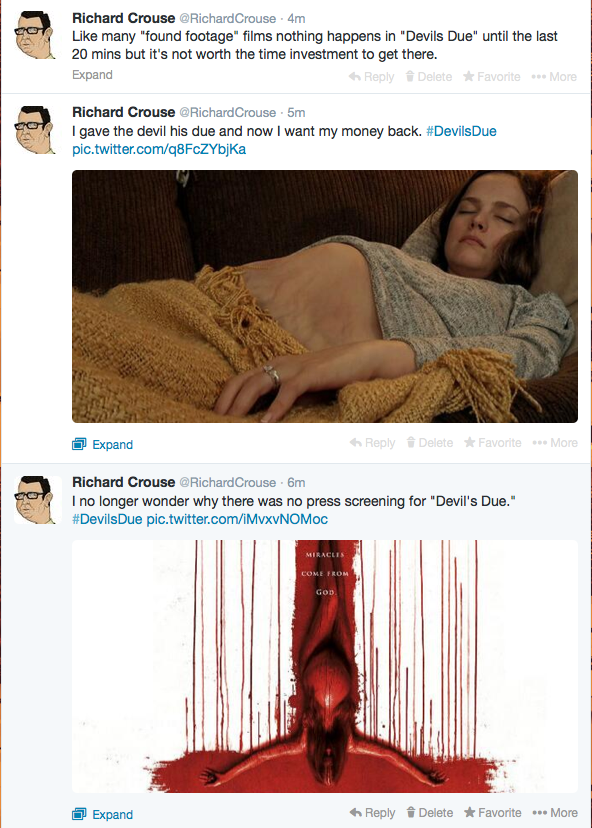 “Devil’s Due,” a new horror film that gives “Rosemary’s Baby” an unwanted found footage update wasn’t screened for the press. Living up to his motto–“I see bad movies so you don’t have to.”–Richard saw it on Saturday afternoon. Here’s his twitter review (click on the pictures to enlarge).