BEING HEUMANN: 3 ½ STARS. “a story of empathy, resilience and community.”
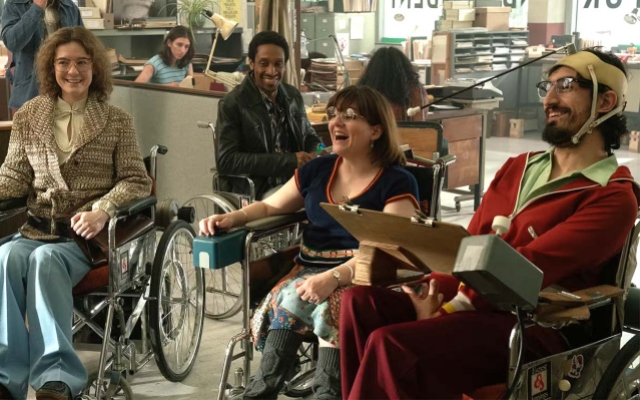
SYNOPSIS: “Being Heumann,” a new biopic now playing in theatres before moving to Apple TV on November 13, tells the undeniably important story of a disabled activist named Judy Heumann, and how she spearheaded the 1977 Section 504 sit-in, which resulted in the federal government of the United States giving more rights and privileges to disabled people.
CAST: Ruth Madeley, Mark Ruffalo, Dylan O’Brien, Rob Delaney, Ray Fisher. Directed by Sian Heder.
REVIEW: “Being Heumann” could have used a bit more grit and a little less made-for-television style, but the story is undeniably affecting.
Based on adaptation of Judy Heumann’s memoir “Being Heumann: An Unrepentant Memoir of a Disability Rights Activist,” the Sian Heder film tells the story of a women left paralyzed by polio at eighteen months, who devoted her life to civil rights for disabled people.
Instead of a cradle to grave look at Heumann’s (Ruth Madeley) eventful life Heder plants most of the action in 1977. Heumann initiated the nationwide Section 504 Sit-In, a cry for the government to implement disability protections which saw hundreds of people with disabilities occupied federal Department of Health, Education, and Welfare buildings across the United States. “We are not leaving this building until these regulations are signed,” she says.
It became the longest occupation of a federal building in U.S. history, ultimately resulting—after much back and forth—in the implementation of the Americans with Disabilities Act. “They’re not asking for a place on a bus,” says the United States Secretary of Health, Education and Welfare Joseph Califano (Mark Ruffalo), “they’re asking for a whole new bus!”
The portrait of Judy Heumann that emerges is one of a tenacious advocate, a blunt person who would not take no for an answer. “I’m not an asshole,” she says. “I’m just from Brooklyn.” Madeley plays her like a real person, not simply an inspirational avatar. Heumann’s work motivates those around her, but it is her take-charge attitude, tinged by both anger and humor that drives Madeley ‘s performance.
Like Madeley, who is an ambulatory wheelchair user, much of the cast are disabled actors. Their presence lends a stirring authenticity to the proceedings, emphasizing the urgency of Heumann’s push for inclusion, representation, and equality. “They see you in front of the stairs,” she said, “and they think that you’re the problem. The stairs are the problem!”
“Being Heumann” is Sian Heder’s crowd-pleasing follow-up to his movie “CODA.” Like that Oscar winner, “Being Heumann” is a story of empathy, resilience and community that engages the audience despite a formulaic presentation.