SYNOPSIS: In “Cold Storage,” a new sci fi comedy starring Joe Keery, and now playing in theatres, an infectious, constantly mutating fungus threatens to end the world unless two storage company nightshift workers and a bioterror expert can combine forces and come to the rescue.
CAST: Georgina Campbell, Joe Keery, Sosie Bacon, Vanessa Redgrave, Lesley Manville, Liam Neeson. Directed by Jonny Campbell.
REVIEW: A throwback to the gross ‘n gory sci-fi and horror popcorn films of 80s and 90s, “Cold Storage” features practical effects, plenty of humor and an exploding eyeball or two.
“Stranger Things” star Joe Keery and Georgina Campbell play Travis and Naomi, nightshift workers at a self-storage company that sits on the site of a decommissioned US military base. Decades before, a deadly, constantly mutating organism, capable of destroying all life on the planet in the grimmest and goriest of ways, was sealed in the facility’s sublevel.
As Travis and Naomi go about their mundane jobs, rising temperatures in the building’s basement allow the rapidly mutating microorganism to grow and escape its underground prison. What began as a sleepy overnight shift soon turns into an outbreak situation that could endanger the entire planet.
With the help of grizzled bioterror expert Robert Quinn (Liam Neeson) Travis and Naomi try and save all of humanity. “You two may have started the night as minimum wage guards,” says Quinn, “but you’re a green light team now.”
Adapted from David Koepp’s (the screenwriter of “Jurassic Park,” “The Lost World,” “War of the Worlds” and “Indiana Jones and the Kingdom of the Crystal Skull”) 2019 sci-fi thriller of the same name, “Cold Storage” is a mix of comedy and gory exploding humans.
Practical special effects, done with very little CGI, bring a nice, nostalgic vibe to the film’s action. Exploding deer and fungus infected human effects are over-the-top and have a cool, retro handmade look that brings back memories of the visceral thrills of movies like “Re-Animator” and “Dead Alive.”
The script is laced with humor, but I wouldn’t call this a comedy. It’s more a sci fi horror with a few laughs, many of which some from Keery’s comic timing.
“Cold Storage” is a bit of b-movie fun that doesn’t take itself seriously, so neither should we.
SYNOPSIS: In “Pillion,” a new queer romantic dark comedy starring Harry Melling and Alexander Skarsgård, and now playing in theatres, timid gay man Colin becomes the submissive partner of Ray, a handsome and dominant biker. “I have an aptitude for devotion,” says Colin.
CAST: Harry Melling, Alexander Skarsgård, Douglas Hodge, Lesley Sharp, Jake Shears. Directed by Harry Lighton.
REVIEW: A study of blossoming sexual awareness and acceptance, “Pillion” traces Colin’s journey into submissiveness with frankness, wry humor and tenderness.
The action in “Pillion” begins on a quiet London suburban Christmas Eve. The mousy Colin (Harry Melling) is performing in a chirpy barbershop quartet at a pub when he meets charismatic biker Ray (Alexander Skarsgård). A relationship quickly blooms, as Colin becomes a submissive partner to the dominant Ray. “Next to you I am nothing,” says Colin, “but I’m yours all the same.”
Over the next year Ray leads Colin into the world of BDSM and dominant-submissive relationship within the gay biker subculture, establishing power dynamics—Colin cooks, cleans, and obeys a strict set of rules while riding pillion, passenger seat on a motorcycle—and the boundaries of the pair’s desires.
Though submissive to Ray, Colin embraces the new relationship through all its challenges and thrills.
Based on Adam Mars-Jones’ novel “Box Hill,” “Pillion” is a straightforward and nonjudgemental rom com about desire and growth.
Melling, best known for playing Harry Potter’s spoiled cousin Dudley Dursley, hands in a wonderful performance as Colin, whose transformation from vulnerable and insecure to someone in control of his life and sexuality is handled with gentleness and authenticity.
Though for the most part emotionally cut off, Ray benefits from Skarsgård’s stoicism, but the actor brings the character to life by allowing hints of vulnerability to shine through his distant facade.
“Pillion” succeeds because of strong performances, but also because it accepts Colin, just as he learns to accept himself.
In this episode of Entertainment Is Broken, the podcast I host with and reality-TV scholar and Big Brother Canada winner Sarah Hanlon we try to make sense of a glossy new Melania Trump “documentary” that feels less like filmmaking and more like the soft launch of a lifestyle brand. From its eye-watering budget to its suspicious lack of actual substance, the conversation quickly turns to what this project really is…and where it’s likely headed next (hint: streaming platform, branded candles, possibly an apron).
As the Oscars loom, the hosts can’t help but compare this lavish production to multiple nominated films that were made for a fraction of the cost, raising uncomfortable questions about access, influence, and what gets financed in today’s entertainment landscape.
Along the way, Sarah offers a clear-eyed — and deeply reluctant — reaction to the concept of a Melania-fronted lifestyle empire, while Richard unpacks the industry mechanics behind attention farming, prestige positioning, and why this “documentary” may be less about storytelling and more about market testing.
It’s a sharp, funny, and slightly horrified look at the intersection of politics, celebrity, streaming economics, and the ever-blurrier line between content and commerce.
Spoiler alert: no one is asking for this… but someone is definitely funding it.
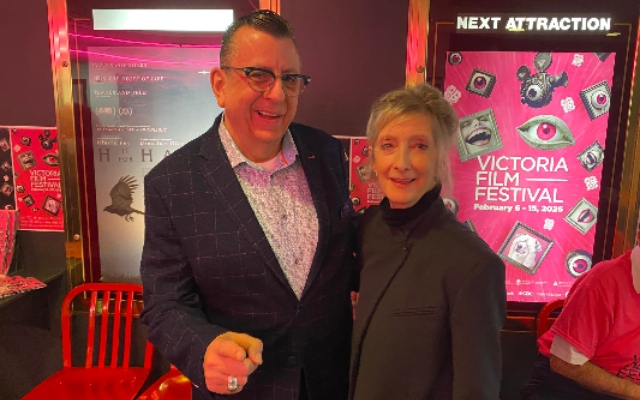
UPDATE: It was a pleasure hosting the In Conversation With… Sheila McCarthy at the Victoria Film Festival on Saturday February 7. As expected, Sheila was hilarious, insightful, and the hour just flew by. Thanks to the festival and to everyone who attended the sold out interview!
I’ll be hosting the British Columbia premier of “Dancing on the Elephant,” a comedy about two women who form an unlikely alliance over a shared distaste for their nursing home. Soon they are plotting one last rebellious adventure. After the screening I’m thrilled to greet the movie’s star, special guest Sheila McCarthy from the Academy Award-winning “Women Talking.”
The VFF goes all in with elbows up as we present two of Canada’s greatest gems, Sheila McCarthy in conversation with Richard Crouse. Following the liveon-stage conversation, we present the BC premiere of their latest film, Dancing on the Elephant.
Dancing on the Elephant
Directors: Julia Neill & Jacob Z. Smithunt
2025 / Canada / 94min / Drama
Atlantic International Film Festival – Outstanding Performance
Fast reviews for busy people! Watch as I review three movies in less time than it takes to slam the door! Have a look as I race against the clock to tell you about the teen horror of “Whistle,” an amorous “Dracula” and the mockumentary “The Moment.
SYNOPSIS: “The Moment,” a musical mockumentary about pop star Charli XCX sees her grapple with fame and her first arena tour. “I just want this moment to last forever,” she says.
CAST: Charli XCX, Rosanna Arquette, Kate Berlant, Jamie Demetriou, Hailey Benton Gates, Isaac Powell, Alexander Skarsgård. Directed by Aidan Zamiri.
REVIEW: Fans of Charli XCX should know that “The Moment” isn’t a concert film. The satirical mockumentary could best be described as a film about a concert.
Set on the eve of the stressed-out singer’s first headlining arena tour, it’s meant to be a poke in the side to a music business who take innovative artists and suck them dry of authenticity.
Folks unfamiliar with Charli XCX may want to check out her songs, like “Von Dutch’s” brash electronic pop, and her Wikipedia page or otherwise be baffled by references to Brat Summer and the color lime green.
In short, the movie takes place in the aftermath of Charli XCX’s sixth studio album “Brat.” Not just a title, it was a state of mind that celebrated a messy, unapologetic, hedonistic, party-girl lifestyle through bangers like “Girl, so confusing” (featuring Lorde).
“The Moment” begins as Charli XCX is having her moment. As she prepares for her biggest tour ever, the singer grapples with her record company’s expectations, exhaustion and loss of creative control. She feels the authentic cultural impact of Brat Summer is being commodified, or worse, might be slipping away. “Everybody’s waiting on the moment I fail,” she says.
The movie captures the Brat vibe. It’s messy, audacious, unapologetic and flawed.
Playing a heightened version of herself, Charli XCX finds some humor, humanity and a healthy dose of vulnerability in the tortured artist syndrome. She hands in a credible lead performance as a woman at a career crossroad, balancing the demands of her record label, a pushy film director (Alexander Skarsgård) and her management. She effectively portrays the fraying effect of fame as her creativity is commercialized and she is increasingly treated like a product rather than artist.
Her performance is aided by director Aidan Zamiri’s extreme up-close-and-personal photography. Her expressive face reveals much in these close-ups, particularly the pressure she feels to be effortlessly cool. The framing provides an interesting look at the woman behind the image and the work that goes into propagating the “Brat” image and allows the singer to let down her guard and reveal the often-insecure person behind the party image.
Skarsgård’s obsequious take on the director of the film-within-the-film provides several memorable, funny moments and raises obnoxiousness to stratospheric heights. His role of manipulative foil to Charli’s creative authenticity pushes the movie’s themes of artistic compromise to the fore.
Unfortunately, that is about as deep as “The Moment” gets.
Director Aidan Zamiri’s fondness for cinéma vérité style jiggly camera requires a dose of Dramamine as the story meanders repeatedly through the same plot points of artist manipulation and the stresses of leveling up.
“The Moment” is a movie with lots of extreme style desperate to say something about what happens when pop culture turns its eye on an artist, but the message gets bogged down by its own Brat style.
SYNOPSIS: “Dracula,” a new take on Bram Stoker’s classic vampire novel, now playing in theatres, is a love story about a 15th-century prince who spends four hundred years searching for the reincarnation of his late wife.
CAST: Caleb Landry Jones, Christoph Waltz, Zoë Bleu, Matilda De Angelis, Ewens Abid, David Shields, Guillaume de Tonquédec, Raphael Luce. Directed by Luc Besson.
REVIEW: This isn’t Bram Stoker’s “Dracula.” It’s maximalist French director Luc Besson’s “Dracula” with all the good and bad that implies.
A love story and an origin tale, the movie begins with Prince Vladimir of Wallachia (Caleb Landry Jones) i.re. Vlad the Impaler, renouncing God after the death of his beloved wife Elisabeta (Zoë Bleu) at the hands of the Ottomans.
Now called Dracula, he spends the next four hundred years drinking blood to stay “alive,” and using a specially formulated vampire perfume to entice women as the lovelorn vampire searches for the reincarnation of his late wife.
“I’m just a poor soul condemned by God and cursed to walk in the shadow of death for all eternity,” he says, “and sustain myself on fresh blood. Human blood is recommended.”
During real estate negotiations Dracula discovers that Mina (Zoë Bleu again), the wife of Parisian solicitor Jonathan Harker (Ewens Abid), is the woman he’s been searching an eternity for. Tracking her down, he convinces her that she is the reincarnation of Elisabeta and offers her eternal life.
“I would recognize you in another lifetime, entirely in different bodies, different times, and I would love you in all of them until the very last star in the sky burned out into oblivion.”
Meanwhile, a Vatican-sponsored vampire hunting priest (Christoph Waltz) is on the hunt for Dracula and his deadly disciples.
Luc Besson has never been known for a light touch. His films, like “The Fifth Element” and “Léon: The Professional,” are crowd-pleasing, style over substance movies that entertain the eye with high concept visuals and high energy action. Unafraid of spectacle, his films are often bold, often cheesy and often sumptuous.
“Dracula” is all those things. Besson’s study of eternal love has philosophical undertones, but, true to form, excess is the name of the game here, not metaphysical discourse. A scene in the court of Versailles, for instance, where Dracula tests out his special perfume is both lovely and lurid, but another sequence in which Drac repeatedly tries to kill himself in the wake of his wife’s death doesn’t have the intended pathos. Instead, it feels like an outtake from one of Abbott and Costello’s horror comedies.
Gorgeous costume and set design set the stage for Besson’s flashy gothic romp, distracting from a distinct lack of chemistry between the star-crossed soulmates. Landry is more convincing as a monster than lovelorn creature of the night, even if his 400-year-old-man makeup is a little rough. If this pair met in a singles bar, you wouldn’t think they had enough of a spark to make it to the dance floor, let alone inspire a lusty 400 yearlong journey.
Despite flaws that would put a stake in the heart of many other films, “Dracula” is entertaining, if only because Besson shakes up the familiar story to focus on the amorous rather than the murderous.
SYNOPSIS: In “Whistle,” a horror film starring Dafne Keen, and now playing in theatres, an ancient Aztec Death Whistle harkens the demise of a group of high school students. “If you hear the whistle scream, dying is not a choice.”
CAST: Dafne Keen, Sophie Nélisse, Sky Yang, Jhaleil Swaby, Ali Skovbye, Percy Hynes White, Michelle Fairley, Nick Frost. Directed by Corin Hardy.
REVIEW: With a healthy dose of nostalgia “Whistle” looks to the teen horror films of the 80s and 90s for inspiration and thrills.
The story begins with Chrys (Dafne Keen) moving to a new town, and a new school following the death of her father. As rumors swirl through the hallways about her dark past she is treated like an outsider by everyone, except Ellie (Sophie Nelisse), her smart, friendly classmate.
When Chrys discovers an ancient Aztec Death Whistle in the shape of a skull, left behind by a former student in her locker, she doesn’t realize that blowing into the artefact will summons the future deaths of anyone in earshot and hunt them down. “Our future death is hunting us.”
“Whistle” is an effective, nasty slasher that delivers a new riff on the “Final Destination” blueprint, finding inventive and entertaining ways to send its characters to the afterlife.
What separates “Whistle” from some (but not all) of its teen predecessors is the attention to character detail. Director Corin Hardy, working from a script by Owen Egerton, ensures the characters aren’t just disposable teens. They have backstories—someone them might even have futures—and they are a little more fleshed out than your run-of-the-mill slasher. When they start disappearing, you feel it.
But that doesn’t mean Hardy goes easy on them. The kills are grotesque and often quite juicy—I’d love to know the film’s fake plasma budget—which should be a bonus for gore hounds.
“Whistle” leans into its nostalgia for teen popcorn horror, but filters it through a new, modern lens.