Over the years I have accidentally picked up life lessons from the famous folks I’ve interviewed. Today I’ll tell you about what I learned from Elizabeth Taylor’s “late” arrival for a red carpet at the Cannes Film Festival.
Every action movie worth their salt has a catchphrase, and “Nobody,” in theatres only, has a pretty good one. “Don’t call 911,” Hutch Mansell (Bob Odenkirk) says to his wife (Connie Nielsen) before taking on an army of baddies. It’s his “I’ll be back,” a line that tells you everything you need to know about the character’s confidence in his special set of skills.
But, when we first meet him unassuming suburban dad Hutch leads a life of quiet desperation. Under appreciated at home, a joke at work, he makes Rodney Dangerfield look like a well-respected man about town by comparison.
He is, by his own admission, a nobody.
When burglars invade his home, his son (Gage Munroe) fights back, but Hutch freezes. Later, when one of the cops of the scene says, “You know, if this was my family…” Hutch’s humiliation hangs heavy in the unspoken words.
But there’s more to Hutch than meets the eye. Turns out he’s an everyman who can kill every man. A former clean-up guy for “one of those three letter organizations,” he left the game for a normal life, but “over-corrected” and became everybody’s doormat. “I always knew it was a facade,” he says of his suburban life, “but it lasted longer than I expected.”
The aftermath of the burglary awakens a long dormant piece of his personality and when he single-handedly takes on a group of Russian toughs on a bus—to the strains of Steve Lawrence crooning “I’ve Gotta Be Me”—he earns the attention of karaoke singing crime boss Yulian Kuznetsov (Aleksey Serebryakov).
What follows is a violent, funny mix of “John Wick” and “Home Alone.”
There isn’t much to “Nobody” except for Hutch’s transformation and his ever-escalating way of offing the hordes of gun toting goons sent to silence him. Director Ilya Naishuller keeps the narrative to a minimum, doling out the exposition in the form of action instead of words. It’s fun, fast-paced and owes a nod to Guy Ritchie’s patented tricky editing and may be the most unexpected good time at the movies since terrible people killed John Wick’s dog.
From bewildered to badass, Odenkirk is an unlikely action star. Slight and wiry, he’s a like a coiled snake, and when he strikes he takes a lickin’ but keeps on tickin’. Unlike most action stars he gets the crap knocked out of him, but like most action stars, he’s relentless. It’s about as far away from his work on the “Mr. Show” as you could get. It’s more like a bloodied and bruised 1970s one man army character—think Charles Bronson—than anything he has done before.
It’s a compelling character, but a movie like “Nobody” is nothing without the fight scenes. Rest assured the action sequences are, as Hutch’s dad David (Christopher Lloyd) says, “just a bit excessive, but glorious.”
“Bad Trip” is a hidden camera movie à la “Borat,” with gross gags, a road trip but without Rudy Giuliani.
Gonzo comedian Eric André is Chris, an underachieving Florida man drifting through life. His life finds new purpose when his high school crush Maria (Michaela Conlin) comes into the juice joint where he is a self-proclaimed chef. As he blends drinks (and other things) they catch up. She’s now a hot shot art dealer in New York, back in her home town for a quick visit.
He asks her out but she declines, telling him she’s off to the airport. But, she adds, “If you’re ever in Manhattan, you should come to the gallery.”
Chris, in love, takes her invitation to heart and convinces his best friend Bud (Lil Rel Howery) to “borrow” his jailbird sister Trina’s (Tiffany Haddish) hot pink Crown Victoria and travel cross country to New York City.
Trouble is, Trina, recently escaped from prison, thinks the car is stolen and vows to track down Chris and Bud, to get her car and revenge.
Partly scripted, mostly improvised, “Bad Trip” follows in the footsteps of “Jackass” and Sacha Baron Cohen and often kicks it up a notch. The satirical edge of “Borat Subsequent Moviefilm” is missing but the outrageous antics on display might make Borat Sagdiyev blush. Barf, poop and bestiality are stops along the way in a road trip that includes drunken line dancing, accidentally getting super high and a tribute to “West Side Story” that is as sweet as it is surreal.
Not every prank sticks the landing, but you have to admire how far André and company (including director Kitao Sakurai) are willing to go to get a reaction. The elaborately staged hidden camera pranks are so outrageous it’s hard to imagine anyone in real life falling for them, but in the moment, who knows?
Several things become clear watching “Bad Trip.”
Firstly, the cast was game for almost anything. André, Haddish and Howery risk life and limb for a laugh, putting themselves in harm’s way in ridiculous ways. “I experienced physical and mental trauma I may never recover from,” Chris says, but I might guess André may feel the same way.
Secondly, it speaks to human nature. André’s bad behavior generally speaking brings out the best in people. It’s an oddly life affirming message from a movie that features random people covered in puke. From an old man on a park bench who gives Chris life changing advice to a bus full of people cheering on his lovesick journey, it’s filled with as much heart as it is gross stuff.
“Bad Trip” is a loosely structured good time that rides the line between gross and goofy, sincere and shocking.
Set in a remote, woodsy cabin on a lake, the rape-revenge film “Violation,” now streaming on Shudder, is an uncompromising, provocative film that uses a broken timeline, remote locations and graphic violence to tell a story of trauma.
Written, produced, and directed by Madeleine Sims-Fewer and Dusty Mancinelli, “Violation” begins with two couples on a weekend get-a-way. Miriam (Sims-Fewer) and Caleb (Obi Abili), a married couple on the brink of divorce, join her sister Greta (Anna Maguire) and brother-in-law Dylan (Jesse LaVercombe) at a family retreat in rural Quebec. The sisters have a fraught relationship and an underlying atmosphere of tension hangs heavy. The morning after night of drinks around the campfire Miriam wakes up as Dylan rapes her. Devastated, Miriam exacts revenge.
“Violation” is a tough watch.
Cruel and hallucinatory, it changes the channel from exploitation to a study of the way Miriam processes her trauma. Sims-Fewer and Mancinelli go deep, using shifts in the colour palette, disquieting, extreme close-ups and nature and insect symbolism to visually add to the sense of unease.
For the bulk of the film Sims-Fewer’s raw performance is played out in dialogue free sequences, placing the focus on her actions and unspoken motivations, but never providing the pay-off typically associated with revenge dramas. That makes “Violation” is something different.
A rape-revenge film that does away with the male gaze, it doesn’t sexualize its female protagonist, which changes the dynamics of what could have been a straightforward genre piece. There is an unnecessary late movie twist and some clumsy exposition early on, but as an honest portrait of a woman who turns to retaliatory violence because she feels powerless, it’s chilling.
Indie science fiction movies tend to take a backseat to their bigger, flashier studio counterparts. The whiz bang of large-scale speculative fiction tends to blind movie goers to the existence of lo-fi sci fi like “Doors,” a VOD portmanteau built around the single idea that alien doors suddenly appear worldwide.
Directed by Jeff Desom, Saman Kesh, Dugan O’Neal with the aid of creative director Saman Kesh, “Doors” unfolds in three stories, and like a character in the movie asks, “You guys ready to get weird?”
Let’s get weird:
First, we meet a group of potty-mouthed high school students attending class when the world changes. Their teacher disappears, leaving them to fend for themselves as they hear strange sounds and voices coming from a large door outside their classroom. As they interact with the portal, their deepest secrets are revealed.
Gah! Creepy!
Then, in another part of the world a group of volunteers, called “knockers,” enter one of the extraterrestrial portals located in a beach house. On the other side of door there’s a deadly alternative reality that looks like ours, just tilted 180 degrees.
Oig! So strange!
Lastly you have the sci fi staple, the loner scientist with a great beard (TV On The Radio’s Kyp Malone), who figures out something no one else has. He discovers a way to communicate with the sentient portals but can he defend himself and others when the portal gets angry?
Yipes! Uncanny!
Binding the three segments together is Marin Midnight (David Hemphill), a podcaster in the vein of Alex Jones who speaks to his bewildered audience through guests like Dr. Price (Darius Levanté), a talking head who bloviates, “Mankind must figure what the doors are, are they gods? A malevolent force bent on destruction? Both? a sign of humanities reset? Is it a test, a way for the doors to figure out where humanity should go from here?”
One might imagine that a portal that can transport people anywhere would have folks ricocheting around the universe but “Doors” keeps the action earthbound. While an interplanetary trip or two might have expanded the film’s sci fi elements, the routine settings of everyday life, a classroom, a house, the woods, creates the otherworldly sense that the ordinary has now become sinister. As an exercise in unsettling speculative fiction the beach house sequence works best. The portal’s mirror world echoes real life, but with just enough differences and danger to be interesting.
The other stories, while nicely shot, don’t have the same impact. The occasional Ed Wood worthy bit of dialogue, like, “You are all in violation of ordinance 256, unlawful engagement with a door,” also blunts the effectiveness of the film’s message.
“Doors” is ambitious, lo-fi sci fi that works as an entry way to new ideas but never quite gets over the threshold.
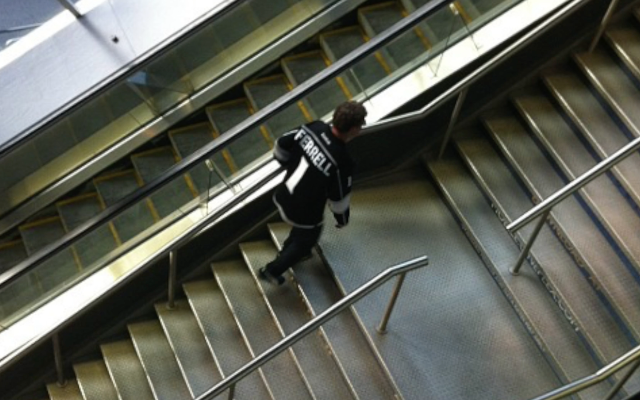
Over the years I have accidentally picked up life lessons from the famous folks I’ve interviewed. Today I’ll tell you about what Will Ferrell taught me, in his own, wild way.
Find out what DeLorean modification restoration king Justin Sookraj said was “so nasty I can hardly talk about it,” in Richard new article for the Toronto Star called, “Restoring a DeLorean requires automotive archeology and a lot of love.”
Based on a true story, “Above Suspicion,” starring “Game of Thrones’” Emilia Clarke, now on VOD, is set in small Kentucky where there are only two ways to make money since the mine closed, “one is the drug business and the other is the funeral business.”
Clarke is Susan Smith, living hand-to-mouth in her Kentucky home town. She wants a better life but drug addiction and her abusive ex-husband’s (Johnny Knoxville) welfare scam has her tied down.
When the married, ambitious FBI agent Mark Putnam (Jack Huston) comes to town there appears to be opportunity for both. He sees her as a conduit of information, a snitch, she thinks he might be her way out. When their work relationship turns romantic, the dynamic changes but when he realizes the error of his ways, Susan becomes obsessed and vengeful.
There’s more but I won’t spoil it for you. The movie kind of does though in its opening minutes. (MILD SPOILER COURTESY OF THE MOVIE) “You know what’s the worst part about being dead?” Susan asks in the opening narration. “You get too much time to think.” It’s a film noir device that works well in “Sunset Boulevard,” but in this case sucks some of the life, literally, out of the storytelling.
A mish mash of drug busts, drawls, deception and clearly telegraphed Southern Gothic plot points, “Above Suspicion” settles on a true crime format instead of digging a little deeper to expose the often-troubled relationship between impoverished people and the folks who are meant to protect them. Instead, it feels like a greatest hits collection of opioid movie tropes tied together with outsized Kentucky accents.
Clarke and Knoxville dirty up real nice but the film’s investment in hard knock poverty porn over substance plays more like an episode of “Dateline” than a cinematic experience.
A quick title IMDB search reveals the name “Above Suspicion” has been used at least twelve times, dating back to 1943. This most recent addition to the ever-growing list of “Above Suspicion” titled movies is about as generic as the common name would imply.
“The Father” is a family drama about taking care of a loved one with dementia that manipulates reality to tell the story from two very different points of view, the caretakers and the patient.
Anthony (Sir Anthony Hopkins) is an eighty-year-old former engineer with a luxurious London apartment filled with art and music. What’s missing is a carer, someone to make sure he eats, takes his pills and is comfortable as dementia makes his behavior increasingly unpredictable. By times charming, other times angry, confused and controlling and always convinced someone has stolen his prized wristwatch, he’s scared away a series of caretakers. “I don’t need anyone,” he bellows in denial. His daughter Anne (Olivia Colman) moved in to run the house, but she’s relocating to Paris and needs to find someone to look after her father.
That is the set-up. From here director Florian Zeller, who co-wrote the script with Christopher Hampton, artfully toggles between realities, Anne’s story and the way Anthony sees what’s happening in his beloved apartment. It is a disorienting technique that switches perspectives without warning, creating a knotty drama where nothing is as it seems in a carefully crafted depiction of dementia.
“The Father” is a sensitively made portrait of a failing mind anchored by a towering, emotional performance from Hopkins. The Oscar winner has made a career playing characters etched in ice; cool and collected. Here we see the vulnerable side, the lion in winter slowly losing himself to the vagaries of disease. It’s a tour de force of a performance that is often a difficult watch but his control of the character, particularly in the film’s final heartbreaking moments, as Anthony’s real and illusory lives intersect, is astonishing.
Coleman brings subtlety and warmth to the long-suffering Anne, but it’s Imogene Poots who makes the most of her small but wonderfully written scene. In the course of just a few minutes she falls prey to Anthony’s charm only to feel the bite of his poison tongue, navigating a range of emotions and reactions like a character on the run from an Edward Albee play.
The success of “The Father” isn’t the structurally complex storytelling but the performances that traverse the trickery of the telling to find the humanity of the situation.
 Over the years I have accidentally picked up life lessons from the famous folks I’ve interviewed. Today I’ll tell you about what I learned from Elizabeth Taylor’s “late” arrival for a red carpet at the Cannes Film Festival.