Actress Phyllis Smith has had many jobs in and out of show business.
She was working as a casting associate when director Ken Kwapis fell in love with the way she read opposite the auditioning actors and cast her as Dunder Mifflin saleswoman Phyllis on The Office. She appeared on the hit show for nine years and just as that series wound down she got a call from Pixar.
Inside Out producer Jonas Rivera was flicking around the stations one night when he settled on Bad Teacher, a 2011 comedy co-starring Smith and Cameron Diaz. The raunchy film couldn’t be further afield of Pixar’s family friendly movies, but Rivera liked the sound of Smith’s voice. He knew she was the actor to play one of Inside Out’s main roles, the living embodiment of an emotion in an eleven-year-old girl’s head.
“He picked up the phone and called [director] Pete Docter and said, ‘I think I’ve found our Sadness,’” recalls Smith. “I guess it was the timidity in that scene and the timbre of my voice. That’s the nice thing about working for Pixar, when you get that call they pretty much already know what they want.”
Smith joins an all-star cast — Bill Hader, Lewis Black, Mindy Kaling and Amy Poehler as Fear, Anger, Disgust and Joy respectively — in a film that Variety called, “the greatest idea the toon studio [Pixar] has ever had.”
“Long after we’re gone people will still be watching,” Smith says. “Sort of like the Wizard of Oz.”
Smith, who is much more gregarious in person than her onscreen persona would suggest, is riding high today but it was a long circuitous route to television and film success.
“I started out as a professional dancer,” she says. “A show dancer. No stripping, but there were plumes, feathers, g-strings and all that. I was also in two ballet companies, a jazz company. That was my passion but I had an injury and knew logically it was time for me to make a switch in my career. I was getting older. So I just did what I had to do to pay my bills.”
She worked as a receptionist, an NFL cheerleader and manned the box office at a Los Angeles movie theatre. She dressed as Marilyn Monroe and played Steve Carell’s mother in a deleted scene from The 40-Year Old Virgin, but one job stands out for her.
“I worked for JC Penny in the warehouse tagging the merchandise,” she remembers. “I used to stand there and tag thousands of fishing lures or bowling balls or roller shades, which were heavy as heck to lift around. The people were great to work with but the merchandise was a little challenging.
“I used to stand there, thinking about life, wondering what it is we all have in common because we’re not all given the same opportunity. Some people’s health is impaired when they’re born while others are charmed with intelligence or looks. I thought, ‘There has to be something that we all have. A commonality.’ I figured out that it’s the ability to love. We all, in some form or another, want to love and be loved. That was my big revelation. My lightbulb moment. Also, if you’re standing on a concrete floor, make sure you’re wearing comfortable shoes or you’ll pay for it later.”
If you’ve ever looked at someone and wondered what’s going on inside their head—and who hasn’t?—the new Pixar film “Inside Out” tries to provide some answers. Loosely based on the mood swings of director Pete Docter’s twelve-year-old daughter it’s an action adventure set in the subconscious of a young girl.
The set up is simple. A Minnesotan family, Mom (voice of Diane Lane), Dad (Kyle MacLachlan) and eleven-year-old daughter Riley (Kaitlyn Dias), leave their comfortable Midwestern life behind in favour of business opportunities in San Francisco. Riley leaves behind her friends, her school and her beloved hockey team; everything she’s ever known.
Plopped down in a new city, homesick and surrounded by new people, she becomes moody. She’s completely guided by her emotions, which happen to run things from Headquarters, located deep inside her thinking box. In these San Fran days and nights Fear (Bill Hader), Anger (Lewis Black), Disgust (Mindy Kaling) and Sadness (Phyllis Smith) rule the roost, while Joy (Amy Poehler) tries to hold things together. Navigating Riley’s cerebrum, Joy journeys through long term and core memories, the Islands of Personality and Dream Productions to realize it takes a variety of emotions to make a balanced life.
I don’t know if there is such a thing as an instant classic but “Inside Out” is the best argument for creating the term I’ve come across for some time. From dazzling animation, to a script that toggles between childlike wonder and ingenious introspection “Inside Out” is glued together with a degree of emotional acumen not often found in mainstream film. In other words, it will make you laugh, cry and think.
Like the best of Pixar’s work—“Toy Story,” “Up,” “WALL-E”—“Inside Out” works on multiple levels. It is, first and foremost a family film designed to entertain everyone from the young’uns to grandma, but it’s also simultaneously a flight of fancy and a grounded story about growing up that kids (and anyone who has ever been a kid) will relate to. The movie may deal with abstract thought, but the idea that without sadness there can be no joy, and vice versa, is clear as day.
“Inside Out” is a film that will deepen with repeat viewings, which is probably a good thing as when it hits Blu Ray kids are going to want to watch it again and again, and for once, parents won’t mind joining in.
“Racing became his passion and he went for it.” So says Paul Newman’s “Butch Cassidy and he Sundance Kid” co-star Robert Redford. Although Newman didn’t start racing cars until his late 40s, when most racers are thinking about retirement, it became a permanent part of his life following the making of the 1969 film “Winning.”
In that movie he plays Frank Capua, an up-and-coming racer with aspirations of winning the Indianapolis 500. For maximum realism it was decided the stars—Newman and Robert Wagner—would drive their own cars. He had always been interested in motor sport but had never been behind the wheel of a race car until signing up at a high performance driving school in prep for the film. He immediately felt the need for speed and became obsessed. “After that he got so boring,” laughs Redford. “[Racing] was all he talked about. It drove me crazy.”
As a driver and the owner of the Newman/Haas Racing team the actor would mentor Willy T. Riggs, the first African American championship racer, and win more than 100 races and 8 Drier’s Championships in IndyCar Series. Newman, after trying his hand at football and boxing, had found his sport. “I didn’t have any physical grace. The only thing I found any grace in was an automobile.”
“Winning: The Racing Life of Paul Newman” paints a picture of a deeply private man who loved pranks, cars and cherished the outlet that racing gave him as a pressure valve release from the day-to-day of being one of the most famous men on the planet. A combination of contemporary interviews with the likes of Jay Leno, Patrick Dempsey and “Cars” director John Lasseter and archival footage, the movie isn’t just a biographical look at one facet of Newman’s life. It focuses on his passion for racing but this isn’t a film for gearheads only. Racing is treated as a portal into the actor’s personality, an entrance into what really made him tick. By zeroing in on one of his passions “Winning” gives us a broader look at what made the man tick.
Director Adam Corolla (who restores and races Newman’s cars) is clearly a fan but it is his passion for both racing and Newman that fuels the doc.
Based on English writer Vera Brittain’s 1933 memoir about her experiences during World War I, “Testament of Youth” is a handsomely presented, if sometimes a bit restrained story of one woman’s voyage into pacifism.
Alicia “Ex Machina” Vikander stars as Brittain, a tenacious young woman who battles against her father’s (Dominic West) wishes and the conventions of the day to take the Oxford University entrance exam. Her schooling is interrupted when WWI breaks out and brother Edward (Taron “Kingsman: The Secret Service” Egerton), her fiancé Roland Leighton (Kit “Game of Thrones “ Harington) and friends Victor (Colin Morgan) and Geoffrey (Jonathan Bailey) are sent to fight at the front lines. With her friends at risk Vera opts to join them, leaving school to enrol as a nurse in the Voluntary Aid Detachment. Tending to both German and English soldiers in London, Malta and France she learns first hand about personal loss, human suffering and the futility of war.
“Testament of Youth” offers up a different, parallel view to combat, than the usual war film. Told from the point of view of a battle nurse, it is different but no less effecting as a story of female strength. Vikander is the movie’s soul and strength, handing in a performance that is both strong willed and remarkably nimble. When Vera pretends to be the German girlfriend of a dying soldier, the performance transcends the “Downton Abbey” vibe of the production. Moments like these are almost an antidote to the melodrama that masquerades as actual emotion in other scenes. Almost but not quite.
The supporting performances work well enough, although other than Vera the emotional connection necessary for the anti-war message to be truly effective is missing. Large scale shots of dead and dying men in battle and hospitals visualize the sentiment but a real, personal connection with the characters would have been more fitting for a story about a woman so absolutely changed by the war and her experiences.
“Testament of Youth” is based on a true and well-documented story but a dose or three of melodrama—does she really have to get such bad news on her wedding day?—blunts the power of the story.
There was a time when there were Jewish delis on almost every street corner in New York. As richly textured as the matzo-ball soup, kreplach and pastrami may have been, they didn’t just provide nourishment for the body, but for the soul as well. These days with fewer than 150 left in the United States director Erik Anjou set out to preserve the culture in a documentary called “Deli Man.”
There are many deli men profiled in the doc, including Canada’s own Zane Caplansky, but the focus is on third-generation deliteur (my word, not his) Ziggy Gruber. He’s a New Yorker through and through who grew up learning at the elbow of his father and grandfather. The twist is that his deli, one of the best in the US, isn’t in NYC but Houston, Texas. Gregarious and passionate about the food, Gruber is an evangelist for the deli tradition and a convincing one. He’s a living testament to the deli rules of buy good food, prepare it well and always be a mensch.
Legendary deli’s like NYC’s Katz’s, 2nd Avenue Deli, Carnegie, the Stage and Los Angeles’s Nate ‘n Al’s round out the picture of a cultural tradition that is about so much more than just food. A visit to Montreal’s fabled Schwartz’s Deli would have been the pickle on top, but as it is “Deli Man” is a delicious look at how delis have influenced not only what we eat, but why we eat it.
From Small Press Reviews: “Word on the street is that Elvis Costello has a memoir due in October. For those who can’t wait, there’s Richard Crouse’s Elvis Is King: Costello’s My Aim Is True, a meticulously researched account of Costello’s early years and the release of his first LP with independent label Stiff Records…” Read the whole thing HERE!
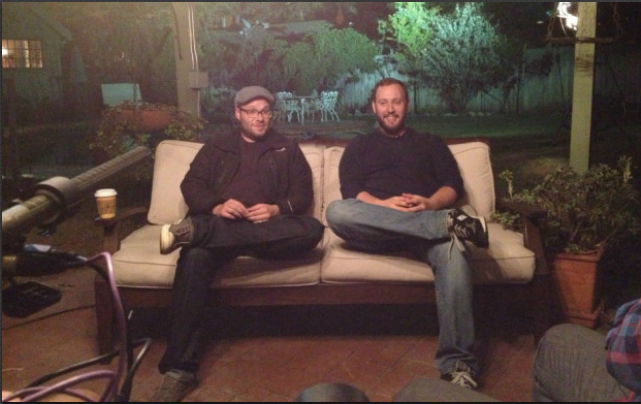
From “National Post” writer Rebecca Tucker: “About midway through the third episode of Reelside, Evan Goldberg and Seth Rogen sit beside one another on an outdoor couch, on the set of their 2013 film Neighbours.
“There’s two levels of famous,” Goldberg says. “There’s Seth famous and there’s…” He points at himself and shrugs…” Read the whole thing HERE!
From “Fangoria” editor Chris Alexander: “Now screening on Canadian pay television is REELSIDE , a new 6-part series executive produced by veteran Toronto film critic and journalist Richard Crouse in which key Canadian performers and artists explore the creative mechanisms of their similarly Northern based colleagues. In the first beautifully shot installment, David Cronenberg favorite Sarah Gadon joined forces with Cronenberg’s photographer daughter Caitlin on an art project, and future episodes will see the likes of Seth Rogen and Bruce McDonald also discussing their own processes and struggles to make their voices heard.
“But for FANGORIA readers, it’s the second installment that stands as the most interesting…” Read the whole thing HERE!
From Paul Salvatori: “Short doc on well-known Toronto movie critic and author, Richard Crouse. In this candid first-person profile, Richard shares unique insight into the art of film, writing, his early introduction to pop culture, and a newfound gratitude following his battle with cancer.”