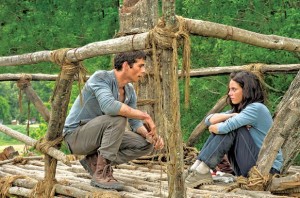
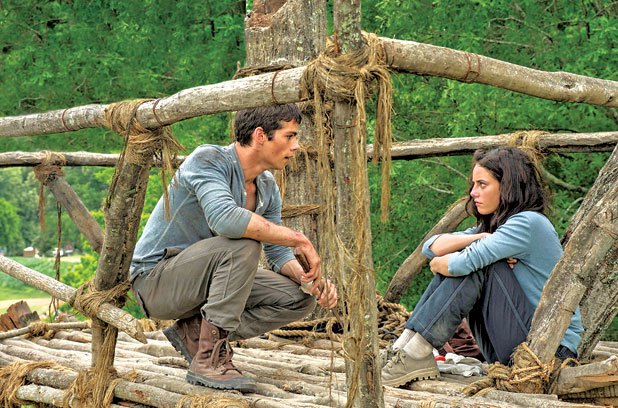
The story in “The Maze Runner” is based on a dare. When Thomas (Dylan O’Brien) is dropped into a mysterious walled world where a society of boys have grown up in the shadow of a giant labyrinth, he is told, “Don’t go in the maze.” Of course he does, because that’s like telling a teen, “Don’t go through that door,” in a horror flick.
The setting is bucolic. A large open green space, dotted by trees, huts built of logs and gardens. The only thing out of place is a large metal elevator that once a month belches to life, bringing supplies and a “greenie” to the surface. These young men arrive with their memories wiped clean, unaware of where they are or why they were brought there. The latest newbie is Thomas (“Teen Wolf’s” Dylan O’Brien), a rebellious young man who doesn’t quite fit into the well ordered life the other boys have created in their walled-in world.
He wants to escape; to become a Maze Runner and see if there is a way to navigate through the ever-changing labyrinth—and its evil guardians the Grievers—that stands between them and whatever is happening on the outside world. When the elevator deposits a girl (Kaya Scodelario) with a note clutched in her hand, “She is the last one,” in the midst, it seems like the time has come to take on the maze.
“The Maze Runner” is based on a series of wildly popular young adult books—so yes, you can look forward to “The Maze Runner 2: Electric Boogaloo” coming soon to a theatre near you—and takes a backwards approach to the storytelling. Here the characters are cyphers with no knowledge of their pasts, so they create personas based on their abilities in the camp. Very “Lord of the Flies.” It’s interesting though, in that unlike most original stores we don’t have to spend much time getting to know the characters, where they came from or what their inner torment is. They don’t know and neither do we. Instead they concentrate on the present—their present—and survival. Imagine if the reality show “Survivor” was set in a world surrounded by an impenetrable maze and the only way to get voted off the island was to be eaten by a giant, mechanical Griever beast.
The immediacy of the story serves it well to a point. Eventually the whole crew, or most of them anyway, attempt the maze at which point the film becomes a standard 3D sci fi chase flick—Watch out for that Griever!—but there are twists and turns to keep things moving along and perfectly set the story up for a sequel.
The movie is buoyed by strong performances from Will Poulter as a young guy content to stay within the walls of his mysterious prison and Dylan O’Brien, who gives the movie its prerequisite heartthrob appeal.
“The Maze Runner” makes comments about the dangers of conformity and the virtues of bravery and loyalty and does appear to be headed into some twisty-turny territory should the next part of the story get made.
In the novel “This is Where I Leave You” by Jonathan Tropper the family’s last name was Foxman. For some reason it was changed to Altman for the film, which, perhaps, was done to subtly infer what kind of film it wants to be. It’s a multi-character comedy with shades of drama and pathos, which, by definition makes it, in film critic shorthand, Altmanesque.
The film may try and speak Altmanese but something gets lost in translation. Instead it does something much more basic but equally satisfying. Once it gets past trying to emulate Robert Altman, it presents a funny and sad glimpse at the inner works of a very dysfunctional but loving family.
Jason Bateman leads the large ensemble cast as Judd Altman, a successful radio producer who comes home one afternoon to find his wife (Abigail Spencer) in bed with his boss. His perfectly constructed world falls a part, sending him onto a tailspin that is only compounded by the death of his father.
Returning to upstate New York for the funeral he is forced to sit Shiva with his family, his over-sharing mom, a bestselling psychologist with fake breasts and a loose tongue (Jane Fonda) and three siblings, married mom Wendy (Tina Fey), practical Paul (Corey Stoll) and Phillip (Adam Driver), a free spirit who brings his much older girlfriend (Connie Britton).
All under one roof for the first time in many years they must confront the ghosts of their pasts—including Wendy’s ex-boyfriend Horry (Timothy Olyphant) and Judd’s high school sweetheart Penny (Rose Byrne)—and deal with some very real truths in the present.
A mix of sentiment and wisecracks, “This Is Where I Leave You” is an all-star feast of dysfunction. The brothers don’t get along, mom dresses inappropriately and everyone seems to have slept with everyone else. No one is particularly happy but where would the drama be if they were?
The themes—it’s a study of love, marriage, divorce—and setup feel like movies we’ve seen before—family gathers for holiday, funeral, birthday—and the situations—family grudges, old girlfriends show up, delinquent sibling throws a wrench into everybody’s plans—are familiar. The thing that sets “This is Where I Leave You” apart is the casting.
Bateman is front and center and brings a nice balance of comedy and pathos to the role of Judd. He has a way with a line, but here reveals a deft hand with dramatic material, often in the same scene. It’s a lovely, quiet performance.
Fey, as the tipsy, protective older sister, also reveals a deeper well than we’ve seen before. Less versatile are Stoll and Driver who hand in enjoyable but familiar feeling work. Other supporting cast click. Like Bateman, Byrne gear shifts between sweet and funny and sweet and serious with ease while Fonda is hilarious as the widow who wonders whether she should tip the coroner.
The point is, it all gels. The cast comes together as a unit and even though the movie veers toward easy sentimentality when an edgier approach might have been more realistic, the players are the ties that bind the family and this movie together.
Liam Neeson does have a “special set of skills” in “A Walk Among the Tombstones” but they’re not really on display in the movie. This isn’t “Taken 4: Armed and Fabulous,” it’s a character study with sadistic serial killers, a precocious kid and plot holes you could drive a truck through. Luckily it also has the jaded but still momentous presence of its star Neeson.
Neeson is Matthew Scudder, a recovering alcoholic who gave up his New York City detective’s badge and the bottle when he was involved in a wild street shoot out left two dead and one wounded. Eight years later he’s working as an unlicensed private investigator—“Sometimes I do favors for people,” he says, “and sometimes they give me gifts.”—when he takes a job to investigate the kidnapping and dismemberment of a drug dealer’s wife. As he gets closer to discovering the people behind the grisly crimes—with the help of T.J. (Brian “Astro” Bradley), a teenage street kid—the case gets gruesome as body parts and clues pile up.
Set against the backdrop of Y2K, “A Walk Among the Tombstones” does little to take advantage of anxious spirit of the times. Instead of playing up on that sense of unease, it is dismissed with the line, “People are afraid of the wrong things.” What’s left is an average police procedural about a world-weary ex-cop chasing down serial killers who do unspeakable things but little more.
The addition of a young character is more of a mystery than the kidnapping story. The grim tone of the rest of the film is lightened somewhat by former “X Factor” contestant Bradley’s performance, but why include him at all? To soften Neeson’s character? To make it family friendly? It accomplishes neither and in fact adds a dreaded “teen sidekick” flavor to a story that takes away from the grit of the serial killer storyline.
Neeson brings his usual action-man gravitas, but tempers it with a little humour and more old school police work than he does in the “Taken” movies. “A Walk Among the Tombstones” is the anti-“Taken.” It pulls its punches and would be better served by showing a little less restraint.
The image of a sandcastle kicks off “Altman,” director Ron Mann’s look at the life and work of Robert Altman. The filmmaker behind movies like “M*A*S*H,” “Nashville” and “The Long Goodbye” once compared making movies to building sand castles, a metaphor he found so powerful he even named his production company Sandcastle 5.
Then later, just before the end credits, the sandcastle disappears. It’s a simple but effective visual summation of Altman’s ethos, build it, watch it go and start all over again.
Mann worked with Altman’s family and colleagues to piece together the personal and professional life of one of the mavericks of American film. The result is a comprehensive documentary that traces Altman’s work back to his roots in industrial filmmaking in Kansas City, to becoming one of television’s most in-demand directors to his iconoclastic work for the big screen. Woven into that narrative is the personal story of the director’s relationship with his wife and business partner of four decades Kathryn and their children.
The story is told in their words—Altman’s reminiscences are culled from 400 hours of footage from his public talks and interviews—accompanied by film clips and unseen until now home movies and stills.
Additional colour comes from the famous faces of Lily Tomlin, Keith Carradine, the late Robin Williams and Elliott Gould, who each answer one question, “What does the word Altman-esque mean to you?” The wide range of answers, which often are pared down to one word or a short phrase, provide a curt but effective glimpse at the unique multiverse Altman created in his life and work.
The result of all these elements is “Altman,” a beautiful and naturalistic portrait of a man, not just his work. It would have been impossible to go in-depth on each of Altman’s 39 films in just ninety minutes, so Mann concentrates on capturing the spirit of a man who built sandcastles over and over again.
Like an over-stuffed kachori “Dr. Cabbie” fills its story to over flowing with dance numbers, social commentary, slapstick humor, romance and even some political intrigue. There’s something for everyone, but the movie goes for heart-warming rather than heart-burn, so what happened to the spice?
Vinay Virmani stars as Deepak, a new immigrant from New Delhi, who arrives in Toronto with a degree in medicine and dreams of following in his MD father’s footsteps. Instead he is met with bureaucracy and frustration. The medical establishment in Canada doesn’t accept his hard-earned degree and he won’t be able to practice medicine in his new country.
A friend (“The Big Bang Theory’s” Kunal Nayyar) gets Deepak a job driving cab, and in one eventful night he meets Natalie, the girl of his dreams (Adrianne Palicki), and delivers her baby in the back of the hack. When a video of the birth goes viral he becomes a something of a sensation. Soon people are flagging his taxi, looking for medical treatment. With a thriving practice on wheels, he doles out medical advice and prescription drugs to customers from the back of his cab. When one of his patients over medicates a lawsuit ensues and Deepak must prove why he deserves to call himself a doctor.
“Dr. Cabbie” means well but maybe if it didn’t mean so well it would be a better movie. The relentlessly upbeat tone of the film doesn’t allow the story, which has an underpinning in a real and compelling immigrant experience, to breathe. The story is so cluttered with stock characters, slapstick and sweetness that the seriousness of Deepak’s plight—his inability to practice medicine—gets lost. In the cartoony world the movie creates the most realistic element is the depiction of Toronto’s chaotic traffic.
As befits the story of a couple that spent almost four decades together, “Love is Strange,” a new drama starring John Lithgow and Alfred Molina, takes its time telling the story.
Lithgow and Molina are Ben and George, a painter and music teacher who, after thirty-nine years together, make it official. Marriage brings with it one unexpected consequence, George loses his job at a Catholic school because he has now officially come out of the closet. The sudden reduction in salary forces the pair out of their Co-Op building and home of twenty years. As they look for a new place they’re forced to live separately, coach surfing with relatives until an apartment they can afford comes available.
“Love is Strange” is a simple, beautiful, restrained, funny and moving movie anchored by two astounding performances. Co-writers Ira Sachs (who also directed) and Mauricio Zacharias blend humour, pathos, love and real estate in a story that is driven by the characters, not the plot.
Everything you need to know about Ben and George is conveyed in the simple glances, the unspoken ballet of their day-to-day lives, and Lithgow and Molina are completely convincing as a couple who have shared love and life. On their first night together in ages they’re forced into bunk beds. Inviting George down from the top bunk Ben says, “I have missed having your body next to mine too much to have it denied to me for the reasons of bad engineering.” It’s funny and touching, a testament to the love that permeates the film’s every frame.
Sachs takes his time, lingering on scenes, allowing the performances to revel in the moments that make up the story. It’s a pleasure to spend time with these characters, but be warned, their story packs an emotional wallop.
Imagine the roar of a jet engine. Then picture yourself being blown backwards by the ferocity of the sound.
That’s the experience I had recently when hosting the Canadian premier of The Maze Runner, a new film based on a popular YA novel about a group of boys (and one girl) who must brave the dangers of a giant labyrinth to gain not only freedom but also their true identities.
There wasn’t a plane in sight, just a theatre packed with young adults. When I made the surprise announcement that some of the film’s stars would be joining us for a Q&A, you would have thought a giant electrical surge had bolted through every seat in the house. As I brought Skins’ star Kaya Scodelario, Meet the Millers’ Will Poulter and Dylan O’Brien, resident heartthrob of Teen Wolf to the stage, the place erupted.
Ears ringing, I asked a few questions, trying to be heard above screams of “I love you!” Not directed at me, but mostly at O’Brien.
As the handsome actor answered a question on bringing the character traits of Thomas alive from the page to the stage, a young woman whooped, “Thomas is hot!” O’Brien played along, saying, “That’s what I really wanted to lift from the page, his hotness. I was really focused on that.”
“You nailed it!” came a voice from the audience.
The enthusiasm wasn’t reserved just for him. Scodelario, a British actress who plays the film’s fierce female lead, could barely be heard above the din as she talked about her character’s empowerment. “I felt very strong playing her,” she said.
“A lot of times in movies, Hollywood and the rest of the world try to soften female characters. We have to see them vulnerable and we have to see them crying, and while that is a part of who we are as women, we can also be tough …”
The rest of her message is lost to the ages, drowned out by, “You go, girl!” hollers and the general melee of excited millennials.
Poulter, a 21-year-old British actor with a resumé that includes the charming Son of Rambow and The Chronicles of Narnia blockbusters, provided comedic relief. When I asked if he modeled his American accent on anyone in particular, he said, “I had to give up modeling, but that’s very sweet. Thanks for asking.”
The trio answered questions, most of which started with, “I just want to say I love you guys,” and ended with the inevitable, “Is there any possibility of getting an autograph or a picture?” for 25 minutes before being whisked away to another city, another press day and another theatre likely full of screaming teens.
Giant labyrinthine puzzles are almost as old as mankind: Prehistoric mazes were built as traps for malevolent spirits, while in medieval times the labyrinth represented a path to God. But recently, the idea of people struggling through a complicated network of paths has made for some striking visuals in movies.
This weekend, The Maze Runner sets much of its action inside a gigantic maze where frightening mechanical monsters called Grievers wander, tormenting Thomas (Dylan O’Brien) as he navigates the maze to pick up clues that help him piece together memories of his past. The sci-fi story is just the latest to feature a maze as a major plot point, but just as Labyrinth’s Sarah (Jennifer Connelly) is warned, “nothing is as it seems” in these movie puzzles.
Remember Harry Potter and the Goblet of Fire? Like Thomas in The Maze Runner, the boy wizard has to make it through a maze (in this instance to find the Triwizard Cup), but instead of fighting magical creatures, this hedge maze is magical; shape shifting to make the journey extra difficult. The 1972 horror film Tales from the Crypt contained an even more sinister maze.
Made up of five stories, the film culminated with the tale of a labyrinth told with razor-sharp wit. Set in a home for the blind, the patients get even with the institute’s cruel director by placing him in the centre of a maze of narrow corridors lined with razor blades. It’s a cutting edge story, that, according to besthorrormovies.com “rivals the ‘death traps’ of Saw and ‘tortures’ of Hostel while only showing a single small cut of the flesh.”
In The Shining, the axe-wielding father Jack Torrance (Jack Nicholson) chases his son Danny (Danny Lloyd) through the Overlook Hotel’s hedge maze. The quick-thinking boy escapes by retracing his steps, confusing his maniacal dad. The documentary Room 237 offers up a number of interpretations of what the maze and Danny’s escape represents. One theory suggests it reflects Greek hero Theseus’ slaying of the Minotaur and escape from the labyrinth, while another speculates it’s a metaphor for conquering repression. Whatever the subtext, it remains one of director Stanley Kubrick’s most tense scenes.
And finally, Francis Ford Coppola’s version of Dracula sees Lucy (Sadie Frost) sleepwalking through a garden maze, chased by Dracula (Gary Oldman) in wolfman form while Pan’s Labyrinth features a maze as a place of safety for Ofelia (Ivana Baquero) to evade her attacker.
Appearing in one of the movies! I was in Red Alert, a short that played before the movie Wet Bum. IT’s not enough that I cover 100 movies during the fest, now I have to be in them too! I even got a review. “@richardcrouse is great in Red Alert…” Mike Bullard wrote on twitter. “I’d like to tell you I didn’t know he was a redhead but I knew… I just knew ok.”
In person Benedict Cumberbatch’s voice sounds like hot melting wax. I liked Sherlock well enough and have seen him in several movies, but for me, and I know I’m the last to get it, his performance in The Imitation Game is a game changer. He plays real-life character Alan Turing, a Cambridge mathematician who volunteers to help break Germany’s most devastating WWII weapon of war, the Enigma machine. It was a top-secret operation, classified for more than 50 years, but that wasn’t Turing’s only secret. Gay at a time when homosexuality was illegal, punishable by jail or chemical castration, he was forced to live a world of secrets, both personal and professional.
Robert Pattinson telling me about how Hollywood was before camera phones: “When I first started going to LA everyone was underage and if you were a famous actor the rules did not apply. You could be a sixteen-year-old and go into a club but now that there are camera phones everywhere that doesn’t exist anymore. That period was so weird. You’d see a fourteen-year-old actor wasted, doing lines of blow on the table. It was crazy. Now they just do it at their parent’s house.”
Julie Taymore telling me that A Midsummer Night’s Dream “It was the first play I ever saw. I saw it here in Canada at the Stratford Festival…”
Michael Moore’s answer to my question about his reaction to all the celebrity he gained after appearing at TIFF 25 years ago with Roger and Me: Asked what was going through his head while all this was swirling around him, Moore says: “Why didn’t I go to Jenny Craig three months ago?”
“I don’t know where they are,” Kingsley says about his characters, “if they’re inside me waiting to come out or whether they are outside of me. Are they hunting me or am I hunting them? I don’t know.”
Repairing Dustin Hoffman’s watch. During a roundtable interview the alarm on his watch went off several times. He gave it to me and I looked up the instructions on how to fix it on Google. “How did it you look it up on line? They have instructions to fix Timexes on line? I don’t automatically go to those things,” he said. During the interview he said: “I was told to take acting. Nobody flunks acting.” Later he said that it wasn’t such a bad choice because, for instance, “No one ever says, ‘I want to be a critic when I grow up.’”
Lowlight… waiting for BIll Murray for seven hours. (Although I love this from @ZeitchikLAT: Bill Murray, offering implicit proof on the merits of Bill Murray Day: “If this is really my day, why do I have to do so much work?”)
Sitting next to next to Boo Radley, Bill Kilgore and Tom Hagan. (Robert Duvall!)
Most quotable actors of the festival? Robert Duvall who said, about acting, “There’s no right or wrong just truthful or untruthful.” He calls Billy Bob Thornton “The hillbilly Orson Welles…” and said “Brando used to watch Candid Camera.” Jane Fonda was a close second when she said acting is great for the heart but terrible for the nerves… “Butts have become more in fashion… (since Barbarella) and “Television is forgiving to older women and making it possible for us to have longer careers.”
“I have distilled socialism in this box and am taking it back to America.” – Robert Downey Jr in my roundtable interview.
#TIFF14 socks day 3. Chris O’Dowd called them “powerful.” and Rosamund Pike said, “I’m enjoying your socks. They make me happy.”
Watching “Whiplash” knock the socks off an audience at an IMAX P&! screening. It is part musical—the big band jazz numbers are exhilarating—and part psychological study of the tense dynamics between mentor and protégée in the pursuit of excellence. The pair is a match made in hell. Teacher Fletcher, played by J.K. Simmons is a vain, driven man given to throwing chairs at his students if they dare hit a wring note. He’s an exacting hardliner who teaches by humiliation and fear. This movie doesn’t miss a beat.
Love this quote: “Being in the military,” said Adam Driver of This Is Where I Leave You, “believe it or not, is very different than being in an acting school.”