WHALEFALL: 2 ½ STARS. “some genuinely uncomfortably claustrophobic moments.”
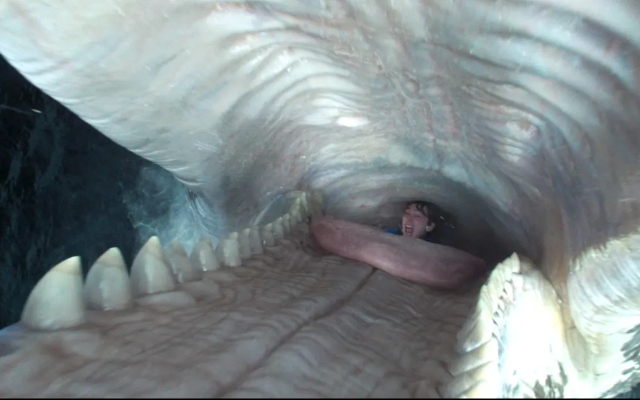
SYNOPSIS: In “Whalefall,” a new whale of a survival tale now playing in theatres, a scuba diver has only one hour of oxygen in the tank after being swallowed by a whale. “Son, what are you going to do? Just accept your fate?”
CAST: Austin Abrams, Josh Brolin, Elisabeth Shue, John Ortiz, Jane Levy, Emily Rudd. Directed by Brian Duffield.
REVIEW: A modern riff on “Jonah and the Whale,” “Whalefall” is a survival story where our main character spends almost an hour up to his neck in viscera that looks like the stuff they throw away at the local fishmonger. But more than that, it’s the slightly waterlogged story of a troubled relationship between a father and son.
Based on Daniel Kraus’ novel of the same name, the action in “Whalefall” begins with Jay Gardiner (Austin Abrams) diving off the central Coast of California in search for his father Mitt’s (Josh Brolin) remains.
When he is gobbled up by a giant sperm whale with only an hour of oxygen left in his tank, Jay must rely on the skills his cantankerous father drilled into him to survive. “I wanted to pass on things I knew,” Mitt said. “So, when it matters, you’ll know what to do. Remember… survivors survive.”
Although the movie could easily have been called “Digestive Tract: The Movie,” “Whalefall” is more than “Fantastic Journey” with a whale. The escape from the whale’s innards takes up most of the film, but it’s the daddy-issues that set it apart from the run-of-the-mill survival flick.
Once inside the whale director Brian Duffield, who co-wrote the script with the source novel’s author Kraus, amps up the film’s claustrophobic feel. The closed in, slimy feeling he creates is effective until Jay’s journey, lit by jelly fish bioluminescence, ceases being exciting and becomes repetitive. The scenes are dark, often hard to follow, and, as the story floats along, less and less interesting.
It’s in the flashbacks to Jay’s childhood that the full picture of his troubled relationship with his father emerges. Fragments of the story of a hard driving father, part drill sergeant, part gruff philosopher, and a son driven away by the tough love, come together to form a “Tender Mercies” style portrait of estrangement. “I’m scared of you,” Jay tells his father.
Those flashbacks provide the film’s emotional core, and even if they stray into saccharine territory and feel overwrought, they allow Austin Abrams, who, after his great work in “Resident Evil” is quickly becoming Hollywood’s go-to survivalist, to do something other than gasp for air. He does what he can despite a breathing apparatus in his mouth for much of the film, but the character is ultimately a bit flat.
“Whalefall” has interesting sound design—you won’t hear anything like the Sperm Whale’s cackling on any new age Whale Song collection—and some genuinely uncomfortably claustrophobic moments but gets drowned in sentiment in the belly of the beast.