Last year Liam Neeson announced his retirement from action films. “Guys I’m sixty-f******-five.’ Audiences are eventually going to go: ‘Come on!'” Then, just months later, he had a change of heart. ““It’s not true, look at me! You’re talking in the past tense. I’m going to be doing action movies until they bury me in the ground. I’m unretired.”
At an age when most action stars are staying home soaking in vats of Voltaren Neeson continues his tough guy ways in this weekend’s action thriller The Commuter. He plays an everyman caught up in a race-against-the-clock criminal conspiracy on his train trip home from work. Expect a mix of blue-collar action and Hitchcock’s Strangers on a Train.
It’s a perfect companion to the movies Neeson has made since his actionman breakout role. It all began with Taken in 2008. He played Brian Mills a former “preventer” for the US government who contained volatile situations before they got out of control. Now retired, when his seventeen-year-old daughter is kidnapped by a child slavery ring he has only 96 hours to use his “particular set of skills” to get her back.
He admits to being, “a tiny bit embarrassed by it,” but his burly build and trademarked steely glare made him an action star.
“Believe it or not, I have even had Arnold Schwarzenegger and Bruce Willis calling my agent saying, ‘How do I get these scripts?’” he said on his sixtieth birthday.
Audiences ate up his rough and tumble work. His habit of paying the rent with chest-beaters like the Taken films, Battleship, Unknown and The A-Team led one macho movie fan to post this on Facebook:
“After watching the movie The Grey, I can only come to the (very logical) conclusion that Liam Neeson should be King of the Earth. Who’s better than Liam Neeson? Nobody. That’s who. Nobody.”
But there was a time when a kinder, gentler Neeson graced the screen.
His first film, 1977s Pilgrim’s Progress, was so low budget he played several characters. He’s credited as the Evangelist, a main character in John Bunyan’s Christian allegory, but can also be seen subbing in as the crucified Jesus Christ.
It was another supporting role in a movie called Shining Through that led to his breakthrough. In it he plays a Nazi party official opposite Michael Douglas. The performance so impressed Steven Spielberg he cast Neeson as Oskar Schindler in Schindler’s List, which turned him into an Oscar-nominated star.
He parlayed that fame into starring roles in period pieces like Rob Roy, Michael Collins (at the age of 43 Neeson was 12 years older than the real-life Michael Collins when he died) and Les Misérables. Then comedies Breakfast on Pluto and High Spirits showcased his more amiable side.
High on the list of his mild-mannered roles are two films with Laura Linney. He’s worked with her so often on stage and in the movies they joke they feel like “an old married couple.” They’re part of the ensemble cast of Love Actually and play husband and wife in Kinsey, about America’s leading sexologist Alfred Kinsey.
Neeson, it seems, can portray almost anything on screen but claims he doesn’t give acting much thought. “I don’t analyse it too much. It’s like a dog smelling where it’s going to do its toilet in the morning.”
In the last decade when Liam Neeson hasn’t been making “Taken” movies chances are good he’s been working with director Jaume Collet-Serra. In the past they’ve teamed for action b-movies “Run All Night,” “Unknown” and “Non-Stop.” This weekend they return to theatres with “The Commuter,” a terror-in-the-tube tale that is a mix of blue-collar action and Hitchcock’s “Strangers on a Train.”
Neeson plays retired NYPD detective turned recently downsized insurance agent Michael MacCauley. “Karen and me,” he says, “we live hand to mouth. We’ve got nothing to fall back on.” With debts mounting, a second mortgage and a son heading off to an expensive school in the fall, MacCauley is presented with an unusual proposition on his commuter train ride home from Manhattan to upstate New York. Mysterious stranger Joanna (Vera Farmiga) offers him $100,000 to do a simple job—find the new passenger on the train from the sea of faces he’s travelled with for the last decade and place a GPS on them. No strings attached. He doesn’t know the person nor will he ever know what happened to the person. “What kind of person are you?” she asks. If he says yes, his financial worries are over. Say no, however, and he risks the safety of everyone on the train and his family.
A better question would be, “What kind of movie is this?“ It’s not exactly fair to call it a thriller because there is very little in the way of actual thrills. After an effective opening montage that shows the drudgery of the 9 to 5 commuter’s life the film settles into very predictable beats as Neeson paces from car to car, desperation growing at every station stop. There’s a twist but as twists go it’s more of a straight line than a real bend in the plot.
This movie should have been called “Stereotypes on a Train.” Who could be the target? Is it the obnoxious businessman? The grizzled commuter? The teen doing an illegal errand for her boyfriend? I didn’t care and you probably won’t either. Things happen, bullets are fired and fists flung but the overly elaborate set-up—why didn’t the evil mastermind, who has absolute control over the situation, plant the GPS herself?—and clichéd dialogue doesn’t leave much room for interesting action.
Neeson certainly knows how to play the everyman with a special set of skills but he’s done it before and better in other movies. Formulaic in the extreme, “The Commuter” is as interesting as taking the same route home day after days for ten years.
If self-described “demonologists, ghost hunters and kooks” Ed and Lorraine Warren didn’t really exist, Hollywood would have invented them.
In addition to investigating 10,000 cases of paranormal activity — including exorcising a “werewolf demon” — they founded the New England Society for Psychic Research, authored three books about their ghostly exploits and were the proprietors of Warren’s Occult Museum in Monroe, Conn.
They are colourful eccentrics whose wild exploits are perfect big-screen fodder.
Patrick Wilson and Vera Farmiga played them in 2013’s The Conjuring. Based on a real-life haunted house in Rhode Island, it comes complete with slamming doors, someone or something goosing family members in their sleep and the smell of rotten meat.
Directed by Saw co-creator James Wan, it’s a mashup of The Exorcist and a particularly unnerving episode of Ghost Hunters and earned Farmiga a nomination for the MTV Movie Award for Best Scared-As-S—t Performance.
The demon-hunting duo are back in theatres in The Conjuring 2. This time they’re looking into the Enfield Poltergeist incident. Instead of a ghost in a house, malevolent spirits possess young children who speak in strange voices, levitate and do all manner of spooky things.
“I’ve known about them since I was pretty young, back in high school,” Wan says of the Warrens.
“I was fascinated by what they did and who they are. I’ve sort of kept them in my peripheral all these years, and I’ve always thought their life stories would make a very interesting movie.”
The Conjuring films are scary but they’re not the only supernatural cases the Warrens investigated that went on to get the big-screen treatment.
Annabelle, a 2014 prequel to The Conjuring, proves you can’t keep a good doll down. It tells the story of Annabelle, that movie’s creepy, possessed dolly before she was safely locked away in Warren’s Occult Museum. Echoes of Rosemary’s Baby and Repulsion reverberate throughout the movie’s low-key weird atmosphere.
The Warrens’ much-documented Carmen Snedeker situation gave us The Haunting in Connecticut. In a disturbing flick that breathes the same air as any movie involving evil spirits, a haunted house, an old aboriginal cemetery or former insane asylum, evil forces torment the Snedekers after they move into a converted funeral home in Southington, Conn.
In the real-life 1986 event, the Warrens were called in and declared the Snedeker house to be crawling with demons, the result of former funeral home workers practising necrophilia.
How accurate was the movie?
“I was also told about scratching on the walls, blood and séances,” Lorraine told MyRecordJournal.com. “That isn’t the type of thing … occurring within the house at all. The movie is very, very loosely based on the actual investigation.”
The eerie couple’s most celebrated case happened at 112 Ocean Ave. in Amityville, Long Island. Known as The Amityville Horror, their look into the Lutz family’s outrageous claims of supernatural terror after moving into the large house where Ronald DeFeo, Jr. shot and killed six members of his family, has been the subject of 10 movies and a number of books.
“The case itself has affected our personal lives more than any other case we’ve ever worked on in 54 years of research,” Lorraine said.
In 2013’s “The Conjuring” self-described “demonologists, ghost hunters and kooks” Ed and Lorraine Warren (Patrick Wilson and Vera Farmiga) battled spirits in a Rhode Island haunted house. Imagine a mash-up of “The Exorcist” and a particularly spooky episode of “Ghost Hunters.” The sequel, eerily titled “The Conjuring 2,” picks up their story seven years later.
This time around again their exploration of the Amityville Horror house has brought the Warrens fame but the case left Lorraine fatigued, too wearied for the weird stuff. “This is as close to hell with this I ever want to get,” she says. She is tormented by strange visions, unsure if she wants to continue exploring the paranormal. “After everything we’ve seen there isn’t much that rattles us anymore,” says Lorraine, “but [Amityville] still haunts me.”
She is drawn back into the world of ghosts, goblins and things that go bump in the night when the Catholic Church calls on the spooky duo to be their eyes and ears in another Ouija board cautionary tale. This one is the Enfield Poltergeist incident in Britain, a 1977 exploration into a case some called the English Amityville.
Once again there’s a haunting, but instead of a ghost in a house, malevolent spirits possess a young child, Janet Hodgson (Madison Wolfe), who speaks in strange voices—“I’ve come from the grave!”—levitates and does all manner of uncanny, violent things.
Director James Wan takes his time unveiling the scares in “The Conjuring 2,” allowing tensions to build slowly and surely. Even the innocent act of watching a bad sitcom takes on a sinister air, with the canned laughter adding to the audience anxiety. Some will think it moves too slowly, others will be edging towards the front of their seats.
Apart from the mouth-agape scared faces—Farmiga is a master at the terrified visage—“The Conjuring 2’s” terror is supplied by very simple special effects. Chairs rocking back-and-forth and slamming doors are simple, practical effects but the fear they deliver is amplified by Wan’s skill with old school timing and beautiful, atmospheric filmmaking. The story is occasionally silly, but still able to raise the hairs on the back of the neck because Wan carefully doles out details that add up to an unsettling night at the movies. Is it grim? Emotionally, perhaps, but there are no blood and guts, just a positive message that love conquers all, even evil.
Interviewers love talking with Robert Downey Jr., not just because he’s one of the biggest movie stars in the world, but also because he’s a one-man quote machine.
Walking into a room full of Canadian reporters to chat up his latest film, The Judge, he’s wearing a festooned shirt — and that is the only word that can be used to describe his flamboyant sartorial choice — with a pattern that resembled a bisected tree trunk. More intriguingly he carried a small green, nondescript box.
Asked what was inside he said, “I have distilled socialism in this box. It wasn’t easy. I’m bringing it back to America.”
And the quotes kept coming.
The Judge is a family drama about Hank, a hotshot, big-city lawyer who returns to his hometown for his mother’s funeral. He’s been estranged from his father, Judge Joseph Palmer (Robert Duvall), for years — “He’s dead to me” — but is forced to re-examine everything he knows about his dad when the judge is accused of murder.
Downey says, “I found myself crying all the time,” (great quote No. 2 for those keeping track) during filming, but not because he was reflecting back on his own life. “I got caught up in the reality the movie expresses,” he says. “Hank’s mom’s funeral is every funeral and Hank’s cut-off with his dad is every cut-off that anyone has ever had. It’s not even particularly a father-son story because the judge could have been the mom. I just think about these family dynamics and they light up constellations that are very emotional” (great quote No. 3!).
He describes shooting the movie as a “weird game of Sudoku” (great quote No. 4) in terms of making sure the emotional moments didn’t stack up against one another, blunting their impact.
“You can’t just play 120 catharses in a row,” he says. “I hate it when I see that in movies. It’s like, ‘All right, is everyone always crying in real life?’”
The first step in finding the character meant not allowing his Hollywood persona to bleed into Hank. “That was the first thing I had to smash,” he says.
“Hank is really observing this situation that’s happening around him and to him and he becomes this person who has to go through this terrible and wonderful crucible. It was really just about doing less and less and less and less and I like being busy. I like to talk and I like to be active and all that stuff, so sometimes I felt like I was literally just sitting on my hands.”
He leaves us with one last great quote that sums up his emotional response to the film. “It kicks me in the stomach in the nicest way.”
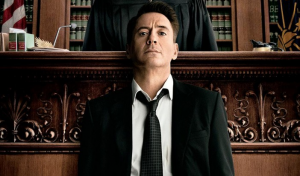
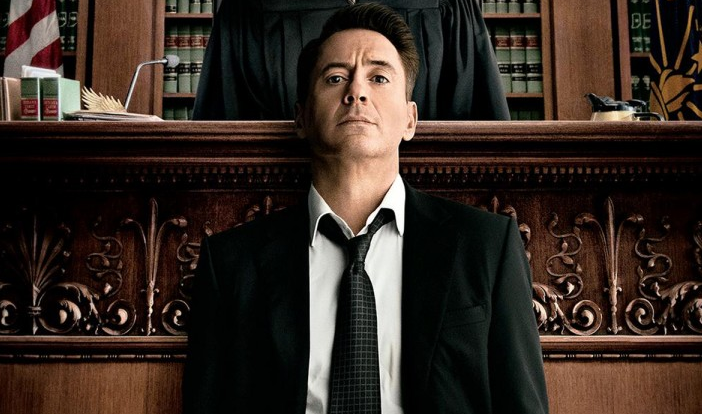
You get value for your money in Robert Downey’s Jr’s new film “The Judge.” Stepping away from the superhero movies that made him a household name, he stars in a film with so many story shards and plot derivations you need a scorecard to keep up.
It’s a legal drama. No, it’s a manboy coming-of-age story. Wait! It’s also romance, a dramedy, a father-and-son tale and a mystery. The only genres missing are horror and science fiction and I suspect they will be included on the director’s cut Blu Ray.
Downey Jr is Hank Palmer, a hotshot defense lawyer. He’ll do anything to win and is proud of it. “Everybody wants Atticus Finch,” he says, “until there’s a dead hooker in the hot tub.” In court he’s Iron Man, an unstoppable force with a thick skin and a quick line. He’s the same outside of court as well, except when it comes to his father.
He’s been estranged from Judge Joseph Palmer (Robert Duvall) for years—“He’s dead to me.”—but is forced to see him when his mother passes away. Returning to his hometown of Carlinville, Indiana for the funeral Hank must confront the life he left behind—ex-girlfriend Samantha (Vera Farmiga), brothers Glen (Vincent D’Onofrio) and Dale (Jeremy Strong) and his cold-fish father. The quick in-and-out trip is extended, however, when the Judge is accused of murder and Hank becomes his lawyer.
“The Judge” feels like Oscar bait. It’s a long movie with a wide story arc that gives its leads ample opportunity to strut their stuff. Downey hands in a solid, if somewhat familiar performance while Duvall plays elder statesman, resurrecting the alpha male feel of “The Great Santini.” Both are used to good effect and the supporting cast keeps things humming along despite a story that pushes credulity to the limit.
The devil is in the details and when the details, no matter how small they are, verge on silly, they become a distraction.
Most of the silly stuff comes in the form of the clues Hank pieces together while forming the Judge’s defense and the trial itself. There will be no spoilers here, but suffice to say the whole thing hinges on a bit of information so implausible that it gives new meaning to the term suspension of disbelief. Trouble is, it didn’t have to be that way. There were any number of ways to establish the point in question (OK, HERE’S AMILD SPOILER ALERT: It involves chemotherapy and a cottage) without trying so hard, but that’s not the kind of film this is.
“The Judge” is the hardest working movie in show business. It’s a film that wants to check all the boxes and tries just a little too hard. Downey and Co. float above it all, however, touching down every now and again to introduce a new plot twist and deliver the occasional touching moment.
This prequel to “The Conjuring” proves that you can’t keep a good doll down. It tells the story of Annabelle, that movie’s creepy, possessed doll before she was safely locked away in ghost hunter Ed and Lorraine Warren’s cabinet of curiosities.
The story begins in the late 1960s with a gift from John (Ward Horton) to his expectant wife Mia (Annabelle Wallis). “There’s something I want to give you,” he says. “Oh no,” she laughs, “the last time you said that I ended up pregnant.” He gives her Annabelle, a seemingly harmless vintage doll, decked out in a lace wedding dress. “She fits right in,” Mia squeals. The quiet peace of John and Mia’s life is broken by a Manson Family style home invasion, and even though Mia and John survive, strange things start happening in the wake of the attack. “Crazy people do crazy things, ma’am,” explains a detective before everyone starts to realize that Annabelle has something to do with the weird goings on. Barbie she ain’t.
“Annabelle” is like a Haunted House attraction at Halloween. There’s nothing that’s really, truly soul-scorchingly scary inside, but it will give you a few good jolts. It’s part psychological drama, part Paranormal Activity and is filled with good weird atmosphere, but where “The Conjuring” had the benefit of two strong leads in Vera Farmiga and Patrick Wilson, “Annabelle’s” stars, Wallis and Horton, aren’t very compelling. She put me in the mind of Sharon Tate, which is appropriate for the time and story and Horton reminded me of… nothing much at all. More interesting leads might have made me care more about the story.
The actors may be milquetoasty, but the movie’s low key eerie atmosphere isn’t. Director John R. Leonetti works in echoes of “Rosemary’s Baby” and “Repulsion,” amping up the tension without the use of computer generated special effects. Instead he relies on silence and everyday sounds to make your skin crawl. The Self-Operating Sewing Machine from Hell and Satan’s Popcorn are effectively used in a movie that may be the quietest horror film ever made.
There are a couple of lines necessary for the success of every Creepy Kid movie. Chief among them: “I have a surprise for you, Mommy!” Why is the line so successful? Because the surprise is never good. A close second is the old, “I don’t think Mommy likes me very much” gag. These lines work because of the juxtaposition of innocence against a malevolent backdrop. In other words, evil children are scary. Orphan, starring Vera Farmiga and Peter Sarsgaard is the latest Creepy Kid movie to hit the big screen, but is it as disturbing as the classics of the genre like The Omen or Village of the Damned?
The story begins with a heartbreaking loss. John and Kate Coleman (Sarsgaard and Farmiga) are reeling after a miscarriage. The loss has taken a toll on their marriage, which seems about as stable as the bond between that other Jon and Kate we’ve been hearing so much about lately. In an attempt to right their awful situation they decide to adopt a child from a local orphanage. Finding themselves drawn to Esther (Isabelle Fuhrman) they welcome the young girl into their home, but as soon as they do strange things start happening. Certain that something is wrong—really, really wrong—with her new daughter Kate tries to convince John that Esther isn’t the little bundle of joy they bargained for. He doesn’t heed her warnings until it is too late.
Orphan has echoes of many creepy kid movies but sets itself apart with (a probably unintentional) sense of camp that permeates its later scenes. It’s the kind of over-the-top dramatics that turned Mommy Dearest from bio pic into giggle fest. Its sense of hysterical fun makes it a good Friday night late show kind of movie with the right audience.
Orphan bills itself as a horror film, and it starts with a bang—well, more of a spurt or a gush, really—but many of the scares aren’t so much scares as they are jolts caused by loud audio cues and red herrings. I call them “booyas,” little unexpected shocks that snap you to attention. It’s a cheap way to get a rise out of people but it does create a bit of tension.
Modigliani beauty Vera Farmiga is effective as the woman on the edge of a breakdown. Peter Sarsguard wins the Least. Supportive. Husband. Ever. Award and has one insane, cringe worthy scene near the end of the movie that I assume he didn’t read before he agreed to take the part. It’s a ridiculous but of overacting but fits the camp feel established by director Jaume Collet-Serra.
The parents are the foundation that holds everything together but the kids are the stars. As younger sister Max Aryana Engineer has mastered the art of the terrified face and Jimmy Bennett as brother Danny has bored teenage boy down to a science but it is Isabelle Fuhrman as evil Esther who steals the show.
She’s a particularly good Creepy Kid, just other-worldly looking enough to be freaky but able to turn on the charm when she needs to. Her facility with Hieronymus Bosch-style paintings and claw hammers are definite signs that something’s not right with the little girl John and Kate invite into their home, but what can you expect when you spend less time deciding to adopt Esther than most people spend deciding on which kind of ice cream to buy.
Esther is a stern mistress who I could see inspiring a drinking game. How about a shot of Jäger every time she gives someone the creepy kid stink eye? You’d be on your butt before the forty minute mark.
Orphan isn’t great but it does provide a few campy laughs and a couple of squirmy scenes.
“Up in the Air,” the third film from director Jason Reitman, takes the best elements from his first two films, “Juno” and “Thank You for Smoking” and molds them into one seamless package.
George Clooney is Ryan Bingham, a high flying “termination engineer” who fires people for a living. Hired by independent companies, he flies from city to city doing the dirty work when it comes to mass lay offs. He’s perfectly suited to the job and with the recent global economic downturn, cousin, business is a boomin’. He’s a road warrior who loves the perks of the job, the air miles—his goal is to hit the 10,000,000 mile mark—the status cards and life in airports. On the road 322 days a year (“That leaves 43 miserable days at home,” he says.) he says all the stuff that people hate about traveling—the recycled air, the artificial light and warm sushi—are the things that remind him that he is home. Other than his job he’s commitment free, other than the odd woman he meets in an airport or hotel bar, like Alex (Vera Farmiga), a fellow road warrior who gets “turned on by Elite status.” His carefully constructed life may come crashing down, however, when his boos (Jason Bateman) hires Nathalie (Anna Kendrick), a know-it-all IT expert who has an idea that may ground him permanently.
It’s possible that George Clooney is the only actor working today who could make Ryan Bingham likeable. He uses every ounce of his considerable charm to make this man who treats commitment like a disease and fires people for a living bearable, much less likeable but he does. If he didn’t the movie wouldn’t work on the level it does, it would simply be a smug (and timely) social satire on how some people have found ways to benefit from the recent economic downturn. Instead it’s a heartfelt portrait of a man who tries his best to isolate himself from the pain and hurt of real life (and his job). Clooney, in what may be his strongest outing yet, combines bravado and vulnerability in one very appealing package.
Jason Reitman has found a balance in style between the heartfelt clarity of “Juno” and the biting satire of “Thank You for Smoking. He’s pitch perfect with the tone, mixing cynical with witty, creating one of the nerviest movies of the year. Opening a comedy about firing people when job market is on red alert takes some stones, but Reitman wisely attacks the subject head on, using vignettes of recently terminated people as a sad comment on the times we live in. Those scenes add some profound emotional heft to the story while Clooney and leading lady Vera Farmiga do the rest with a wonderfully acted relationship between two sharks that leads Bingham to an existential epiphany.
Clooney and Farmiga aren’t the only high fliers in the cast; Anna Kendrick, a young actress best known for her role in Twilight shines as the overly meticulous IT expert who has a thing or two to learn about people.
It’s hard to believe that “Up in the Air” is only Reitman’s third film. It’s the feel bad feel good movie of the year, so self assured, so strong in style and performance that it should get much notice at awards time.