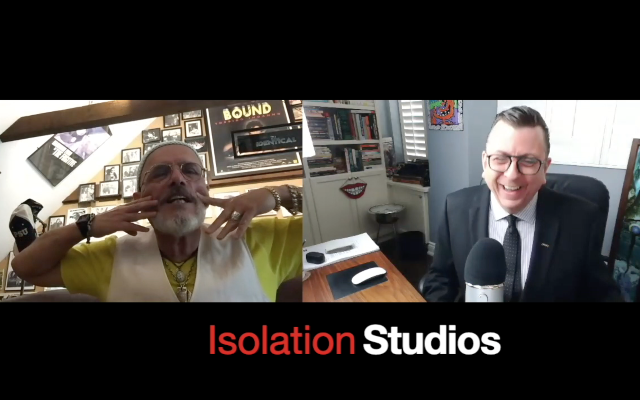
Check out episode twenty-four of Richard’s web series, “In Isolation With…” It’s the talk show where we make a connection without actually making contact! Today, broadcasting directly from Isolation Studios (a.k.a. my home office), we meet Joe Pantoliano, a working actor for over forty years. From doing plays in empty basement theatres in New York City to Broadway to guest roles on the biggest television shows of several decades like “M*A*S*H” and “The Sopranos” and juicy supporting parts in films like “Risky Business,” “The Goonies,” “The Fugitive,” “Memento,” “Bad Boys” and “The Matrix” he says “There aren’t any small parts, only small paychecks.”
He jokes that he has a twenty-minute face, perfect for character work but his new film, “From the Vine” offers him the chance to show off his ninety-minute face. His first starring role in recent memory sees him playing a man who gives up a high-flying career as an executive to return to Italy, where he was born, to search for find his centre and regain his moral compass. In this interview we talk about the parallels between his life and that of his “From the Vine” character, Jimmy Stewart’s wig and how “On the Waterfront” made him want to be an actor… and here’s a surprise… it had nothing to do with Marlon Brando.
“They sent me to a place called Bob Roberts,” Joe says in the interview, “a guy who made wigs on Robertson Avenue. Robertson Boulevard in LA, and as I was walking up the courtyard out walks Jimmy Stewart. He’s got a fishing cap on, and he is carrying a box. It’s his hairpiece. I said, ‘Mr. Stewart. I’m a young actor and I just got a big job over at Warner Bros. I’m getting fitted for my first hair piece.’ He said, ‘Well good for you young man. I didn’t get fitted for mine until I was 38.’”
Let’s get to know Joe Pantoliano.
Watch the whole thing HERE on YouTube or HERE on ctvnews.ca!
“From the Vine” breathes the same fragrant air as “Under the Tuscan Sun,” “A Good Year” and any number of other movies that offer up beautiful scenery and a stripped-down way of life as a tonic for the soul.
In a rare leading role Joe Pantoliano stars as Marco Gentile, an Italian born CEO of a Canadian automobile company. He’s at a crossroads in his life. Tired of the grind and troubled by an unkept promise he made years ago, he throws it all away. Without consulting his wife Marina (Wendy Crewson) he quits his high-paying job and makes a plan to hightail it to the tiny town of Acerenza, site of his grandfather’s old vineyard in Italy. There he hopes to reconnect to a way of life that will help him find his centre and regain his moral compass. But will his new beginning spell an end to old relationships?
There is a sense of déjà vu that comes along with watching “From the Vine.” Like the movies I mentioned above, it’s a beautifully shot travelogue with that follows a familiar path. Adding some spark are engaging performances from the cast.
Pantoliano plays Marco as a man having an extreme mid-life crisis, but it’s not about buying a Maserati or trading in his starter wife for someone younger. He’s having an actual existential crisis brought on by the realization that the life he leads isn’t the life he wants. To illustrate his dilemma director Sean Cisterna adds in a few surreal Felliniesque flourishes, but the heart of the character comes from Pantoliano’s rough-hewn charm.
As Marco’s long-suffering wife, Crewson brings warmth and a considerable amount of heart.
“From the Vine” doesn’t add anything new to the soul-searching travelogue genre but the point of these movies is not to reinvent the wheel. Like rom coms, the most formulaic variety of mass entertainment there is, it’s about the journey not the individual stops along the way. Sure, the story is predictable but it exudes good vibes and tries to appeal to our better natures and these days maybe that’s enough.
Road movies might be the great Canadian genre. From “Goin’ Down the Road” to “Highway 61” generations of Canadians have travelled from Cape Spear to Tofino in search of story, enlightenment and cold cans of Molson Export. With ruggedly beautiful terrain in the background and characters criss-crossing in the foreground, our filmmakers have often hit the road in search of cinematic success.
The latest Canadian director to hit the road is Kire Paputts. In his feature debut he tells the story of Eugene (Dylan Harman), a nineteen-year-old man with Down syndrome. When we first meet Eugene he’s living with his mom in a cramped Toronto apartment. She lies in bed hacking up a lung, her smoker’s cough filling the air, as and he fills his time watching “The Littlest Hobo,” the great canine Canadian traveller, on TV while drawing pictures of rainbows. “They say that at the end of the rainbow there is a pot of gold,” he says. “If I found the pot of gold I would buy video games.” He believes rainbows are a symbol of hope, so when tragedy strikes he sets off across country, on a bicycle with training wheels, greeting strangers with a simple question, “Have you seen the rainbow?”
By their nature road movies are episodic. The great ones tie their segments together thematically, building on a central thesis. “The Rainbow Kid” plays itself out in chapters but feels more like a series of random situations banged together to form a whole rather than a complete narrative that runs from start to finish. There are highlights along the way. Eugene’s rainbow hunt yields Elvis Grimes—Julian Richings doing a memorable riff on his “Hard Core Logo” character Bucky Haight—and Anna (Krystal Hope Nausbaum), a young special needs girl who introduces our hero to the carnal side of her nature.
To the film’s credit, as these segments drift together, Paputts is fearless his treatment of Eugene and the story. The tale takes a dark, unexpected turn near the end, but the tone of the film is less important than the way it portrays Eugene’s single mindedness of pursuit. He’s on a hero’s journey and nothing—irate stepfathers, old rock stars or criminals—will stop him. “The Rainbow Kid” happens to have a character with a disability but doesn’t use its non-traditional lead as a gimmick. Instead Harman’s emotional, charming performance grounds the fanciful film in humanity.
 Check out episode twenty-four of Richard’s web series, “In Isolation With…” It’s the talk show where we make a connection without actually making contact! Today, broadcasting directly from Isolation Studios (a.k.a. my home office), we meet Joe Pantoliano, a working actor for over forty years. From doing plays in empty basement theatres in New York City to Broadway to guest roles on the biggest television shows of several decades like “M*A*S*H” and “The Sopranos” and juicy supporting parts in films like “Risky Business,” “The Goonies,” “The Fugitive,” “Memento,” “Bad Boys” and “The Matrix” he says “There aren’t any small parts, only small paychecks.”