As Dave Edmunds once warbled, “From small thinks baby, big things one day come.”
In Hollywood right now no one is bigger than Chris Pratt. His films Guardians of the Galaxy and The Lego Movie were two of the top five grossing hits of last year and Jurassic World is pegged to light up the box office with an estimated $100 million take this weekend.
Esquire has declared him “awesome” and The Guardian noted “there’s a lot of love for Chris Pratt right now.” He has momentum, the kind of Hollywood heat that gets your name mentioned as the lead in every big movie, including the proposed reboot of Indiana Jones. In fact, some even label him the next Harrison Ford.
The hype swirling around the affable thirty-five-year-old actor places him at the top of the Hollywood ladder, but it certainly wasn’t always that way. A scan of the early credits on IMDB does not point toward superstardom.
Guest spots on the short-lived bounty hunter series The Huntress and a third lead in the so-little-seen-it-doesn’t-even-have-a-Rotten-Tomatoes-rating action film The Extreme Team seem positively high profile compared to his first credit.
Pratt was working as a waiter at the Bubba Gump Shrimp Co. restaurant in Maui when actress Rae Dawn Chong came in for lunch. She happened to be in the midst of casting Cursed Part 3, a short horror satire about a director who tries to convince his actors and crew not to flee when a mysterious killer visits the set.
Pratt was living with a group of friends in a van, doing stand-up comedy and community theatre when he approached the Quest for Fire star. “I said, ‘I know you. You’re a movie star, right?’ She said, ‘You’re cute. Do you act?’”
Chong thought he’d be a good fit for the part of “a beautiful kid to play the Brat, an actor who complains out loud about having to make out with an older actor, played by Donna Mills.”
The film was set to roll in five days and after a quick audition Chong offered Pratt a plane ticket to California and the role of Devon. “I had far more confidence than capability at the time,” he says, “but I knew I could do it.”
Shot next door to Michael Jackson’s Neverland Ranch, Cursed Part 3 isn’t much of a movie, but Pratt made $700 for his debut, money he invested in a car so he could drive to auditions.
“I went from waiting tables in Maui to waiting tables in Beverly Hills,” he says of Cursed Part 3, “but with a little bit of movie experience under my belt.”
The film was a stepping-stone to bigger and better jobs, including the role that made him a star, Pawnee City Hall shoe-shiner Andy Dwyer on Parks and Recreation.
Movie stardom was harder to come by. Losing blockbuster roles like Avatar’s Jake Sully and Captain James Kirk of the rebooted Star Trek was discouraging, but he was determined to act. “People have to work,” he said. “I just don’t want it to be at a restaurant.”
With big budget movies on the way like the proposed sci fi adventure Passengers with Jennifer Lawrence and an all-star remake of The Magnificent Seven, it doesn’t look like he’ll have to dust off the Bubba Gump Shrimp Co. uniform again any time soon.
For the fourth time all heck breaks loose on Isla Nublar when gene-spliced dinosaurs get loose and start chowing down on humans. And you thought genetically modified food was bad for your health.
“Jurassic World” is set in a theme park of the same name, a bigger, flashier version of the one first seen in “Jurassic Park.” For years over 20,000 people a day have come to visit the dino petting zoo and see the T-Rex in his “natural” habitat. Think SeaWorld with Archaeopteryx instead of dancing dolphins and you get the idea. Business is brisk but park director Claire (Bryce Dallas Howard) feels their exhibits are old hat, as exciting as a clown in an elephant suit.
“No one is impressed by dinosaurs anymore,” she says. “Consumers want bigger, louder and more teeth.”
Her solution is to genetically manufacture a designer dinosaur, a hybrid of T-Rex DNA and bits and pieces from several other creatures. Called Indominus Rex, it’s a fearsome fifty-foot tall beast with fierce intelligence and an attitude to match. When it escapes (that’s not a spoiler, just a fact of life in the “Jurassic” films) Claire calls upon dino trainer Owen Grady (Chris Pratt)—he’s the Cesar Millan of the dinosaur world—to bring the situation under control before her two visiting nephews get eaten or a military contractor (Vincent D’Onofrio) who wants to repurpose the beasts as weapons.
“Jurassic World” is a respectable entry into the “Jurassic Park” genus. It’s a monster movie, with a bigger, louder and toothier villain than the previous films, but not quite as many thrills. It’s near impossible to top the visceral thrills of Steven Spielberg’s original movie so director Colin Trevorrow doesn’t try. Instead he weaves an homage or two to “Jurassic Park” into the fabric of the story and makes sure there are roaring dinosaurs and snarling Raptors on screen as much as possible. They run, leap and do battle in a climatic scene that can only be described as ridonkulous. The tempered skill Spielberg brought to the first movie is replaced by bombast, but what can we expect form a movie whose manifesto is, “No one is impressed by dinosaurs anymore; consumers want bigger, louder and more teeth”?
Pratt takes a step closer to claiming the role of Indiana Jones by playing Craig as the wisecracking but charming and resourceful hero and “New Girl” star Jake Johnson offers some welcome comic relief. Howard is self-possessed and intense, and has good chemistry with Pratt.
“Jurassic World” is a fun summer distraction, with enough of its predecessor’s DNA to be worth a look.
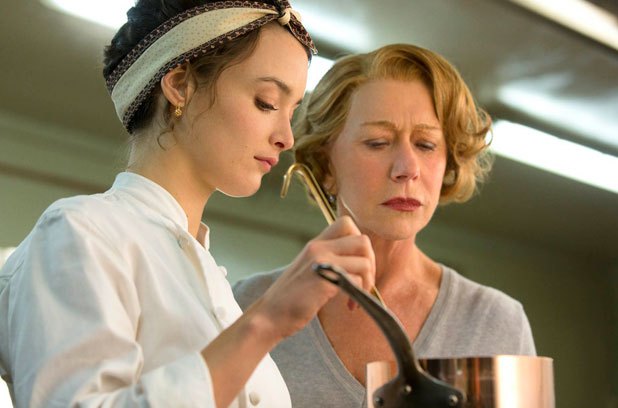
“The Hundred-Foot Journey” is a rich concoction that flavors its story with the sweetness of “The Best Exotic Marigold Hotel” and the sour competitiveness of “MasterChef.”
It’s a feel-good movie about an Indian family who moves to a town in France to open a restaurant. Across the street is a Michelin-starred French eatery run with an iron fist by Madame Mallory (Helen Mirren). Cultures and personalities clash, but soon Hassan Kadam’s (Manish Dayal) talent in the kitchen leads him on a journey. First he crosses the hundred feet between his father’s (Om Puri) restaurant to Madame Mallory’s kitchen, then to Paris and ultimately to his real passion.
The last time director Lasse Hallström went all Food Network on us the result was the 2000 bonbon “Chocolat,” a comic story with a bittersweet edge. He’s revisiting similar ground here, mixing gastroporn, good old-fashioned romance and cross-cultural farce.
The conflicts between restaurateurs Madame Mallory and Mister Kadam, and newbie chefs Hassan and Marguerite (Charlotte Le Bon), (SPOILER, BUT ONLY IF YOU HAVEN’T EVER SEEN A MOVIE BEFORE), are, of course, going to change from rivalry to romance, that much is obvious from the beginning, but the predictability of the story is tempered by very charming performances from the leads.
Mirren essentially plays two characters. As Madame comes to respect and then like her new neighbors, her ice queen demeanor slowly melts, allowing the actress to subtly reveal layers of character. There’s no neighborly epiphany that changes her mind—although a cowardly racist act sets things in motion. Instead, she rediscovers her various passions and each new revelation is registered on her face and in her body language.
Puri’s stubborn patriarch is mischievous and charming while Dayal and Le Bon (who lives up to her name) are solid romantic leads.
Despite its predictability, “The Hundred-Foot Journey’s” collection of characters keeps things lively and amusing and the food looks so good you’ll wish the movie was in Smell-O-Vision. It’s an enjoyable film about passion; the passion for food, passion for culture but most of all, passion for life.
Charlotte Le Bon, the Paris-based, Quebec-born star of The Hundred-Foot Journey was in Toronto recently to do a round of interviews to promote the movie. “How’s the day going for you so far?” asked your intrepid reporter.
“Amazing! I’m so happy answering the same questions over and over again. Be creative,” she says with a laugh.
So the standard, “How is it working with Helen Mirren?” is off the table. Ditto questions about producers Oprah and Steven Spielberg, although later she offers up that the idea of working with those powerhouses was enticing.
“When somebody calls you to say Steven Spielberg thinks you’re the one, you don’t go, ‘I’m going to think about it, read the script a couple of times and maybe I’ll call him back.’ It’s super overwhelming and exciting.”
In the film, she plays Marguerite, sous-chef to chef Madame Mallory (Mirren) in Mallory’s Michelin-starred French restaurant. When an Indian family, and their prodigiously talented chef (Manish Dayal) opens a restaurant just 100 feet across the street, rivalry and romance blossom between the two young kitchen stars.
Have you ever worked in a restaurant?, I enquire. “You’re the first journalist to ask that!” she says. “Yay! I worked in a sushi restaurant as a busgirl, just setting the tables. I realized how difficult working in a restaurant is. You have to be some kind of actor to be a good waiter because you’re always doing small talk and usually you don’t care about the people in front of you, but you have to act like you mean it.
“It’s a very difficult job and when you’re a chef it is over-the-top difficult. That’s why you have to be a control freak or a dictator to have a good restaurant and win Michelin stars.”
The 27-year-old vegetarian says she spent time in an upscale restaurant in Paris, “to learn how to act like a chef,” but don’t expect to see the impressive cooking talent she displays in the movie in her own kitchen.
“I’m really lazy when it comes to food,” she says. “I have experience in food in the way that I really enjoy eating people’s food,” she says. “I have no skills whatsoever.”
She prefers eating out because, “you don’t have to do the dishes, you can choose whatever you want and you don’t have to go grocery shopping.”
There’s anticipated, then there’s highly anticipated and even strongly anticipated and then there is the level of audience expectation for Indiana Jones and the Kingdom of the Crystal Skull. It’s the kind of anticipation that didn’t accompany the resurrections of other screen icons like Rocky or Rambo. Nope, this is in a class of its own. I’ve known expectant parents who weren’t as pent up as some of the Indy fans I’ve spoken to in recent months.
“Will Crystal Skull hold up to the originals?” they ask.
“Can senior citizen Harrison Ford (he’s 66 years old!) convincingly don Indy’s fedora after a gap of twenty four years?”
“Will George Lucas tarnish the Indy franchise as badly as he has buggered up Star Wars?” they bleat.
The answers, I’m glad to report are yes, yes and no.
Indiana Jones and the Kingdom of the Crystal Skull is a return to form for not only Lucas, but also Steven Spielberg and Ford. Separately they churn out trash like Star Wars: Episode II – Attack of the Clones, The Terminal and Hollywood Homicide, but bound together sparks fly. Lucas has kept only the clichés necessary for the continuity of Indiana’s character; Spielberg has amped up the action and the pacing and Ford fits the lead role like a well worn-in pair of slippers.
In this cold war story’s opening minutes Indy (Harrison Ford) is taken prisoner by Russians dressed as American soldiers, led by Irina Spalko (Cate Blanchett). Seems she’s interested in an artifact that could help her exert mind control over entire armies; an artifact that Indy can help her locate. In a breathless sequence involving car chases, rockets and an atomic bomb blast Indy escapes. Soon he teams up with a switchblade-toting juvenile delinquent in a leather jacket (Shia LeBeouf) and together they high tail it to the Peruvian jungle, racing against time to reach the Crystal Skull before Irina and her KGB thugs.
Of course that’s the Reader’s Digest version of the story. There’s also double crosses, rekindled love, giant ants, a snake that comes to the rescue, science fiction and action, action, action. While there is nothing here as iconic as the giant boulder chase or the Nazi face-melt from Raiders of the Lost Ark by and large Crystal Skull does a good job of paying homage to the original three movies.
At the heart of the film, of course, is Harrison Ford. Of all the actors who came of age in the 1970s—De Niro, Pacino, Hoffman, Hackman—Ford may be the most ironically American. He’s not the best actor of the bunch, not by a long shot, but like John Wayne he represents what is good about the United States—strength, courage and ingenuity. He brings these traits to every character he plays, but Indiana Jones is his greatest creation and the two decades between films in the franchise hasn’t dimmed that light one bit. He’s aged—LeBeouf’s character asks, “What are you, like 80?”—but fedora planted firmly on the top of his head he is still the heroic icon he was when the first film hit theatres and Ronald Reagan was president.
That’s great for movie fans who lined up to see Indiana Jones and the Temple of Doom on opening day, but audiences have changed in the years since the last movie was released, and there is a whole generation of moviegoers who have never seen an Indy movie projected on a screen. It raises the question of whether kids will be interested in Indy’s old-fashioned brand of screen hero. Sure, there’s action and adventure a plenty, but I wonder if today’s audiences, many of whom weren’t even born when Indy first bull whipped a golden idol out of the hands of the bad guys, aren’t more cynical and more likely to gravitate towards a deeply flawed and conflicted hero like Iron Man’s Tony Stark. It would be a shame if they didn’t. In these dark and dangerous times a bit of simple, straightforward heroics just might be a good thing.
Chances are you’ve already seen the latest 3D action adventure movie lumbering toward theatres this weekend. “Jurassic Park’s” DNA’d dinos originally scared the spinosaurus out of people in 1993, but has been updated—except for excited references to interactive CD-ROMs—with the addition of stereoscopic imagery. It’s a blast from the Mesozoic past with 3D dinosaurs.
A refresher for those used to fast forwarding to the exciting bits: Set in a time when CD ROMs aren’t the culture’s biggest scientific advance, the action begins when billionaire John Hammond (Richard Attenborough) invites his two grandchildren, Tim (Joseph Mazzello) and Lex (Ariana Richards) and a group of scientists (Sam Neill and Laura Dern), lawyer Donald Gennaro (Martin Ferrero) and a mathematician (Jeff Goldblum) to his new biogenetics theme park, Jurassic Park, located on a remote island off the coast of Costa Rica.
The park’s big draw are real brachiosaurs, triceratops, velociraptors and Tyrannosaurus Rexes grown from long-dormant dino DNA molecules taken from dinosaur-biting prehistoric insects preserved in amber.
It’s all fun and games until an underhanded employee (Wayne “Newman” Knight) hatches a plan to steal dinosaur embryos. His plan goes awry and soon hungry dinosaurs are on the rampage, snacking on lawyers and hunting the kids!
For a period piece–this year marks its twentieth anniversary—“Jurassic Park” is still a pulse pounder. Twenty years ago the special effects that gave us the lifelike dinosaurs made our eyeballs dance. Today we don’t notice the computer generated magic as much and can allow ourselves to be swept away by the thriller and horror aspects of director Steven Spielberg’s vision.
After an opening that relies too heavily on exposition—show me, don’t tell me!—the movie’s pleasures reveal themselves when Spielberg’s impeccable sense of timing comes into play. The now legendary trembling glass of water scene—ripples slowly appear as a T-Rex approaches—is as exciting now as it was two decades ago.
The question here is whether or not a film like “Jurassic Park” is improved by the addition of 3D bells and whistles. The real answer is no, but the movie remains an adrenaline rush and a treat to see back where it belongs, on the big screen.
Seen as a pair “Lincoln” and “War Horse” appear to usher in a new phase in Steven Spielberg’s career. No longer the Young Turk who made “Jaws,” or the blockbuster king of “Indiana Jones” or the family friendly maker of “ET,” he now is entering his golden age, or at least his homage to the golden age of Hollywood and the movies of his old-school heroes.
Despite a running time of two-and-a-half hours, “Lincoln” focuses on a short period of time in the president’s career. Spielberg and “Angel’s in America” writer Tony Kushner have zeroed in on the months surrounding the backroom politics that allowed passage of the 13th Amendment—“Neither slavery nor involuntary servitude, except as a punishment for crime whereof the party shall have been duly convicted, shall exist within the United States, or any place subject to their jurisdiction.”—through the House of Representatives. Several stories run parallel, but the thrust of the narrative focuses on the passage of this historic document.
The first glimpse of Daniel Day-Lewis as Abraham Lincoln, the 16th President of the United States, feels like watching a Yankee five-dollar bill come to life. Day-Lewis takes a familiar character, seen on money, enshrined in marble at the National Mall in Washington, portrayed on stage and screen*, and brings him to vivid life.
It’s a remarkable performance that blends familiar historical details with personality to create real flesh and blood character, complete with all the iconic traits history has endowed on him, and quirkier qualities—his habit of telling long anecdotes, his occasional prickliness. It falls in line with history’s attempts to bestow sainthood on Honest Abe, but doesn’t ignore the president’s human side.
Day-Lewis’s work brings the myth of the man to life in a film filled with remarkable acting. Despite the worst wig in cinema history Tommy Lee Jones as Thaddeus Stevens, the radical Republican who wanted to give voting rights to freed slaves, makes the speeches in legislature sparkle with life and righteous indignation.
Sally Field sheds light on the misunderstood Mary Todd Lincoln–“All anyone will remember of me is that i was crazy and ruined your happiness,” she says—and James Spader provides a much-needed light touch as a proto lobbyist.
The glimpse of backroom politics, 19th century style, is fascinating, although restless viewers may find some of the colourful dialogue daunting. Many of the speeches sounds like Conrad Black on a bafflegab bender, so bring a dictionary if words like pulchritude throw you for a loop.
The final vote is somewhat drawn out for dramatic effect, but considering it is one of the most important ballots in American history–make that human history–it deserves the space to breathe dramatically.
Spielberg’s treatment of the story is respectful, but nuanced. He doesn’t shy away from showing Abe and Mary arguing, for instance, but the well-crafted film feels old-fashioned, like a throwback to another era when epic filmmaking didn’t necessarily mean showing planets exploding but showcasing epic ideas.
*Most famously by Canadian-born Raymond Massey, who played him multiple times on stage and on film. In fact, he was so attached to the character a colleague joked that Massey wouldn’t be satisfied with his Lincoln impression until someone assassinated him
Legend has it that when Steven Spielberg offered Jamie Bell the lead role in The Adventures of Tintin, the actor looked the Hollywood legend in the eye and said, “I’ll have to think about it.”
“What is true is that he said, ‘If you were to be Tintin it would be about five years of your life. Are you comfortable with that?’
“To me, as a 16-year-old, five years was a really long time. [He’s 24 now.] So I didn’t want to be the naïve actor and say, ‘OK, I’m fine with that. I wanted to really consider it. I don’t even think I said I’d think about it, I just didn’t give a definitive answer.
“For me it was more important to be sitting down at a table with him.
“Just sharing a Hollywood meeting with him was awesome. To me, as a child, he was otherworldly. He was a Houdini character who made dinosaurs live and boys fly on bicycles.”
Bell, who first won hearts as the lead in coming-of-age-dance movie Billy Elliot, says getting to make the movie with Spielberg has “remarkable synergy” because “Tintin was one of his favourite childhood things.”
Originally, he simply enjoyed the characters, he says, but there was something special that set the stories about the young detective apart from other kid’s comics.
“It was different from all the other cartoons. I felt respected, as a kid, by Tintin. That allowed me to gravitate toward him and go on his adventures.
“I was a very inquisitive kid,” he says.
“I used to watch a lot of political satire comedy shows. I’m sure I had no idea what they were talking about, but they were funny to me. Grown-ups making fun of other grown-ups was hilarious.
“So when I read Tintin and he was travelling around the world solving political corruption, I just knew what was going on.”
The film grabs the spirit of the beloved books, bringing some of the intensity — and mild violence — of the original Hergé books to the screen.
“If Tintin wasn’t the beacon of excellence that he is,” says Bell, “if he wasn’t the guy with the correct moral compass, if he wasn’t so innocently earnest all the time, I think that could be an issue.
“But because the character at the front is such a great, natural and instinctual heroic character, I think you kind of get away with it.”