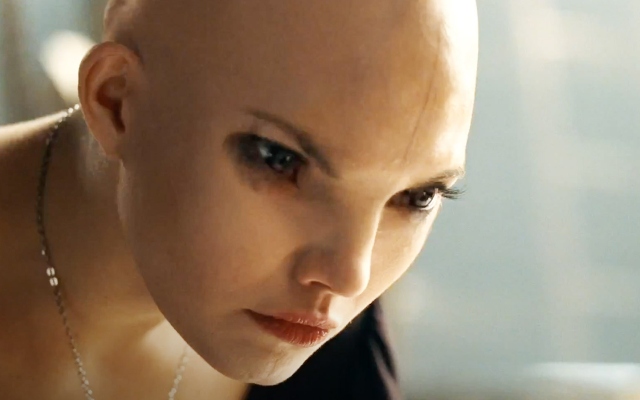
They grow up so quickly, don’t they? One day they are slimy bipedal creatures who look like a cross between Yul Brenner and a slug, the next they are flesh eating, underwater breathing alien looking supermodel types. At least that’s the way it is in “Splice,” a new sci fi thriller starring Oscvar winners Sarah Polley and Adrien Brody, about a creature who goes from newborn to troubled teen in a matter of weeks.
Clive (Brody) and Elsa (Polley) are bio chemists (and boyfriend and girlfriend) who develop a splicing technology which binds the DNA from multiple animals to create new life and, possibly, cures for everything from Parkinson’s to cancer. It’s the medical breakthrough of the century. The next logical step is to fuse human and animal DNA but despite their success in the lab, their employers, the evil conglomerate Newstead Pharma, is wary of the publicity such a radical step would incur. Secretly the pair go rogue, continue their experiments, and give “birth” to a new life form they dub Dren (that’s “nerd” backwards), a tailed creature resembling a bald dinosaur. Clive, conflicted by the ethical and moral issues of cloning, wants to kill the creature but Elsa won’t have it. “Human cloning is illegal,” she says, “but this won’t be entirely human.” Dren develops at a rapid pace, changing from unrecognizable organism to something akin to a humanoid kangaroo. Soon though problems arise. The creature becomes Daddy’s little… whatever, leaving Elsa to deal with Dren’s difficult puberty.
Like the hybrid creature at the center of the action “Splice” is a cross of genres—part b-movie sci fi and part body horror à la David Cronenberg. Liberally mixing “The Island of Dr. Moreau,” “Frankenstein” and “The Brood,” “Splice” examines ideas of life and death, of playing God, of what is human (and what is not) and even touches on Woody Allen style relationships. There are plenty of moral concepts to chew on, many ruminations to be had on what it is to be human, but only if you look past the b-movie thrills director Vincenzo Natali slathers on with a trowel.
Splice goes places that bigger budget science fiction wouldn’t dare to tread. This isn’t the enviro-friendly sci fi of James Cameron or the space opera of George Lucas. No, this has more in common with the exploitation films of Roger Corman. There’s an icky creature, some scientist sexy time and loads of crazy science. Corman might not have been as successful at layering in the love, jealousy and real human emotions Natali heaps on his characters but I think the b-movie king would approve of “Splice’s” overall tone. It’s doesn’t skimp on the blood and guts but it’s funnier than you think it is going to be, wilder than expected—Sarah Polley’s maternal instincts towards Dren are right out of “Mommie Dearest”—and takes several unexpected twists and turns.
“Splice” is giddy good fun, the rare sci fi flick that revels in its b-movie roots while also offering up something to think about over a beaker of coffee afterward.
“Women Talking,” directed by Sarah Polley and now playing in theatres, is a very specific portrayal of the aftermath of sexual abuse, with a universal message of standing up for one’s self, family and community.
Based on a 2018 Miriam Toews novel of the same name, in the film, the women of a tightly knit religious colony gather in the wake of terrible, on-going sexual abuse by the men. For years the commune’s husbands and sons have tranquilized the women with cow medication, raped them regardless of age, and then convinced the victims the abuse was the work of Satan or their “wild imaginations.”
“We know that we’ve not imagined these attacks,” says Salome (Claire Foy), the mother of an abused child. “We know that we are bruised, and infected, and pregnant, and terrified.”
In the wake of the allegations, the men, sequestered in the city for their safe keeping, have given the women two days to forgive them. If they don’t, they threaten to expel from the community women which means they will be denied entry into the Kingdom of Heaven.
“Surely,” says mother-to-be Ona (Rooney Mara), “there must be something worth living for in this life. Not only the next.”
Now, gathered in the hayloft of one of their barns, the women, including the rancorous Mariche (Jessie Buckley) and community matriarch Agata (Judith Ivey), debate their three options: do nothing in retaliation, stay and fight, or leave.
The spirited deliberations give way to a variety of points of view. “Is forgiveness that’s forced upon us true forgiveness?” wonders Mariche. “We have been preyed upon like animals,” says Greta (Sheila McCarthy). “Maybe we should respond like animals.” Others wonder what life would have been like if none of this ever happened.
Set in 2010, timely social issues of justice, autonomy and unanimity among victims collide in a movie that captures the extended conversations, highlighting their harrowing nature, while slyly mixing in some unexpected humour.
Polley, who wrote as well as directed, ensures that each of the characters bring dynamic notions to their performances, and aren’t just placeholders representing opposing ideas for the sake of drama. The set-up, based on true events in a religious community in Boliva, offers a fascinating window into a fight for survival and the opportunity to examine the situation from a variety of thoughtful viewpoints.
A film, largely set in one room, whose action is verbal, not physical, could have been dry or, at the least, feel stage bound but Polley’s deep dive into the human condition crackles with life. She has carefully calibrated every line, every pause, to create forward momentum as the life-changing deliberations move toward their conclusion.
“Women Talking” is elegant filmmaking buoyed by emotional intelligence and powerhouse performances and is sure to be Oscar bound.
Richard hosted the May Giller Power Panel, exploring how books are adapted to the big and small screen, how the writer is involved (or not) in the process, how much control they can exert over the final product, how a book gets optioned, and more.
The panel featured Margaret Atwood, Emma Donoghue, Sarah Polley and Clement Virgo.
What to watch when you’ve already watched everything Part Five! Binge worthy, not cringe worthy recommendations from Isolation Studios in the eerily quiet downtown Toronto. Three movies to stream, rent or buy from the comfort of home isolation. Today, a human-animal hybrid, a homemade superhero and a country music legend.
Sarah Polley has been in front of the camera since she was a little girl as the star of dozens of films like “The Sweet Hereafter, “Go” and “The Adventures of Baron Munchausen.” Now in her first documentary she turns the camera on herself and her family.
“Stories We Tell” is a frank look at a family secret. For years Sarah’s family wondered why she didn’t bare much resemblance to her father, actor Michael Polley. It was the source of family jokes and conjecture, but it wasn’t until a Canadian journalist contacted Polley claiming to have the story of Polley’s lineage and real father that she began to investigate in detail. The result is a stunning film packed with humor, sadness and stark truth and family secrets.
Polley’s portrait of her mother, actress Diane Polley who passed away when Sarah was just eleven years old, father and family is affectionate and unexpected. Her father, for instance, reacts to the news that his late wife had an affair that resulted in Sarah’s birth not with anger, but with the advice for her and her siblings not to blame their mother for straying outside of the marriage.
“Stories We Tell” shuns the exploitive approach of reality television—imagine what Mauray Povich might have done with this story—to explore the consequences of a long ago indiscretion. What could have been a self-indulgent home movie is, instead, a riveting look into the dynamics of a group of individuals bound together by birth and circumstance.
They grow up so quickly, don’t they? One day they are slimy bipedal creatures who look like a cross between Yul Brenner and a slug, the next they are flesh eating, underwater breathing alien looking supermodel types. At least that’s the way it is in “Splice,” a new sci fi thriller starring Sarah Polley and Oscar winner Adrien Brody, about a creature who goes from newborn to troubled teen in a matter of weeks.
Clive (Brody) and Elsa (Polley) are bio chemists (and boyfriend and girlfriend) who develop a splicing technology which binds the DNA from multiple animals to create new life and, possibly, cures for everything from Parkinson’s to cancer. It’s the medical breakthrough of the century. The next logical step is to fuse human and animal DNA but despite their success in the lab, their employers, the evil conglomerate Newstead Pharma, is wary of the publicity such a radical step would incur. Secretly the pair go rogue, continue their experiments, and give “birth” to a new life form they dub Dren (that’s “nerd” backwards), a tailed creature resembling a bald dinosaur. Clive, conflicted by the ethical and moral issues of cloning, wants to kill the creature but Elsa won’t have it. “Human cloning is illegal,” she says, “but this won’t be entirely human.” Dren develops at a rapid pace, changing from unrecognizable organism to something akin to a humanoid kangaroo. Soon though problems arise. The creature becomes Daddy’s little… whatever, leaving Elsa to deal with Dren’s difficult puberty.
Like the hybrid creature at the center of the action “Splice” is a cross of genres—part b-movie sci fi and part body horror à la David Cronenberg. Liberally mixing “The Island of Dr. Moreau,” “Frankenstein” and “The Brood,” “Splice” examines ideas of life and death, of playing God, of what is human (and what is not) and even touches on Woody Allen style relationships. There are plenty of moral concepts to chew on, many ruminations to be had on what it is to be human, but only if you look past the b-movie thrills director Vincenzo Natali slathers on with a trowel.
Splice goes places that bigger budget science fiction wouldn’t dare to tread. This isn’t the enviro-friendly sci fi of James Cameron or the space opera of George Lucas. No, this has more in common with the exploitation films of Roger Corman. There’s an icky creature, some scientist sexy time and loads of crazy science. Corman might not have been as successful at layering in the love, jealousy and real human emotions Natali heaps on his characters but I think the b-movie king would approve of “Splice’s” overall tone. It’s doesn’t skimp on the blood and guts but it’s funnier than you think it is going to be, wilder than expected—Sarah Polley’s maternal instincts towards Dren are right out of “Mommie Dearest”—and takes several unexpected twists and turns.
“Splice” is giddy good fun, the rare sci fi flick that revels in its b-movie roots while also offering up something to think about over a beaker of coffee afterward.
“Take This Waltz,” the second feature from actor-turned-director Sarah Polley, is a bittersweet Canadian kitchen sink drama about being trapped in a marriage with someone who can’t speak his mind and falling in love with someone who can’t help but speak his mind.
Margot (Michelle Williams) is a struggling writer married to Lou (Seth Rogen), cookbook writer and home cook. Married for five years they have a loving but superficial relationship. She’s not unhappy exactly, but she’s not entirely happy either. When she meets Daniel (Luke Kirby), a quick talking neighbor, painter and rickshaw driver, she must make the painful decision about whether it is worthwhile to trade someone old for someone new.
In her last film, “Away from Her,” Polley placed Alzheimer’s disease between a husband and wife. Here she shows what happens when one partner takes a relationship for granted.
Polley creates complicated relationship patterns in her films, weaving together small moments to create a large and profound truth. “Away from Her,” is a sublime mix of the mundane and the heartfelt, just like real life. “Take this Waltz” too is an interesting look how relationships unravel but has a much more melancholy edge. From the minor chord music that makes up much of the soundtrack to Williams’ terminally sad expression—her face fluctuate between joy and sorrow with just a very slight change in expression—the movie redefines bittersweet.
We never really see the upside of Margot’s relationships and it’s hard to know when she’s happy, or if she’ll ever be truly happy. The focus here is a little fuzzier than it was in “Away from Here.” Margot’s search for happiness a little less defined. Some audiences will get it, others will likely find her self serving.
So why spend time with Margot, Lou and Daniel? Apart from the beautiful shots of Toronto neighborhoods (although Torontonians will notice that the geography doesn’t make any sense!) “Take this Waltz” is recommended for the uncompromising way it presents its story. This isn’t a rom com, although there are laughs and it isn’t a traditional romance. This is a refreshingly raw slice of life with all the frustrating things that make us human front and center.
Williams, Kirby and Sarah Silverman (as Margot’s sister-in-law) hand in strong work, but for me the surprise was Seth Rogen’s naturalistic performance. As a comedian I expect him to always go for the joke, and while he does raise the odd smile all his reactions—humorous or otherwise—are completely derived from the situation and feel authentic.
“Take this Waltz” doesn’t have the emotional impact of “Away from Her,” but it is a different, lower key story about the erosion that an undercurrent of tension can have on a relationship.
Beowulf and Grendel is a film adaptation of the first epic poem in the English language. It’s about a king who, having killed a terrifying troll, recruits the help of a foreign warrior named Beowulf to battle the unforgiving son of the troll he murdered.
From its opening minutes, a chapter subtitled A Hate is Born, Beowulf and Grendel could have been an effective allegory for racism and the fear of anything that is different, but is stymied by its delivery. Director Sturla Gunnarsson makes great use of the rocky landscapes of Iceland, where the film was shot, and successfully cast Gerard Butler as the heroic Beowulf and Stellan Skarsgard as the broken-down king but fails to impart any real empathy for Grendel, the revenge-seeking troll. If the audience doesn’t feel for the character then the story becomes strictly about revenge and not anything deeper.
There are some memorable scenes. After Grendel sees his father killed he takes a souvenir to remember his dad—his head!—and the rocky scenery is beautiful, perfectly complimenting the brutal story.