CTV NEWS CHANNEL: RICHARD’S SUNDAY MORNING MOVIE REVIEWS FOR AUGUST 24!
 I join CTV NewsChannel anchor Renee Rogers to talk about the thriller “Relay,” the neo-noir “Honey Don’t” and the rock doc “DEVO” on Netflix.
Watch the whole thing HERE!
I join CTV NewsChannel anchor Renee Rogers to talk about the thriller “Relay,” the neo-noir “Honey Don’t” and the rock doc “DEVO” on Netflix.
Watch the whole thing HERE!
SYNOPSIS: Ron Howard’s “Eden” is a star-studded—Ana de Armas, Vanessa Kirby, Sydney Sweeney, Jude Law and Daniel Brühl— story of backstabbing, ego and survival set against the unforgiving landscape of a deserted Galápagos Island. Based on a true story, it’s a heart of darkness tale done on an operatic level.
CAST: Jude Law, Ana de Armas, Vanessa Kirby, Sydney Sweeney, Daniel Brühl, Felix Kammerer, Toby Wallace and Richard Roxburgh. Directed by Ron Howard.
REVIEW: Based on a true story, “Eden” is an ambitious psychological thriller from director Ron Howard about a utopia that echoes the savagery and societal collapse of “Lord of the Flies.”
The film begins in the early 1930s with Dr. Friedrich Ritter (Jude Law) and his wife Dora Strauch (Vanessa Kirby) leaving the chaos of post-World War I Germany behind in favor of the solitude of Floreana Island in the Galápagos. Ironically, the misanthropic Ritter spends his days writing a philosophical manifesto about the betterment of humanity.
His dispatches to Europe attract the attention of the open-hearted Heinz and Margaret Wittmer (Daniel Brühl and Sydney Sweeney) who, much to Ritter’s annoyance, arrive with the hope of creating a community on the remote island.
Ritter’s solitude is further interrupted when the flamboyant Baroness Eloise Bosquet de Wagner Wehrhorn (Ana de Armas), and her two lovers land on the island with the idea of opening a luxury hotel on the beach.
A tale of survival, jealousy, betrayal, and violence, “Eden” is about the collapse of idealism. Director Ron Howard and screenwriter Noah Pink explore human nature through a jaundiced lens. The film takes its time escalating the power struggles that eventually erupt into violence, building tension as it does so, but a lack of energy in the film’s first half, as jealousy, deception, and betrayal blossom, makes our introduction to the story a bit of a slog.
Despite Jude Law’s full-frontal nudity and grotesque infected tooth, things liven up considerably when the larger-than-life Baroness and entourage show up. It’s a reset for the staid storytelling of the first half. Not only do her hedonistic ways alienate the island’s occupants, but she actively attempts to pit the Friederichs against the Wittmers. Her actions are the match to the powder keg, leading to the film’s more sordid aspects. The Baroness’s luridly glamorous presence adds some much-needed zip and Ana de Armas steals every scene she appears in with a deadly mix of charm and menace.
There is much to recommend in “Eden.” Gorgeous cinematography by Mathias Herndl and a tense score from Hans Zimmer go a long way to sell the story, but slack storytelling mars what could have been a fascinating trip to Floreana Island and the human condition.
Robbie Robertson passed away today at the age of 81. Here is my “Pop Life” interview with him from September of 2019.
On the season five opener of “Pop Life” the panel, Kelsey Miller, author of “I’ll Be There For You: The One About Friends,” Steve Jordan, founder and Executive Director of the Polaris Music Prize and Wesley Williams (aka Maestro Fresh Wes), the “godfather of Canadian hip hop,” discuss how to define a disruptor in the arts and what it means to be a game changer. Then legendary musician Robbie Robertson talks about his earliest musical inspirations, how he was booed by Bob Dylan’s audience and how he once almost turned to a life of crime when he couldn’t get gigs.
Watch the whole thing HERE!
Film critic and pop culture historian Richard Crouse shares a toast with celebrity guests and entertainment pundits every week on CTV News Channel’s talk show POP LIFE.
Featuring in-depth discussion and debate on pop culture and modern life, POP LIFE features sit-down interviews with celebrities from across the entertainment world, including rock legends Sting, Meat Loaf and Robbie Robertson, musicians Josh Groban, Shania Twain and superstar jazz pianist Diana Krall, You Tube superstar Gigi Gorgeous, comedian Ken Jeong, writer Fran Lebowitz, stand-up comedian and CNN host W. Kamau Bell, actors Danny DeVito and Jay Baruchel, celebrity chefs Bobby Flay, Gail Simmons and Nigella Lawson, and many more.
The story begins as we get to know the Wild Boars, hours before their group decision to take a detour to explore a cave before heading off to a teammate’s birthday. Alarm bells are triggered when only one boy shows up to the party. It’s soon discovered the team is trapped deep inside a treacherous network of caves. As early monsoon rains approach it becomes a race against time to rescue the stranded soccer players before the caves fill with water.
When a rescue attempt by the Royal Thai Navy SEALs fails, local cave diver Vernon Unsworth (Lewis Fitz-Gerald) appeals to English splunkers, John Volanthen (Colin Farrell) and Rick Stanton (Viggo Mortensen), for help. After an arduous dive of more than seven hours, they find the boys alive, but how do they get them out through the winding maze of quickly flooding caves?
As water engineer Thanet Natisri (Nophand Boonyai) devises ways of diverting the water from the caves, anesthetist Dr. Richard Harris (Joel Edgerton) and cavers Chris Jewell (Tom Bateman) and Jason Mallinson (Paul Gleeson) who develop an audacious plan to administer a sedative to the boys, ensuring they did not panic during the watery, claustrophobic swim to safety.
“Thirteen Lives” is first and foremost a tribute to the courage of, not only the rescuers, but also of the people trapped in their subterranean prison. In the showdown of man vs. nature, it took bravery and brains to succeed, not just brawn. Howard takes his time, carefully doling out the details of the rescue plan, creating great tension in a story with a well-known ending. But knowing the outcome doesn’t take away from the effectiveness of the tale. The drama here is in the details, the careful planning and its bold execution.
Howard emphasizes action over character in many of the scenes, never allowing Harris, Jewell or Mallinson to overtly hero-it-up and pull focus from the mission at hand. The low-key performances dodge the white savior aspect of the story, while emphasizing the key factors of communication, camaraderie and cooperation between the rescuers. It may be slightly hokey, but when the actual cave diving begins—the narrow caves are almost impossibly tight and very claustrophobic—the all-business approach gives way to a kind of wonder as Howard terrifyingly recreates the cramped retrievals.
“Thirteen Lives” does away with many of the tropes of a big rescue movie. Big speeches and back slapping are kept to a minimum. Instead, the life-and-death stakes speak for themselves.
 On the season five opener of “Pop Life” the panel, Kelsey Miller, author of “I’ll Be There For You: The One About Friends,” Steve Jordan, founder and Executive Director of the Polaris Music Prize and Wesley Williams (aka Maestro Fresh Wes), the “godfather of Canadian hip hop,” discuss how to define a disruptor in the arts and what it is like to be a game changer.
“Coming out of Toronto, you know, we knew anything we did was going to be groundbreaking,” says Wes Williams on his influential hit “Let Your Backbone Slide,” “within the parameters of Toronto and within the parameters of hip hop which was at our time was Toronto, New York City, New Jersey and then there was a guy named Ice-T on the west coast. That was it really, so we thought within our parameters we thought whoever comes out with a hit first is going to be the one. I remember the first day I heard my song played in the club. Oh my goodness. They mixed it in with Heavy D and The Boyz. Me my man Farley Flex, we just jumped around the club like like idiots because we finally reached the final destination. We were considered innovators and we were disrupting what was known at the time.”
Watch the whole thing HERE!
Film critic and pop culture historian Richard Crouse shares a toast with celebrity guests and entertainment pundits every week on CTV News Channel’s talk show POP LIFE.
Featuring in-depth discussion and debate on pop culture and modern life, POP LIFE features sit-down interviews with celebrities from across the entertainment world, including rock legends Sting, Meat Loaf and Robbie Robertson, musicians Josh Groban, Shania Twain and superstar jazz pianist Diana Krall, You Tube superstar Gigi Gorgeous, comedian Ken Jeong, writer Fran Lebowitz, stand-up comedian and CNN host W. Kamau Bell, actors Danny DeVito and Jay Baruchel, celebrity chefs Bobby Flay, Gail Simmons and Nigella Lawson, and many more.
 This week on the season five opener of “Pop Life” legendary musician Robbie Robertson talks about his earliest musical inspirations, how he was booed by Bob Dylan’s audience and how he once almost turned to a life of crime when he couldn’t get gigs.
“It was a revelation to me,” Robertson says of visiting his relatives on the Six Nations Reserve, “because I grew up between Toronto and Six Nations, and when we would go to Six Nations it seemed to me as a young kid that everybody played an instrument or sang or danced. I thought, ‘I just have to join this club.'”
Watch the whole thing HERE!
Film critic and pop culture historian Richard Crouse shares a toast with celebrity guests and entertainment pundits every week on CTV News Channel’s talk show POP LIFE.
Featuring in-depth discussion and debate on pop culture and modern life, POP LIFE features sit-down interviews with celebrities from across the entertainment world, including rock legends Sting, Meat Loaf and Robbie Robertson, musicians Josh Groban, Shania Twain and superstar jazz pianist Diana Krall, You Tube superstar Gigi Gorgeous, comedian Ken Jeong, writer Fran Lebowitz, stand-up comedian and CNN host W. Kamau Bell, actors Danny DeVito and Jay Baruchel, celebrity chefs Bobby Flay, Gail Simmons and Nigella Lawson, and many more.
As the title suggests “Once Were Brothers: Robbie Robertson and the Band” is a study of a brotherhood that changed the way music was made in the 1970s and 80s.
The documentary, inspired by Robertson’s 2016 memoir “Testimony,” produced by the powerhouse duo of Ron Howard and Brain Grazer and directed by Daniel Roher, details the guitarist’s early life as the son of Mohawk mother Dolly and “Hebrew gangster” father named Alexander Klegerman who died before he was born. An interest in music and storytelling came from visiting his relatives on the Six Nations Reserve, inspiring him to pick up a guitar and express himself.
His “personal big bang” came with the discovery of rock and roll. An even bigger bang came when the teenaged Robertson saw Rompin’ Ronnie Hawkins, a flamboyant, ex-pat Southern American rock-a-billy musician playing in Toronto. The music, a frenetic blend of rock and roll and hopped-up country music, expertly played by a band that included drummer Levon Helm, spoke to Robertson, revealing an aural passageway to a world he had only ever read about. Eventually, at age sixteen, he joined the band, a move that set on the path to helping to take Bob Dylan electric, and form a band that melded Hank Williams, Muddy Waters with roots music into something that had never been heard before. When they played together, talking head and fan Bruce Springsteen says, “something happened that couldn’t happen on their own. Something miraculous.”
The Band, Canadian multi-instrumentalists and singers Rick Danko, Richard Manuel and keyboardist Garth Hudson alongside Robbie Robertson and Helm, made classic albums like “Music from Big Pink,” “The Band” and “Stage Fright,” and formed a logical, if not biological, musical family. “I was an only child so this brotherhood was so powerful,” says Robertson. But like all families there were problems. Unbridled creativity and stardom led to drug abuse and in 1976, after sixteen years together and documenting their final star-studded concert in the Martin Scorsese-directed “The Last Waltz,” they went their separate ways. Robertson says the idea was, “to get back together and make music like never before… everyone just forgot to come back.”
This is Robertson’s documentary. Helm, Danko and Manuel are all gone, while Hudson appears only in archival clips so the film has the feeling of a requiem for a friendship and brotherhood lost. Other than a visit to Helm’s deathbed, Robertson hadn’t spoken to his old bandmate in years. The film chalks up the skism in their relationship to drugs, jealousy and fighting the way only people who love one another can.
With a deep, sonorous voice that makes you wish he would narrate every documentary made from now on, Robertson eloquently shares his story, sometimes funny—having a hypnotist on stage at the Fillmore West to help him overcome nerves—and sometimes heartfelt—”I still loved him but something was broken,” he says of his relationship with Helm. “It was like glass. Hard to put back together.”—in a way that doesn’t lay blame, simply present his side of a much-debated rock ‘n roll feud.
Adding colour to the story are testimonials from Springsteen, Eric Clapton, ex-wife Dominique Robertson and, best of all, Hawkins who livens things up with his reminisces. “There was enough flour and sugar in that to make us sneeze biscuits,” he says of the cocaine backstage at “The Last Waltz.”
The final word on The Band is, of course, the music they left behind. Their musical partnership may have ended amid acrimony but “Once Were Brothers: Robbie Robertson and the Band” understands that the lasting legacy is in the songs. Music appears throughout but Roher bookends the film with remarkable performances. Early on we see the guys, crammed into a small room, so closely packed they’re almost sitting on top of one another, rip through a version of “Up on Cripple Creek” so transcendent it could only be played by musicians connecting on a spiritual level. Roher finishes things off with footage from “The Last Waltz” that showcases the band in all their ragged glory proving that in the end, it’s the music that matters.
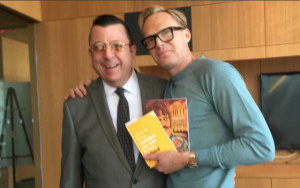 Richard sat down with Paul Bettany, who plays intergalactic boogeyman Dryden Vos in “Solo: A Star Wars Story,” to discuss why the actor is feeling blessed for his role.
Watch the whole thing HERE!
This weekend professor of religious iconology and symbology Robert Langdon (Tom Hanks) returns to theatres in Inferno, the third movie in the Da Vinci Code franchise.
In 2006 the fictional Harvard prof made his big screen debut, uncovering the complicated personal life of Jesus Christ in The Da Vinci Code. Three years later he used his knowledge of symbology to unravel the mystery of a secret brotherhood called the Illuminati and thwart a terrorist act against the Vatican.
In between those two movies I received dozens of outraged emails, long tracts regarding Dan Brown’s books, the up-coming movie, The Illuminati and the veracity of the stories.
In response to the anxious folks who contacted me, concerned the film, which had not been released yet, would be a dangerous piece of anti-Catholic propaganda, I wrote a forward to my Angels and Demons review, pointing letter writers toward the Vatican newspaper L’Osservatore Romano. They described Angels and Demons as “harmless entertainment which hardly affects the genius and mystery of Christianity.” Their review noted it is filled with historical inaccuracies but went on to suggest that one could make a game of pointing out all of the film’s historical mistakes.
In other words, don’t take it seriously and you’ll have a good time. Despite the Vatican newspaper’s warm embrace, the film still ignited a firestorm of criticism from people upset about the story’s alleged anti-Catholic sentiments, “malicious myths” and churches being associated with scenes of murder.
Inferno sidesteps religious controversy with a tale of a deadly virus that threatens all of humanity, but cinema and religion have often made for uncomfortable pairings.
In 1999 the Catholic League denounced Dogma’s tale of two fallen angels (Ben Affleck and Matt Damon) trying to get back into heaven as “blasphemy.” More recently uproar erupted over Darren Aronofsky’s unorthodox take on the story of Noah. Jerry Johnson, president of the National Religious Broadcasters, loudly objected to the film’s “insertion of the extremist environmental agenda.”
Perhaps the most controversial religious film ever was The Devils, based on Aldous Huxley’s nonfiction book The Devils of Loudun. Years before Ken Russell made the movie, a filmmaker approached Huxley wanting to turn the story of a radical 17th century French Catholic priest accused of witchcraft and burned at the stake, into a film. Huxley said, ‘Don’t do it. Don’t make a movie out of this.’ He thought there was no way the story could be presented in an entertaining way without short-circuiting people’s minds. Turns out maybe he was right.
Forty-five years after its release Russell’s film is little seen but much talked about. Banned, censored and still unavailable in its complete form on Blu-Ray, the movie’s graphic church orgy offended many—and was cut to pieces and removed by censors—but it’s more than shock and titillation. It’s a film that makes a serious statement about the struggle between church and state but does so in an entertaining and provocative way.
Lots of movies contain violence or sex or religion, but Russell mixed all three together in one toxic cocktail. If released today The Devils may not inspire riots in the streets, as it did in 1971, but if presented in its complete form the following indignation would make the Angels and Demons protests seem tame.