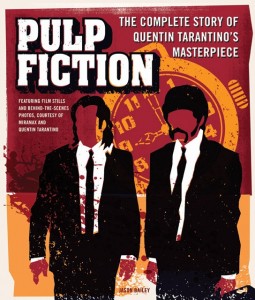
I saw Quentin Tarantino’s “Pulp Fiction” on its opening day in Toronto. I sat through it once, transfixed and while everyone else stayed glued to their seats for the credits, discussing the movie and picking up their jaws from the floor, I rushed out and bought another ticket for the next screening and sat through it once more. Not sure how many times I’ve seen it since then, but I was reminded of that first screening when I looked at “Pulp Fiction: The Complete Story of Quentin Tarantino’s Masterpiece,” Jason Bailey’s book on the making of the film.
From amazon.ca: ”
When Pulp Fiction was released in theaters in 1994, it was immediately hailed as a masterpiece. The New York Times called it a “triumphant, cleverly disorienting journey,” and thirty-one-year-old Quentin Tarantino, with just three feature films to his name, became a sensation: the next great American director.
“Nearly twenty years later, those who proclaimed Pulp Fiction an instant classic have been proven irrefutably right. In Pulp Fiction: The Complete Story of Quentin Tarantino’s Masterpiece, film expert Jason Bailey explores why Pulp Fiction is such a brilliant and influential film. He discusses how the movie was revolutionary in its use of dialogue (“You can get a steak here, daddy-o,” “Correct-amundo”), time structure, and cinematography—and how it completely transformed the industry and artistry of independent cinema. He examines Tarantino’s influences, illuminates the film’s pop culture references, and describes its phenomenal legacy. Unforgettable characters like Jules Winnfield (Samuel L. Jackson), Vincent Vega (John Travolta), Butch Coolidge (Bruce Willis), and Mia Wallace (Uma Thurman) are scrutinized from all-new angles, and memorable scenes—Christopher Walken’s gold watch monologue, Vince’s explanation of French cuisine—are analyzed and celebrated.
“Much like the contents of Marcellus Wallace’s briefcase, Pulp Fiction is mysterious and spectacular. This book explains why. Illustrated throughout with original art inspired by the film, with sidebars and special features on everything from casting close calls to deleted scenes, this is the most comprehensive, in-depth book on Pulp Fiction ever published.”
Quentin Tarantino doesn’t care if you like him or his movies.
“My films are unabashedly about myself and you’re either going to like them or go against them,” he says, “but that’s OK because I like me.”
Tarantino’s films — Pulp Fiction, Jackie Brown and Kill Bill Vol. 1 and 2, to name a few — sharply polarize people. For every person who gets all aquiver at the prospect of a new picture from the Reservoir Dogs director, there’s another who thinks his movies are too long, too self-indulgent and too derivative.
Despite those criticisms, fair or not, there can be no argument that of all the brand name directors working today Tarantino is the most audacious. His films are a singular vision and this weekend’s Inglourious Basterds is no exception.
His films are unapologetically bloody, in-your-face talky and ripe with larger-than-life characters, and perhaps it’s those qualities that rub certain people the wrong way.
He refuses to play it safe and take the Michael Bay road churning out Hasbro movies. He’s told interviewers he would die to make his movies perfect, and I believe him, but I’m a fan.
Not all critics are. Writer Ryan Gilbey said Death Proof represented “a sort of embarrassment of riches, only without the riches,” and more recently the Guardian called Inglourious Basterds “an armor-plated turkey.” Everyone is entitled to his or her opinion, but I think the Tarantino hecklers miss the point.
Tarantino is a provocateur who excels when he doesn’t play nice with the audience. Unlike the vast majority of films at the local bijou, his films demand something from an audience; they demand to be noticed and argued about over coffee (or something stronger) afterward. Many films fade quickly from memory, but, like them or not, Tarantino’s don’t.
When he’s at his best—Reservoir Dogs, Pulp Fiction and Inglourious Basterds — the movies are transformative cinematic experiences, but even when he’s not in top form — say, Death Proof — his work is, as critic Peter Bradshaw said, “more interesting than the successes of dullards and middleweights churning out Identikit films by the truckload.”
Tarantino’s films aren’t for everyone, but it’s undeniable that he takes movies seriously.
So seriously in fact, that the heroine in Inglourious Basterds is a cinema owner who literally uses film to bring down the Third Reich. I love that.
Say what you will, you can never accuse Tarantino of being boring.
 I saw Quentin Tarantino’s “Pulp Fiction” on its opening day in Toronto. I sat through it once, transfixed and while everyone else stayed glued to their seats for the credits, discussing the movie and picking up their jaws from the floor, I rushed out and bought another ticket for the next screening and sat through it once more. Not sure how many times I’ve seen it since then, but I was reminded of that first screening when I looked at “Pulp Fiction: The Complete Story of Quentin Tarantino’s Masterpiece,” Jason Bailey’s book on the making of the film.
